 AI Tools Review Editorial Team
While the last two weeks of AI headlines have been dominated by Kimi K3's GPU meltdown and sanctions threat, a much quieter release from a San Francisco startup made a different point entirely: you no longer need a trillion-parameter model to be competitive at agentic coding.
Laguna S 2.1 is Poolside's third model release in about three months, and its benchmark card is the most interesting part of the story - not because it tops every leaderboard, but because of how little compute it needs to get close.
WorldofAI covers Laguna S 2.1 in this video.
Summary
Poolside released Laguna S 2.1 on 21 July 2026: a 118-billion-parameter Mixture-of-Experts model with 8 billion active parameters per token, positioned as the mid-sized member of the Laguna family, between the smaller Laguna XS 2.1 (33B-A3B) and the flagship Laguna M.1 (225B-A23B). It is designed specifically for agentic coding and long-horizon software engineering work, with a 1,048,576-token context window and native, controllable reasoning.
The headline is not that it beats everything - it doesn't. It is that Laguna S 2.1 outright wins two of the six benchmarks Poolside publishes against much larger rivals, and stays within single digits of the frontier on three more, all while activating a fraction of the parameters of models like Kimi K3 (2.8T-A50B) or DeepSeek-V4-Pro Max (1.6T-A49B). Combined with a genuinely permissive licence and same-day availability across every major serving engine, it is one of the more credible "do more with less" stories in open-weight coding models this year.
- Best for: self-hosted agentic coding, terminal-use agents and codebase Q&A where licence freedom and serving cost matter as much as raw capability.
- Headline numbers: 78.5% SWE-Bench Multilingual (wins outright), 46.2% SWE Atlas (wins outright), 70.2% Terminal-Bench 2.1, 59.4% SWE-Bench Pro.
- Defining trait: 118B-A8B parameter efficiency - competitive with models 5-24x its total size.
- Main caveat: Kimi K3 and Claude Fable 5 still lead outright on Terminal-Bench 2.1 and SWE-Bench Pro; this is a value and openness story, not a frontier-capability one.
Who Is Poolside?
Poolside is a San Francisco AI lab founded in 2023 by Jason Warner, formerly CTO of GitHub, and Eiso Kant. The company has raised in the region of $626 million at a reported $3 billion valuation, with backers including Bain Capital Ventures, Nvidia and eBay Ventures - more recent reporting suggests a much larger subsequent raise, though the figures have not been uniformly confirmed across outlets. Poolside's stated thesis from the outset has been "execution-first" models: systems trained not just to write plausible code but to run it, inspect the output, fix what breaks, and keep iterating until a task is actually done, rather than stopping at a plausible-looking first draft.
The Laguna family is the public expression of that thesis. Poolside's flagship, Laguna M.1, is a 225B-parameter MoE model trained from scratch on 6,144 Nvidia Hopper GPUs across 30 trillion tokens. Laguna XS.2 and Laguna XS 2.1 are smaller open-weight siblings aimed at local and consumer-hardware use. Laguna S 2.1 slots in as the mid-sized option: bigger and more capable than the XS line, but still small enough to be realistically self-hosted - and, notably, the company took under nine weeks from the start of training (22 May 2026) to public launch, its third release in roughly three months.
Coverage of the release has framed it explicitly as part of a wider "Western open-weight" push - Forbes described a cohort of American labs positioning themselves as an answer to Chinese open-weight releases like DeepSeek and Qwen, and other outlets described Laguna S 2.1 specifically as pitched as "the West's answer to DeepSeek and Qwen." Whether that framing holds up matters less than the benchmark card itself, which is where Laguna S 2.1's actual case is made.
Architecture & Training
Laguna S 2.1 shares the Laguna family's architectural recipe. It is a 118B-total-parameter Mixture-of-Experts model with roughly 8B activated per token, using a token-choice router with softplus gating over 256 routed experts (top-10 selected) plus one always-on shared expert. Attention is grouped-query with 8 KV heads and a head dimension of 128, spread across 48 layers in a 1:3 global-to-sliding-window ratio - 12 layers use full global attention, and 36 use a 512-token sliding window, each with per-layer-type rotary position scaling. The context window reaches 1,048,576 tokens, and the vocabulary uses the 100,352-token Laguna family tokenizer.
Reasoning is native and interleaved: the model can think between tool calls rather than only at the start of a response, controlled per request via an enable_thinking flag. Poolside recommends preserved thinking for agentic use - keeping prior reasoning_content in the message history - since the model reasons less thoroughly on later turns if earlier thinking blocks are stripped out. A trained speculative-decoding draft model, DFlash, is available separately to cut serving latency.
Post-training leaned heavily on agentic environments: Poolside reports 409,000 total agentic and non-agentic training environments, including 83,000 terminal-use setups and 168,000 software-engineering workflow tasks, run through a two-stage process of supervised fine-tuning (including synthetic data) followed by reinforcement learning in FP8 precision. New sandboxing infrastructure added background-process support and network blocking, and training used multi-harness rollouts - deliberately varying the agent scaffold during RL - specifically to avoid overfitting to a single tool-calling harness, capped at a maximum of 500 steps per evaluation run.
The Benchmark Card: Real Numbers
Poolside's own comparison chart puts Laguna S 2.1 against six rivals spanning a huge range of sizes: Tencent Hy3 (295B-A21B), Inkling (975B-A41B), Nemotron 3 Ultra (550B-A55B), DeepSeek-V4-Pro Max (1.6T-A49B), Kimi K3 (2.8T-A50B), Qwen 3.7 Max and Muse Spark 1.1 (both undisclosed size), and Claude Fable 5 (undisclosed, closed). The size gap is the entire point of the chart.
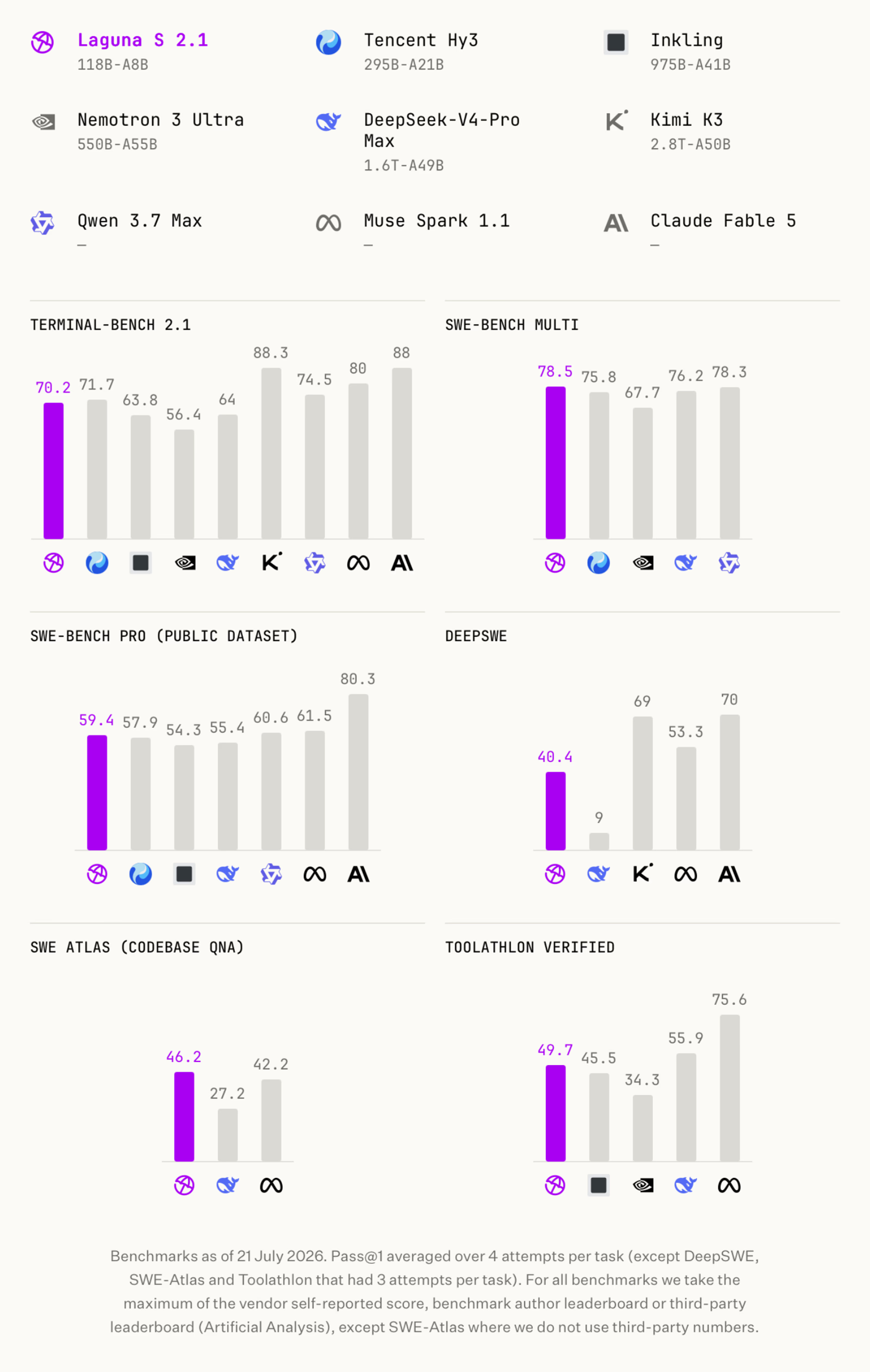
- Terminal-Bench 2.1: 70.2% - behind Kimi K3 (88.3%), Claude Fable 5 (88%) and Muse Spark 1.1 (80%), but ahead of Inkling (63.8%), Nemotron 3 Ultra (56.4%) and DeepSeek-V4-Pro Max (64.0%).
- SWE-Bench Multilingual: 78.5% - Laguna S 2.1's outright win, narrowly ahead of Qwen 3.7 Max (78.3%) and Tencent Hy3 (75.8%).
- SWE-Bench Pro (public dataset): 59.4% - mid-pack, well behind Claude Fable 5's 80.3%, but ahead of Tencent Hy3 (57.9%) and Inkling (54.3%).
- DeepSWE: 40.4% - a distant second to Claude Fable 5 (70%) and Kimi K3 (69%), but well clear of DeepSeek-V4-Pro Max's 9%.
- SWE Atlas (codebase Q&A): 46.2% - another outright win, ahead of Muse Spark 1.1 (42.2%) and DeepSeek-V4-Pro Max (27.2%).
- Toolathlon Verified: 49.7% - behind Muse Spark 1.1's 75.6% and DeepSeek-V4-Pro Max's 55.9%, but ahead of Inkling (45.5%) and Nemotron 3 Ultra (34.3%).
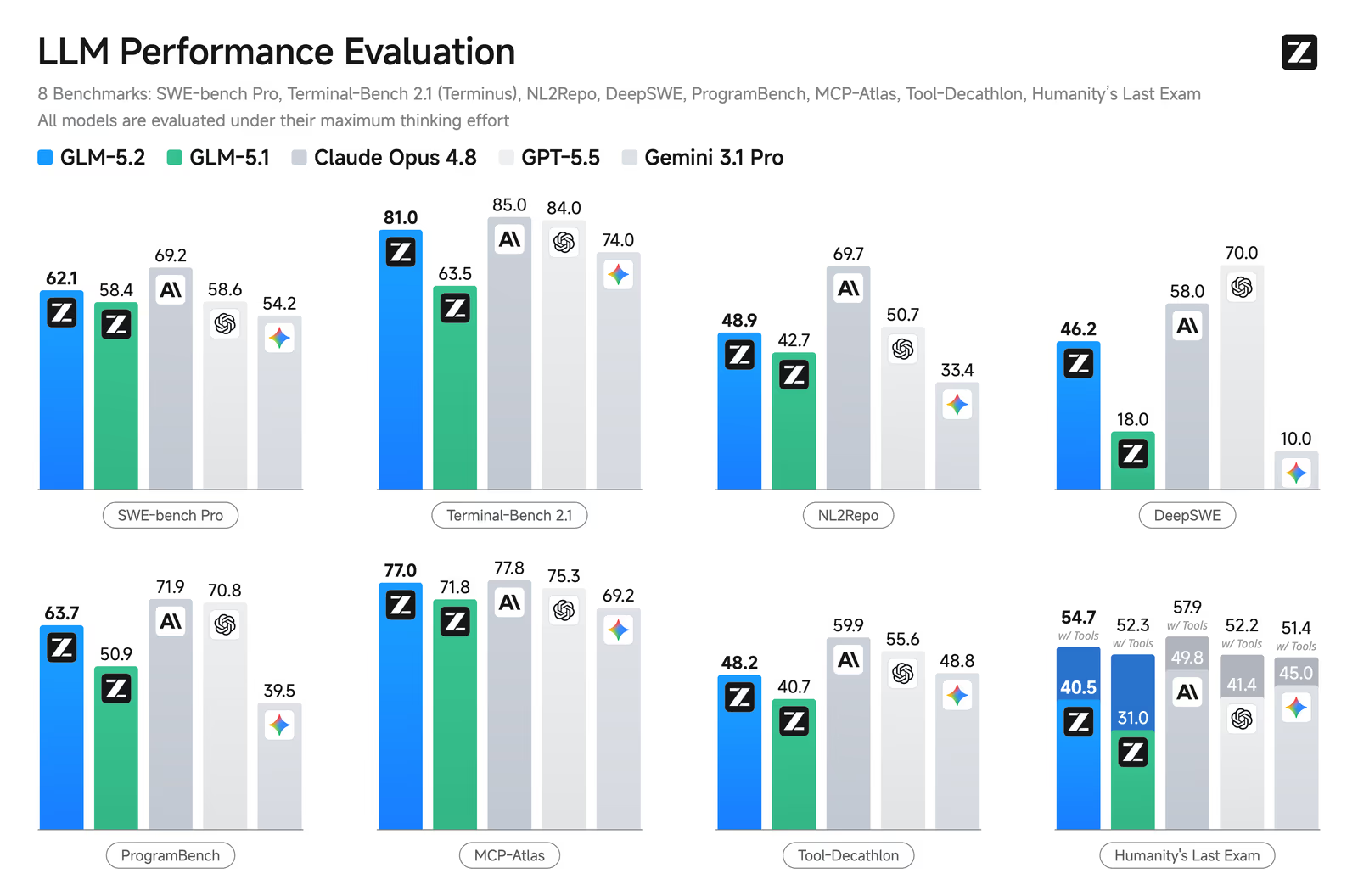
Poolside's own footnote is worth reading closely: scores are pass@1 averaged over three or four attempts depending on the benchmark, and where a vendor's self-reported number, a benchmark author's leaderboard and a third-party leaderboard (Artificial Analysis, for Terminal-Bench 2.1 and DeepSWE; Scale AI's official leaderboard for SWE Atlas; Toolathlon's own leaderboard) all exist, Poolside takes the highest of the three - a generous methodology worth bearing in mind when comparing across the table, and one shared by most vendor-published comparison cards on this site, including GLM 5.2's.
Read as a whole, the honest summary is: Laguna S 2.1 is not the strongest coding model available at any price, but it is startlingly strong for its activated-parameter count. Against Kimi K3's 50B active parameters or Claude Fable 5's undisclosed but presumably much larger footprint, Laguna S 2.1's 8B active parameters getting within 10-20 points on most benchmarks - and ahead outright on two - is the real story.
Thinking Mode: What It Actually Buys You
Because reasoning is toggleable per request, Poolside can show its cost directly. On Terminal-Bench 2.1, disabling thinking drops the score from 70.2% to 60.4% - a real but moderate 9.8-point hit. On DeepSWE, the gap is far larger: 16.5% with thinking off versus 40.4% with it on, more than doubling the pass rate. Reported mean completion-token counts with thinking enabled range from roughly 80,000 to 249,000 tokens depending on the benchmark, which is the practical cost of that gain - Laguna S 2.1 thinks a lot to get there, and that shows up directly in serving cost and latency.
The practical guidance follows directly from that data: for anything resembling real agentic coding work, leave thinking on and preserve reasoning across turns, and budget token spend accordingly. For latency-sensitive, simpler completions, thinking off is a legitimate and much cheaper mode - it just should not be confused with the benchmarked configuration when comparing Laguna S 2.1's headline scores to other models.
Deployment, Hardware & Pricing
Laguna S 2.1 ships under the OpenMDW-1.1 licence, which permits free commercial and non-commercial use and modification of both the model and its associated materials. Full BF16 weights, plus FP8, NVFP4, INT4 and GGUF quantised variants, are published on Hugging Face, alongside a separate DFlash speculative-decoding draft model. Engine support spans vLLM, SGLang, Transformers, TensorRT-LLM and llama.cpp (via Poolside's own fork, with upstream support in review), and hosted access is available through OpenRouter, Vercel AI Gateway, Baseten and Ollama. Agent-framework integrations include Kilo, Hermes Agent, Pi, OpenCode, OpenClaw and Cline, and local desktop use is packaged through atomic.chat.
Hardware requirements scale with precision: the full BF16 checkpoint needs roughly 236GB of weights and realistically multiple GPUs, while the quantised variants cut that substantially - reviewers have reported running quantised builds on a single Nvidia DGX Spark, which is the basis for coverage describing it as one of the strongest models available for local, consumer-grade deployment. On pricing, Poolside does not operate its own hosted API; OpenRouter lists third-party hosted access at $0.10 per million input tokens, $0.20 per million output tokens and $0.01 per million cached-read tokens - genuinely cheap for a model in this capability band, and a direct product of both the open licence and the 8B active-parameter footprint that keeps inference cost down.
Limitations and Known Issues
- Not the frontier: Kimi K3 and Claude Fable 5 lead outright on Terminal-Bench 2.1, SWE-Bench Pro and DeepSWE, sometimes by 20-30 points.
- Tool-schema friction: reported to struggle with non-native tool schemas in third-party agent harnesses, and with correctly escaped JSON in nested tool calls.
- Overthinking on hard maths: can spend excessive reasoning tokens on complex mathematics problems before making concrete progress.
- Thinking-mode cost: the benchmarked configuration burns 80k-249k completion tokens per task on average - a real serving-cost consideration, not a footnote.
- Vendor-favourable scoring methodology: Poolside takes the best of vendor-reported, benchmark-author or third-party numbers per cell, which is standard practice but inflates the comparison slightly versus a single consistent evaluation harness.
How It Compares
Against Kimi K3, the comparison is stark on paper - Kimi's 2.8T parameters against Laguna's 118B - and Kimi wins most head-to-head rows outright. But Kimi K3 is currently capacity-constrained after its own GPU meltdown and sanctions controversy, while Laguna S 2.1 is immediately self-hostable on modest hardware under a genuinely open licence - a very different deployment proposition regardless of the benchmark gap. Against GLM 5.2 and Kimi K2.7 Code, the three form a genuine open-weight coding-model tier below the closed frontier, each with different size/capability trade-offs worth benchmarking against your own workload rather than assuming one dominates.
Against Claude Fable 5, there is no real contest on raw capability - Fable 5 leads every shared row, often by a wide margin - but Fable 5 is closed, expensive relative to Laguna's OpenRouter pricing, and cannot be self-hosted at all. The choice between them is really a choice between "best available" and "best you can run yourself, modify, and deploy without a per-token bill to a third party."
Who Should Use It
Choose Laguna S 2.1 if you need a self-hostable or genuinely open-licensed coding model, your workload leans toward multilingual code understanding or codebase Q&A (where it wins outright), or you want frontier-adjacent agentic coding without the per-token cost or capacity risk of the largest closed or Chinese open-weight models.
Look elsewhere if you need the single highest score available regardless of cost or openness - Claude Fable 5 or Kimi K3 (capacity permitting) still lead outright - or if your harness relies heavily on non-native tool-calling schemas that Laguna S 2.1 is reported to handle less gracefully.
The Bottom Line
Laguna S 2.1 will not top many leaderboards outright, and Poolside does not pretend otherwise - its own chart shows Kimi K3 and Claude Fable 5 ahead on most rows. What it demonstrates instead is that a 118B-parameter, 8B-active MoE model, trained start-to-launch in under nine weeks, can win two real benchmarks and stay within striking distance on the rest, against rivals with five to twenty-four times its parameter count. Combined with a genuinely open licence, same-day support across every major serving engine, and pricing that undercuts most of the field, it is a strong pick for anyone who values control and cost over the single highest score on a leaderboard.
Last updated: 27 July 2026. Benchmark figures, architecture details and licensing information are drawn from Poolside's official Laguna S 2.1 model card and release blog post (as of 21 July 2026); company background and framing are drawn from reporting including Forbes, VentureBeat and TheNextWeb. Some benchmark cells reflect third-party leaderboards (Artificial Analysis, Scale AI, Toolathlon) rather than Poolside's own evaluation.
Get the free guide: Claude vs ChatGPT, Gemini & Grok
A 20-page playbook covering everything you need to choose and use the big four AI models in 2026, full cost and feature comparisons, what each is best (and worst) at, and how-tos for images, vectors, building a website, Claude Code and more.