 AI Tools Review Editorial Team
Kimi K3 moved from model launch to capacity constraints and a US-China policy dispute in less than two weeks. The model's open weights are now available, while the allegations about restricted chips and model distillation remain contested.
This article separates confirmed developments from attributed claims, and updates the record with Moonshot's denial, China's response and the completed open-weights release.
AI Revolution X's round-up covering the Kimi K3 crisis as it broke.
Summary
Moonshot AI released Kimi K3 on 16 July 2026. It is a 2.8-trillion-parameter mixture-of-experts model with a 1-million-token context window, and its early results placed it among the strongest available models for several coding and agentic tasks.
Two separate stories then developed. Demand pushed Moonshot's hosted service close to capacity, leading it to pause new subscriptions. At the same time, Kimi K3 added to market concerns about Chinese competition before US officials made allegations about restricted-chip access and model distillation. Moonshot has denied the distillation claim, and the allegations remain unproven.
- The trigger: Kimi K3's benchmark results on 16-17 July, which beat GPT-5.5, Claude Opus 4.8 and GLM-5.2 on several agentic and coding suites.
- The capacity response: new subscriptions paused on 19 July after the hosted service approached its compute limit.
- The market context: Kimi K3 added to concerns about Chinese competition during a much wider global selloff on 17 July.
- The policy dispute: sanctions language from Treasury Secretary Bessent on 21 July, followed by chip-access and distillation allegations from OSTP Director Kratsios on 22 July.
Timeline: Eleven Days
- 16 July: Moonshot AI launches Kimi K3 - 2.8T parameters, 1M-token context, native vision - available via Kimi.com, Kimi Work, Kimi Code and the Kimi API.
- 17 July: Independent evaluators publish results. Arena ranks K3 #1 in its Frontend Code leaderboard (1,679 Elo, a 17-place jump from K2.6's #18). Artificial Analysis places it third on its Intelligence Index (57), just behind GPT-5.6 Sol/GPT-5.5 (59) and Claude Fable 5 (60). The Nasdaq Composite falls roughly 1.4% and Nvidia around 2.2%; Z.ai and MiniMax fall approximately 28% and 16% respectively.
- 19 July: Moonshot posts on X that demand has "pushed close to the limits" of its capacity within 48 hours, pauses new subscriptions, and splits membership into two tiers to protect existing users.
- 20 July: Coverage of the capacity halt spreads; analysts note Kimi K3 is unusually compute-hungry to serve at scale and that Moonshot likely under-provisioned for demand.
- 21 July: Treasury Secretary Scott Bessent, speaking on Fox Business, says the US "has the ability to sanction" firms found to be stealing from American AI companies.
- 22 July: White House OSTP Director Michael Kratsios accuses Moonshot of accessing export-restricted Nvidia GB300 chips via infrastructure in Thailand, and of running a platform to covertly distil Anthropic's Claude Fable 5 at scale.
- 27 July: Moonshot publishes Kimi K3's weights, model card, licence and technical report through its official GitHub and Hugging Face repositories. Reuters reports that Moonshot denied the distillation allegation and attributed K3's advances to original architecture changes. China's commerce ministry rejects the US claims and warns of possible countermeasures.
What Kimi K3 Actually Is
Kimi K3's results explain why the release attracted attention, but the figures need context. Moonshot's comparison card places it ahead of Claude Opus 4.8 and GPT-5.5 on several tasks, while Claude Fable 5 and GPT-5.6 Sol lead on others. Its reported GDPval-AA v2 score is 1,668 Elo, compared with 1,190 for K2.6. It also performed strongly on Terminal-Bench, DeepSWE, Program Bench and Arena's Frontend Code leaderboard.
Artificial Analysis measured 21% fewer output tokens than K2.6 alongside a 13-point gain on its Intelligence Index. That suggests a meaningful efficiency improvement, although benchmark results do not establish real-world cost or quality for every workload. The open-weights release makes independent testing more practical.
The Compute Crunch
Success became its own emergency almost immediately. On 19 July, Moonshot posted that "Kimi K3 has received far more love than we expected, and our GPUs are feeling it. Over the past 48 hours, demand has pushed close to the limits of our current capacity." New subscriptions were paused; existing subscribers were unaffected; and membership was restructured into two tiers so the company could "prioritise available compute for current members" while capacity was added "in batches."
The public statement establishes that demand approached the available capacity. It does not disclose how much compute Moonshot had provisioned, how many users caused the pressure or whether the bottleneck came from model size, long-context requests, coding workloads or another part of the service. The later open-weights release gives well-resourced organisations another route to deploy the model without relying on Moonshot's hosted capacity.
The Market Reaction
On 17 July, the Nasdaq Composite fell roughly 1.4% and the S&P 500 about 1%. Semiconductor shares also declined. Reuters described Kimi K3 as adding to existing concerns about rich chip valuations and returns on AI spending, but the session also reflected company-specific news and renewed disruption in the Middle East. The timing supports describing Kimi K3 as one factor, not the sole cause.
Shares linked to Chinese AI developers also fell sharply. Those moves are consistent with investors reassessing competition after Kimi K3's release, but share prices alone do not prove a technical verdict. Liquidity, valuation and broader risk sentiment can all amplify one-day moves.
The Chips and Distillation Accusations
The policy escalation followed within days. On 21 July, Treasury Secretary Scott Bessent told Fox Business: "If we see, especially, that overseas models are stealing from our great companies, we have the ability to sanction them because of this theft" - a general warning rather than a specific charge, but one that primed the ground for what came next.
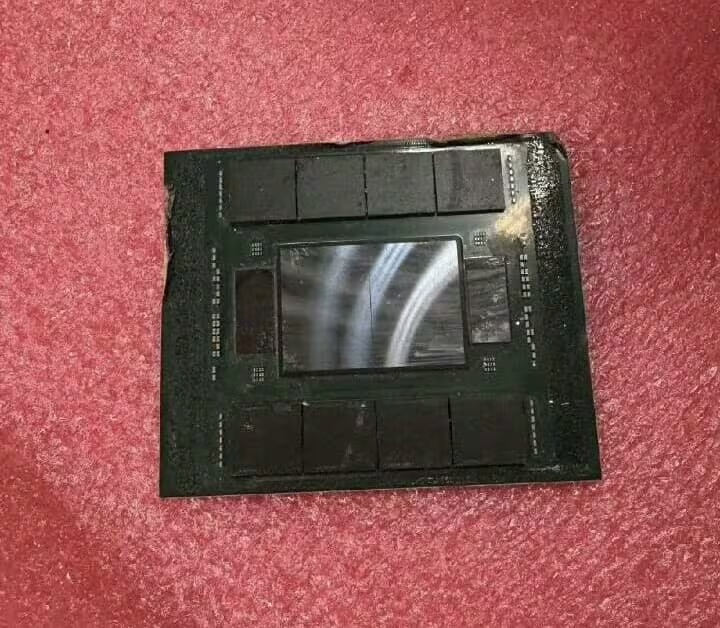
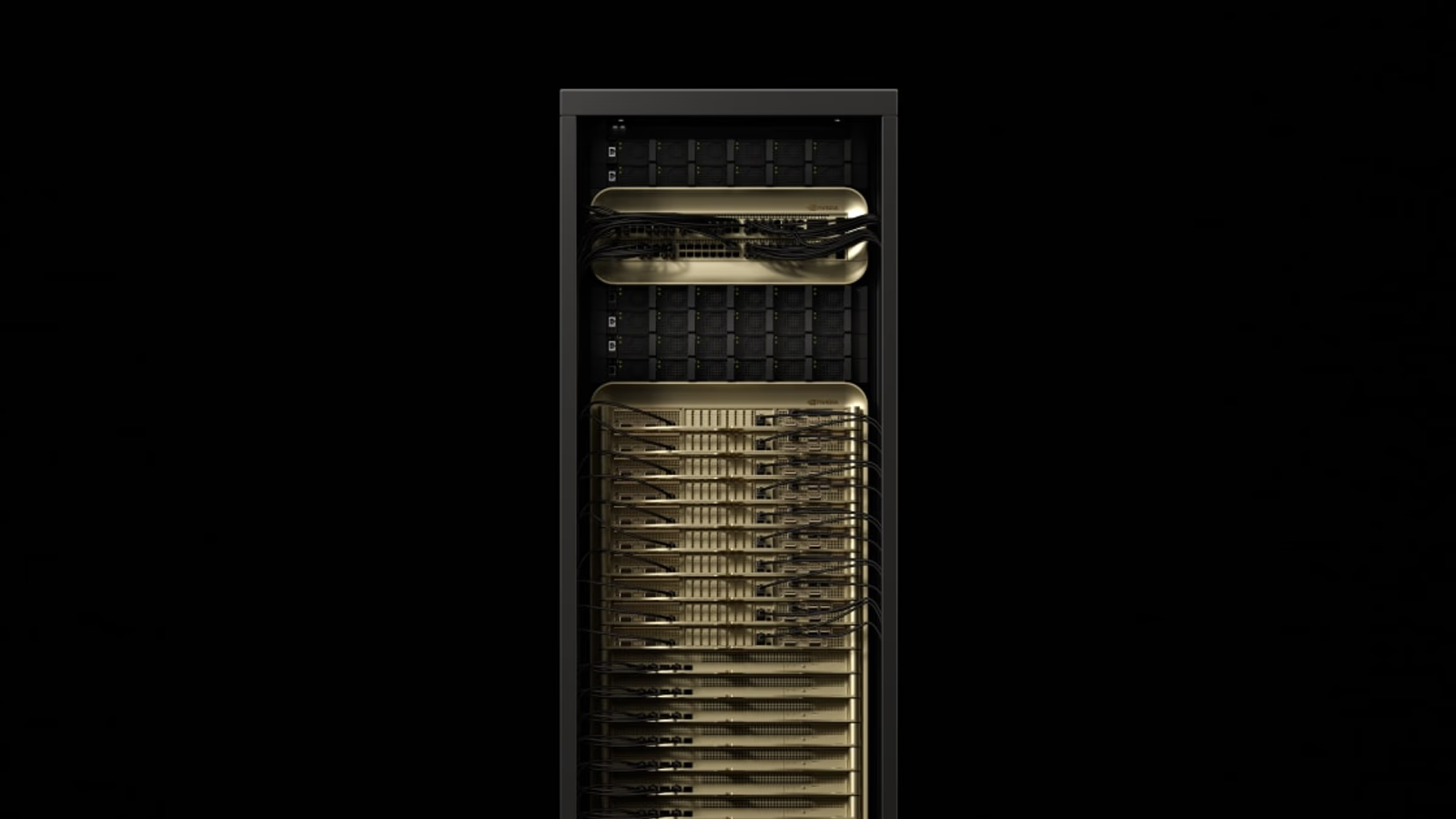
On 22 July, White House Office of Science and Technology Policy Director Michael Kratsios made two specific allegations. First, that Moonshot obtained access to export-restricted Nvidia GB300 (Blackwell Ultra) servers - the same rack-scale hardware pictured above - through infrastructure located in Thailand, allowing its engineers to train on the most advanced Nvidia silicon without the physical chips ever being imported into China. Second, that Moonshot operated an internal platform designed to covertly and extensively distil outputs from Anthropic's Claude Fable 5 at scale, built specifically to evade detection while doing so - in effect, training Kimi K3 partly on a rival's model outputs rather than solely on independent data and compute.
Both allegations would be significant if substantiated. The chip claim raises questions about whether remote or third-country access can circumvent export controls. The distillation claim concerns the use of another provider's outputs at scale and possible breaches of service terms. Neither allegation had been established by an independent investigation by 28 July.
Moonshot and Nvidia's Response
Reuters reported on 27 July that Moonshot denied the allegation that Kimi K3 was built by illegally distilling Claude Fable 5. The company said its gains came from original architecture changes. China's commerce ministry also rejected the US position and said it could take countermeasures if investigations proceed.
Moonshot's denial does not independently settle the dispute. The key distinction remains that these are attributed allegations and responses, not findings from an independent investigation, a court or an export-enforcement action. Nvidia has reiterated that it complies with export-control rules but has not publicly resolved the specific Thailand claim.
Industry Pushback: Nvidia, Microsoft, Meta and OpenAI Warn Against a Ban
While Washington weighed sanctions, much of the US AI and chip industry pushed the opposite direction. In an Axios interview published 22 July, the same day as Kratsios' allegations, Nvidia CEO Jensen Huang rejected the idea that Chinese open-weight models pose a hidden surveillance risk, calling that framing a "misconception." His view, in his own words: "These Chinese models are excellent. Open-source models that are excellent should be used," adding that because open weights are downloadable and can be run with customised guardrails, they are, if anything, easier to inspect than a closed API. Huang argued restricting them would not meaningfully slow adoption of AI generally, and that more AI use of any kind, open or closed, means more demand for the computing infrastructure Nvidia sells.
Days later, Nvidia, Microsoft and Meta put a joint position in writing, reportedly warning regulators against "premature restrictions" on open-weight AI models, arguing that open weights broaden competition and keep the benefits of AI from concentrating in a handful of closed labs. OpenAI, whose own Claude Fable 5 rival is the model Moonshot stands accused of distilling, reportedly signed the same letter, a notable position for a company with a direct commercial and competitive stake in how the distillation allegation resolves.
That alignment between chipmakers, cloud platforms and even a directly affected frontier lab, all arguing against a ban on the country the White House is simultaneously accusing of chip-smuggling and IP theft, is the clearest sign yet that the sanctions question is not settled industry sentiment dressed up as policy. It is a live disagreement between the White House's national-security framing and much of Silicon Valley's commercial and competitive interest in keeping Chinese open-weight models legal to download and run in the US.
Why This Matters
Regardless of how the specific accusations resolve, the underlying pattern is now well established and matters independently of Kimi K3's guilt or innocence. Export controls on advanced AI chips assume that restricting direct imports into China meaningfully slows Chinese frontier-model progress. A routing scheme through a third country - if the allegation holds up - would demonstrate that determined actors can access restricted compute without technically importing the silicon, which is a policy-design problem regardless of whether Moonshot specifically did it. Our China AI chip race explainer covers the domestic side of that story - Huawei's Ascend roadmap and the bet on self-sufficiency - and this incident is the mirror image: a bet that offshore access can substitute for it.
Second, Kimi K3 adds another data point to the debate over AI infrastructure spending. Competitive open-weight models can affect assumptions about pricing and demand, but one market session cannot settle whether hyperscaler capital expenditure is justified. That depends on adoption, operating costs, utilisation and the value created by the systems being deployed.
What We Don't Know
- The chip-access claim is unverified: it comes from a White House official's public statement, not a published investigation, customs enforcement action or independent forensic audit.
- The distillation claim is even harder to verify externally: proving a model was trained on another model's outputs at scale typically requires internal access most outside parties, including journalists, do not have.
- Moonshot has denied the distillation allegation, but its response does not independently establish how the model was trained or what hardware was used.
- No sanctions have been issued as of publication - Bessent's comments describe a capability and intent to act, not a concluded case.
- The open weights are now available, but publishing weights and a technical report does not by itself resolve the provenance claims.
How This Compares to the DeepSeek Moment
The DeepSeek comparison is useful but limited. Both releases prompted questions about the cost of frontier AI and the competitiveness of Chinese laboratories. Kimi K3 has also become the subject of specific allegations from named US officials and an explicit denial from Moonshot. That makes it a policy dispute as well as a model release, but its outcome remains open.
Who Should Care
Developers and businesses evaluating Kimi K3 can now inspect the official model materials and test the open weights, but they should still check the licence, infrastructure requirements and model behaviour for their own use case. Hosted-service users should monitor capacity notices. Policy and procurement teams should distinguish allegations from enforcement action and review any export-control or supplier obligations that apply to their organisation.
The Bottom Line
Kimi K3 is a strong open-weight model, and its official release gives developers direct access to the weights and technical documentation. The policy dispute is much less settled. US officials have made serious allegations, Moonshot and China have rejected them, and no independent finding or sanction has followed. Those facts should remain separate until stronger evidence appears.
Sources
- Moonshot AI's official Kimi K3 repository, including the model card, licence and technical report.
- Moonshot AI's Kimi K3 model page on Hugging Face.
- Reuters, 27 July 2026, covering Moonshot's denial, China's response and the status of possible US action.
- Reuters, 17 July 2026, covering the wider global market selloff and Kimi K3's role in investor concerns.
- Fortune, 22 July 2026, on Jensen Huang's Axios interview calling Chinese open-weight models "excellent."
- TechRadar, on the Nvidia/Microsoft/Meta/OpenAI joint position against "premature restrictions" on open-weight models.
Last updated: 29 July 2026, adding industry pushback from Nvidia, Microsoft, Meta and OpenAI against restricting open-weight Chinese models. The chip-access and distillation claims remain allegations. Moonshot has denied the distillation claim, and no independent finding or formal US sanction had been announced at the time of this update.
Get the free guide: Claude vs ChatGPT, Gemini & Grok
A 20-page playbook covering everything you need to choose and use the big four AI models in 2026, full cost and feature comparisons, what each is best (and worst) at, and how-tos for images, vectors, building a website, Claude Code and more.