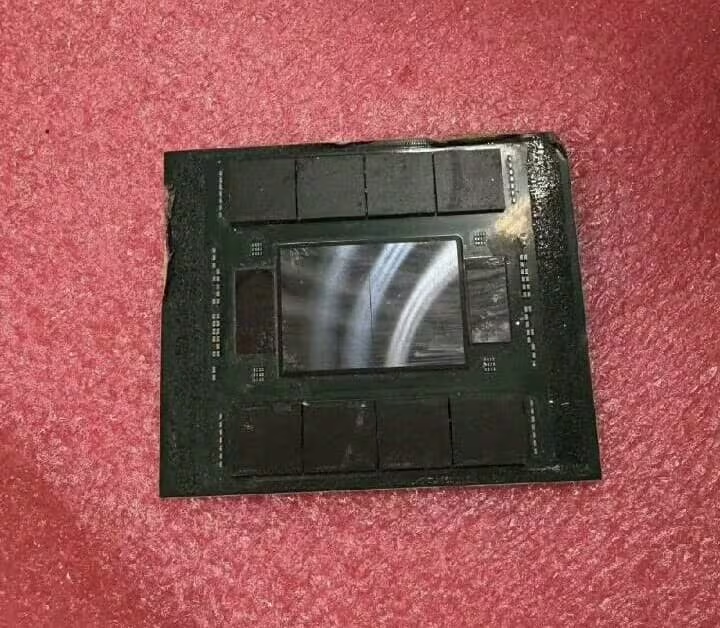
 AI Tools Review Editorial Team
Quick Answer:
China is building a state-scale replacement for Nvidia inside its own borders, and the pieces are landing faster than most Western coverage assumed. Beijing is reportedly drafting a roughly $295 billion (2 trillion yuan) plan to link every major Chinese data centre into a single AI computing grid by 2028, with at least 80% of the underlying chips required to be domestic. The chip doing most of the work is Huawei's new Ascend 950 family, fabricated on SMIC's most advanced 5nm-class process, with ByteDance, Alibaba Cloud and Tencent all reported to have placed large procurement orders. Analyst estimates cited in the trade press put Nvidia's 2026 China AI chip market share at around 8%, down from near-total dominance a few years ago, with Huawei's share near 50%. The catch: SMIC's fabs are reportedly running above 93% utilisation on a node roughly two generations behind the global frontier, and domestic chip supply may only cover around 76% of Chinese AI chip demand by 2030. This is a real pivot, not a completed one.
For most of the generative-AI boom, "AI chips" has meant one company: Nvidia. That is changing fastest not in the West, but inside China, where a combination of US export controls and an aggressive state industrial policy has turned domestic chip substitution from a slogan into procurement contracts worth billions of dollars.
This is a status report on where that pivot actually stands in mid-2026: what Huawei has shipped, what Beijing is funding, what the manufacturing base can realistically deliver, and where the gap between ambition and capacity still shows.
Summary
Three things are happening at once. First, Beijing is funding a nationwide AI data-centre grid worth roughly $295 billion that structurally excludes Nvidia and AMD by mandating 80% domestic silicon. Second, Huawei has a real, shipping chip family, the Ascend 950, with specifications that stand up to scrutiny and procurement orders from China's largest cloud platforms. Third, and less discussed in enthusiastic coverage, the manufacturing base underneath all of this is stretched close to its limit, meaning the policy ambition and the physical chip supply are not yet the same thing.
- The plan: a reported $295 billion (2 trillion yuan) national AI computing grid, unifying data centres by 2028, with an 80% domestic-chip mandate.
- The chip: Huawei's Ascend 950 family (950PR and 950DT), fabricated on SMIC's 5nm-class N+3 node, with in-house HBM memory replacing foreign suppliers.
- The buyers: ByteDance, Alibaba Cloud and Tencent are reported to have placed large Ascend 950PR orders, pushing committed 2026 procurement above half a million units.
- The market shift: reported analyst estimates put Nvidia's China AI chip share falling to around 8% in 2026, with Huawei's share rising to roughly 50%.
- The constraint: SMIC's leading fab is reportedly running above 93% utilisation on a node two generations behind the global frontier, and domestic HBM packaging cannot yet yield at volume.
The $295 Billion National AI Grid
At the centre of China's chip pivot is an infrastructure plan rather than a chip announcement. China's National Development and Reform Commission (NDRC) is reportedly drafting a blueprint to spend roughly 2 trillion yuan, about $295 billion, over five years building a nationwide web of AI data centres. State carriers China Mobile and China Telecom are expected to operate most of the physical facilities, with the goal of linking them into a single national computing grid by 2028.
The politically decisive detail is the sourcing requirement: at least 80% of the underlying technology, chips included, must come from domestic suppliers such as Huawei. That threshold effectively locks Nvidia and AMD out of the largest planned AI infrastructure build in the country, regardless of whatever export licences either company might otherwise secure. Reported financing leans heavily on sovereign debt and ultra-long special government bonds, and if power-grid upgrades needed to feed the data centres are included, the total capital requirement could reportedly exceed 5 trillion yuan.
This is the piece of the story that turns "China wants domestic chips" from aspiration into forced demand. A state-funded grid with an 80% domestic mandate creates a captive customer base for Huawei and its peers that no amount of Nvidia price-cutting can easily win back, even if export rules were to loosen.
Huawei's Ascend 950: The Chip Doing the Heavy Lifting
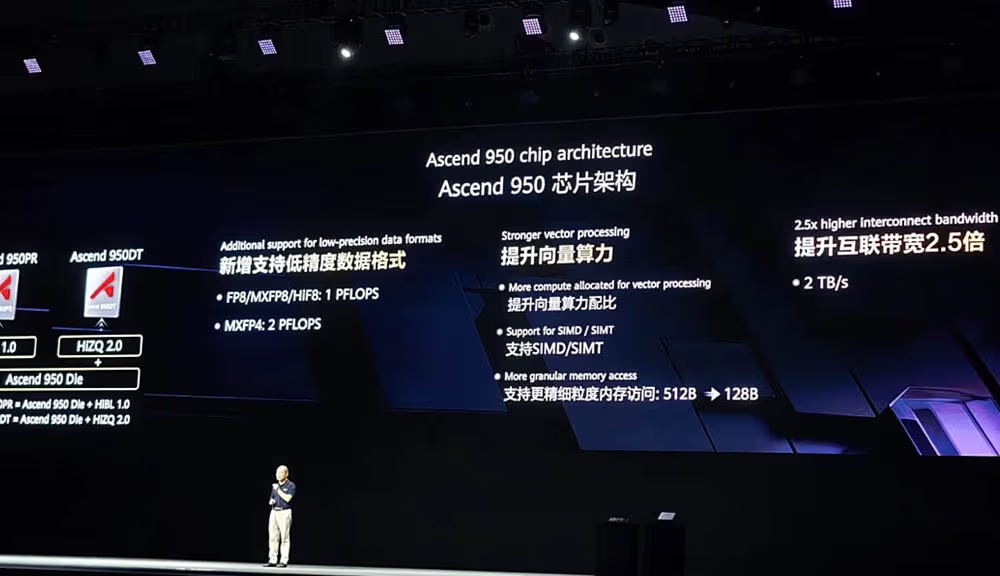
The chip built to fill that mandate is Huawei's Ascend 950 family, unveiled as part of a three-year roadmap running through 2028. It comes in two variants: the 950PR, aimed at prefill and recommendation workloads that need large but not maximally fast memory, and the 950DT, aimed at decode-heavy inference. Both are built around a shared "Ascend 950 Die" paired with different in-house HBM memory stacks, Huawei's own HiBL 1.0 memory for the 950PR and HiZQ 2.0 for the 950DT.
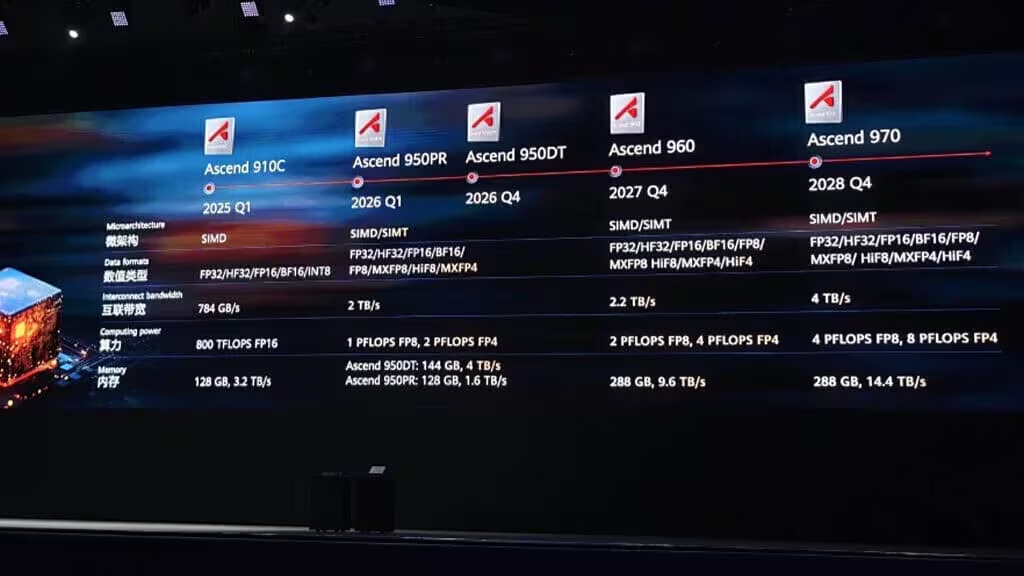
Compared with the current-generation 910C, which posts 800 TFLOPS of FP16 compute and 128GB of memory at 3.2TB/s, the 950 family roughly doubles peak low-precision compute and adds native support for the FP8, MXFP8, HiF8 and MXFP4 data formats that modern large-model inference increasingly relies on. Huawei has also detailed a 2.5x jump in interconnect bandwidth, to 2TB/s, and more granular memory access (down to 128-byte blocks from 512 bytes), both aimed squarely at the kind of large-batch inference serving that Chinese cloud platforms now run at scale.
Independent trade coverage has put the Ascend 950PR's inference throughput at roughly 2.8 times Nvidia's export-restricted H20 on FP4 workloads, a meaningful claim given the H20 was itself a China-specific, deliberately downgraded Nvidia part. It is worth being precise about what that comparison is and is not: it is a comparison against the H20, the chip Nvidia was permitted to sell into China under earlier export rules, not against Nvidia's unrestricted global flagship silicon. Reported unit pricing sits around $16,000, and the chip reportedly ships with a CUDA-compatible translation layer intended to let Chinese developers run existing Nvidia-optimised code with minimal rewriting, a pragmatic bridge over the software gap discussed further below.
The Orders: ByteDance, Alibaba and Tencent Buy In
Specifications only matter if someone buys the chip, and this is where the Ascend 950 story moves from roadmap slide to real procurement. Multiple outlets, including Reuters via CNBC, reported that ByteDance and Alibaba began placing substantial orders for the Ascend 950PR in the first quarter of 2026, with Tencent following. One widely cited figure puts ByteDance's committed order alone at roughly $5.6 billion: at the reported ~$16,000 per-unit price, in the region of 350,000 chips, nearly half of Huawei's entire 2026 production target for the part.
Combined, reported orders from the three platforms push committed 2026 procurement of the Ascend 950PR above 500,000 units, against Huawei's own stated target of 750,000 units for the year, with mass production reportedly starting in April 2026. Trade press has also linked the order surge to the release of DeepSeek's V4 model family, which Chinese cloud operators reportedly want to serve at scale on domestic silicon rather than constrained Nvidia allocations, tying China's frontier-model ambitions directly to its chip-substitution programme.
For context on why that model-chip linkage matters, see our coverage of DeepSeek V4: a domestic frontier model is only as useful at scale as the domestic compute available to serve it, which is precisely the bottleneck this entire infrastructure push is designed to solve.
Procurement at this scale also functions as a public vote of confidence that is hard to fake. ByteDance, Alibaba and Tencent are sophisticated buyers with every commercial incentive to keep using cheaper, better-supported Nvidia hardware if it remained available to them at scale: export restrictions aside, switching a production inference stack to new silicon carries real engineering cost in re-tuned kernels, retrained ops teams and a period of degraded reliability while bugs get found. That they are reportedly committing hundreds of thousands of units rather than running small pilot deployments suggests the Ascend 950's specifications are being validated in their own internal testing, not just accepted on Huawei's word, though none of the three companies has published its own benchmark data confirming this, so it remains a reasonable inference from order volume rather than a directly confirmed fact.
Nvidia's Retreat: The Market-Share Numbers
The cumulative effect shows up in market-share estimates that would have looked implausible three years ago. Bernstein analysts are reported to put Nvidia's China AI chip market share at around 8% in 2026, with Huawei's share rising to roughly 50%, a near-total reversal from a market Nvidia once dominated almost completely. Huawei's own AI chip revenue is reportedly on track to reach $12 billion in 2026, up from about $7.5 billion in 2025.
Huawei's semiconductor division head, identified in reporting as Tingbo, was quoted describing the company's chip development as having "found pretty good solutions", measured phrasing for a division that has gone from near-irrelevance in AI accelerators to roughly half of its home market's volume in a few years. Antonia Hmaidi of the Mercator Institute for China Studies (MERICS) put it more bluntly in press commentary, saying Nvidia "has definitely lost significant ground to Huawei, which leads domestically."
The scale needs context, though: Nvidia's global revenue is reported at close to $216 billion, meaning the China AI chip segment specifically (however sharply it has shrunk as a share of that country's market) remains a fraction of Nvidia's total business. This is a regional displacement driven by US export controls and Chinese industrial policy acting together, not evidence that Nvidia is losing the global AI chip race.
The Manufacturing Bottleneck: SMIC's Ceiling
Every chip in this story has to physically exist before it can be a market-share statistic, and this is where the picture gets more cautious. The Ascend 950 is fabricated on SMIC's N+3 process, a domestically developed node broadly equivalent to a 5-nanometre-class process, an genuine step up from the N+2 (7nm-class) line used for earlier Ascend chips, and evidence that China's leading foundry has cleared a real technical hurdle.
The constraint is capacity, not capability. Analyst commentary cited in trade coverage describes China's sole leading-edge domestic foundry running above 93% utilisation at a node that remains roughly two generations behind the global frontier represented by TSMC's most advanced processes. Domestic high-bandwidth memory (HBM) packaging, the technology behind the in-house HiBL and HiZQ memory Huawei uses to reduce reliance on Korean and US suppliers, reportedly cannot yet yield at volume, which is precisely the kind of bottleneck that turns an ambitious annual production target into a stretch goal rather than a certainty.
One widely cited estimate captures the gap directly: domestic Chinese chipmakers are projected to cover only around 76% of Chinese AI chip demand by 2030, even as that total market grows toward $67 billion. That is a real, state-backed industry closing a large gap quickly, and still not expected to fully close it within the decade.
This is also why the Ascend 950's headline compute figures need reading alongside SMIC's process gap rather than in isolation. A 5nm-class node is a genuine achievement given the equipment-export restrictions China has operated under since 2019, but it remains roughly two full process generations behind the 3nm and rapidly maturing 2nm nodes TSMC uses for Nvidia's latest designs. Smaller process nodes generally mean better performance-per-watt and higher achievable clock speeds at a given power budget, so even chips with competitive headline FLOPS figures can carry a real efficiency penalty against process-leading Western silicon, a gap Huawei is reportedly trying to close partly through architecture (the vector-processing and interconnect gains detailed above) rather than through the process node alone.
The Software Gap: CANN vs CUDA
Hardware specifications are only half of Nvidia's moat; the other half is CUDA, the software platform that has underpinned AI training and inference since 2007 and, by some counts, has more than four million registered developers. Huawei's equivalent, CANN (Compute Architecture for Neural Networks), is now in its eighth major version, and reporting describes CANN 8.0 as a genuine step forward, but developers porting CUDA-optimised production code still reportedly encounter friction, performance regressions and debugging overhead that CUDA workflows do not present. Community support is thinner too: Huawei's Ascend developer forums reportedly see far less engagement than Nvidia's, in both English and Chinese.
Huawei's own response is telling. The company has reportedly committed to open-sourcing CANN and its MindSpore training framework by the end of 2026, a direct, public acknowledgement that ecosystem maturity, not chip performance, is now the harder problem to solve. The Ascend 950PR's reported CUDA-compatible translation layer is a stopgap aimed at the same issue: let Chinese developers run existing Nvidia-optimised code on Huawei silicon while the native CANN ecosystem catches up. Industry commentary suggests genuine parity with CUDA's developer experience is unlikely before 2027 at the earliest.
Beyond Huawei: Cambricon and the Wider Field
Huawei dominates the headlines, but it is not the only domestic supplier benefiting from the mandate. Cambricon has emerged as a credible second-tier competitor, with reported deals to supply Alibaba Cloud and ByteDance alongside their Huawei orders, a sign that Chinese cloud platforms are deliberately diversifying their domestic chip suppliers rather than betting entirely on one company, much as Western hyperscalers have hedged against Nvidia dependence with in-house silicon.
Smaller players (Biren, MetaX and Moore Threads among them) round out a domestic AI-chip field that has grown crowded enough to support a wave of Chinese IPOs, even as Huawei's HiSilicon division remains the clear market leader by volume and revenue. The breadth of that field matters for the 80%-domestic mandate: Beijing's policy does not require any single company to supply the entire market, only that foreign suppliers stay locked out of it.
That IPO wave is itself a signal worth reading. Chinese capital markets rewarding a cluster of AI-chip listings in the same eighteen-month window as the procurement surge suggests investors are pricing the domestic-substitution mandate as durable policy rather than a temporary reaction to export controls, a bet that the 80% domestic-sourcing requirement in the national AI grid plan will outlast any near-term thaw in US-China trade relations. Whether that bet pays off depends heavily on the manufacturing constraints covered above: a crowded field of chip designers does not by itself solve the shortage of leading-edge fab capacity they all compete for.
The same dynamic is playing out one rung up the stack, in physical AI hardware rather than chips. On 19 August 2026, humanoid-robot maker Unitree listed on Shanghai's STAR Market and was oversubscribed more than 8,000 times by retail investors, days after unveiling an experimental robot it claims can out-sprint Usain Bolt. See our full Unitree Superman robot and Shanghai IPO coverage for the verified financial figures alongside an honest look at which of the robot's own performance claims hold up to scrutiny.
What This Means for the Global AI Compute Race
For the frontier labs racing to ship models like GPT-5.6, Grok 4.5 and Google's incoming Gemini 3.5 Pro, this story is largely happening in a separate lane: those models run overwhelmingly on Nvidia and, increasingly, custom silicon from US hyperscalers, not on Ascend chips. Its real significance is structural: China is proving that a determined state-industrial response to export controls can produce shipping, ordered-at-scale AI silicon within a few years, not a decade, even if it cannot yet fully replace the volume or software maturity of the incumbent it is displacing.
That has knock-on effects for Nvidia's investment case in China specifically, a market it can now credibly expect to keep shrinking as a share of its total revenue regardless of future export-rule changes, and for the global AI supply chain more broadly, which is bifurcating into a Nvidia-CUDA ecosystem and a Huawei-CANN ecosystem that increasingly do not need each other. Whether that split accelerates or slows global AI progress overall is genuinely contested; what is not contested is that it is happening.
There is also a compute-sovereignty angle that extends beyond China. Governments elsewhere, from Gulf states building sovereign AI infrastructure to the EU's own chip-independence efforts, are watching the Ascend programme as a proof of concept: it demonstrates that a determined state actor with a large captive domestic market can stand up a competitive, if not yet fully mature, alternative chip and software stack inside a five-year window when supply of the incumbent option is cut off. That template, more than any single benchmark number, may be the most exportable part of this story.
It's worth separating the hardware race documented above, which is real and measurable in fab utilisation and shipped units, from the rhetorical framing applied to AI policy more broadly. See our coverage of why the US-China AI "race" framing itself may be the wrong lens for a counter-argument from a former HTC China President on why treating every AI policy question as zero-sum can produce worse outcomes than the chip competition alone would suggest.
Risks and Open Questions
- Production targets are not guarantees: 750,000 Ascend 950PR units for 2026 is Huawei's own target, running against a foundry reportedly above 93% utilisation, a genuine execution risk, not a settled outcome.
- Memory packaging is the quiet bottleneck: domestic HBM packaging reportedly cannot yet yield at volume, which could cap chip output even if wafer capacity holds.
- The software gap is real and admitted: Huawei's own decision to open-source CANN by end-2026 is itself evidence that CUDA parity is not close.
- Market-share figures come from analyst estimates, not audited company disclosures: the 8%/50% Nvidia/Huawei split is reported analyst modelling (Bernstein), not a confirmed government or company statistic.
- The 76%-by-2030 domestic-supply estimate implies a persistent gap: even a successful pivot may not mean full self-sufficiency within this decade.
- Geopolitics can move faster than fabs: any change in US export-control policy, or a domestic Chinese supply shock at SMIC, would move every figure in this piece.
The Bottom Line
China's AI chip pivot is no longer a policy aspiration: it is a $295 billion infrastructure programme, a shipping chip family with real procurement orders from the country's largest cloud platforms, and a reported market-share shift that would have sounded like propaganda in 2023. Huawei's Ascend 950 is a genuine, competitive piece of silicon, not a token substitute, and Beijing has built the demand-side mandate to make sure it gets bought.
What it is not, yet, is a finished replacement for Nvidia. SMIC's fabs are stretched, domestic memory packaging is immature, and CANN remains a real step behind CUDA by Huawei's own public admission. The honest read is a pivot that is real, well-funded and moving fast, running directly into the physical limits of chip manufacturing, which no amount of state investment shortens overnight. Expect this story to keep moving through the rest of 2026 as SMIC's next process node, Huawei's open-sourced CANN release and the first full year of Ascend 950 volume production all land in the same twelve months.
Last updated: 15 July 2026. Figures on the national AI grid, market share and chip orders are drawn from reporting including Bloomberg, Reuters (via CNBC), Tom's Hardware and TechRadar; chip specifications are sourced from Huawei's own roadmap and architecture slides. All figures marked as reported should be confirmed against primary company and government sources as they are published.
Get the free guide: Claude vs ChatGPT, Gemini & Grok
A 20-page playbook covering everything you need to choose and use the big four AI models in 2026, full cost and feature comparisons, what each is best (and worst) at, and how-tos for images, vectors, building a website, Claude Code and more.