 AI Tools Review Editorial Team
"OpenClaw is the operating system for personal AI," declared NVIDIA CEO Jensen Huang at the GTC 2026 keynote in San Jose. "Every company in the world today needs to have an OpenClaw strategy."
Huang's keynote marked a turning point in the AI industry, transitioning from simple model inference to complex, multi-agent orchestration via NemoClaw, NVIDIA's open-source security and privacy stack.
FuturMinds covers NVIDIA NemoClaw in this video.
Why Agent Security Became Urgent
To understand why NVIDIA built a security stack rather than another model, look at the two months before GTC. OpenClaw, Peter Steinberger's open-source agent framework, became one of the fastest-growing open-source projects ever recorded in early 2026, and in his keynote Huang compared its significance to Linux. Millions of people were suddenly running autonomous agents with shell access, stored credentials and open network connections on personal machines.
The risks stopped being theoretical almost immediately. In late January 2026, 404 Media reported that Moltbook, the viral social network for OpenClaw agents, had left a database unsecured in a way that let anyone hijack any agent on the platform. Cloud security firm Wiz separately found an exposed key that revealed roughly 1.5 million API authentication tokens and 35,000 email addresses. We covered that episode in our Moltbook analysis.
Those incidents crystallised the enterprise objection: the same properties that make agents useful, persistence, credentials and the ability to act, make them a new attack surface that traditional endpoint security was never designed to police. NemoClaw is NVIDIA's answer to exactly that objection.
NemoClaw: Security Stack for Agents
NemoClaw was developed specifically to address the security vulnerabilities exposed during the explosive adoption of OpenClaw in early 2026.
OpenShell: Sandbox for AI Agents
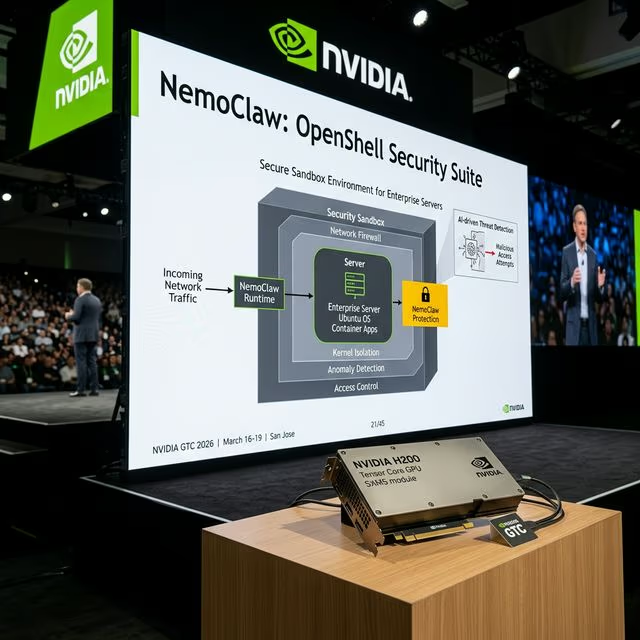
The centerpiece of NemoClaw is OpenShell, an isolated sandbox environment that enforces guardrails for security, network, and privacy.
- Policy Enforcement: Define strict rules on what an agent can and cannot do before a single line of code is run.
- Network Control: Transparently monitor and block unauthorized API calls from autonomous agents.
- Hardware Agnostic: While optimized for NVIDIA GPUs, NemoClaw runs safely across Mac, Windows, and Linux environments.
Conceptually, OpenShell inverts the default trust model of early agent frameworks. A vanilla OpenClaw install trusts the agent and hopes for the best; OpenShell trusts nothing and requires every action, file read, shell command or outbound request, to pass through an enforcement point first. The agent's model weights never need to be trusted, because the boundary is enforced outside the model.
Inside the Policy Layer: How the Stack Fits Together
NemoClaw's design addresses the three failure modes that dominate real-world agent incidents, and it is worth understanding each in turn.
- Prompt injection: An agent that reads the open web can be given instructions by anyone who controls a page it reads. No model reliably ignores these, so NemoClaw's answer is containment rather than detection: a hijacked agent inside OpenShell can still only perform the actions its policy already permits.
- Credential exfiltration: Early agent setups stored API keys and session tokens in plain-text config files that the agent itself, and therefore anything that compromised the agent, could read. A policy gateway lets credentials be brokered per action instead of handed over wholesale.
- Unbounded network egress: An agent that can call any endpoint can leak data to any endpoint. Declarative network rules turn "the agent phoned somewhere unexpected" from a forensic discovery into a blocked request in a log.
Policies are written declaratively, reviewed like code and enforced at runtime, which is what makes the model auditable: a security team can answer "what could this agent ever do?" by reading a file rather than by reverse-engineering prompts. That property, more than any individual guardrail, is what compliance teams had been demanding before signing off on autonomous agents.
None of this is conceptually new; it is least-privilege sandboxing, the same doctrine that governs mobile app permissions and browser tabs. What is new is applying it to software whose behaviour is generated at runtime by a language model, where the traditional approach of auditing the code before deployment cannot work, because the "code" is decided per task.
OpenClaw for Enterprise
By adding a security layer to OpenClaw, NVIDIA has transformed it into a trusted enterprise product. Companies can now leverage the power of autonomous agents without the "wild west" risks of unencrypted API keys and session tokens.
The strategic logic mirrors what Red Hat did for Linux: take a community project that is powerful but operationally scary, wrap it in policy, support and certification, and sell the wrapper. NVIDIA gives the security stack away as open source and monetises the hardware and enterprise software around it, a familiar and effective play.
For teams evaluating deployment, the practical questions remain the boring ones: which actions do your agents genuinely need, who reviews the policy files, where do logs go, and who is paged when an agent's request is blocked. NemoClaw provides the enforcement points; it does not write your policy for you.
What Has Happened Since GTC
Four months on, the March announcement looks less like a one-off keynote moment and more like the opening move of a sustained platform strategy. At GTC Taipei during COMPUTEX in June 2026, NVIDIA published reference architectures for Secure Agent Workspaces, arguing that legacy IT security controls were not designed for autonomous agents, and formalising the principle that agents should run in managed workspaces without ever receiving raw credentials.
The bigger June announcement was Nemotron 3 Ultra, a 550-billion-parameter open model NVIDIA describes as trained on agent traces and optimised for agent harnesses, claiming up to 5x faster inference and up to 30% lower cost on complex agentic tasks. Early adopters named by NVIDIA include Perplexity, Palantir, ServiceNow and CrowdStrike.
Notably, the NemoClaw blueprint has also broadened beyond OpenClaw itself. NVIDIA's streamlined installer now supports the Hermes Agent alongside OpenClaw, and Nemotron models are supported across harnesses including Factory AI, Cline, LangChain Deep Agents and OpenHands. The message is deliberate: NemoClaw and OpenShell are pitched as the secure runtime for whichever agent framework wins, not a bet on a single one.
Market Impact & AI Economy
NVIDIA projects the total market for AI infrastructure to reach $1 trillion by 2027. This growth will be driven not just by raw compute, but by the "inference economy", the billions of autonomous tasks performed by agents running on NVIDIA data centers.
Huang also teased upcoming Vera Rubin GPUs and CPUs, promising order-of-magnitude improvements in token production and agentic reasoning efficiency.
Final Summary
GTC 2026 confirmed that NVIDIA's future is inextricably linked to the success of agentic AI. By open-sourcing NemoClaw, NVIDIA is positioning itself as the foundational security provider for the entire AI agent ecosystem.
The events since March reinforce that reading. With Nemotron 3 Ultra, Secure Agent Workspaces and multi-harness support, NVIDIA is assembling the full stack of the agent era: the chips agents run on, the models they think with and the sandbox that keeps them honest. For how the underlying framework compares with its rivals, see our OpenClaw vs DuClaw comparison.
Last updated: 15 July 2026. Post-GTC details draw on NVIDIA's official GTC 2026 and GTC Taipei at COMPUTEX live blogs, with keynote coverage from SDxCentral and Futurum Group, and Moltbook security reporting from 404 Media and Wiz.