 AI Tools Review Editorial Team
Update, checked 25 September 2026: Claude Fable 5.1 has since launched.
Anthropic launched Claude Fable 5.1 on 1 September 2026, six weeks after this comparison published. Base API pricing is unchanged at $10/$50 per million input/output tokens, so the pricing table and 3.3x cost gap below still hold - but the cache-hit price dropped 75%, from $1.00 to $0.25 per million tokens, confirmed against Anthropic's own pricing docs today. That widens Fable's cost advantage on cache-heavy, agentic workloads specifically. No new Kimi K3 vs Fable 5.1 benchmark scorecard has been published by either vendor, so the 14-benchmark table below still reflects the original Fable 5 launch figures rather than 5.1.
Quick answer:
Neither model wins outright. Across 14 benchmarks both vendors report head-to-head, Claude Fable 5 wins 8 and Kimi K3 wins 6. Fable 5 leads on frontier-difficulty engineering, professional knowledge work and visual reasoning; K3 leads on long-horizon agentic coding, terminal-driven tasks and web research, and costs roughly a third as much per token. The viral claims that one model has "crushed" or "beaten" the other are each true of a specific benchmark and false as a general statement; the real story is a genuine, close, task-dependent contest between the two.
Watch the Kimi K3 versus Claude Fable 5 video
Watch AI Tools Review's first YouTube video: a benchmark-by-benchmark breakdown of Kimi K3 and Claude Fable 5.
Within 48 hours of Kimi K3's launch, AI YouTube split into two camps. "Kimi K3 just beat FABLE" and "Kimi K3 CRUSHED Fable" ran alongside "Did Kimi K3 really beat Fable?"; the same week, from channels covering the same release. Both framings are defensible, because Moonshot's launch benchmark table and the independent numbers that followed it are not one race with one finish line. They are several different races, and each model won some of them.
This is the scorecard, benchmark by benchmark, with the actual numbers and where each figure came from; plus the training-data controversy hanging over Moonshot's agentic capabilities that most of the head-to-head videos left out.
Note: figures below are drawn from Moonshot AI's official Kimi K3 launch materials, Artificial Analysis's Intelligence Index v4.1 and GDPval-AA v2 leaderboard, Anthropic's published Claude Fable 5 pricing, and independent reporting from the-decoder, Tom's Hardware, Decrypt and CNBC. AI Tools Review has not independently reproduced any benchmark. All prices are billed in US dollars per million tokens unless stated.
Summary
- 8 wins to 6. Across the 14 benchmarks both vendors report, Claude Fable 5 wins eight and Kimi K3 wins six. Neither model sweeps a category cleanly.
- Intelligence Index: Fable 5 leads, 60 to 57. Artificial Analysis's broadest single-number comparison places K3 third overall, level with Claude Opus 4.8 territory, behind Fable 5 and GPT-5.6 Sol.
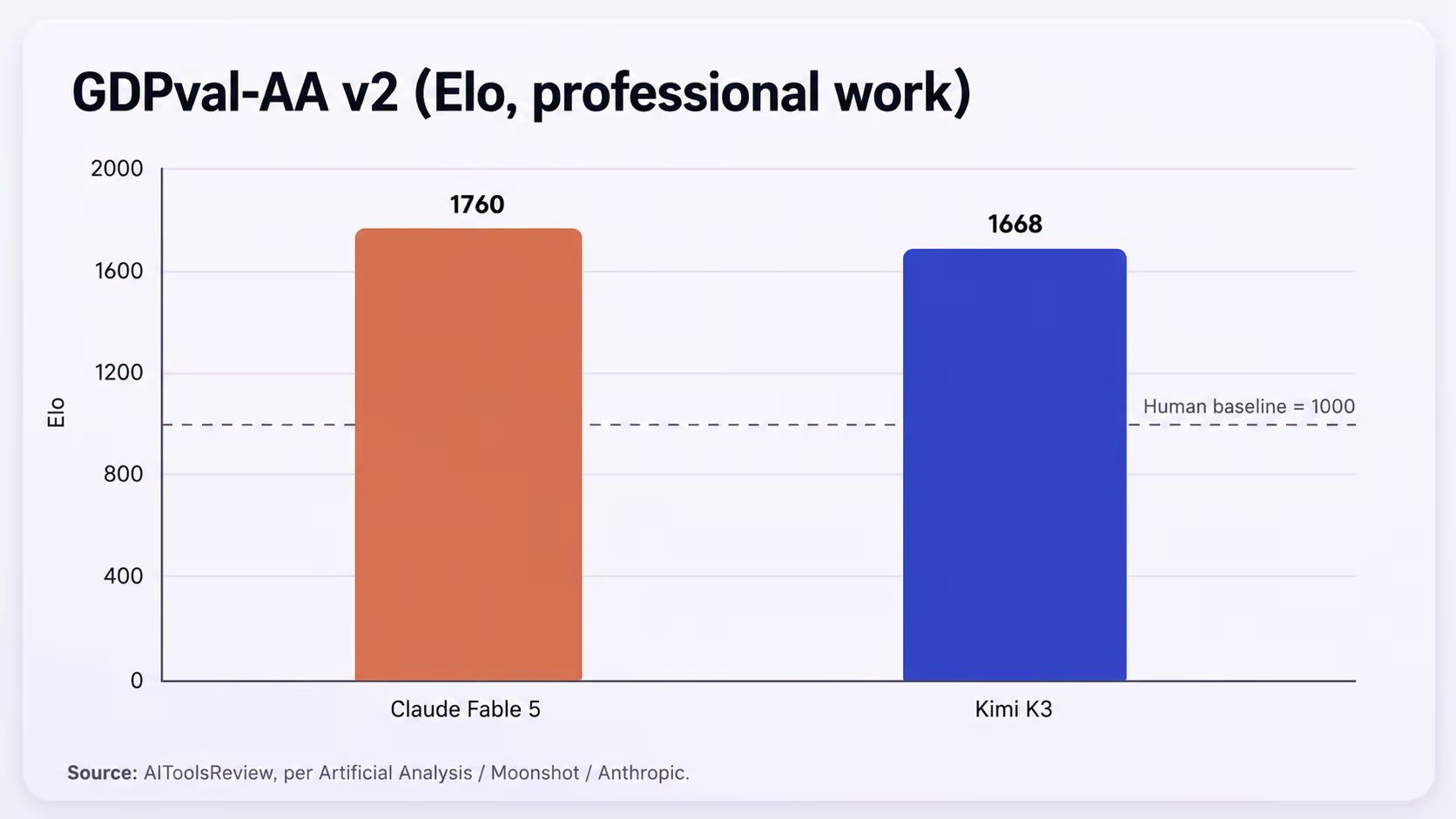
- Fable 5's biggest lead is professional work: GDPval-AA v2, an Elo-ranked benchmark of realistic tasks anchored to a human baseline of 1,000, has Fable 5 at 1,760 versus K3's 1,668; a 92-point gap, the widest of any benchmark either model leads.
- K3's biggest lead is long-horizon agentic coding: SWE Marathon has K3 at 42.0 versus Fable 5's 35.0, a 7.0-point margin, and K3 also topped Arena.ai's Frontend Code Arena with 1,679 points.
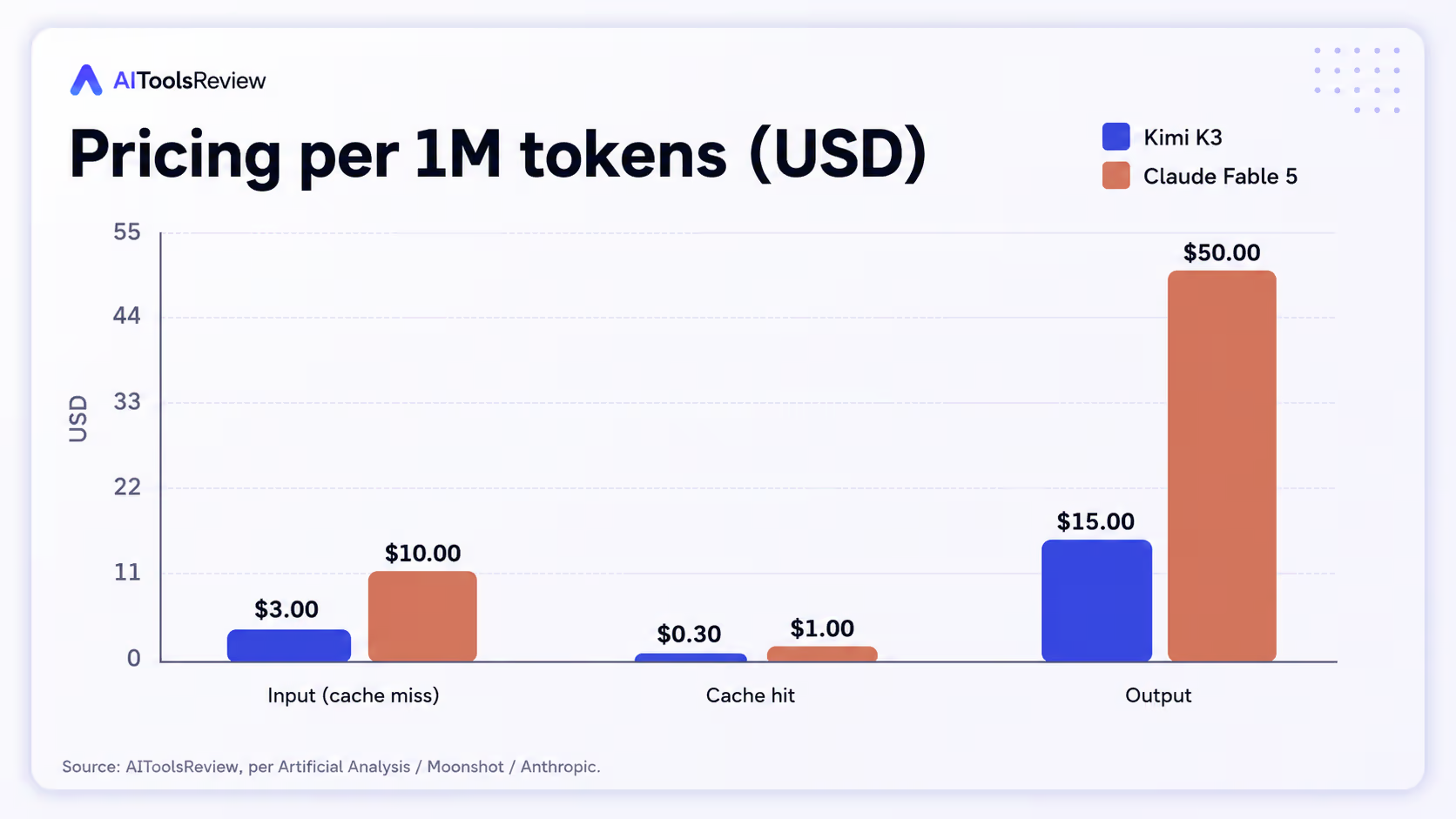
- K3 is roughly a third of Fable 5's price; $3.00/$15.00 per million input/output tokens versus $10.00/$50.00; a 3.3x gap that holds across input, cached input and output pricing alike.
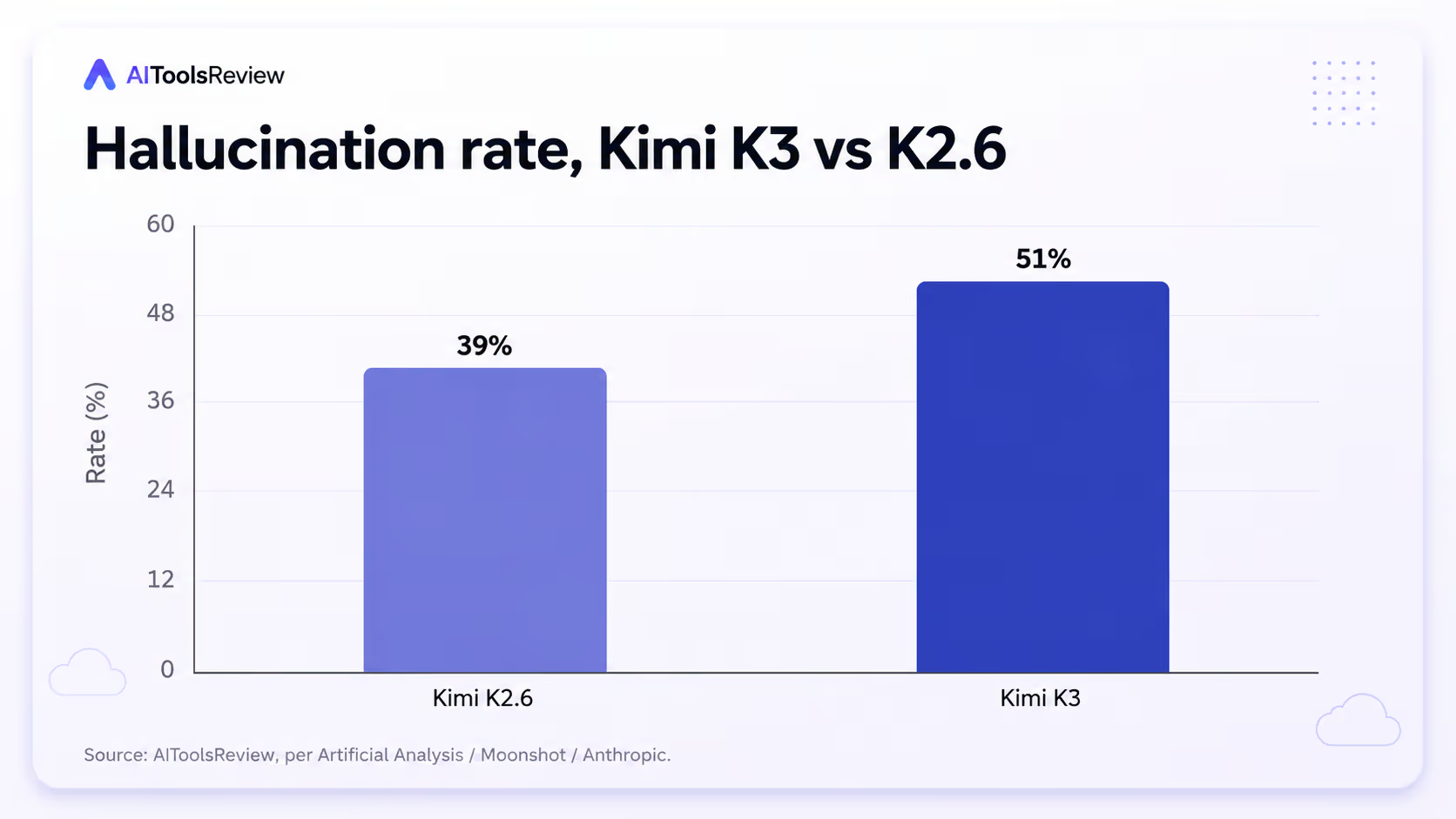
- K3's accuracy and its hallucination rate both rose compared with its own predecessor, Kimi K2.6; a real trade-off, not just a competitive-positioning footnote.
- Anthropic separately accused Moonshot, in February 2026, of running roughly 3.4 million distillation exchanges against Claude; a documented allegation worth knowing when weighing K3's agentic-task gains.
The 14-benchmark scorecard
The clearest way to answer "who won" is to list every shared benchmark and its margin, rather than pick the one that flatters either model. Both models are run at their maximum reasoning-effort configuration in the source figures below.
| Benchmark | Claude Fable 5 | Kimi K3 | Winner |
|---|---|---|---|
| FrontierSWE (frontier-difficulty engineering) | 86.6 | 81.2 | Fable 5 (+5.4) |
| SWE Marathon (long-horizon agentic coding) | 35.0 | 42.0 | K3 (+7.0) |
| Terminal-Bench 2.1 | 84.6 | 88.3 | K3 (+3.7) |
| DeepSWE (real-repository engineering) | 70.0 | 67.5 | Fable 5 (+2.5) |
| GDPval-AA v2 (professional work, Elo) | 1,760 | 1,668 | Fable 5 (+92) |
| BrowseComp (web research) | 88.0 | 91.2 | K3 (+3.2) |
| JobBench (occupational tasks) | 57.4 | 52.9 | Fable 5 (+4.5) |
| Frontend Code Arena (Arena.ai leaderboard) | Not reported | 1,679 (#1) | K3 |
| CharXiv & Zerobench (visual reasoning, 2 tests) | Fable 5 leads both | Fable 5 (x2) | |
Tallied across the full set, Fable 5 wins eight of the fourteen shared tests and K3 wins six. That is a genuine contest, not a rout in either direction; and it is exactly why two AI YouTubers covering the same launch week can walk away with opposite headlines while both be quoting real numbers.
The single-number comparison
If you only look at one chart, this is the one most people cite: Artificial Analysis's Intelligence Index v4.1, which aggregates nine evaluations; GDPval-AA v2, τ³-Banking, Terminal-Bench v2.1, SciCode, Humanity's Last Exam, GPQA Diamond, CritPt, AA-Omniscience and AA-LCR; into a single comparable score.
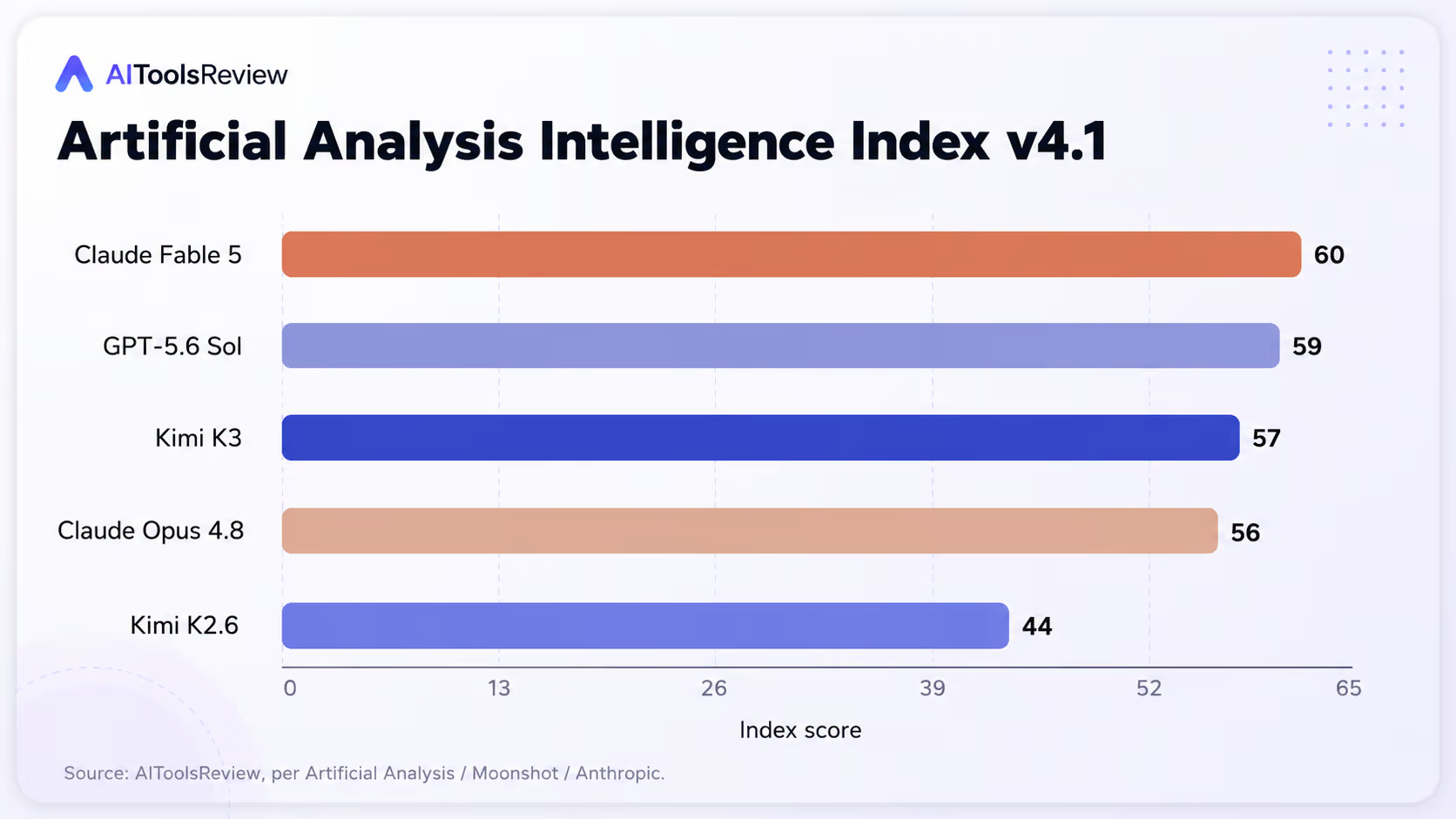
On the Intelligence Index itself, Claude Fable 5 (with fallback) scores 60, GPT-5.6 Sol (max) scores 59, and Kimi K3 scores 57; placing it third overall, just ahead of Claude Opus 4.8 (max) at 56, and clear of every other open-weight model on the board, including its own predecessor Kimi K2.6 at 44. That is a genuinely strong result for an open-weights model against three closed frontier labs, even though it is not a win against Fable 5 specifically.
On GDPval-AA v2, the gap is proportionally larger: 1,760 Elo for Fable 5 versus 1,668 for K3, a 92-point margin; the single widest lead either model holds on any benchmark in this comparison. GDPval-AA v2 is designed to measure realistic, professional-grade work rather than narrow academic tasks, which is a meaningful category to be behind on if you are routing knowledge work rather than code.
Coding, head to head
Coding is where the "K3 beat Fable" claims are strongest, and where they are also most benchmark-specific. K3 leads on three of the four coding-adjacent tests in the shared set: Terminal-Bench 2.1 (88.3 vs 84.6), SWE Marathon (42.0 vs 35.0, the largest margin K3 holds anywhere), and Arena.ai's Frontend Code Arena, where it topped the leaderboard outright with 1,679 points. Arena.ai's CEO, Anastasios Angelopoulos, called the frontend result "the moment that OSS Chinese models have surpassed US models"; a claim specific to that leaderboard, not a statement about coding generally.
Fable 5 pushes back on the two benchmarks that weight raw engineering difficulty over agentic endurance: FrontierSWE, a frontier-difficulty software-engineering suite, where it leads by 5.4 points (86.6 vs 81.2), and DeepSWE, a real-repository engineering benchmark, where it leads by 2.5 points (70.0 vs 67.5).
Read together, the pattern is consistent: K3 is stronger on long-running, terminal-driven, agentic coding sessions; the kind of task where a model has to keep working autonomously for many steps; while Fable 5 is stronger on frontier-difficulty, single-pass engineering problems that reward raw problem-solving depth over endurance. Both claims; "K3 wins at coding" and "Fable 5 wins at coding"; are true of different benchmarks in the same set.
Agentic and knowledge work
Outside pure coding, the pattern flips further in Fable 5's favour. It leads GDPval-AA v2 by 92 Elo points and JobBench; an occupational-tasks benchmark; by 4.5 points (57.4 vs 52.9), and wins both visual-reasoning tests in the shared set, CharXiv and Zerobench with tool use. K3's one clear agentic win outside coding is BrowseComp, a web-research benchmark, where it leads 91.2 to 88.0; consistent with Moonshot positioning K3 for browser automation and long-document research work.
The practical read: if your workload looks like professional deliverables; reports, spreadsheets, structured knowledge work, anything requiring visual reasoning over charts or documents; Fable 5's lead is broader and deeper than K3's coding wins. If your workload is specifically web-browsing agents or long-horizon terminal automation, K3's advantage is real and specific.
Pricing and data policy
| Metric | Kimi K3 | Claude Fable 5 |
|---|---|---|
| Input (cache miss), per 1M tokens | $3.00 | $10.00 |
| Input (cache hit), per 1M tokens | $0.30 | $1.00 |
| Output, per 1M tokens | $15.00 | $50.00 |
| Batch API discount | Not published | $5.00 / $25.00 |
| Data retention | Not published at launch | 30 days mandatory, no ZDR exception |
| Context window | 1M tokens, flat pricing | 1M tokens |
Update, 25 September 2026: Claude Fable 5.1 launched 1 September 2026 with the same $10/$50 base rate but a cache-hit price cut 75% to $0.25 per million tokens (from the $1.00 shown in the table above for the original Fable 5). That widens Fable's relative advantage on cache-heavy agentic sessions specifically, though K3 remains cheaper on base input, uncached, and output pricing by the same roughly 3.3x margin.
K3 is cheaper by almost exactly the same ratio; roughly 3.3x; on input, cached input and output pricing alike. That consistency matters: it means the price gap does not shift much based on your input/output mix the way it can with vendors who discount one side of the ledger more than the other. K3 also applies flat pricing across its full 1-million-token context window, with no length-based tiering.
The one place Fable 5 has a real structural advantage is data governance: its batch API offers discounted pricing, but Claude Fable 5's standard terms include a mandatory 30-day data retention period with no zero-data-retention exception; worth flagging for regulated workflows regardless of which model you choose, since neither vendor's published terms at launch fully solve for that use case.
Why the "who really won" debate exists
The scorecard above should make the disagreement among AI YouTubers easy to understand: "Kimi K3 just beat FABLE" and "Kimi K3 CRUSHED Fable" are accurate if the video is about SWE Marathon, Terminal-Bench, or the Frontend Code Arena. "Did Kimi K3 really beat Fable?" is the more accurate framing if you are looking at the full 14-benchmark set, the Intelligence Index, or GDPval-AA v2; where Fable 5 leads clearly.
There is a second, more technical reason for the confusion. The-decoder has flagged that scores in circulation for K3 are not all collected the same way: some come from public leaderboards, some are Moonshot-run using its own KimiCode agent harness, and some come from independent labs using Claude Code or Codex as the harness for competing models. Harness choice; the scaffolding and tool-calling framework a model runs inside during a benchmark; can shift a score by several points on its own, independent of the underlying model's capability. That means two channels quoting different numbers for the "same" benchmark are not necessarily wrong; they may simply be citing runs with different scaffolding.
The practical takeaway is the one every credible comparison converges on: treat any single benchmark as a signal about a specific task type, not a verdict on either model overall, and test on your own workload with your own tooling before switching a production pipeline.
The Anthropic distillation allegation
One piece of context most head-to-head coverage of K3 has left out entirely: in February 2026, Anthropic publicly accused three Chinese AI labs; DeepSeek, Moonshot AI and MiniMax; of running coordinated "distillation attack" campaigns against Claude, using large volumes of fraudulently created accounts to extract training-relevant data from Claude's outputs. Anthropic estimated the three labs generated over 16 million exchanges with Claude combined, from roughly 24,000 fake accounts. Of that total, Anthropic attributed about 3.4 million exchanges specifically to Moonshot AI, and said Moonshot's activity focused on agentic reasoning and computer-use agent development; the exact capability area K3's strongest benchmark wins (SWE Marathon, Terminal-Bench, BrowseComp) fall into.
This was reported on the record by CNBC, TechCrunch, VentureBeat, CNN and the South China Morning Post at the time, and Anthropic framed it as part of a wider concern about authoritarian governments accessing frontier AI capability through extraction rather than independent research. It is a serious, separately documented allegation about Moonshot's training practices; not proof that any specific K3 benchmark score is inflated, and Moonshot has not, to AI Tools Review's knowledge, admitted to the specific claim. But given that the allegation is about agentic-task data extraction and K3's standout results are in agentic tasks, it is directly relevant context that belongs in any serious comparison, and it is worth knowing before treating K3's agentic wins as evidence of independent architectural progress alone.
The pelican test
Away from formal benchmarks, independent developer Simon Willison ran his long-running informal test; asking a model to generate an SVG of "a pelican riding a bicycle"; against K3 within a day of launch. It is not a rigorous evaluation, and Willison is upfront that the test has been "mostly severed" from real model-quality assessment at this point; he treats it more as a forcing function for actually trying a new model than a scorecard. But it is a useful, independently reproducible sanity check that costs about 25 cents to run.

Willison's own read, based on self-reported benchmark comparisons rather than the pelican test itself, was that K3 "mostly beat Claude Opus 4.8 max" while "losing out to Claude Fable 5"; which lines up closely with the formal scorecard above: strong against the previous-generation flagship, competitive but usually trailing against the current one.
Real-world reports vs benchmarks
Early hands-on coverage from AI YouTube broadly mirrors the benchmark split rather than contradicting it. Channels running side-by-side game-generation and frontend-build demos generally found K3's output competitive and often faster to iterate on for terminal-driven agentic tasks, at a noticeably lower cost per run. Channels testing more open-ended reasoning, professional writing, or multi-step planning tasks more often reported Fable 5 handling ambiguity and instruction-following more reliably; consistent with its wider lead on GDPval-AA v2 and JobBench.
One consistent theme across independent coverage, including Moonshot's own disclosed limitations for K3: the model has a documented tendency toward "excessive proactiveness" when operating agentically, doing more than a task strictly called for. Combined with its rising hallucination rate versus K2.6 (39% to 51%, per Artificial Analysis via the-decoder), that argues for tighter permission scoping and review when running K3 unsupervised, regardless of how it scores on any individual benchmark. See our full Kimi K3 review for the complete breakdown of that trade-off.
How to choose between them
Choose Kimi K3 if: your primary workload is long-horizon autonomous coding, terminal-driven agent tasks, or web-browsing and research automation, and you want roughly a third of Fable 5's per-token cost. Scope its permissions tightly given the documented over-proactiveness and rising hallucination rate.
Choose Claude Fable 5 if: your workload is frontier-difficulty software engineering, professional knowledge work, or anything involving visual reasoning over charts, documents or screenshots; or if you need the more predictable, single-vendor safety and data-handling posture that comes with Anthropic's published terms. It is also the safer single default if you can only standardise on one model, given its wider win margin across the full shared benchmark set.
Consider running both if your pipeline can route by task type; several teams covered in launch-week coverage described exactly this pattern: K3 for high-volume, cost-sensitive agentic and browsing work, Fable 5 for the smaller share of tasks that are highest-stakes or most ambiguous. For the full field of scored frontier models, see our live Benchmarks page.
The bottom line
Kimi K3 did not "crush" Claude Fable 5, and Fable 5 did not run away with the field either. The real result is an 8-to-6 benchmark split that favours Fable 5 on breadth and professional-knowledge work, and favours K3 specifically on long-horizon agentic coding and browsing; at roughly a third of the price. Both framings that dominated launch-week video titles are technically defensible and both are incomplete on their own.
What the head-to-head videos mostly skipped is the February 2026 distillation allegation against Moonshot, which is directly relevant to K3's strongest category. That does not settle the benchmark debate, but it belongs in the conversation about how K3's agentic capability was built, alongside the numbers themselves.
Sources for the figures in this article include Moonshot AI's official Kimi K3 technical blog post, Artificial Analysis's Kimi K3 Intelligence Index analysis, the-decoder's independent evaluation, and CNBC's February 2026 reporting on Anthropic's distillation allegations.
Last updated: 18 July 2026, two days after Kimi K3's API launch. Benchmark scores in this category shift quickly in the days after a release as more independent evaluations publish; check the linked sources for the latest figures before making a production decision. Pricing checked again on 25 September 2026 against Anthropic's own pricing documentation: Claude Fable 5.1 (launched 1 September 2026) carries the same $10/$50 base rate as the Fable 5 figures used throughout this piece, but its cache-hit price is now $0.25 per million tokens, not the $1.00 shown above.
Get the free guide: Claude vs ChatGPT, Gemini & Grok
A 20-page playbook covering everything you need to choose and use the big four AI models in 2026, full cost and feature comparisons, what each is best (and worst) at, and how-tos for images, vectors, building a website, Claude Code and more.