 AI Tools Review Editorial Team
Quick Answer:
In a single stretch of late May 2026, Google shipped Omni (a unified multimodal model), Spark (a fast, lightweight tier), AntiGravity 2 (its agentic developer platform) and a rebuilt AI Search. Individually impressive; together, a statement that Google intends to own the full stack from model to search box. The vertical integration - not any single benchmark - is the real story.
"Google just changed AI forever" is the kind of headline you learn to discount. But four serious launches in quick succession is harder to wave away.
The pattern matters more than any single product: Google is shipping a coordinated platform, not a scattering of features - and that changes how you should read each piece.
Summary
Google's wave is best understood not as four announcements but as one strategy. Omni provides the frontier capability, Spark provides the volume tier, AntiGravity 2 provides the developer surface, and AI Search provides distribution to billions of users. Each is competitive on its own terms; combined, they describe a vertically integrated AI stack that few competitors can match end to end.
For most observers, the temptation is to benchmark each piece against its closest rival - Omni against other multimodal models, AntiGravity 2 against other coding platforms. That misses the point. Google's advantage was never going to be winning every individual benchmark; it is owning the whole pipeline from model training to the search box on every phone. This deep dive takes each launch in turn and then steps back to the strategy that ties them together.
A Wall of Launches
Most of the channels we track spent late May untangling Google announcements. The sheer volume is itself the strategy: keep competitors reacting to your release cadence rather than setting their own, and dominate the conversation through density. It landed in the middle of an already crowded fortnight - see the June 2026 model wars - and still managed to command attention.
There is a risk to this approach: launch too much at once and individual products get under-examined, their rough edges lost in the noise. But for an incumbent defending a search monopoly against AI-native challengers, controlling the narrative is worth the trade-off. The wave was as much a messaging exercise as a product one.
Google Omni
Omni is positioned as a unified multimodal model - text, vision, audio and video understanding under one roof, with notably strong real-time and video reasoning. The pitch is fewer specialised models to juggle: one system that sees, hears and reasons, designed to slot directly into Google's products and cloud.
The strategic value of true multimodality is integration. A model that natively handles video and audio, rather than bolting separate models together, is far easier to embed across YouTube, Android, Workspace and the rest of Google's surface area. Omni's strongest claim is not that it beats every rival on every modality, but that it is one coherent system Google can deploy everywhere - which, at Google's scale, is a formidable advantage. On the image side specifically, that same integration logic is what makes Nano Banana 2's photorealistic generation so disruptive: it ships directly into products billions of people already use, rather than as a standalone destination.
Google Spark
Spark is the counterweight to Omni: a fast, lightweight tier built for latency-sensitive, high-volume work. The frontier gets the headlines, but the cheap-and-quick tier is what actually ships into consumer features at Google's scale. Spark is the model most users will touch without ever knowing its name - powering autocomplete, summaries and the countless small AI interactions woven through Google's products.
This two-tier structure - a frontier model for hard problems and an efficient model for everything else - is now the standard shape of a serious AI portfolio, mirroring the Opus/Sonnet/Haiku split at Anthropic. Spark is Google making that economics explicit: most queries do not need frontier intelligence, and serving them cheaply is how you deploy AI to billions without bankrupting yourself.
AntiGravity 2
AntiGravity 2 is the next iteration of Google's agentic developer platform - and the most contentious launch of the set, with some creators framing it as Google "changing the rules" for how developers build. It pushes harder into autonomous, multi-step coding and tool use, putting Google directly into the agentic-IDE fight alongside Cursor, Windsurf and the rest.
The contention is partly about Google's gravitational pull: when the company that controls so much of the developer ecosystem ships an opinionated agentic platform, it reshapes norms rather than just adding an option. For the broader context of this shift, see our agentic AI evolution coverage. The verdict on AntiGravity 2 will hinge on whether its autonomy genuinely outperforms the incumbents or merely leverages Google's distribution.
The New AI Search
The rebuilt AI Search is arguably the most consequential launch of the wave, because it touches Google's core business and, by extension, the entire open web. Moving from a list of links to AI-generated answers reshapes how information is found - and how publishers receive traffic. It is the launch with the longest tail, changing the rules of discovery rather than just adding a feature.
For Google, the move is existential as much as opportunistic: AI-native challengers threatened to make traditional search feel dated, and a defensive reinvention was inevitable. But it carries a profound tension - the same answer-first experience that delights users starves the publishers whose content trains and feeds it. How Google balances user experience against the health of the web it depends on is the defining question of this launch, and it is far from resolved.
The Vertical Integration Thesis
Read individually, each launch is a strong release. Read together, they describe a vertically integrated stack: a frontier model (Omni), a volume model (Spark), a developer platform (AntiGravity 2) and a distribution surface (AI Search) reaching billions. No competitor controls all four layers as completely.
That integration is Google's structural advantage, and the reason rivals like Anthropic compete on focus and trust rather than breadth. The risk for Google is the perennial incumbent's dilemma: integration breeds complacency, and a sprawling platform can be out-executed at any single layer by a focused challenger. Owning the whole stack is powerful only if each layer stays genuinely competitive.
What It Means for Developers
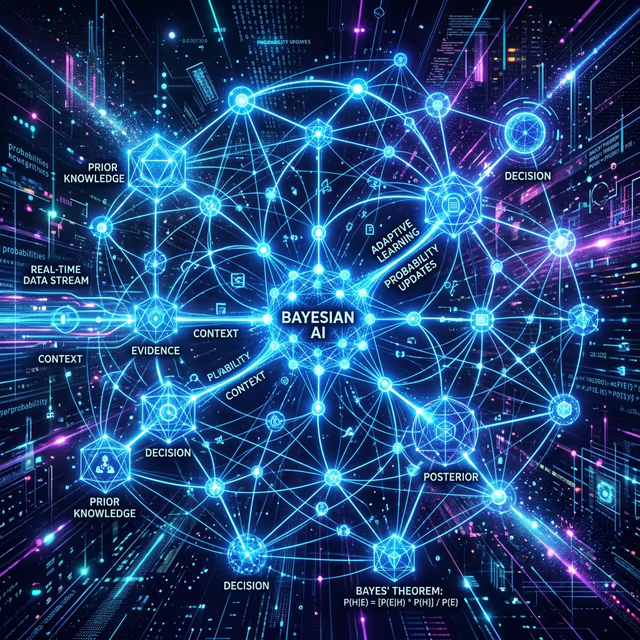
For developers, the wave means more capable Google models available through familiar surfaces, a serious new agentic platform to evaluate, and a multimodal model worth testing for video- and audio-heavy applications. The pragmatic stance is the same as ever: ignore the marketing, run the tools against your actual workload, and pick on merit. Google's distribution does not make AntiGravity 2 the right choice; your benchmarks do. Further back in Google's research pipeline sits Google's Bayesian AI architecture, a genuinely different approach worth tracking for anyone interested in where continual, real-time-learning models might head next.
What It Means for Publishers and SEO
For publishers, the new AI Search is the launch to watch. As answers increasingly appear directly in search rather than as links to click, the traffic economics of the open web shift. The defensive playbook - depth, expertise, first-hand experience and content that an answer box cannot fully substitute for - becomes more important, not less. Thin, easily-summarised content is most exposed; genuinely useful, hard-to-replicate work is most defensible.
The Competitive Response
Google's wave did not happen in isolation. It landed alongside Claude Opus 4.8, Grok 5, GPT-5.6 and Microsoft's model family - the densest fortnight of releases of the year. The competitive message is that no one is conceding the frontier, and that the differentiators are increasingly integration, distribution and trust rather than raw capability, which is converging across labs.
Open Questions
- Execution at each layer: can Google keep all four layers genuinely competitive, or will focused rivals out-execute it where it matters?
- The web's health: how does AI Search balance user experience against the publishers it depends on?
- AntiGravity 2's substance: is its autonomy a real lead or a distribution play?
- Under-examined launches: shipping everything at once risks rough edges going unnoticed until production.
The Bottom Line
Google's wave is less about any one model than about coordination at scale. Omni, Spark, AntiGravity 2 and AI Search are pieces of a single platform play, and that is what makes this fortnight matter beyond the launch-day noise.
The strategy is formidable on paper - own every layer from training to the search box. The open question is execution: integration is only an advantage if each layer stays sharp enough to win on its own. Google has assembled the pieces; whether it can keep them all competitive against focused challengers is the story of the next year.
Last updated: June 2026. Based on launch-window coverage; product details may evolve as the rollouts widen.