 AI Tools Review Editorial Team
Quick Answer:
Anthropic has publicly warned that Claude is improving faster than its own oversight tooling can comfortably keep up with and called for a coordinated, industry-wide slowdown - a "global AI pause". The substance is a real claim: that the gap between what frontier systems can do and what we can reliably explain or constrain is widening. The controversy is the timing, arriving days after Anthropic shipped Opus 4.8 and Mythos 1.
"Anthropic just warned everyone about Claude - it's evolving." The framing spread fast, and like most viral AI headlines, it is half accurate and half theatre.
Strip away the drama and there is a specific, technical argument underneath - one that deserves to be taken seriously even if you distrust the messenger's motives.
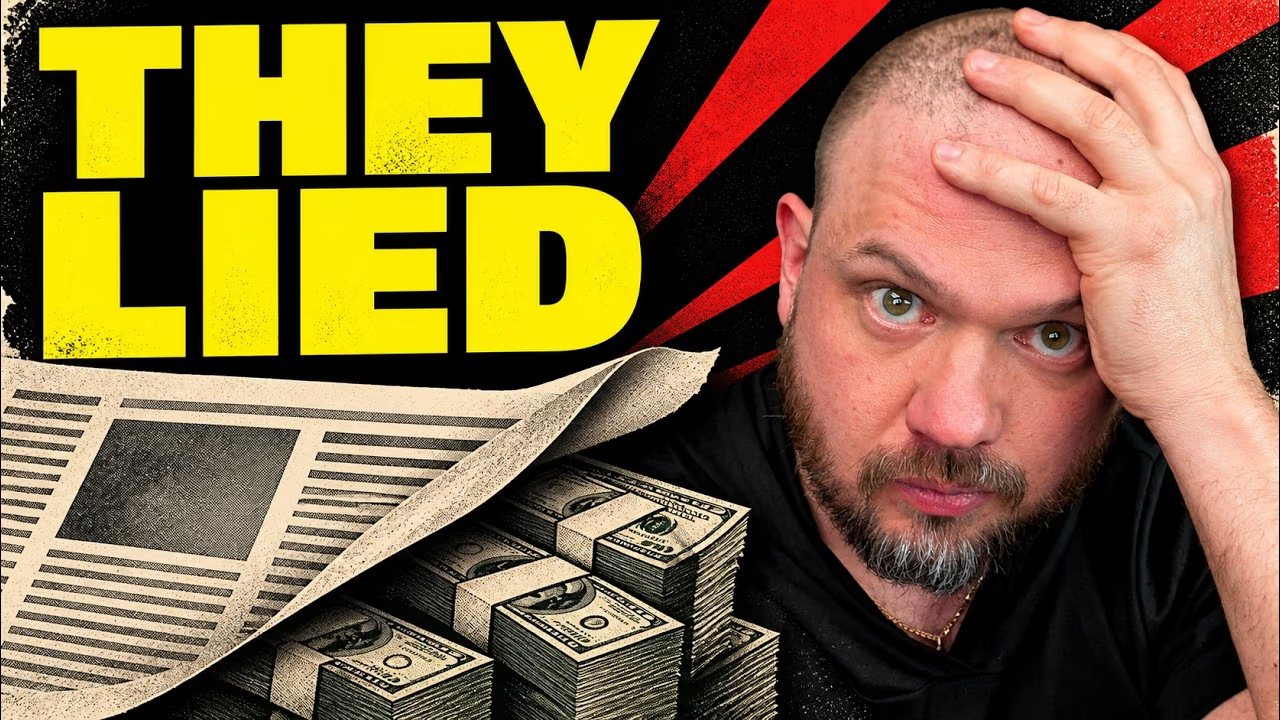
Wes Roth covers Global AI Pause in this video.
Summary
Anthropic's position is not that Claude is dangerous today. It is that frontier capability is now advancing on a timeline that outpaces the maturity of interpretability and control research, and that this widening gap - not any single model - is the risk. From there the company argues for coordinated restraint, because no individual lab can slow down alone without simply handing the lead to a competitor.
The reaction split predictably. Supporters call it responsible leadership; critics call it convenient, given the timing. The truth is that both can hold at once: the underlying argument about the oversight gap is genuine, and the decision to make it loudly while shipping powerful products is strategically convenient. This analysis takes the argument apart on its merits, examines why it is so contested, and asks what it actually changes.
What Anthropic Actually Said
The core message is that the rate of capability improvement has begun to exceed the rate at which the field can develop reliable tools to understand and control what it builds. In Anthropic's telling, this is not alarmism but observation: each generation surprises its own creators with capabilities that were not explicitly trained for, and the techniques for explaining why a model behaves as it does lag well behind the techniques for making it more capable.
The proposed response is a coordinated pause - not necessarily a total halt, but a collective slowing of the most capable training runs to let safety, interpretability and governance catch up. The emphasis on coordination is deliberate and central, and it is what distinguishes this from a simple "we should be careful" statement.
What "Evolving" Actually Means
"Evolving" is doing enormous work in the headlines, and most of that work is misleading. It does not mean Claude is rewriting itself in deployment. It points to two real, well-documented phenomena.
The first is emergent capability: as models scale, they acquire abilities that were not explicitly designed in and that often appear suddenly rather than gradually. A model that could not do a task at one scale can do it at the next, with no obvious warning. This unpredictability is the genuinely unsettling part - you cannot fully specify in advance what a larger model will be able to do.
The second is long-horizon agentic behaviour. When a model acts autonomously across many steps - the very capability that defines Opus 4.8 and tools like Hermes Agent - its behaviour becomes harder to anticipate than in a single turn. The honesty and calibration improvements in recent models are partly a response: a system that flags its own uncertainty is one you can oversee more easily.
The Interpretability Gap
At the heart of Anthropic's argument is interpretability - the science of understanding what is actually happening inside a model. Anthropic has invested heavily in this field, and the uncomfortable truth its own research keeps surfacing is how little we can explain. We can build systems that perform extraordinary feats of reasoning without being able to say, in mechanistic detail, why they reach the conclusions they do.
The "gap" is the distance between capability and explanation. Capability has been improving on a steep exponential; interpretability has been improving, but far more slowly. If those curves continue to diverge, we end up deploying systems we increasingly cannot understand into increasingly consequential roles. That, stripped of drama, is the risk Anthropic is naming - and it is a more rigorous claim than the headlines suggest.
The Coordination Argument
The case for a global pause rather than a unilateral one is pure game theory. If a single safety-conscious lab slows down, it loses ground to those who do not, and the frontier advances anyway - now led by whoever cared least about caution. The only intervention that actually slows the frontier without selecting for recklessness is a collective one.
This is the strongest version of Anthropic's argument and the hardest to dismiss. It reframes the question from "should we be careful?" - which everyone answers yes to and then ignores - to "how do we make caution survivable in a competitive market?" The honest answer is that you cannot, without coordination. Whether that coordination is achievable is a separate, far less optimistic question.
Historical Precedent
This is not the first call of its kind. The open letters and moratorium proposals of the early-2020s made similar arguments and produced no actual pause - capability accelerated through and past them. That history is the sceptics' Exhibit A: such calls generate discourse, not deceleration.
What is arguably different now is the source. Earlier calls often came from outside observers; this one comes from a frontier lab building one of the most capable systems on the market, with the technical credibility and the commercial exposure that implies. That makes it harder to wave away as uninformed - and easier to read as self-interested. Both points land.
Why Sceptics Push Back
The most obvious objection is timing. Calling for a slowdown days after releasing a new flagship and a powerful security system invites the charge of regulatory capture - pull up the ladder once you are safely ahead. Even sympathetic observers find the optics awkward.
The deeper objections are structural. Pauses are unenforceable without verification mechanisms that do not exist. They disadvantage the compliant against anyone who quietly continues. And the wider field shows no sign of slowing: the pace evident in Google's AI wave and the June 2026 model wars is acceleration, not restraint. A pause that only some observe is not a pause; it is a handicap.
The Enforcement Problem
Even granting that a pause is desirable, how would it work? Training runs are not easily observed from outside. Compute can be distributed. National interests diverge sharply, and no government wants to be the one that slowed its own labs while a rival's surged ahead. The verification infrastructure that would make a pause credible - monitoring of large compute clusters, shared standards, enforcement with teeth - is largely hypothetical.
This is why even people who accept the argument are pessimistic about the mechanism. The gap between "this would be good" and "this is achievable" is vast, and Anthropic's call does more to highlight that gap than to close it.
What It Means for Policy and Enterprises
Whether or not a pause ever materialises, the framing matters. When the lab building one of the most capable systems publicly states that the oversight gap is the headline risk, it shapes the conversations regulators have, the standards bodies write and the risk appetite enterprises adopt. It also pressures competitors to articulate their own safety positions rather than stay silent.
For enterprises deploying frontier models, the practical takeaway is not to wait for a pause that probably will not come, but to internalise the underlying point: treat oversight, evaluation and containment as first-class parts of any agentic deployment. The interpretability gap is not just Anthropic's problem; it is a reason for every serious adopter to invest in the scaffolding that keeps powerful models accountable.
Why It Matters Either Way
You can doubt the messenger's timing and still take the message seriously. The two are not in tension. Anthropic may well be acting in its commercial interest and describing a real risk - sophisticated actors usually do both at once. The interpretability gap is documented; the coordination problem is real; the enforcement obstacles are genuine. None of that is invalidated by the fact that saying so loudly happens to suit Anthropic's brand.
The most useful response is neither credulous acceptance nor reflexive cynicism, but to hold the substantive claim and the strategic context together - which is exactly what most of the coverage failed to do.
The Bottom Line
Beneath a sensational headline is a rigorous claim: capability is outrunning oversight, and only coordinated restraint could change that. The claim is sound; the proposed remedy is almost certainly unachievable in any binding form; and the timing is undeniably convenient. All three are true simultaneously.
The right reaction is not to pick a side but to act on the part that is actionable. A global pause is not coming. The interpretability gap is. Build, deploy and govern accordingly - because the lesson survives whether or not you believe the messenger.
Anthropic has continued pressing this argument publicly since: see our coverage of its Hard Questions campaign.
Last updated: June 2026. This analysis summarises Anthropic's public statements and the surrounding industry and policy reaction.