 AI Tools Review Editorial Team
Quick answer:
On 30/10/2026 Google said its Project Suncatcher prototype satellite, built with Planet, returned its first AI response from orbit: a haiku written by Gemma 4 running on a data-centre-class Trillium TPU. It is a genuine “hello world” for orbital compute, but heat and radiation endurance remain untested.
A language model has now answered a prompt from low Earth orbit, on the same class of chip Google uses in its terrestrial data centres. The poem was small. The idea behind it is not: that the next generation of AI infrastructure could be solar-powered satellites rather than power-hungry buildings on the ground.
This article separates what Google has demonstrated from what is still a research hypothesis, drawing on press coverage of the announcement and Google's own 2025 research on the concept.
Executive Summary
AI Revolution X walks through the orbital Gemma 4 response and the wider challenges of space-based data centres.
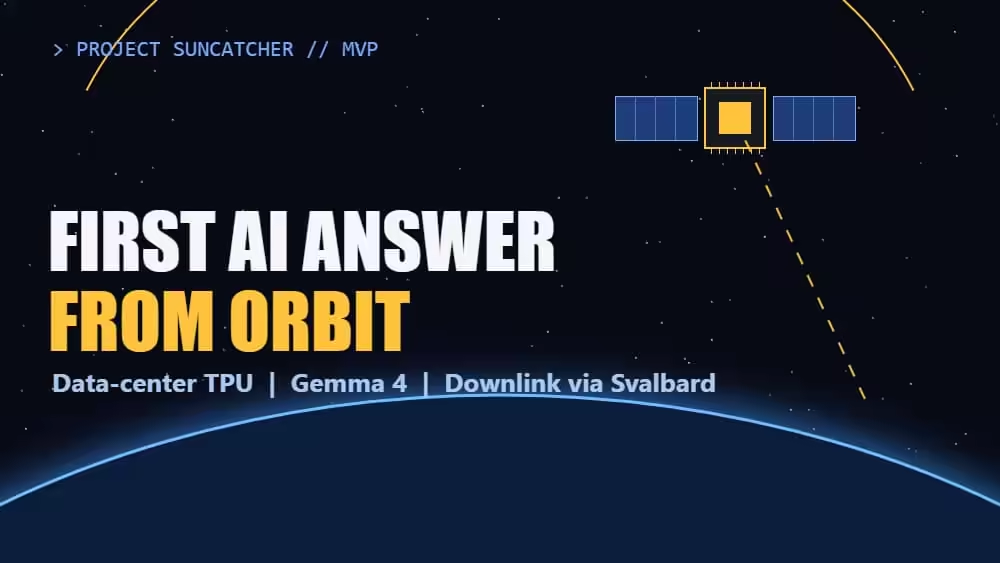
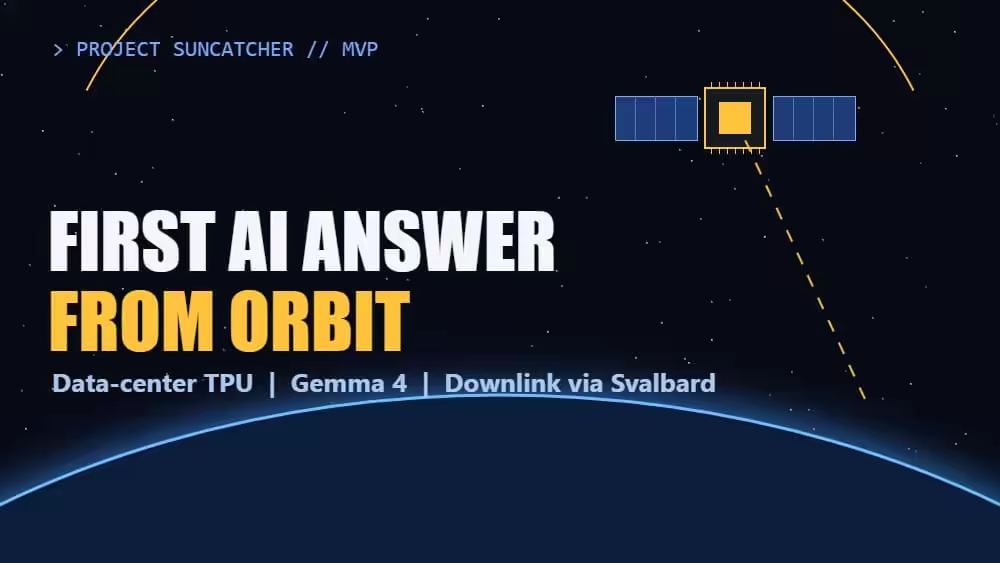
Project Suncatcher is a Google research effort to test whether machine-learning compute can run in space, powered directly by the Sun. Its first hardware milestone arrived on 30/10/2026, when Travis Beals, senior director of Google's Paradigms of Intelligence group, announced that the prototype satellite had returned an AI response generated on board. Engineers uplinked a prompt during a ground-station pass, asking Gemma 4, Google's open-weights model family, for a haiku about being in space. The answer was downlinked as the satellite passed over Svalbard, Norway.
The reported text was: “Blue marble below / Data streams in silent grace / Starlight feeds my core.” It is charming, but the significance is the plumbing. A data-centre-class accelerator, normally cooled by liquid in a rack, booted, loaded a modern model and produced output in orbit, and that output reached the ground.
What it does not show is equally important. Thermal stress tests have not been reported, no in-orbit radiation results have been published, and the satellite is four chips on roughly one kilowatt of solar power. Google's long-term vision of dozens of satellites flying in formation and linked by lasers is still a design on paper.
What Actually Happened
According to coverage of the announcement, the satellite was built with Earth-imaging company Planet and launched on 01/10/2026 aboard SpaceX's Transporter-18 rideshare mission. Google confirmed contact shortly afterwards and spent the following weeks commissioning the payload.
Commissioning followed a sensible order. The team powered up the host computer and the TPU trays first, then ran early machine-learning tests, and only then sent the first natural-language prompt. Later prompts reportedly asked for space-themed limericks and for telemetry about the payload's own systems, which is a neat use of the model: asking the computer in orbit to describe its own health.
Two details vary between reports. Some outlets say the satellite launched on 01/10/2026, others say “early October”. One report says operating sessions are capped at 15 to 20 minutes by thermal constraints; another describes the power budget differently. We have not been able to confirm either against Google's own post, so treat session length and exact power figures as provisional.
The Hardware: Four TPUs and About 1 kW
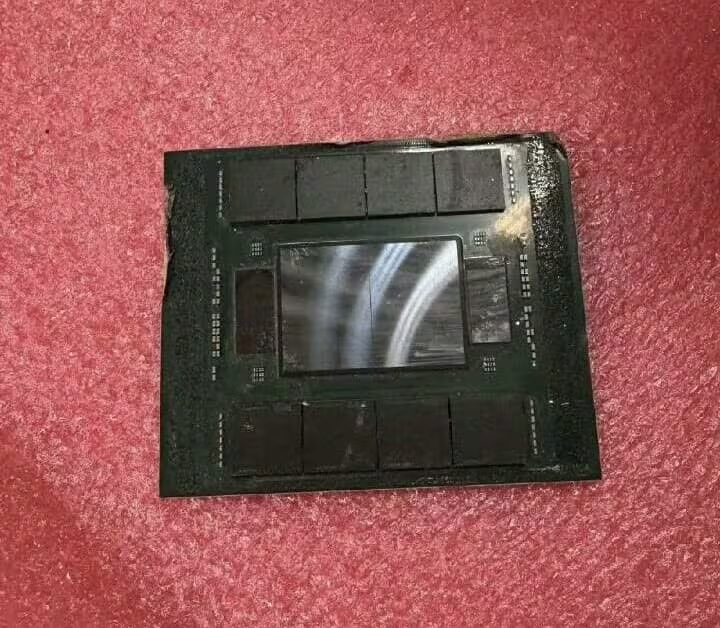
The payload carries four Trillium-generation TPUs, the sixth-generation Google accelerator, fed by solar arrays rated at roughly 1 kW. For comparison, a single modern AI accelerator in a terrestrial rack can draw several hundred watts on its own, so four chips on a 1 kW budget leaves very little headroom for the host computer, communications and thermal control. That is why short operating sessions are plausible.
Gemma 4 is a sensible choice of model. As an open-weights family it can run on modest hardware, it needs no external services to produce an answer, and Google can inspect exactly what is running. We have covered the broader Google model line-up in our guide to Gemini 4 Carbon; Gemma is the smaller, openly available sibling aimed at local and edge deployment, which is exactly what an orbiting computer is.
Why Put AI Compute in Orbit?
The motivation is energy. AI data centres are limited less by chips than by power, grid connections and cooling water, a theme that runs through our analysis of Anthropic's compute commitments and of the China AI chip race. Every large AI lab is searching for gigawatts.
Google argues that in the right orbits, solar panels can be several times more productive than the same panels on the ground. A dawn-dusk sun-synchronous orbit keeps a satellite near the day-night boundary, so the arrays see the Sun almost continuously, with no night, no weather and no atmosphere to absorb light. That removes the need for large batteries and for land. Coverage of the new milestone does not give a specific multiplier, so we will not either.
- Near-continuous power: dawn-dusk orbits avoid long eclipses.
- No land or water: no planning permission, no grid queue, no evaporative cooling.
- Scalability in principle: more satellites means more compute, if the links between them keep up.
The 2025 Research Behind It
Suncatcher was introduced in a Google Research post and accompanying paper in November 2025, titled “Exploring a space-based, scalable AI infrastructure system design”. It laid out an illustrative architecture rather than a product: a cluster of about 81 satellites flying within a radius of roughly one kilometre at about 650 km altitude, with neighbouring satellites a few hundred metres apart and connected by free-space optical links.
Optical links are central because machine-learning workloads need very high bandwidth between chips. Google's paper described bench-scale demonstrations of high-bandwidth inter-satellite links, with a figure of around 1.6 Tbps bidirectional reported in secondary summaries. Keeping satellites in such tight formation also requires careful orbital modelling. The 2027 plan to launch a pair of interconnected satellites is the first real test of that part of the design.
The paper also reported radiation testing of Trillium TPUs in a 67 MeV proton beam at UC Davis. Per Google's account, the chips showed no hard failures attributable to total ionising dose up to the maximum tested dose of 15 krad(Si) on a single chip, which Google framed as better than expected for the mission. At least one secondary source claims memory irregularities begin at a lower dose; we could not reconcile this with the primary paper, so we cite Google's figure and flag the disagreement.
The Heat Problem
On Earth, a data centre moves heat into air or water. In vacuum there is no air, so the only way for heat to leave is by radiating it away, which is far slower per square metre. A chip that is comfortable in a liquid-cooled rack can overheat quickly when it has only a radiator for company.
This is the most important unresolved engineering question. The coverage we reviewed gave no numerical thermal limits, and thermal stress tests are still to come. The 15 to 20 minute session figure, if accurate, suggests the prototype manages heat by duty-cycling rather than by cooling continuously. A production design would need large radiators, which add mass, which raises launch cost, which feeds straight back into the economics.
Heat also interacts with orbit. Satellites that spend part of each orbit in sunlight and part in shadow experience thermal cycling, which stresses solder joints and materials. A dawn-dusk orbit helps by reducing eclipses, but does not eliminate the need for careful thermal design.
The Radiation Problem
Space is full of energetic particles. They flip bits in memory, degrade transistors over time and occasionally destroy devices outright. Spacecraft normally use radiation-hardened parts that are slow and expensive; Suncatcher's bet is that commercial data-centre chips, plus error-correction and redundancy in software, can survive long enough to be worthwhile.
Ground-based beam tests are encouraging but not the same as a year in orbit. Total dose is only one effect. Single-event upsets, where a particle corrupts a value mid-computation, matter greatly for inference, because a flipped bit in a weight or activation can change an answer silently. In-orbit radiation results have not yet been reported. The prototype is expected to operate for a limited period, so real data should arrive, and it will be one of the most informative outputs of the whole programme.
Launch Costs and the Economics
The 2025 paper argued that orbital compute could become cost-competitive with terrestrial data centres on an energy basis if launch prices fall below roughly $200 per kilogram (about £155) by the mid-2030s. Press commentary tied that to fully reusable heavy-lift rockets launching very frequently; reusable Falcon 9 pricing today is a small multiple of several thousand dollars per kilogram, according to the reports we reviewed.
Put simply, the idea works only if three curves bend together: launch gets roughly an order of magnitude cheaper, satellite mass per kilowatt falls, and chips survive long enough to repay their cost. None of those is guaranteed. A four-chip prototype tells us almost nothing about the second and third, and nothing at all about the first.
It is also worth being sceptical about the framing that space solves AI's energy problem. Even an optimistic orbital build-out would add a tiny fraction of the compute that terrestrial sites are adding each year. The nearer-term value may be niche: processing data where it is collected, such as satellite imagery, rather than competing with hyperscale training clusters.
The Wider Race: Who Else Is Building Orbital Compute
Google is not alone. The AI Revolution X video notes that Nvidia already has chips in orbit, and several start-ups have talked publicly about space-based data centres. What distinguishes Suncatcher is that it is a full-stack effort from a company that designs its own accelerators, trains its own models and runs its own cloud, so it can optimise the chip, the model and the network together.
The competition is also political. Governments are treating compute as strategic infrastructure, and orbital capacity would sit outside national grids and, potentially, outside some national regulations. That raises questions about licensing, debris and who controls the hardware, which will matter long before any commercial service exists. For an adjacent story on open models and national strategy, see our coverage of Mistral Large 4 and Europe's sovereign-compute push.
What Is Not Proven
- Thermal endurance: no stress-test results yet.
- Radiation in orbit: only ground-based beam tests so far.
- Inter-satellite links: the 2027 pair of satellites is the first real test.
- Scale: four chips on about 1 kW is not a data centre.
- Economics: depends on launch costs that do not exist yet.
- Primary source: some details here come from press coverage of Google's post rather than the post itself, and reports disagree on a few figures.
What It Means for AI Builders
For developers, nothing changes this year. You cannot rent a TPU in orbit, and nothing about your inference costs will move because of this prototype. The practical takeaway is directional: AI infrastructure is now constrained by energy to the point that serious companies are testing hardware in orbit to get around it.
The more immediate lesson is about small models. Gemma 4 was chosen because it fits modest hardware and works offline. As open models become more capable per parameter, more places become viable for inference: phones, laptops, vehicles and, now, satellites. That is a strong argument for investing in efficient open models rather than assuming all useful AI will run in a hyperscale facility.
The Bottom Line
Suncatcher's haiku is a milestone because it converts a slide-deck idea into working hardware: a data-centre chip, a modern model and a working downlink. It is not yet evidence that orbital data centres are practical. The tests that matter, thermal stress, radiation in orbit and laser links between satellites, are still ahead, and the economics depend on launch prices that remain a prediction. Watch for the 2027 two-satellite mission; that is where the idea either gains credibility or runs into physics.
Sources
- Google Research: Exploring a space-based, scalable AI infrastructure system design (2025)
- HWBusters: Project Suncatcher's orbiting TPU sends back its first AI answer
- Notebookcheck: Google's first orbital AI data centre is up and running
- Data Center Dynamics: Project Suncatcher and 81-satellite clusters
- arXiv 2511.19468
Last updated: 02/11/2026. Sourced from Google Research's 2025 paper and press coverage of the 30/10/2026 announcement. We could not retrieve Google's own announcement post, so some figures are secondary and flagged where sources disagree.