 AI Tools Review Editorial Team
Quick answer:
Krea opened the beta for Krea Agents on 3 September 2026, a new agent-native layer on top of its creative canvas that replaces node-graph wiring with a single plain-language prompt. The agent reads whatever is already on the canvas, plans a multi-stage pipeline, picks which of 60-plus supported models (Flux, Veo 3.1, Kling, Runway, Luma, Krea 2, Ideogram, Nano Banana Pro and Topaz among them) to call at each stage, shows the plan before running it, and executes the job end to end. A hosted MCP server at api.krea.ai/mcp exposes the same capability to Claude, Cursor and Codex, so a coding-agent session can produce a finished image or video asset without switching tools. It remains an invite-only beta with no published Agents-specific pricing yet.
Every generative creative tool eventually runs into the same wall: a genuinely good result rarely comes from one model call. It comes from a pipeline — generate a base image, upscale it, relight it, animate it, add sound — and building that pipeline by hand, node by node, is the part that scares off everyone who isn't already a power user. Krea's bet with Krea Agents is that the pipeline itself should be planned by an agent, not wired by a human, and that the same planning layer should be reachable from inside a coding agent's own chat window.
This article draws on Krea's own beta announcement and MCP documentation, plus launch-week reporting from AlphaSignal, Blockchain.News and Krea's own social announcement. Krea Agents and its companion model, Krea 3, are both still pre-general-availability at the time of writing; details below reflect the beta as announced and will be revised as Krea publishes more.
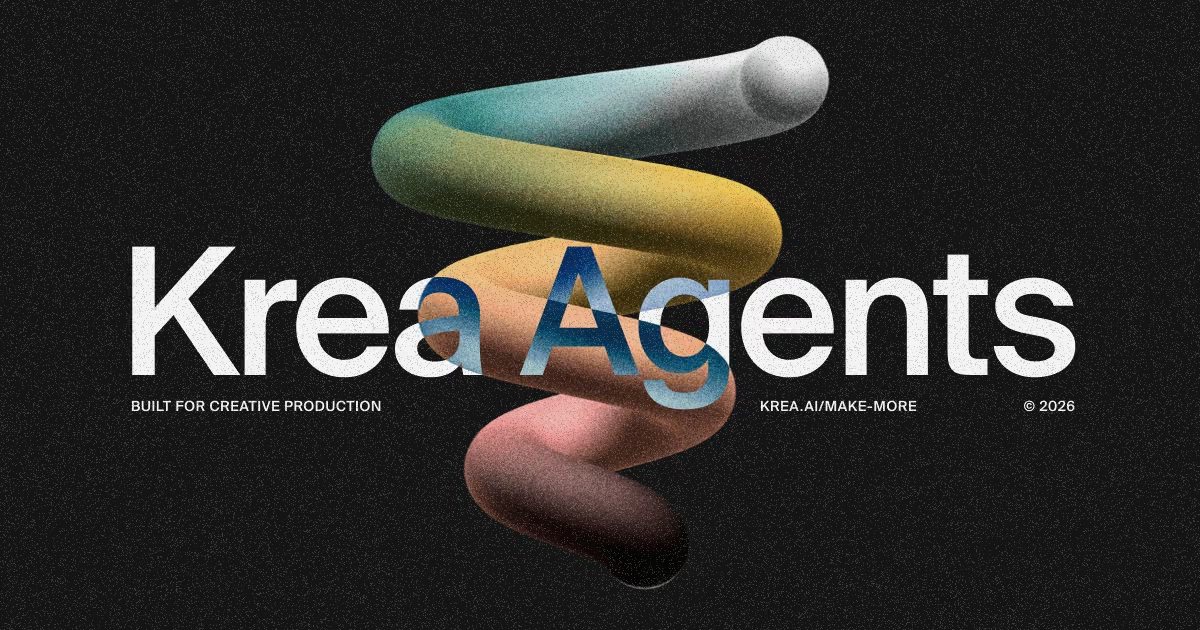
A first look at the Krea Agents beta: replacing node-graph wiring with a single creative prompt.
Executive Summary
- Beta opened 3 September 2026, roughly a week after Krea first revealed the concept alongside its Krea 3 foundation model on 28 August 2026.
- Replaces node-graph wiring with one prompt. The agent reads the existing canvas, plans a pipeline, picks models, shows the plan, and runs the job — building directly on Krea's earlier Node Agent feature.
- Orchestrates 60+ models, including Krea 2, Flux, Veo 3.1, Kling, Runway, Luma, Ideogram, Nano Banana Pro and Topaz, rather than locking users into Krea's own models alone.
- Stateful, not one-shot. Existing nodes, connections and outputs from earlier runs are factored into new plans, and intelligent recomputation only reruns downstream nodes affected by an edit, caching everything else.
- Hosted MCP server at
api.krea.ai/mcpconnects Claude, Cursor, Codex and other MCP clients directly to Krea's model catalogue and job pipeline. - Uses frontier LLMs, including Anthropic's models, for the planning and reasoning layer that decides which models to call and in what order.
- Invite-only beta. No published pricing tiers for Agents specifically, and no firm general-availability date; distributed via waitlist and social engagement.
- Sits on a large existing base: Krea reports more than 30 million users across 191 countries on its core platform.
From Node Agent to Krea Agents
Krea Agents did not appear from nowhere. Its core mechanic — type a description, have the system read the canvas, plan a pipeline, wire the nodes, and run the job — debuted first inside Krea's node-based canvas as a feature called Node Agent. That feature already showed a plan before touching anything and was stateful: whatever was already on the canvas, including existing nodes, connections and outputs from earlier runs, got factored into what it built next.
On 28 August 2026, Krea revealed the next step publicly: Krea 3, a new foundation model, and an agent-driven creative platform built around that Node Agent mechanic, aimed specifically at designers rather than at prompt-engineering hobbyists. Krea 3 itself is a 12-billion-parameter single-stream Diffusion Transformer built from the Krea 2 base, inheriting Krea 2's visual aesthetic while promoting editing to a first-class capability rather than a bolt-on afterthought — relighting a scene with up to four virtual lights, and colourising a grayscale image, are both cited as native editing features rather than separate tools. Krea 3 was not generally available at reveal, and remains so at the time of writing; Krea said showcase recordings were coming soon.
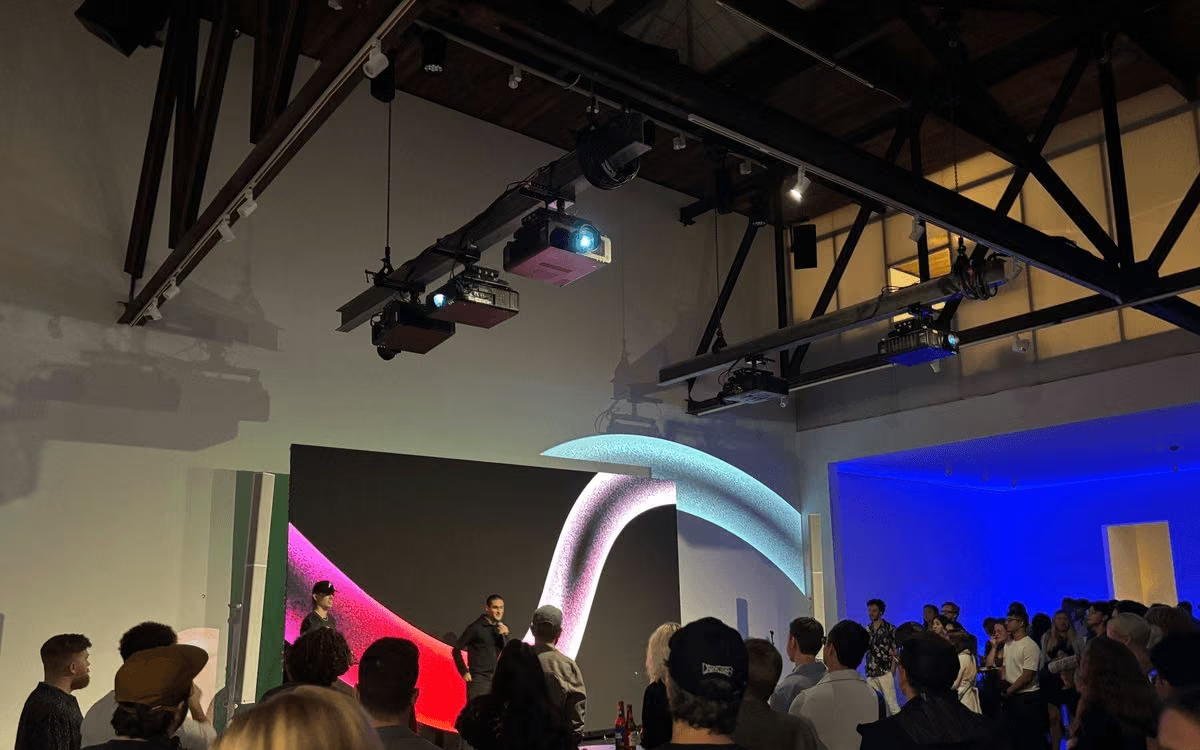
A week later, on 3 September 2026, Krea opened the actual beta: Krea Agents, distributed through an invite-only waitlist with free LLM calls and extra generations offered to invited users during the first week. That gap between reveal and beta — one week — is itself informative: Krea shipped the agent-native interface into real hands well before Krea 3, the new underlying model it was announced alongside, is generally available. The two releases are related but travelling on separate timelines, and Krea Agents today calls existing models like Krea 2 rather than waiting on Krea 3.
How Krea Agents Works
The pitch is simple to state and unusually hard to build well: describe what you want in plain English, and the agent reads the canvas, plans a multi-stage pipeline, picks the models, and runs the job — from a single prompt. Under the surface, that description implies several distinct capabilities working together rather than one clever prompt-to-image call.
First, the agent is canvas-aware: it inspects whatever already exists — prior nodes, their connections, and the outputs of earlier runs — before deciding what to build next, rather than starting from a blank slate every time. Second, it is a planner, not just an executor: before anything runs, it shows the proposed pipeline back to the user, the same "show the plan first" behaviour Node Agent introduced, so a multi-stage job doesn't silently burn credits on a misunderstood request. Third, it performs intelligent recomputation: editing one part of an existing pipeline only reruns the downstream nodes actually affected by that change, with everything else served from cache rather than regenerated from scratch.
That combination — read state, plan visibly, recompute selectively — is what separates an "agent&quos; wrapper from a simple one-shot generation button, and it is the same set of properties that make Krea Agents useful as infrastructure for other agents to call into, which is precisely what its MCP server exposes.
60+ Models Under One Roof
Krea's own announcement puts the orchestrated model count at more than 60, spanning image, video and upscaling. Named examples include Krea's own Krea 2, Black Forest Labs' Flux, Google's Veo 3.1, Kling, Runway, Luma, Ideogram, Nano Banana Pro and Topaz. The strategic point is not any single model in that list — it is that Krea Agents is explicitly positioned as an aggregation layer sitting above all of them, deciding per-stage which model is the right tool for the job, rather than a showcase for Krea's own models alone.
| Category | Named models in Krea's catalogue |
|---|---|
| In-house image | Krea 2 (Krea 3 announced, not yet GA) |
| Third-party image | Flux, Ideogram, Nano Banana Pro |
| Video | Veo 3.1, Kling, Runway, Luma |
| Enhancement | Topaz (upscaling/restoration) |
Compiled from Krea's own Krea Agents beta announcement and MCP documentation; the full catalogue exceeds 60 models and is not itemised in full by Krea.
This is the same model-agnostic logic that underpins the broader shift toward agentic creative tooling: rather than every studio racing to build one model that does everything well, the more durable layer turns out to be the orchestration and planning logic that picks the right specialist model for each step and hands off between them cleanly.
The MCP Server: Claude, Cursor, Codex
The feature most relevant to developers is Krea's hosted Model Context Protocol (MCP) server, reachable at https://api.krea.ai/mcp. Adding it to Claude Code is a single line:
claude mcp add --transport http krea https://api.krea.ai/mcpThe same endpoint connects over OAuth to Codex, OpenClaw and Cursor, alongside broader integrations named in Krea's own materials that extend to Slack, Figma and Google Drive. Once connected, an agent gains a defined set of capabilities against Krea's catalogue: model discovery (what's available), schema inspection (what inputs a given model expects and what it returns), job submission, asset upload, result polling, and error cancellation.
Krea also confirms that the planning layer itself runs on frontier LLMs, including Anthropic's models, for reasoning about what pipeline to build — meaning a Claude-based coding agent connecting over MCP is, in effect, one Claude session directing another Claude-backed planning layer to orchestrate 60-plus third-party creative models on its behalf. Krea's framing of its own strategic position is explicit: it wants to be the connective tissue between coding agents and creative tools, so that a Claude Code or Cursor session can produce a finished visual asset — a hero image, a product shot, a short video — without a developer ever leaving that session to open a separate creative app.
Why an Orchestration Layer, Not Another Model
Krea Agents arrives at a moment when the Model Context Protocol itself, the standard Krea's MCP server implements, has gone from a new idea to a near-default way for agents to reach external tools: coding agents from multiple vendors now expect to discover a service's capabilities, inspect its schemas, and call it, rather than requiring a bespoke integration per tool. Krea's decision to expose its entire model catalogue this way, rather than shipping only its own web app, is a bet that being reachable by every major coding agent is worth more long-term than owning the interface a user actually types into.
That bet mirrors a broader pattern already playing out across creative AI: individual model quality is converging and commoditising faster than most companies expected, while the layer that decides which model to call, in what order, and how to recover when one stage fails, remains genuinely hard to get right and much stickier once a workflow depends on it. A team that wires its landing-page generation, its product-shot pipeline, or its marketing video workflow through Krea's planner is making a bet on Krea's orchestration logic, not on any single one of the 60-plus models underneath it — which is precisely why Krea is racing to be the aggregation layer before some other company builds an equivalent one.
Real-World Use Cases
The clearest use case Krea itself describes is a designer replacing a node graph with a sentence: rather than manually chaining a base-generation node into an upscaler into a relighting pass into a video model, a single prompt like "turn this product shot into a 6-second video with warmer lighting" is planned as a pipeline, shown back for approval, and executed. Because the agent is stateful, iterating on that result — "make the lighting cooler instead" — only reruns the relighting stage, not the whole chain.
The MCP path opens a distinct second use case aimed squarely at developers: a coding agent building, say, a marketing landing page or an app onboarding flow can call out to Krea mid-session to generate the actual hero image, product render or explainer clip the page needs, upload reference assets, poll until the job completes, and drop the finished file straight into the codebase — all without a human ever switching to a separate creative tool. That is the scenario Krea's own positioning statement is describing when it calls itself connective tissue between coding agents and creative tools.
A third, more iterative use case follows directly from the stateful, canvas-aware design: an agency running dozens of variants of the same ad creative for different markets can describe the base concept once, let the planner build the first pipeline, then request per-market tweaks (a different language on-screen, a warmer colour grade, a locally relevant background) as follow-up prompts against the same canvas, with intelligent recomputation reusing every stage that didn't change instead of re-running the entire pipeline per variant.
Beta Access & Pricing
Krea Agents is, as of publication, an invite-only beta. Access is distributed through Krea's waitlist and through social engagement on its launch announcement rather than open signup. During the beta's first week, Krea offered invited users free LLM calls and extra generations inside Agents specifically, on top of whatever plan they already held on the core platform.
Krea has not published Agents-specific pricing tiers, benchmark comparisons, or a firm general-availability timeline, according to AlphaSignal's launch-week coverage. That leaves genuine open questions: whether Agents will be a flat add-on to existing Krea subscriptions, a separate credit-metered product given it can invoke 60-plus third-party models with their own underlying costs, or bundled differently for individual creators versus teams. For scale context, Krea's core platform, which Agents sits on top of, reports more than 30 million users across 191 countries.
Limitations
- Invite-only, no public pricing. There is no self-serve way in yet, and no published cost structure for Agents specifically — an important unknown given the beta can fan a single prompt out across dozens of paid third-party models.
- Krea 3 is not part of the beta yet. The model announced alongside Krea Agents is still pre-release; the beta today runs on Krea 2 and the third-party catalogue, not the newer architecture.
- No independent benchmarks exist. Because this is a planning and orchestration layer rather than a single model, there is no equivalent of a benchmark suite to independently verify plan quality, and Krea has not published one itself.
- Model-picking is opaque. Krea's own materials do not fully specify the criteria the planner uses to choose between, say, Runway and Kling for a given video stage, which matters for anyone trying to predict or control cost and output style precisely.
- New surface, new failure modes. An agent that plans multi-stage pipelines across 60-plus external models introduces more places a plan can go wrong than a single generation call — a stage failing partway through a longer chain is a different debugging problem than a single bad image.
How It Compares
Against OpenAI's Agents API, which puts a coding-and-tool-use agent harness behind one API call for developers building their own agent products, Krea Agents is narrower and more specialised: it is specifically a creative-production planner sitting in front of image and video models, not a general-purpose agent framework. The two are complementary rather than competing — an agent built on OpenAI's or Anthropic's tooling is exactly the kind of client Krea's MCP server is designed to be called from.
Against single-model video generators covered on this site, such as ByteDance's Seedance 2.0, the comparison is again more about layer than head-to-head quality: Seedance is one model competing on output quality, while Krea Agents is a layer that can call Seedance-class models (and many others) as one option among 60-plus, chosen automatically per stage rather than selected by the user up front.
Against agent-extension approaches like Google Antigravity's Skills, which extend a coding agent's own capabilities directly, Krea's approach is to be the thing being extended into — a hosted external service an agent reaches out to via MCP, rather than a skill packaged inside the agent itself.
Who Should Use It
Worth requesting beta access now if you are a designer or creative team already using Krea's node canvas and want to skip manual pipeline wiring for common multi-stage jobs, or a developer building agent products who wants a single MCP endpoint that can generate finished images and video without standing up your own multi-model orchestration layer.
Worth waiting on if predictable, published pricing matters to your workflow today, if you specifically need Krea 3's new relighting and colourisation features (not yet available), or if you need a verified, benchmarked comparison of plan quality before committing production work to it — none of that exists publicly yet.
The Bottom Line
Krea Agents is a clear bet that the next layer of value in creative AI tooling is not another single model, but the planning and orchestration logic that sits above dozens of them — reading canvas state, proposing a visible plan, picking the right specialist model per stage, and recomputing only what actually changed. Exposing that same logic over a hosted MCP server, reachable from Claude, Cursor and Codex with one line of configuration, is the more consequential move: it turns Krea from a destination app into infrastructure other agents can call into mid-task.
The obvious caveats are the ones that come with any invite-only beta sitting in front of a not-yet-public pricing model: nobody outside Krea's beta cohort can yet verify plan quality, cost predictability, or how gracefully a long multi-stage pipeline fails when one of 60-plus third-party models has a bad day. Krea 3, the foundation model announced alongside all of this, is not even in the beta yet. Worth watching closely; not yet a settled verdict.
Last updated: 13 September 2026, ten days after the Krea Agents beta opened. This article will be revised as Krea publishes pricing, opens general availability, or ships Krea 3.
Get the free guide: Claude vs ChatGPT, Gemini & Grok
A 20-page playbook covering everything you need to choose and use the big four AI models in 2026, full cost and feature comparisons, what each is best (and worst) at, and how-tos for images, vectors, building a website, Claude Code and more.