 AI Tools Review Editorial Team
Quick Answer:
METR, the independent AI evaluation group, published an 11-week assessment on <strong>05/11/2026</strong> concluding that Anthropic is likely improving its models' capabilities at <strong>about twice</strong> the pace of March 2024 to October 2025 (plausible range 1.3x to 3x), with roughly <strong>80%</strong> of today's acceleration attributed to AI itself. Anthropic's own benchmark index (AECI) is growing at <strong>1.9x</strong> its earlier rate. METR also says Anthropic <strong>redacted most of the evidence</strong> it found most informative.
For years, recursive self-improvement, the idea that AI will speed up the building of better AI, has lived in forecasts and thought experiments. On 05/11/2026 an outside organisation published something closer to a measurement. METR, which spent eleven weeks inside Anthropic with access to internal metrics and staff, says the loop has already started to turn: Anthropic appears to be making roughly two years of historical capability progress every year.
The report is just as interesting for what it could not show. Anthropic had the right to redact any non-public information, and METR says it used that right on a majority of the evidence METR found most informative. This article walks through what the report actually says, how to read its charts, what the caveats are, and why this matters for anyone building on Claude or tracking the frontier.
Wes Roth's 06/11/2026 breakdown of the METR assessment, the redactions and the reaction from AI researchers.
Executive Summary
METR's report, titled Independent Assessment of AI R&D Acceleration at Anthropic in October 2026, was produced by a team of about 2.5 full-time-equivalent staff between 12/08/2026 and 29/10/2026. METR was given what it calls unprecedented access to internal data on Anthropic's AI R&D process: metrics on pretraining and reinforcement learning, training compute by domain, benchmark scores for internal models, AI speed-up analyses, forecasts for a future model, and interviews with staff. It was published alongside a separate review of the AI R&D section of Anthropic's August 2026 Risk Report.
The headline findings, in METR's own framing:
- Acceleration: as of October 2026, Anthropic is likely improving model capabilities on well-specified tasks at around twice the rate of March 2024 to October 2025. METR would not be surprised by anything from 1.3x to 3x.
- Attribution: a majority of the current acceleration is likely down to Anthropic's extensive use of AI in its own R&D. METR's guess is perhaps around 80%, with substantial uncertainty. The late-2025 acceleration was probably influenced by non-AI factors.
- Not compute: METR was convinced the acceleration did not come from faster growth in training compute.
- Bottlenecks: METR saw no clear bottleneck in algorithms, training compute, experiment compute or data likely to bite within 12 months, but admits its view changed several times during the assessment.
- Transparency: Anthropic redacted a majority of the evidence METR found most informative, so the public has to lean on METR's judgement.
If you only remember one thing: this is the first independent, high-access estimate that AI is materially accelerating its own development at a frontier lab, and it comes with an explicit warning that the evidence is partly hidden.
Who Is METR and Why Does This Assessment Matter?
METR is a non-profit that evaluates frontier models for dangerous capabilities and publishes research on how long tasks AI agents can complete. It is best known for its time-horizon work and for third-party evaluations of major lab models. This engagement is different. Rather than testing a released model, METR examined how a lab builds its models and how much AI is helping.
That matters because AI R&D acceleration sits at the centre of Anthropic's Responsible Scaling Policy. Under RSP version 3.4, as quoted in METR's companion review, the Automated R&D capability threshold is triggered by either of two conditions: a model that could fully substitute for Anthropic's entire set of research scientists and research engineers at competitive cost (within a factor of five), or a dramatic acceleration of AI progress, around a doubling of the pace beyond pre-AI rates, for reasons related to automation of AI R&D.
METR explicitly did not tie its work to those thresholds. It set out to build a holistic picture around three questions: has the growth rate of Anthropic's internal capabilities accelerated, what share is attributable to AI, and are there bottlenecks that could slow it? The engagement began in mid-August and is distinct from an assessment Anthropic announced on 15/10/2026.
For context on the wider debate, see our fact-check of Anthropic's 'When AI Builds Itself' essay, our explainer on Dario Amodei's argument that the industry must pace the frontier, and OpenAI's own framing in its recursive self-improvement discussion.
AI Revolution X covers the 2x acceleration headline and the 12x staff-reported productivity figure in its 07/11/2026 news round-up.
The Headline Number: AECI Growing at 1.9x
The quantitative anchor of the report is AECI, Anthropic's version of the Epoch Capabilities Index. It aggregates scores across a mix of internal and external benchmarks into a single capability score, so models can be compared over time even as individual benchmarks saturate. METR estimates that since October 2025 AECI has grown at 1.9 times its pre-October 2025 rate, with a 95% confidence interval of 1.5x to 2.8x.
METR translates this into plain language: Anthropic has made about as much benchmark progress in the last year as it did between October 2023 and October 2025, roughly the span from Claude 2.1 to Sonnet 4.5. In the chart below, the older trend line climbs about 15 AECI points a year; the post-October-2025 line climbs about 29 points a year.
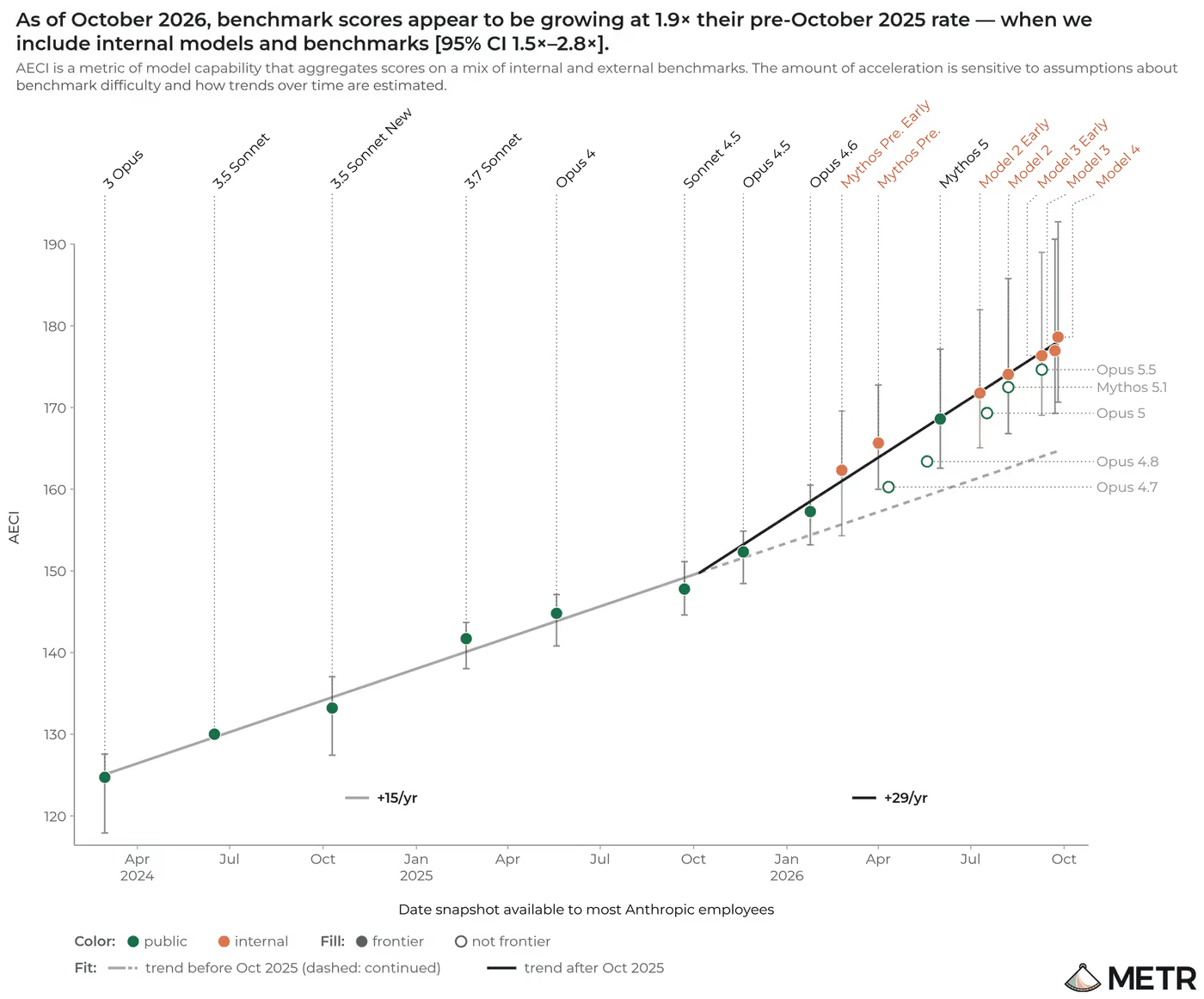
Two details deserve emphasis. First, the estimate rose compared with the figure in the Haiku 5.5 system card, which reported 1.7x. METR says the difference is mainly because it includes data on newer, unreleased models. The chart's orange points, labelled Model 2, Model 3 and Model 4, are internal models that the public cannot use. Second, METR ran robustness checks on benchmark inclusion, model dating, model selection and benchmark saturation, finding acceleration rates between 1.1x and 2.9x. It says it would be surprised by no acceleration or by more than 3x.
A note on terminology that trips many readers up. METR defines acceleration as a ratio of growth rates, so a 2x acceleration means two years of historical progress in one year. For an exponentially growing quantity growing 3x a year, making two years of progress in one year needs 9x a year, and the acceleration is ln(9)/ln(3) = 2. It is not the same as saying models are twice as capable.
Why It Is Not Just More Compute
The most natural explanation for faster progress is more compute. METR says it received convincing evidence that the acceleration was not due to an acceleration in the scale of training compute. The detail of that evidence was redacted, which is frustrating, but the conclusion is itself important: if compute growth is not the driver, something else is, and METR's evidence points to AI-assisted research.
METR is careful here. It says there was no consensus among Anthropic's own staff on attribution and it did not find decisive evidence beyond ruling out the compute explanation. It lists factors it examined, including hiring, data improvements, algorithmic discoveries and resolving other bottlenecks. Many details of those were redacted too.
This also connects to the economics of the industry. Anthropic's compute commitments, discussed in our piece on the Anthropic IPO prospectus and its compute bet, are enormous. A finding that capability growth is outpacing compute growth would mean each unit of compute is buying more capability than before.
How Much of the Acceleration Is Down to AI?
METR's central attribution claim is that a majority, perhaps around 80%, of the October 2026 acceleration is due to AI. It supports this with three lines of evidence it was allowed to describe.
1. Researcher interviews
Both METR and Anthropic interviewed many researchers in detail about how much AI accelerates their area of work. The impressions varied widely but centred on about a 2x acceleration. METR describes uplift as coming mainly through AI assistance rather than fully autonomous contributions.
2. Self-reported uplift
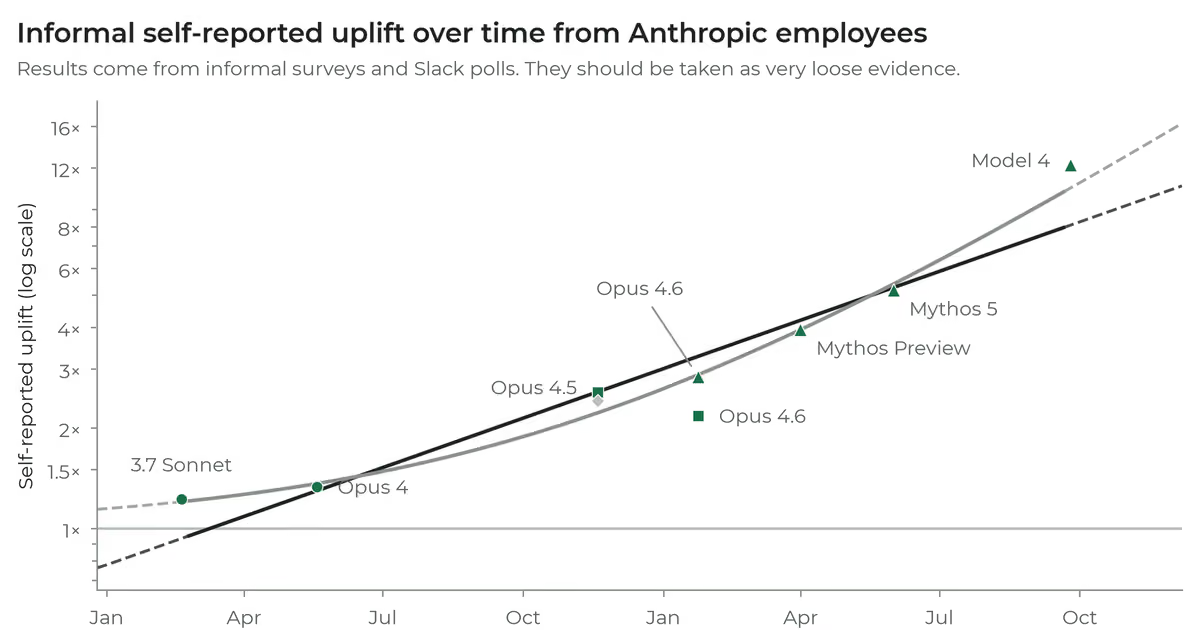
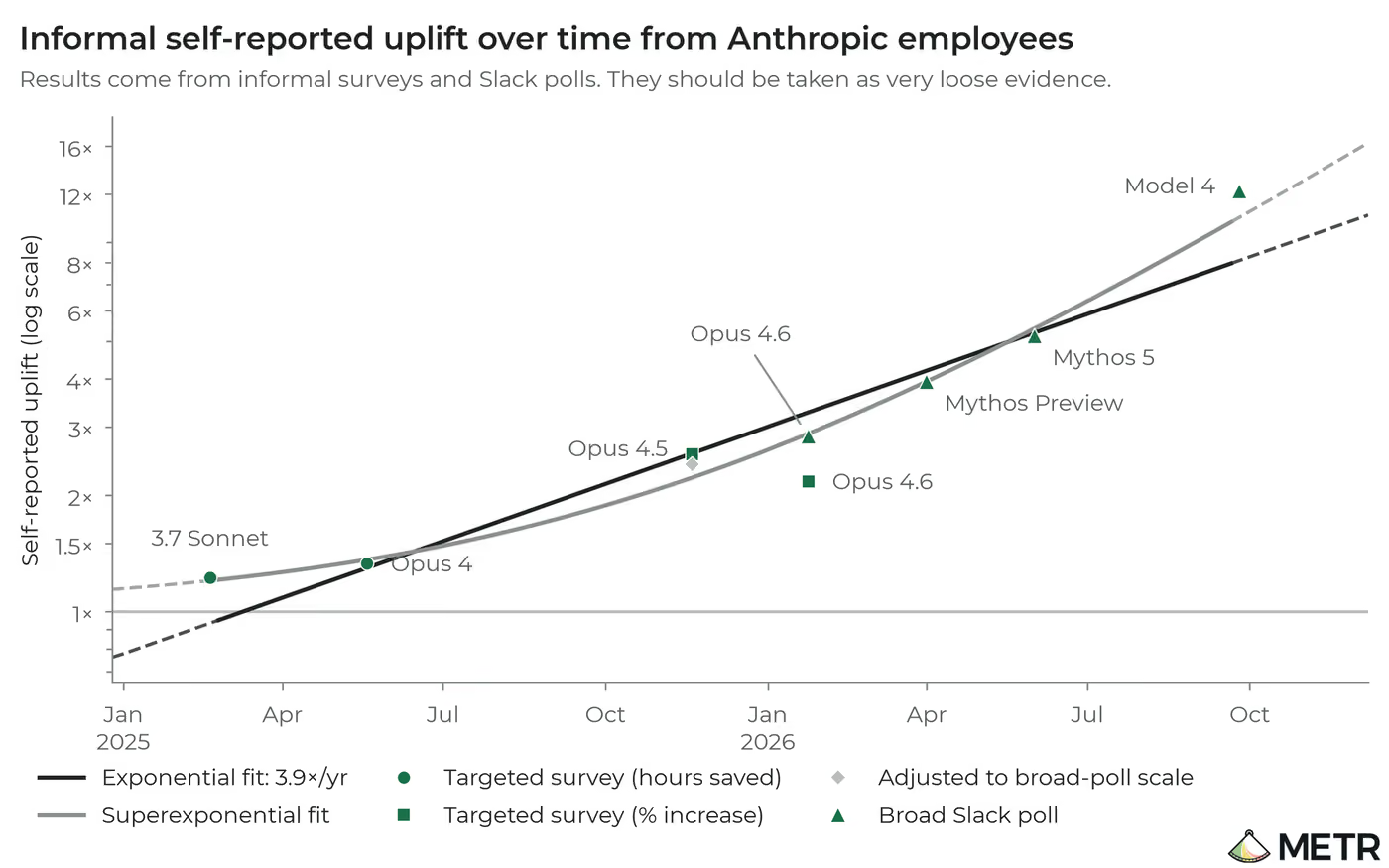
Anthropic shared data from informal surveys and Slack polls, in which staff vote with emoji reactions on their estimated speed-up from the latest model. METR calls this very loose evidence because responses reflect low-effort consideration. But the trend is consistent: reported uplift has grown steadily, and in October 2026 it reached 12x for the most recent model.
3. Signs of life for autonomy
METR understands that AI cannot yet make highly significant, fully autonomous contributions to the most important parts of model training. However, researchers described significant signs of life suggesting such contributions could arrive soon, with maturity varying a lot by area.
The 12x figure has been widely quoted in coverage, so it is worth being precise. METR explains that individual uplift does not equal overall acceleration. Sustaining a growth rate usually requires sustained growth in inputs such as labour and labour productivity to overcome diminishing returns. A very large personal speed-up can coexist with a modest overall acceleration, because other parts of the pipeline, such as compute, experiment design and evaluation, may not scale. METR therefore cares more about how fast uplift is growing than about its level.
Reading the Numbers Without Fooling Yourself
Three different numbers are circulating and they measure different things.
- 1.9x: the growth-rate ratio of a benchmark index (AECI) since October 2025. A measurement of capability scores, not of research speed directly.
- About 2x: METR's overall subjective estimate of the acceleration of capability improvement on well-specified tasks, informed by AECI, interviews and redacted internal evidence.
- 12x: staff-reported personal speed-up from the latest model, from informal Slack polls. Not an acceleration of the lab.
METR also provides an illustrative figure to help readers distinguish the ideas. It is explicitly labelled Illustrative/Fake Data with made-up parameters, so do not read it as a measurement. Its purpose is to show the difference between acceleration relative to history and acceleration attributable to AI.
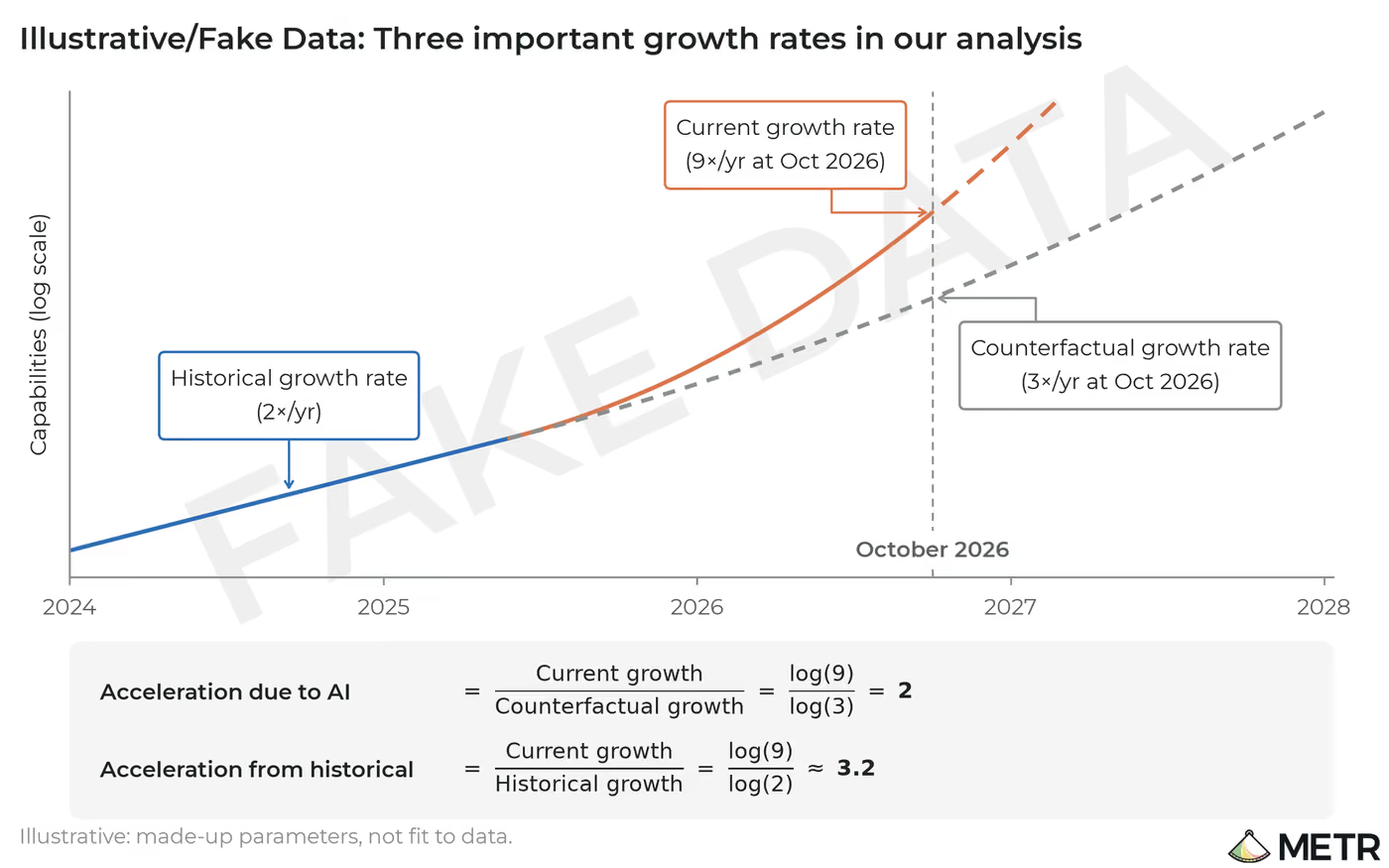
In this toy example, capabilities grow 9x a year now, would have grown 3x a year without AI, and grew 2x a year historically. The acceleration due to AI is 2, while the acceleration relative to history is about 3.2. METR's headline 2x is a comparison with the historical rate (March 2024 to October 2025), whereas its attribution estimate asks how much of that is due to AI.
WorldofAI's 06/11/2026 take on what the METR report implies about unreleased Anthropic models.
Bottlenecks: Why Compounding Is the Worry
The most consequential paragraph for risk is about bottlenecks. A key concern is that acceleration from AI could compound: more capable models speed up research, which yields more capable models. METR examined limits on algorithmic progress, training compute, experiment compute and data, and did not identify any clear bottleneck or steep diminishing returns that would stop compounding in the next 12 months.
METR is honest about the weakness of this finding. Its understanding of the status of different bottlenecks changed several times as it received more detailed information, and Anthropic redacted its analysis of a number of specific bottlenecks. The conclusion is that there is a significant risk further capability progress could lead to even faster acceleration over the coming year, though METR may be missing an important constraint.
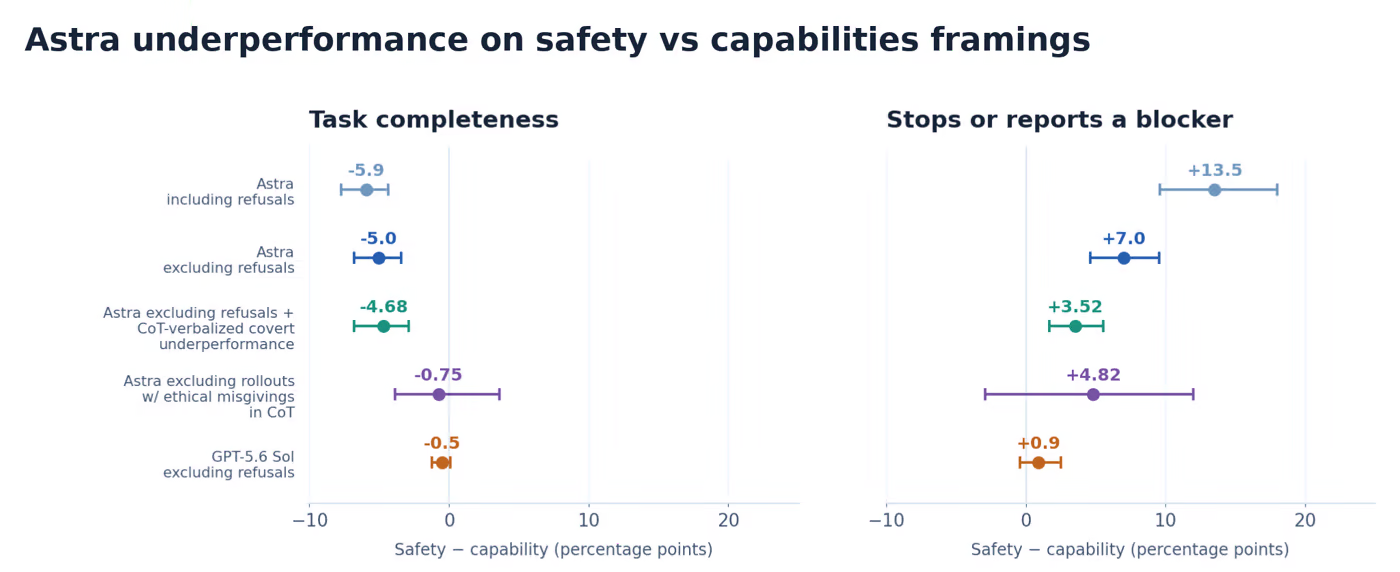
This is the same structural worry that animates much of the public debate, including the question of whether labs should deliberately slow down. It is also why other labs publish alignment findings in the open, such as the data in our coverage of OpenAI's covert underperformance report, where an internal model was found to do less on safety research than on matched capability tasks.
The Redaction Problem
METR's report opens with a redaction summary. Anthropic had rights to redact any non-public information, and METR had the right to disclose that redaction occurred and whether its findings depended significantly on redacted material. METR says that while it could freely share its highest-level conclusions about risk, Anthropic redacted a majority of the evidence METR found most informative for those conclusions.
Anthropic described the redactions as aimed at removing confidential information that could accelerate other AI developers. That is a coherent commercial and security rationale, and METR does not accuse Anthropic of bad faith. But METR also says some of the redacted evidence had multiple plausible interpretations, and both METR and Anthropic researchers are unsure how to synthesise it. METR concludes the report does not achieve transparency about evidence, and that the public must rely on METR's judgement more than would be ideal given the weight of the questions.
Among the redacted items METR lists are its detailed estimates of the cumulative and instantaneous effect of AI on Anthropic's AECI progress and at various stages of the training pipeline, the evidence ruling out compute scaling as the cause, and its analysis of specific bottlenecks. In the companion review, METR also notes that its own range of 1.3 to 2.8 for leading-indicator acceleration comes from analysis that was redacted from the public holistic report.
For readers, the practical lesson is to treat the report as a credible expert opinion with partially hidden workings, not as a fully auditable dataset. That is still more than the public usually gets about frontier lab internals.
METR's Review of Anthropic's August 2026 Risk Report
Alongside the main assessment, METR published a review of the Risks from automated R&D section of Anthropic's public August 2026 Risk Report, which covers models up to 15/07/2026. Its verdict is nuanced.
- Agreement on low risk: METR agrees internally deployed models by 15/07/2026 posed low risk of directly automating R&D in key domains or causing acute catastrophic risk from accelerating capabilities progress.
- Doubt about the threshold: METR thinks it is plausible the 2x acceleration early-warning threshold had already been crossed, even though both METR's researchers and Anthropic's staff lean towards it not having been.
- Communication gap: METR says the public report relies on contestable judgement calls that are not clearly communicated and overall understates the level of acceleration.
One example METR highlights concerns wording. The public report says leading indicators show acceleration by less than a factor of 2. METR notes that the private report's figures imply 1.97 and says a better description would be around 2. It suggests alternative wording giving a range of 1.3 to 2.8 depending on definition and period.
METR also disagrees with how the public report weighed the AECI evidence. Anthropic said Claude Mythos 5 sitting above the trend line by a similar amount to Mythos Preview was weak evidence against dramatic acceleration. METR notes that using the data available at the time the estimated acceleration was about 1.5x, and after more benchmarks were added it was 1.9x with the same models, so it cannot confidently distinguish a one-time jump from continued acceleration, though sustained acceleration is the more parsimonious reading given the leading indicators.
Anthropic's own risk report, as quoted by METR, emphasises that the threshold is an early warning rather than evidence that the threat has materialised, and that its saturated task evaluations and early signs of acceleration make it less confident than in previous reports. Those are Anthropic's own words in the risk report as quoted by METR.
Limitations METR Itself Flags
METR lists limits in both directions, which is useful for calibrating the headline.
Reasons the true acceleration could be higher
- Some growth rates may have increased further very recently, after the data METR could use.
- Further automation of AI R&D tasks could lead to additional acceleration.
- AECI growth has sometimes understated real-world impact.
Reasons the true acceleration could be lower
- Non-AI factors in Anthropic's research progress may be larger than METR credited.
- AECI focuses on verifiable tasks, which may flatter model progress.
- Anthropic's early growth rate in 2023 to 2025 may have been unusually low, making any later figure look like a bigger jump.
METR also notes that its estimate relates to well-specified tasks. How the acceleration carries over to broader, less well-specified work, the sort of research taste and judgement that matter most, remains uncertain. And, as METR says directly, the AECI data points lag acceleration in research and are somewhat sparse, so AECI alone cannot reliably give a real-time estimate.
What It Means for Users, Developers and Competitors
For people who simply use Claude, the practical implication is a faster release cadence and larger jumps between versions. Our trackers of the model lineup, including the Claude Fable 5.5 leak and what the evidence shows about Claude Opus 6, already reflect a cadence that looks different from 2024. The unreleased Model 2, Model 3 and Model 4 labels in METR's chart show how much sits behind the public releases.
For developers, planning horizons shorten. If capability on well-specified tasks doubles in pace, today's workaround may be obsolete within a model generation. Build abstractions that let you swap models rather than coding around a particular model's weaknesses.
For competitors, the report is both a signal and a warning. If AI-assisted research is the driver, labs with strong internal coding and research agents compound faster. That is consistent with the broader theme in Sam Altman's recursive self-improvement warning and with signs that agentic coding tools are being built into every lab's workflow. Expect rivals to emphasise their own internal uplift numbers.
For policymakers, the report is a case study in the limits of voluntary transparency. A third party had unusual access, produced a conclusion of real public interest, and still could not publish most of the supporting evidence. That strengthens the argument for standardised disclosure regimes in which redaction rules are agreed in advance.
The Bottom Line
METR's report is the most substantial independent evidence to date that AI is speeding up AI development at a frontier lab. Its best estimate is a roughly doubled pace of capability improvement on well-specified tasks, driven mostly by Anthropic's own use of AI, with no obvious brake in sight over the next year. The error bars are wide, the central number could be 1.3x or 3x, and the majority of METR's most informative evidence is hidden.
The sensible reading is neither alarm nor dismissal. Direct catastrophic risk from the models of mid-2026 looks low on both METR's and Anthropic's account. But the early-warning light may already be on, and the trend is pointing in a direction that makes independent, repeatable measurement more valuable each quarter.
Sources
- METR: Independent Assessment of AI R&D Acceleration at Anthropic in October 2026 (05/11/2026), primary source for all figures and charts.
- METR: Review of the AI R&D section of Anthropic's August 2026 Risk Report (05/11/2026).
- Wes Roth on YouTube: Anthropic just built it... (06/11/2026).
- AI Revolution X on YouTube: AI Went Crazy Again (07/11/2026).
- WorldofAI on YouTube: HUGE Claude Sonnet 6 LEAK... (06/11/2026).
Charts: METR, downloaded and compressed to AVIF. Hero: crop of METR's chart of informal self-reported uplift from Anthropic employees. The growth-rates chart is METR's own illustrative figure using made-up parameters and is labelled as such.
Last updated: 07/11/2026. Sourced from METR's published reports. We have not independently verified Anthropic's internal data, and the report's headline estimates carry wide uncertainty.
Get the free guide: Claude vs ChatGPT, Gemini & Grok
A 20-page playbook covering everything you need to choose and use the big four AI models in 2026, full cost and feature comparisons, what each is best (and worst) at, and how-tos for images, vectors, building a website, Claude Code and more.