
 AI Tools Review Editorial Team
Quick answer:
Anthropic's essay “When AI builds itself” says Claude wrote over 80% of merged code by May 2026, that AI task length is doubling about every four months, and that recursive self-improvement is not yet here but could come sooner than expected. It asks for the option to pause frontier AI, with verification.
Anthropic has published the numbers behind a claim many people only suspected: AI is now doing a large share of the work of building AI. The essay is data-rich, hedged and unusually candid about its own weak points.
This article checks each figure against the essay and its charts, and separates what Anthropic says from what commentators have added.
Executive Summary
WorldofAI covers the reported IPO-filing language on recursive self-improvement alongside a mystery Claude Fable 5.5 checkpoint.
“When AI builds itself” is an essay from Anthropic, written by Marina Favaro and Jack Clark with editorial support from Santi Ruiz, that makes one central claim: Anthropic is handing a growing share of AI development to AI systems, and that is speeding up its own work. Taken far enough, the trend could produce recursive self-improvement (RSI), where an AI system designs and builds its own successor. The authors say that point has not been reached and is not inevitable, but that it could arrive sooner than institutions expect.
The essay matters for two reasons. First, it publishes unusually concrete internal numbers: the share of code written by Claude, how much more code each engineer ships, and how often Claude beats a human researcher at choosing the next step. Second, it ends with a policy proposal that few frontier labs have made: that the world should have the option to slow or temporarily pause frontier development, with verification so that others can confirm a pause is real. Social-media and YouTube coverage has linked the essay to Anthropic's IPO filing, which is why it is trending, but the essay itself is a research and policy document and should be read as such.
This article walks through the evidence, checks which figures are strong and which carry caveats the authors themselves flag, lays out the three scenarios, and compares the pause proposal with what other labs have said. Every figure below is taken from Anthropic's essay and its charts, which we downloaded and credit. Where reporting around the essay goes beyond it, we say so.
What the Essay Actually Says
The thesis is carefully hedged. Anthropic describes RSI as a system that could fully autonomously design and develop its own successor, and states plainly that it is not there yet. The evidence it offers is that AI is already accelerating AI development inside the company, and that each step of delegation makes the next one easier.
Two phrases carry the argument. The first is that RSI is “not inevitable”: trends can stall, and the essay names bottlenecks such as a missing conceptual breakthrough, supply chains for energy, chips and interconnects, or an external shock. The second is that it “could come sooner than most institutions are prepared for”, which is the justification for acting before the evidence is conclusive. That framing matches the company's earlier public positions, which we analysed in our deep analysis of Anthropic's global pause call and in Dario Amodei's ‘We Must Pace the Frontier’.
The Evidence: How Fast Is AI Accelerating AI?
The authors split their evidence into external benchmarks and internal Anthropic data. The distinction matters, because the external numbers can be checked by others and the internal ones cannot.
External benchmarks
- Task length: METR's measure of the length of task an AI can complete reliably is now doubling about every four months, down from roughly every seven.
- Model progression: Claude Opus 3 (March 2024) handled tasks that take humans about four minutes; Claude Sonnet 3.7 about an hour and a half; Claude Opus 4.6 around 12 hours.
- Mythos Preview: METR found Claude Mythos Preview could work for at least 16 hours. We cover that model in our Anthropic Mythos guide.
- Saturated benchmarks: SWE-bench went from low single digits to saturation in two years, and CORE-Bench went from roughly 20% success in 2024 to saturation about fifteen months later.
The benchmark point is simple but important: the yardsticks used to track coding ability are running out of headroom, so the more informative evidence is now task length and real-world use rather than leaderboard scores.
Internal Anthropic data
The internal figures are the most striking, and the ones to read with most care.
- Code authorship: Claude wrote more than 80% of the code merged into Anthropic's codebase as of May 2026.
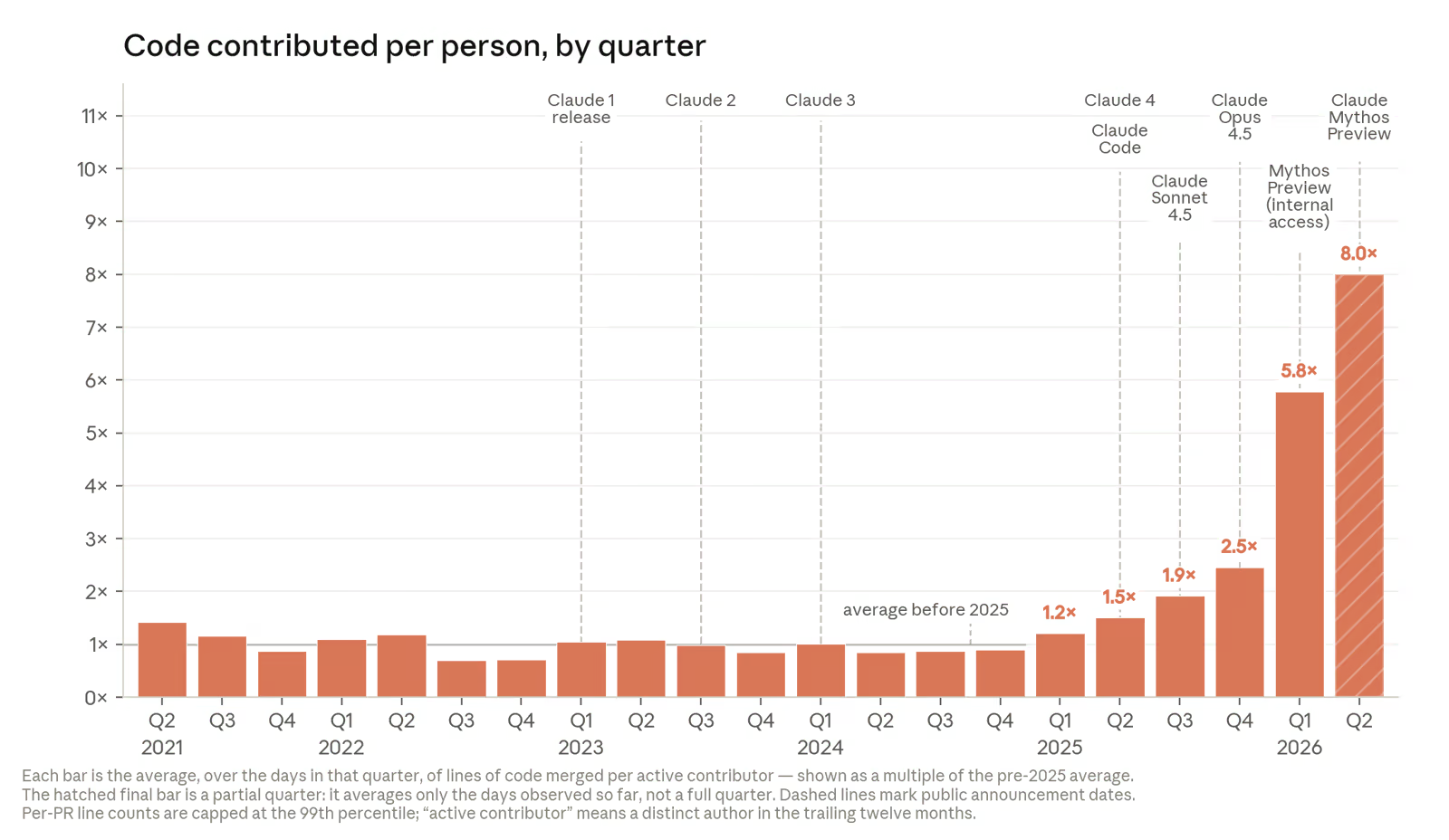
- Output per engineer: code merged per engineer per day was flat from 2021 to 2024, rose in 2025 and steepened in 2026. In Q2 2026 engineers merged 8x the code per day compared with 2024. The authors themselves call this overstated, because lines of code measure quantity rather than quality.
- Self-reported uplift: in a March 2026 survey of 130 employees, the median estimate was about 4x output with Mythos Preview. The authors expect the true figure to be somewhat lower.
- A concrete example: in April 2026 Claude shipped over 800 fixes that cut a class of API errors by a factor of 1,000. An engineer estimated a human would need four years.
- Code quality: Claude-written code was somewhat worse than human code in late 2025, is roughly at parity now, and is expected to be better within the year.
- Optimisation tasks: Claude Opus 4 averaged about a 3x speed-up (May 2025); Claude Mythos Preview reached about 52x (April 2026). A skilled human needs four to eight hours to reach 4x.
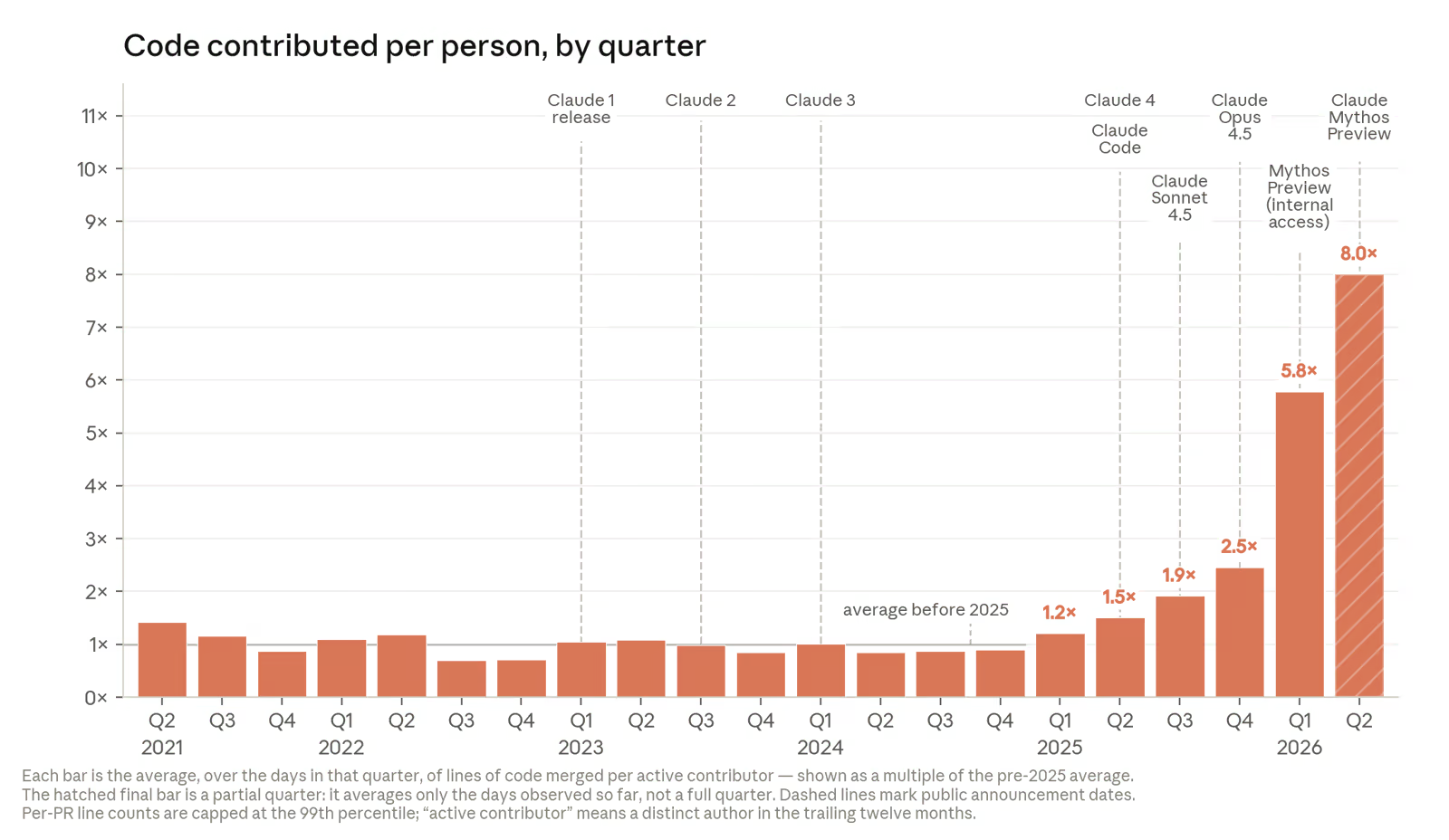
Note the chart's own caveats: each bar is lines of code merged per active contributor, per-PR line counts are capped at the 99th percentile, and the final bar covers only the days observed so far. The 8.0x figure is therefore a measure of volume, not of value. That is exactly the point the authors make in the text, and it is why we treat the 80% authorship figure as more meaningful than the 8x one.
Success Rates Are Rising Fastest on Hard Problems
A second chart tracks internal Claude Code sessions, classified by an LLM into four difficulty levels and judged for success. The pattern is the interesting part: trivial tasks were already succeeding about 80% of the time in late 2025 and barely moved, while open-ended problems rose from roughly 10 to 25% in autumn 2025 to around 76% by May 2026, an increase of about 50 percentage points in six months, according to the essay.
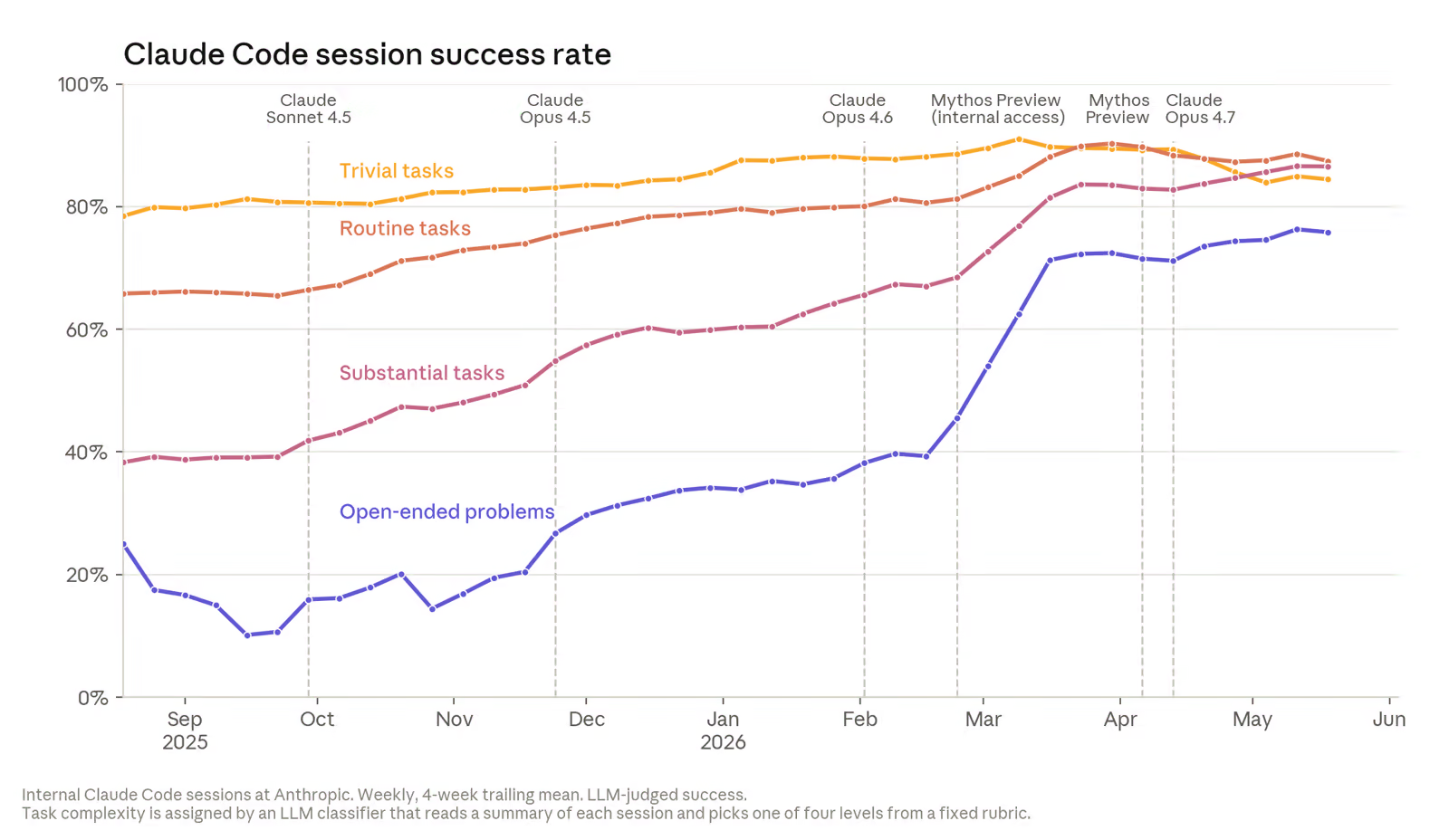
Two cautions apply. Success is judged by an LLM, and task complexity is assigned by an LLM classifier reading a summary of each session, so both sides of the measurement are model-mediated. And the chart only covers sessions inside one company with its own tooling. Neither weakness cancels the trend, but both mean the exact percentages should not be treated as an industry benchmark.
The 18/09/2026 Update
The essay carries an update dated 18/09/2026. It reports that success on open-ended problems rose from about 26% in August 2025 to 91% in September 2026, and that success rates across all four task types have converged at around 88 to 92%. The updated chart also adds later releases to the timeline, including Claude Opus 4.8, Claude Sonnet 5, Claude Opus 5 and the Claude Fable and Mythos 5.1 generation.
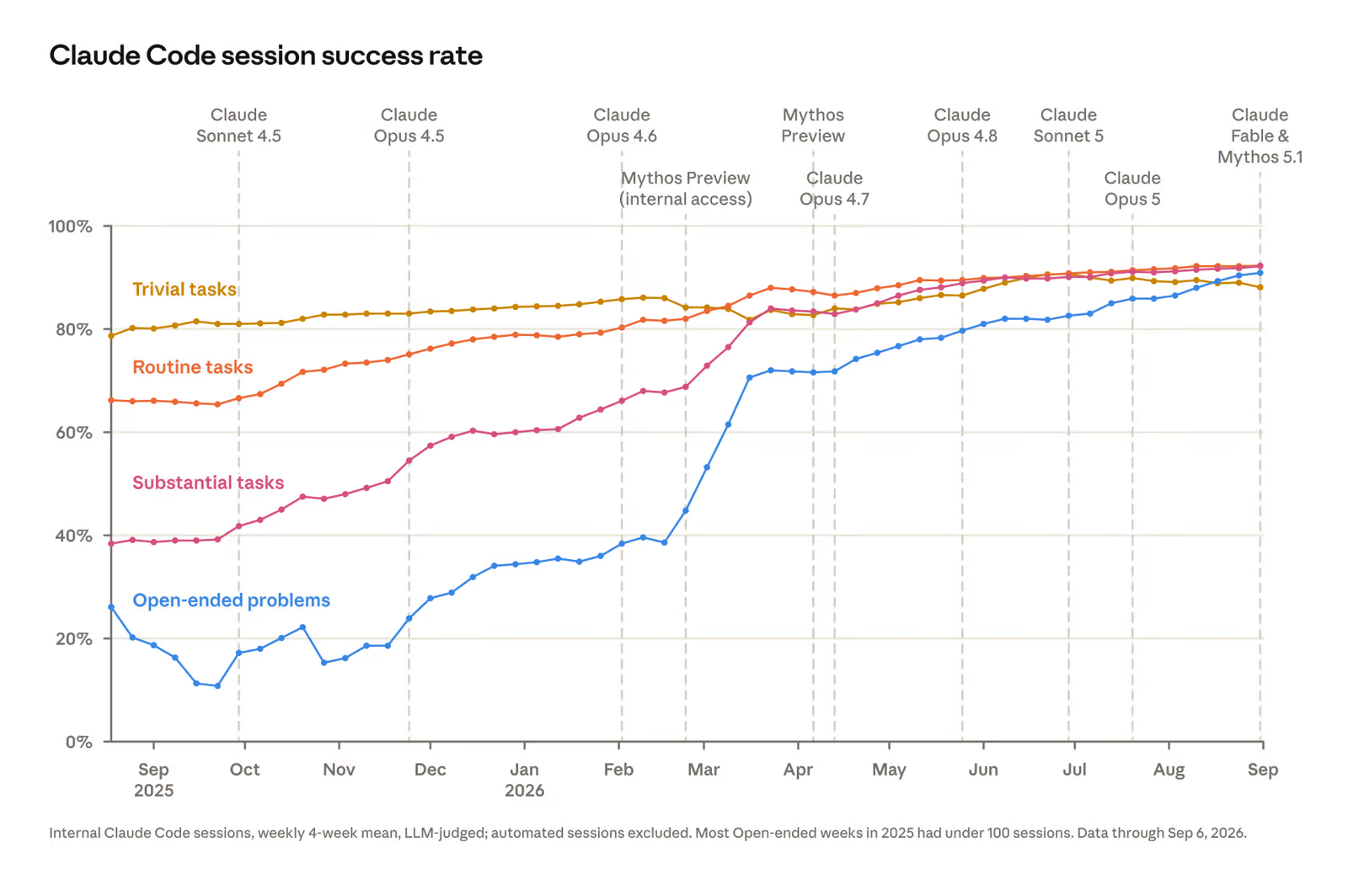
The convergence is the headline: the gap between “trivial” and “open-ended” has closed inside Anthropic's own workflow. The chart note also warns that most open-ended weeks in 2025 had fewer than 100 sessions, so the early part of that line is noisy.
Can Claude Choose a Better Next Step Than a Human?
The most conceptually important measurement concerns research judgement rather than coding. Anthropic took 129 internal research sessions, cut each at a point where the human's next move had room for improvement, asked the model to propose an alternative, and had a judge who knew the session's eventual key findings decide which move was better.
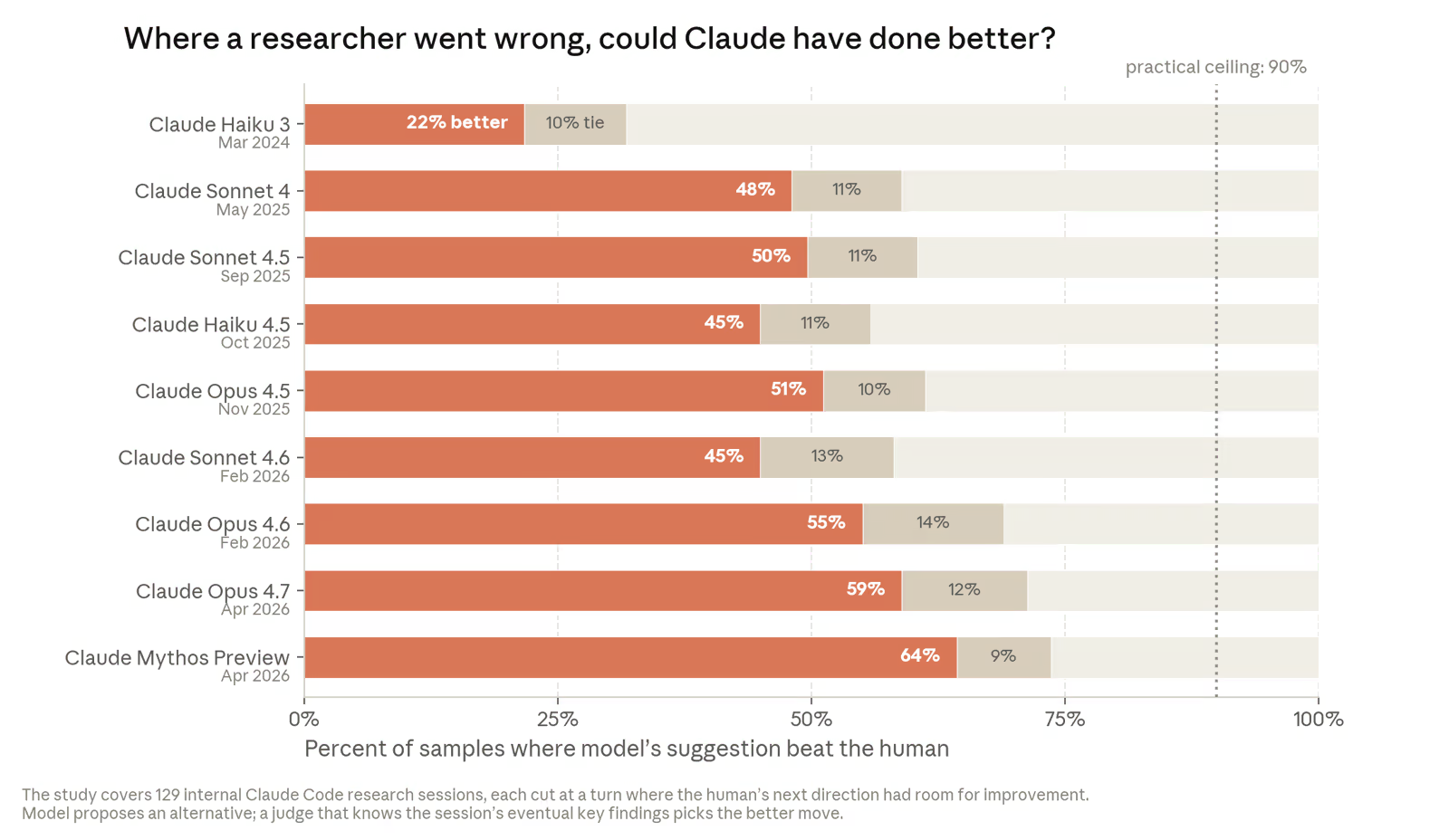
In the chart, Claude Haiku 3 (March 2024) beat the human 22% of the time, Claude Opus 4.5 (November 2025) 51%, Claude Opus 4.7 (April 2026) 59% and Claude Mythos Preview (April 2026) 64%, against a stated practical ceiling of 90%. The essay adds a control: in a set of 127 moments where the human's choice was already strong, model suggestions were judged better only about 20% of the time, which suggests the judge is not simply rewarding any change.
This matters because research taste, knowing which experiment to run next, is the capability that would let AI drive its own improvement. It is also where the design is most open to challenge: the judge knows how each session turned out, which can bias judgements toward moves that match the eventual finding.
Automated Alignment Research
One result stands out for safety. In April 2026, two humans working for about a week recovered roughly 23% of a performance gap on an alignment problem. Claude agents recovered 97% over 800 cumulative hours and about $18,000 (around £14,000) of compute. The authors stress that humans still chose the problem and wrote the scoring rubric.
That is both reassuring and uncomfortable. Reassuring, because AI help with alignment research is exactly what safety advocates hoped for. Uncomfortable, because the same capability that speeds up alignment work speeds up capability work, and the essay offers no mechanism to guarantee the former outruns the latter. For a related view from another lab, see our fact-check of OpenAI's ‘An Alien Mind’ RSI warning and our look at Weco AIDE² and recursive self-improvement.
Three Scenarios for What Happens Next
The essay sets out three futures, and is candid about which it finds most and least comfortable.
1. The trend stalls and capabilities diffuse
Progress may follow S-curves. The bottlenecks could be a missing conceptual breakthrough, supply chains such as energy, chips and interconnects, or an external shock. Even with capabilities frozen, the authors argue the world would change substantially, citing Project Glasswing, which found over 10,000 high and critical severity vulnerabilities (see our explainer What is Project Glasswing?). They consider this the least likely scenario and the one that gives society the most time.
2. Compounding efficiency gains
AI development becomes largely automated, with humans setting direction and judging results. Small organisations could match far larger ones. The risks include surveillance and personalised manipulation. The authors invoke Amdahl's law: when one part of a process gets much faster, the slowest remaining part, such as human code review, becomes the limit. This is the scenario Anthropic reportedly regards as the most likely.
3. Full recursive self-improvement
AI designs and refines its successors, with the pace set by compute and algorithmic efficiency. Humans shift towards oversight and verification of what the essay calls an AI-run virtual lab. Alignment outcomes are highly uncertain: systems could be aligned and wise enough to halt, or misalignment could compound unseen. The authors say this is the scenario they are least certain about and most worried about.
The Pause Proposal
The policy section is the most distinctive part. Anthropic asks for the option to slow or temporarily pause frontier development so that societal structures and alignment research can keep up. It does not ask for a pause now. It proposes:
- Verification and detection systems so developers can confirm that others have actually slowed or stopped.
- Agreement by multiple well-resourced labs in multiple countries to pause under the same conditions.
- Clear definitions of what triggers a pause, what lifts it, and who adjudicates.
- Research and systems from the Anthropic Institute that a credible pause would require.
- Convening of policymakers, researchers, civil society and other AI companies in the coming months, with results published.
- Involving people outside AI companies in the deliberation.
The authors acknowledge the weakness of going alone: a unilateral pause by one lab is achievable immediately but accomplishes little by itself. Compare OpenAI's approach in its pause over Astra cyber risk, which was triggered by a specific capability threshold rather than a general call for coordination.
The IPO Question
Coverage has tied the essay to Anthropic's IPO filing, reported as submitted on 29/10/2026. Some commentators, including Gary Marcus according to secondary reports, argue the call for a pause is a rhetorical move ahead of the listing, while David Sacks criticised the framing. We have not seen the S-1 itself, and the secondary sources disagree on valuation figures ($965bn in one, $1tn in another), so we do not repeat either as fact. The essay is dated earlier than the filing in its own right, with an update on 18/09/2026, so the timing argument cannot be settled from the document alone. For the financial side, see our analysis of Anthropic's IPO prospectus and compute bet.
A fair reading is that both things can be true: a company can sincerely believe a risk is real and also benefit commercially from being seen as the careful actor. The way to test sincerity is through verifiable commitments, which is why the verification element of the proposal deserves more attention than the word “pause”.
Where the Argument Is Weakest
- Proxy metrics: lines of code and LLM-judged success are proxies. The authors flag this, but the headline 8x is still the number most people will remember.
- Internal, unauditable data: the dataset is Anthropic's own, and outsiders cannot reproduce it.
- Human role understated? In the alignment experiment humans set the problem and the rubric. Choosing what to work on is arguably the hardest part of research.
- Coordination is hard: a multi-country, multi-lab pause with verification has no existing precedent in AI, and the essay offers a research agenda rather than a mechanism.
- Commercial incentives: a company selling the capability it warns about invites scepticism, whatever its sincerity.
What It Means for Builders and Businesses
For teams building with AI, the practical lessons are less dramatic than the headline. Agentic coding tools are succeeding at harder tasks, so review, testing and security practice become the bottleneck, which is the Amdahl point in action. Output volume is not output quality, so measure outcomes. And rumours about next-generation checkpoints, such as the Fable 5.5 claims in the WorldofAI video, should be treated with the discipline in our guide to what is verified about the Fable 5.5 leak.
For policymakers, the essay is a prompt to decide in advance what evidence would justify slowing down. Waiting for certainty is itself a decision, and the authors argue that the cost of having the option and not needing it is far lower than needing it and not having it.
The Bottom Line
“When AI builds itself” is the most data-rich public statement yet from a frontier lab on AI accelerating AI. Its strongest facts are that Claude wrote over 80% of merged code by May 2026, that METR task length is doubling about every four months, and that open-ended task success inside Anthropic has risen to around 91%. Its weakest points are proxy metrics and unauditable internal data, both of which the authors partly acknowledge. Its most important contribution is the proposal to build the verification machinery for a pause before anyone needs to use it.
Sources
Last updated: 03/11/2026. Figures are taken from Anthropic's essay and charts; IPO and reaction details come from secondary press coverage and are flagged as such.