
 AI Tools Review Editorial Team
Quick Answer:
Goodfire researcher Nick Cammarata's essay Neural Networks Are Already Clean argues that most neurons in modern networks have one legible job, and that the famous evidence for tangled, superposed neurons was misread. His preliminary audit of Qwen3-32B estimates roughly 90% of neuron poles have one main job, about 7% have two related jobs and only 2-4% are not yet understood. It is framed as a working hypothesis, a companion technical paper is still to come, and critics dispute how it treats superposition.
For years the quiet assumption in interpretability has been that large networks are fundamentally messy: neurons that mean several unrelated things at once, concepts smeared across thousands of units, and a decoder-shaped tax on every attempt to read a model's mind. Nick Cammarata, who helped start that tradition, now says the pessimism was largely a tooling and measurement error.
This guide walks through what the Goodfire essay actually says, which numbers come from the essay itself, what the evidence looks like, why alignment researchers care, and where serious people disagree. We have separated the author's claims from our commentary throughout.
Nate B Jones reads the essay and explains why an interpretability result matters to anyone building with or worrying about frontier AI.
Summary
Neural Networks Are Already Clean is an informal research essay published on Goodfire's own site by Nick Cammarata, with credit to Curt Tigges for language-neuron research and Tarun Gogineni for editing. It describes itself as a working hypothesis rather than a finished map, runs to a 65-minute read, and refers to a forthcoming companion paper. It carries no explicit publication date; secondary coverage places it in mid-October 2026.
The central claim is that modern networks learn using one broad principle that Cammarata calls recursive generalisation, and that most of what looked like neurons mixing unrelated concepts is better explained by it than by superposition, the idea that a network crams more features than it has neurons into overlapping directions. In his words, he now thinks he was making superposition the null hypothesis when it should have been the last hypothesis.
- Headline estimate: in a preliminary audit of Qwen3-32B, about 90% of neuron poles have one main job, about 7% have two related jobs, and about 2-4% remain unexplained.
- Famous example reversed: the InceptionV1 neuron long cited as a cat-and-car neuron is described as a V-shape neuron.
- Tooling matters: older feature visualisation was under-tuned and sometimes reward-hacked, which made clean neurons look messy.
- Path forward: agents that probe neurons, inspect connections and test explanations could make ordinary scientific work on interpretability scale.
- Honest limits: trillion-parameter models are nowhere near fully understood, the percentages depend on how 'one thing' is defined, and the author labels his broader outlook highly speculative.
Two things here are secure and one is not. The essay's existence, its headline numbers and its examples are stated by the author on the primary page. The interpretation, that interpretability is now a tractable engineering problem, is a hypothesis. And the full technical evidence sits in a companion paper that had not been released when we checked.
Background: Why Interpretability Looked So Hard
Mechanistic interpretability tries to explain what a neural network computes by reading its internal parts, much as a reverse engineer would read a compiled program. Early success came from vision models. Researchers could take a neuron in a network such as InceptionV1, optimise an image to make it fire, and see curve detectors, dog-head detectors and wheel detectors emerge. That work suggested networks might be legible all the way down.
The mood darkened as the field met neurons that seemed to respond to unrelated things. The standard explanation was polysemanticity, one neuron participating in several concepts, and its proposed cause, superposition: if a network needs to represent more features than it has dimensions, it can pack them in almost-orthogonal directions and tolerate a little interference. Superposition motivated a whole generation of tools, above all sparse autoencoders, which re-express activations in a larger, sparser dictionary in the hope that individual dictionary entries are cleaner than raw neurons.
The essay places an early automated-interpretability effort at OpenAI, which Cammarata began, in this story. By its most generous measure only about 1.7% of neurons were understandable, a figure other coverage rounds to about 2%. It is a useful reminder that those numbers were the product of the tools of the day, not a ceiling on the networks. Cammarata says that result left him pessimistic. His new claim is that the pessimism confused weak instruments with a messy subject.
If that sounds familiar, it should. Astronomy did not get simpler when better telescopes arrived; the sky simply came into focus. The essay's wager is that interpretability is having a similar moment.
The Core Argument: Recursive Generalisation
The essay's most original idea is that neurons are not usually storing several unrelated concepts. Instead, a neuron is a core idea that generalises outward to related cases, and those related cases can look unrelated if you only see the extremes. Cammarata calls this recursive generalisation: related concepts grow out of one another.
The author's examples come from language models. A neuron that begins with the letters 'iy' extends to 'diy' and then to 'do it yourself'. A planetary-geology neuron generalises into Cesium JavaScript code, a mapping library for globes. Seen alone, the second pair sounds like two jobs; seen as a chain of related cases, it looks like one broad idea (a globe, a planet, a map of one) stretching along its own gradient.
One learning principle, not two
An important consequence is that the essay posits a single learning principle across vision and language rather than a separate bag of tricks for each. If the same mechanism produces pose neurons in image networks and the 'iy to do it yourself' chain in language models, then techniques developed on small, inspectable vision systems should carry across more than the field has assumed. That is a strong claim, and it is one reason the essay has drawn so much attention.
Poles, not just neurons
The audit figures are stated per neuron pole. A neuron can push a quantity up in one direction and down in the other, and each side of that axis can have its own meaning. The essay highlights negative poles such as taxis versus ambulances, broccoli versus cauliflower, spoonbills versus flamingos and wolves versus huskies. Counting poles instead of whole neurons is a sensible refinement, but it also means any headline percentage needs the footnote that the unit of analysis is not the same as in older studies.
The V-Shape Neuron and the Cat-and-Car Reversal
The best-known reversal in the essay concerns a neuron in InceptionV1, labelled 4e:55, which the community had long described as responding to both cats and cars. Superposition fans loved it: two unrelated things, one neuron, a textbook case of overlap.
Cammarata's re-reading is that neuron 4e:55 responds to pointed, V-like shapes (the ears of a fox or cat, the corners of a car, the tips of flames) and is pushed negative by round shapes. In his words: it is not a cat and car neuron, it is a V-shape neuron. The same logic is applied to the Zoom In circuit, where a car signal flows into dog neurons. The essay's reading is that those are shared-pose neurons, generalised across animals and vehicles that happen to share a posture, rather than evidence that the network is storing cars inside dog detectors. It cites over a hundred such generalised pose neurons in InceptionV1.
The cover image on this page is the positive-pole image associated with that neuron on the essay site, shown upscaled from a small original. It looks like a furry animal face, which is exactly the intuition the 'cat' label captured, but the argument is about the shared geometry underneath.
- What the evidence is: pole-by-pole examples, feature visualisations that look crisp once transformation robustness is added, and parameter-matched comparisons across network sizes.
- What it is not: a proof that superposition never occurs. Critics are quick to point out that rejecting superposition as a default is a weaker claim than rejecting it altogether.
Why the Tools Made Networks Look Messy
A repeated theme is that the field misread its own instruments. The essay argues that feature visualisation, the technique of optimising an input to excite a neuron, was often under-tuned and in deep layers was effectively reward-hacked: the optimiser found noisy patterns that fired the neuron without showing what it meant. Missing transformation robustness and weak regularisation made neurons look worse than they were.
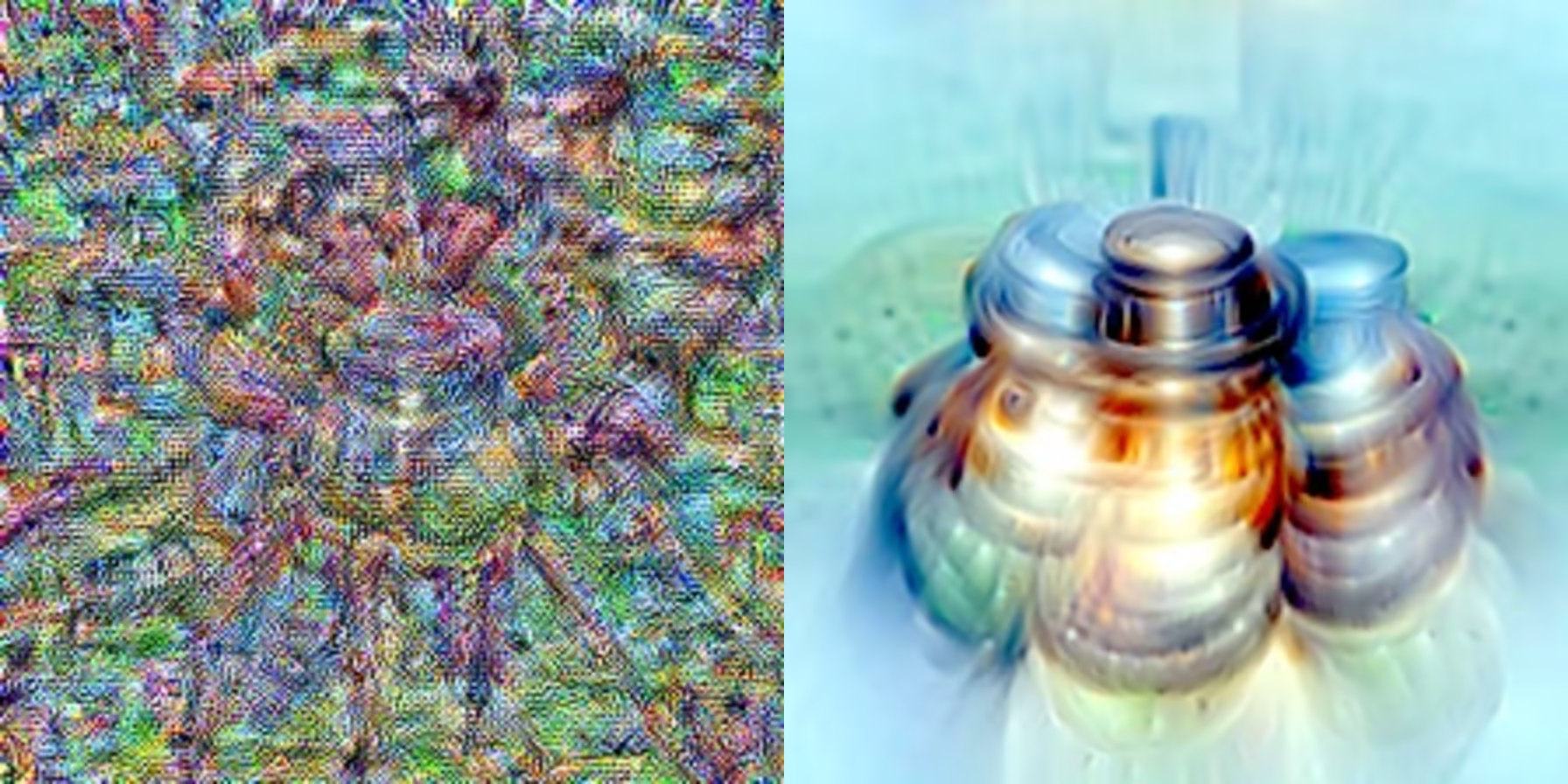
The figure above is the single most intuitive piece of evidence in the essay. The two images come from the same neuron, as labelled on the essay site, and the difference is the tooling. The older rendering is a swarm of texture; the newer one resolves into a recognisable set of objects. If that is what better tooling does for one neuron, the essay asks us to consider how much of the field's accumulated confusion was optics.
Last layers and architecture
The essay also argues that InceptionV1's famously messy last layer was an ordinary failure of learning and tooling. It reports that interpretability of that layer is about 5% with 2014-era tools by the author's estimate, about 50% with better tools, about 70% after retraining with modern regularisation, and about 99% in a ConvNeXt of the same size. Architectural choices such as residual connections and layer normalisation also appear to produce cleaner deep layers.
The ConvNeXt experiment is worth dwelling on because it is controlled. The essay compares models at roughly 92 thousand, 7.06 million (the same size as InceptionV1) and 28.6 million parameters, a span of about 300 times. If cleanliness tracked size in the way superposition would predict, a small model should be dramatically messier than a large one at fixed task difficulty. The author's reading is that it is not.
The Qwen3-32B Audit and What the Numbers Mean
Vision is the controlled lab; language is the real prize. The essay's preliminary audit of Qwen3-32B, an open-weight language model, estimates that roughly 90% of neuron poles have one main job, about 7% have two related jobs, and about 2-4% are not yet understood. It also reports that about 97% of the strong-activation samples checked were non-arbitrary.
Those are striking numbers when set beside the earlier baselines the essay quotes. Towards Monosemanticity's median neuron scored 0 out of 14 on its interpretability scale, and OpenAI's automated interpretability work found about 1.7% of neurons understandable. Cammarata is explicit that percentages like these depend on how 'one thing' is defined. A neuron that reads as one job at a coarse resolution may split into several at a fine one.
- Treat the audit as preliminary: the essay says so, and the full evidence is in a companion paper that had not appeared at the time of writing.
- Secondary coverage is not primary evidence: several summaries add commentary that is not in the essay, including some of the figures. Quote the essay, not the summaries.
- Definitions drive the result: 'one main job' is a judgement, and the 90% would move if the standard moved.
The essay also mentions scale directly: models up to trillions of parameters, with Kimi K3 named as an example, are not close to fully understood simply because of their size. The optimistic claim is about tractability, not completion.
Is Superposition Dead? The Objections
The essay is persuasive, but it is not the end of the argument. Researcher Liv Gorton has argued publicly that it mischaracterises what superposition actually predicts. That is a technical objection: if superposition theory does not predict the messy neurons the essay attacks, then showing those neurons are clean does not refute superposition.
There are other reasonable concerns. A neuron-level audit can say little about distributed representations, where information is spread across many units and no single neuron carries it. Sparse autoencoders exist precisely because some features seem to live in directions rather than at individual neurons. The essay itself runs a squeezed-layer experiment in which InceptionV1's layer 3b is cut from 480 neurons to 10, reaching 58.35% top-1 and 81.14% top-5 ImageNet accuracy. A sparse autoencoder explains 82% of the variance in that setting, but top-1 accuracy falls to 43.0% when it is spliced in, and it does not recover clean curve detectors. That is a candid result that cuts against the idea that autoencoders are a clean substitute for reading neurons.
The right posture is to treat the essay as a serious challenge to a default assumption and to wait for the paper. If recursive generalisation holds up, the practical conclusion is that simple tools applied carefully may beat complicated tools applied hastily. If it does not, we will have learned where the limit of neuron-level reading sits.
Why This Matters for AI Safety
The reason a neuron-labelling essay has travelled far beyond the interpretability community is alignment. If networks are mostly legible, then in principle we can audit what a model has learned, detect deception-relevant features, and verify behaviour from the inside rather than only from outputs. The author hopes that better automated science will make ambitious interpretability tractable in time to help with alignment, and also labels that broad near-term outlook as highly speculative.
That fits the wider debate on this site about how much we can trust internal readings. Anthropic's work on what it calls J-space and the question of machine consciousness, covered in our guide to Anthropic's J-Space explained, is another example of labs trying to read model internals rather than simply believing a model's self-report. The same logic drives the growing interest in recursive self-improvement warnings: if models will increasingly help build their successors, the ability to inspect what they have learned stops being a research luxury and becomes a safety requirement.
There is also a commercial angle. Goodfire is an interpretability company, and its pitch is that understandable models can be edited and debugged. A result that interpretability is more tractable than assumed is, among other things, good news for that business model. We flag that not to dismiss the research but to remind readers that authors, like everyone, are not neutral about their own field.
Automated Interpretability and the Bitter Lesson
The essay proposes a bitter lesson for interpretability, echoing Rich Sutton's famous argument in machine learning: general methods that scale with compute tend to beat clever hand-built ones. Applied here, the claim is that ordinary normal science at scale, guided by agents that probe neurons, examine connections and test candidate explanations, can outrun bespoke tooling.
This links directly to the current wave of agent harnesses that improve themselves. Google's work on Harness-squared self-improving agents and the self-training loop in Ornith 1.5 both show that agent systems can generate and test their own hypotheses at scale. An interpretability agent is the same pattern pointed inward. If an agent can propose an explanation for a neuron, test it on held-out activations and refine it, then the bottleneck moves from human attention to compute and evaluation design.
There is a real risk in that loop. An automated explainer judged by an automated scorer can learn to flatter itself, the same reward-hacking failure the essay accuses older feature visualisation of. Any serious programme will need held-out checks that the explainer cannot see, human spot audits, and the humility to publish negative results.
What to Watch Next
Four things will decide whether this essay marks a turning point or a good argument that did not survive contact with data.
- The companion paper. The essay points to a forthcoming technical paper. Methods, definitions of a 'job' and the audit protocol will matter more than the headline percentages.
- Independent replication. A clean result on Qwen3-32B is encouraging; the same audit on a different architecture, by a different team, would be convincing.
- Frontier models. The essay itself concedes that trillion-parameter systems are not close to fully understood. Whether the claim holds as scale grows is the open question.
- Practical payoff. Does a cleaner picture produce better steering, better safety checks or better debugging in real products? That is the test that matters outside the lab.
For readers building with AI rather than studying it, the near-term takeaway is modest but real: the idea that models are inscrutable by nature is now contested by a credible practitioner with concrete examples. That should make you a little more demanding when a vendor says its model cannot be inspected.
How to Read an Interpretability Claim
Interpretability results are easy to over-read, so it helps to have a few questions ready. They apply to this essay and to the next ten you will see.
- What is the unit? Neurons, neuron poles, dictionary features and circuits are different things, and percentages are not comparable across them.
- Who judged the explanation? A human, a language model or an automated score each have different failure modes.
- What was held out? An explanation that only fits the examples it was written from has not been tested.
- Does it predict behaviour? The strongest evidence is that an explanation lets you steer or predict what the model will do, not merely label what it activates on.
- Who benefits? Not a reason to dismiss a result, but a reason to want replication from someone with no stake.
By those standards the essay does several things right: it reports an earlier, more pessimistic baseline, names its own failed experiments, labels its outlook speculative and promises a technical paper. What it cannot yet do is answer the replication and held-out questions, which is why we have kept the language here cautious.
There is also a practical lesson for anyone who builds on top of models rather than studying them. Interpretability claims will increasingly appear in vendor marketing, safety cards and regulatory filings. Knowing the difference between a labelled neuron and a verified explanation of behaviour will help you judge which of those claims deserves weight.
Limitations of This Coverage
We were able to read the essay's primary page and cross-check its headline figures against secondary coverage, but the page is long and interactive, and we did not independently rerun any of its experiments. The companion paper was unavailable. Some secondary summaries differ in detail (for example, about 2% versus 1.7% for the earlier OpenAI result), and we have used the essay's own figure where it gave one. Percentages should be read as the author's preliminary estimates, not settled measurements.
The Bottom Line
Neural Networks Are Already Clean is a bold, readable and unusually candid argument that interpretability's hardest-looking problem may have been partly a problem of instruments. The V-shape reversal and the 2009-versus-2026 renderings are persuasive demonstrations, and the Qwen3-32B audit, if it survives scrutiny, would mean the field has been underestimating how much of a language model can already be read.
It remains a working hypothesis, with a paper still to come and a live technical dispute over superposition. Read it as the strongest recent case that the black box is more open than we assumed, and as a prompt to verify, not to celebrate. For related reading, see our coverage of Anthropic's intuition model leak and DeepSeek V4 Pro and the J-space claims.
Last updated: 23 October 2026. Sourced from the essay Neural Networks Are Already Clean on Goodfire's essay site (already-clean.goodfire.com), secondary coverage including Digg's AI aggregator, Yellow, MindStudio and Let's Data Science, and the tracked-creator video embedded above. Figures are the author's preliminary estimates; the companion paper had not been released at the time of writing. Images are credited to Goodfire.
Get the free guide: Claude vs ChatGPT, Gemini & Grok
A 20-page playbook covering everything you need to choose and use the big four AI models in 2026, full cost and feature comparisons, what each is best (and worst) at, and how-tos for images, vectors, building a website, Claude Code and more.