 AI Tools Review Editorial Team
Note: This article is based on extensive research of publicly available information, official statements, press reports, and expert analyses from the AI community. We have compiled insights from multiple sources to provide a comprehensive overview.
Quick Answer:
On 15 February 2026, Sam Altman announced that Peter Steinberger - the sole developer behind OpenClaw and its 196,000+ GitHub stars - was joining OpenAI to lead personal agent development. This is an acqui-hire, not an acquisition: OpenAI hired the person, not the product. OpenClaw will transition to an independent open-source foundation under the MIT licence. Both Meta and OpenAI made competing offers, with Mark Zuckerberg personally reaching out via WhatsApp. Steinberger chose OpenAI for access to frontier models, compute, and distribution to hundreds of millions of ChatGPT users.
A solo developer from Vienna built the fastest-growing open-source project in GitHub history. Then the two most powerful people in technology - Sam Altman and Mark Zuckerberg - fought over who got to hire him.
The OpenClaw story is not just about a brilliant piece of software. It is about the moment the AI industry decided that agents - not chatbots, not copilots, but autonomous systems that actually do things - are the next trillion-dollar platform shift. And the person who understood that first just got the resources to prove it.
What Happened
On 15 February 2026, Sam Altman posted on X that Peter Steinberger was joining OpenAI. The announcement was characteristically direct: Steinberger would "drive the next generation of personal agents." Altman described him as "a genius with a lot of amazing ideas about the future of very smart agents interacting with each other to do very useful things for people."
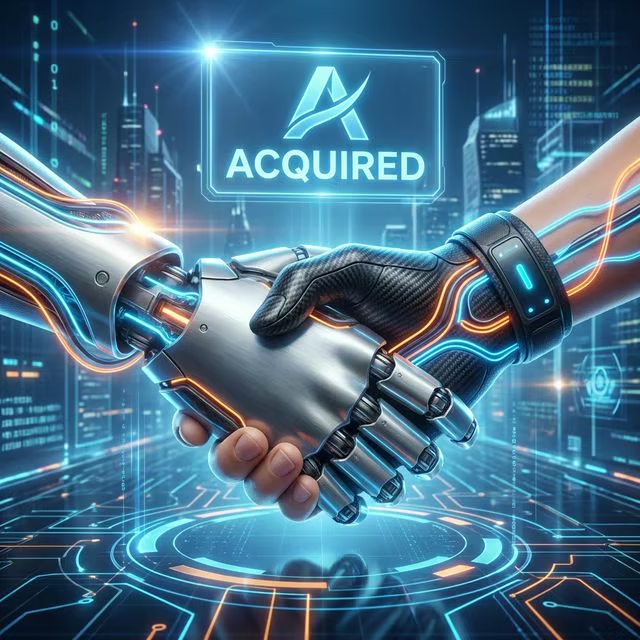
This is not a traditional acquisition. OpenAI did not buy OpenClaw as a company or product. No company was purchased. No codebase was acquired. It is an acqui-hire - OpenAI hired the developer, not the software. The distinction matters: OpenClaw remains an independent open-source project under the MIT licence, transitioning to a foundation that OpenAI will sponsor but not control.
Steinberger simultaneously published a blog post confirming the move, writing that OpenAI offered something no other organisation could match: access to frontier models, unreleased research, massive compute resources (including Cerebras systems), and distribution to hundreds of millions of ChatGPT users. His non-negotiable condition was that OpenClaw remain open source. OpenAI agreed.
Financial terms were not disclosed. Industry estimates place the deal at $2-15 million (~£1.6-12 million), though both Meta and OpenAI reportedly made offers characterised as "in the billions" when including total compensation packages with equity, compute access, and resources. For Steinberger, who had already exited PSPDFKit for over EUR 100 million (~£86 million), money was explicitly not the deciding factor.
Who is Peter Steinberger?
Steinberger is an Austrian software developer with a track record that reads like a startup parable. The short version: he bootstrapped a PDF SDK into a company serving Apple, Dropbox, and IBM, sold it for nine figures, burned out for three years, failed at 43 consecutive projects, and then built the most viral open-source project in history on attempt number 44.
The PSPDFKit Era (2011-2021)
In 2010, Steinberger was an iOS freelancer who took a contract to fix a crashing PDF viewer. The experience convinced him there was a market for a robust, cross-platform PDF SDK. He bootstrapped PSPDFKit from his apartment, growing it to approximately 70 employees over 13 years. Enterprise clients included Apple (which used it internally), Dropbox, DocuSign, IBM, and Volkswagen.
In October 2021, PSPDFKit received a EUR 100 million (~£86 million / ~$116 million) strategic investment from Insight Partners. Steinberger and co-founder Jonathan Schuerrer stepped back from day-to-day operations but remained invested.
The Wilderness Years (2021-2025)
What followed was a period of deep post-exit burnout. Steinberger has spoken publicly about therapy, ayahuasca, and 43 failed projects over roughly three years. In 2022, he co-founded Founders of Europe, an early-stage investment consortium with six other experienced startup founders. In May 2025, he founded Amantus Machina in Vienna with the mission of building "the next generation of hyper-personal AI agents."
Project 44: OpenClaw
In November 2025, Steinberger released a project originally called "Clawdbot" - a local AI assistant that could control a computer through natural language. It was project number 44. It was the one that worked. Within three months, it had more GitHub stars than projects that took React eight years and Linux twelve years to accumulate. Steinberger's own summary of the journey: "What I want is to change the world, not build a large company."
The Deal: What OpenAI Gets
On paper, OpenAI hired one person. In practice, they acquired something far more valuable than code.
| Asset | Value |
|---|---|
| Developer Ecosystem | 196,000+ GitHub stars, 145,000+ contributors, 2 million weekly visitors |
| Technical Vision | The architect of the most successful agentic framework in history |
| Community Goodwill | Association with the open-source project that defined the "agentic AI" moment |
| Strategic Positioning | Denied Meta/Zuckerberg access to the same talent and ecosystem |
| Open-Source Credibility | Foundation sponsorship positions OpenAI as a supporter of open-source AI |
Altman stated that Steinberger's work will "quickly become core" to OpenAI's product offerings. Given OpenAI's recent launches - Operator, ChatGPT agent mode, and the Frontier enterprise platform - the integration path is clear: OpenClaw's architectural patterns (hub-and-spoke gateways, lane queues, semantic snapshots) are likely to influence how OpenAI builds its next generation of autonomous agent infrastructure.
There is also a defensive dimension. By hiring Steinberger, OpenAI ensured that the person best positioned to build the definitive consumer agent platform is working for them, not against them - and not at Meta.
The Meta Bidding War
The competition for Steinberger was intense and personal. Mark Zuckerberg did not delegate the outreach - he reached out directly via WhatsApp. The two reportedly spent time debating whether Claude Opus or GPT Codex was the superior coding model.
Zuckerberg went further than conversation. According to reports, he ran OpenClaw on his own machine for a week and sent detailed, hands-on feedback - describing features as "great" or "shit" in real time. He used it until it broke, then sent notes on what to fix. Multiple sources described Zuckerberg's feedback as "blunt and specific."
Meta's strategic interest was not just the codebase. With OpenClaw's 196,000 GitHub stars and 2 million weekly visitors, the real asset was the community and developer ecosystem. Industry analysis suggests Meta wanted to integrate agent capabilities into WhatsApp, its primary messaging platform. One commentator warned that losing the bid could "turn WhatsApp into a pipe" - a dumb transport layer for someone else's AI agents.
Steinberger chose OpenAI for three reasons: access to frontier models and unreleased research, massive compute resources, and distribution to hundreds of millions of ChatGPT users. Critically, OpenAI also agreed to his non-negotiable condition: keeping OpenClaw open source via an independent foundation. No European company or institution could match these terms.
OpenClaw Stays Open Source
The open-source question was the single most important condition in the entire negotiation. Steinberger made it non-negotiable, and it shaped which offer he accepted.
OpenClaw will transition to an independent open-source foundation with the following structure:
- The project remains under the MIT licence - fully open, no restrictions
- The foundation structure prevents any single company (including OpenAI) from controlling the project's direction
- The repository continues accepting community contributions from its 145,000+ contributors
- OpenAI will sponsor and support the foundation but not exclusively control it
- Steinberger will dedicate time to foundation work as part of his OpenAI role
Steinberger compared the intended model to Chrome and Chromium - OpenClaw as the open foundation that anyone can build on, with commercial products layered on top. He wrote that the goal is to make the foundation "a place for thinkers, hackers and people that want a way to own their data," supporting "even more models and companies."
Why This Matters:
Before the deal, Steinberger was personally spending £7,900-£15,800/month ($10,000-$20,000) of his own money running OpenClaw's infrastructure, generating zero revenue. The foundation model with OpenAI sponsorship makes the project financially sustainable for the first time whilst preserving independence.
Altman publicly reinforced the commitment, stating on X that OpenClaw will "live in a foundation as an open source project that OpenAI will continue to support." He added: "The future is going to be extremely multi-agent and it's important to us to support open source as part of that."
What Makes OpenClaw Special
For readers unfamiliar with OpenClaw, here is why both Altman and Zuckerberg were willing to fight over a project built by one person. OpenClaw is not just another chatbot wrapper. It is a self-hosted, autonomous AI agent that executes real tasks through messaging platforms - Slack, Discord, iMessage, WhatsApp, and Telegram.
Its tagline is "the AI that actually does things." That means managing calendars, booking flights, replying to emails, executing shell commands, automating workflows across third-party services, and doing it all autonomously via a heartbeat scheduler that wakes up at configurable intervals without being prompted.
Key Architectural Innovations
| Innovation | What It Does | Why It Matters |
|---|---|---|
| Hub-and-Spoke Gateway | A single WebSocket server acts as the control plane between user inputs and the agent | Any messaging platform becomes an interface - no separate apps needed |
| Lane Queue System | Lane-aware FIFO queue with separate lanes for messages, cron jobs, and sub-agents | Prevents state corruption - tasks execute serially unless explicitly parallelised |
| Semantic Snapshots | Parses accessibility trees into text (under 50KB) instead of screenshots (5MB+) | 100x reduction in token costs for web browsing; more accurate than pixel guessing |
| Heartbeat Scheduler | Full cron expression support - agent wakes up and runs tasks without being prompted | Turns a reactive chatbot into a proactive autonomous agent |
| Local-First Memory | Memory stored as Markdown files on the user's machine - no cloud dependency | Privacy-first: your data never leaves your machine |
The project offers over 100 pre-configured "AgentSkills" and supports multiple AI models, including local models. It reached 34,168 GitHub stars in 48 hours after its final rebrand, crossing 106,000 stars faster than any project in GitHub history. For context, React took approximately 8 years and Linux approximately 12 years to reach similar milestones.
Running Costs for UK Users
OpenClaw itself is free (MIT licence). The costs are infrastructure and API tokens:
| Usage Level | Monthly Cost (GBP) | Monthly Cost (USD) |
|---|---|---|
| Personal / light use | £4-£10 | $5-$13 |
| Small team | £20-£40 | $25-$50 |
| Mid-sized / scaling | £40-£79 | $50-$100 |
| Heavy automation | £79-£158+ | $100-$200+ |
OpenAI's Three-Tier Agent Strategy
The Steinberger hire is not an isolated event. It fits into a clear strategic trajectory that has accelerated over the past 13 months.
OpenAI's Agent Stack (2025-2026)
- January 2025: Launched Operator - a browser-based agent that navigates websites and completes tasks independently
- July 2025: Operator integrated into ChatGPT as ChatGPT agent mode - combining web automation, deep research, and conversational AI
- 5 February 2026: Launched Frontier - an enterprise platform for building, deploying, and managing AI agents. Early customers include Intuit, Uber, State Farm, HP, Oracle, and Thermo Fisher
- 15 February 2026: Steinberger hire announced - specifically to drive "personal agents"
The pattern reveals a three-tier agent strategy:
- Consumer Tier: ChatGPT agent mode - agents for individual users within the existing ChatGPT product
- Enterprise Tier: Frontier - a dedicated platform for businesses to build and manage agent fleets
- Developer/Open-Source Tier: The OpenClaw foundation - an open-source ecosystem that feeds innovation back into the commercial products
Altman's statement about "very smart agents interacting with each other" points toward a multi-agent architecture as core to OpenAI's vision. This is precisely what OpenClaw's hub-and-spoke design was built for - orchestrating multiple agents working in parallel across different tasks, tools, and services.
Community Reaction
The response has been divided, which is unsurprising for a community of 145,000+ contributors who built something extraordinary on the assumption it would remain independent.
The Optimists
Many developers view the move as validation. OpenClaw's architectural patterns are likely to influence how OpenAI builds its next generation of agents - meaning the community's work will reach hundreds of millions of users rather than remaining a developer-only tool. The foundation commitment reassured contributors that their work would not be locked behind a corporate paywall.
The Sceptics
Critics coined the term "Closedclaw" to express concern about long-term open-source independence. The worry is that the foundation structure could become a fig leaf for gradual corporate capture - a pattern that has precedents in the tech industry. There are also concerns about corporate influence eroding the community-first ethos that drove OpenClaw's viral growth.
The truth likely lies somewhere in between. The Chrome/Chromium model that Steinberger cited as inspiration has, in practice, meant that Google's priorities heavily influence the Chromium project's direction, even though it remains technically open-source. Whether the OpenClaw foundation achieves genuine independence will depend on its governance structure and funding model over the coming months.
The European Brain Drain
The European tech community felt this hire acutely. Steinberger is Austrian, PSPDFKit was built in Vienna, and OpenClaw was developed in Europe. The fact that no European institution contacted him to recruit or support the project has become a focal point for criticism of Europe's AI ecosystem.
The structural challenges are real:
- No European company could offer access to frontier models, unreleased research, or distribution to hundreds of millions of users
- Regulatory burden (GDPR, NIS2, EU AI Act, ISO certifications) slows European go-to-market compared to the US
- The compute gap is enormous - five US companies are expected to spend over £330 billion ($450 billion) in aggregate AI-specific capital expenditure in 2026
One European commentator summarised the situation bluntly: "Europe has perfected the production of talent for American consumption." Steinberger himself acknowledged this, writing that the resources he needed simply did not exist in Europe.
For UK businesses specifically, the implication is that the most important agentic AI infrastructure is being built in the United States, by American companies, using European talent. The UK's competitive position depends on adoption speed and integration expertise, not on building competing foundation models.
The Agentic AI Market in 2026
The Steinberger hire sits within an industry-wide shift that is transforming how businesses think about AI. This is no longer about chatbots or copilots - it is about autonomous systems that work alongside humans.
| Metric | Figure |
|---|---|
| Global AI Agent Market (2025) | £5.76 billion ($7.29 billion) |
| Projected Market (2030) | £41 billion ($52 billion) |
| Enterprise Apps with AI Agents (Gartner, 2026) | 40% (up from under 5% in 2025) |
| Google Cloud Projected Market Value (2040) | £790 billion ($1 trillion) |
| Projects Expected to Be Cancelled (Gartner, by 2027) | Over 40% - due to costs, unclear ROI, or risk |
A three-tier ecosystem is forming: Tier 1 hyperscalers (infrastructure providers), Tier 2 enterprise software vendors (embedding agents into existing products), and Tier 3 agent-native startups building agent-first products. OpenAI is positioning across all three tiers simultaneously - and the Steinberger hire strengthens their position at every level.
The cautionary note comes from Gartner's prediction that over 40% of agentic AI projects will be cancelled by end of 2027 due to escalating costs, unclear ROI, or inadequate risk controls. 2026 is widely described as the "show me the money" year - enterprises need to demonstrate real returns on AI agent investments, not just proof-of-concept demos.
Full Timeline
| Date | Event |
|---|---|
| 2011 | Steinberger bootstraps PSPDFKit from his Vienna apartment |
| Oct 2021 | PSPDFKit receives EUR 100M (~£86M) from Insight Partners; Steinberger steps back |
| 2021-2024 | Post-exit burnout; 43 failed projects over three years |
| May 2025 | Founds Amantus Machina in Vienna |
| Nov 2025 | Releases "Clawdbot" - project number 44 |
| 27 Jan 2026 | Anthropic sends trademark notice; project renamed to "Moltbot" within hours |
| 29-30 Jan 2026 | Renamed to "OpenClaw". Achieves 34,168 GitHub stars in 48 hours. Crosses 106K - fastest to 100K in GitHub history |
| 5 Feb 2026 | OpenAI launches Frontier enterprise agent platform |
| 12 Feb 2026 | OpenClaw surpasses 180,000 GitHub stars |
| 14 Feb 2026 | Steinberger announces on his blog he is joining OpenAI; OpenClaw moves to a foundation |
| 15 Feb 2026 | Sam Altman formally announces the hire on X |
The Bottom Line
The OpenClaw acqui-hire is less about one developer joining one company and more about the entire AI industry placing a massive bet on agentic systems as the next platform. When both Sam Altman and Mark Zuckerberg personally compete to recruit the same person, it signals that autonomous agents - not better chatbots, not smarter copilots - are the strategic priority for the largest AI companies in the world.
For the open-source community, the foundation structure is a meaningful commitment. But history teaches scepticism - the Chrome/Chromium analogy cuts both ways, and the difference between "sponsored but independent" and "sponsored and influenced" will only become clear over time.
For UK businesses evaluating agentic AI, the practical takeaway is that OpenClaw remains free, open, and actively developed. It can be self-hosted on modest infrastructure for £4-10/month for personal use. Whether it eventually becomes a funnel for OpenAI products or remains a genuinely independent platform depends on decisions that have not yet been made.
What is beyond debate is the trajectory. The AI industry is moving from "talk to an AI" to "let an AI work for you." The person who built the best implementation of that vision just got access to the most powerful AI infrastructure on the planet. Whatever comes next, it is going to be consequential.
Last updated: February 2026. OpenClaw foundation governance details are still being finalised. This article will be updated as the foundation structure is formally announced.