
 AI Tools Review Editorial Team
Quick Answer:
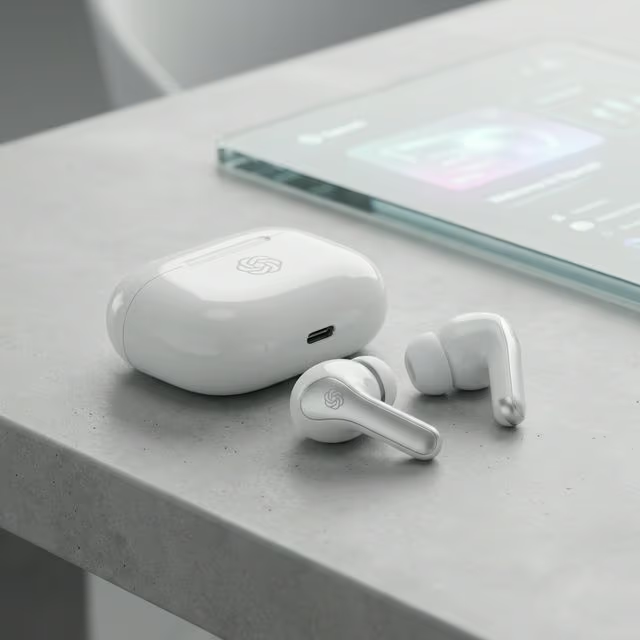
OpenAI's "Dime" project is a rumoured pair of smart earbuds designed to bypass the mobile OS duopoly. Reported at the time to be integrated with GPT-5.3 (OpenAI's then-current model; the line has since moved to GPT-5.6), they aim to provide always-on, low-latency AI intelligence that can see and hear the world with you, potentially defining the new "Operating System of Life."
The rumours are louder than ever: OpenAI is building hardware. Codenamed "Dime", these smart earbuds represent more than just a new gadget. They signal the next phase of the AI revolution, the war for the "Operating System of Life."
Why would a software company with a $157 billion (approx £125 billion) valuation risk entering the graveyard of hardware startups? Because in an AI-first world, the screen is no longer the primary interface.
The "Dime" Leak: What We Know
According to recent leaks covered by AI Revolution X, the "Dime" project is a pair of smart earbuds integrated deeply with what was then reported as a new multimodal GPT-5.3 model (any shipping product would presumably use OpenAI's current generation). Unlike Apple's AirPods, which rely on Siri (and by extension, the iPhone) for intelligence, Dime is rumoured to feature onboard processing for near-zero latency voice interactions.
- Always-On Intelligence: A direct line to an agent that sees what you see (via camera integration rumours) and hears what you hear.
- Contextual Awareness: Not just answering questions, but whispering schedule reminders, translating conversations in real-time, and coaching you through tasks.
- Platform Independence: A device that bypasses the iOS/Android duopoly to establish a direct relationship with the user.
One thing is not rumoured, and it is the foundation of everything else. In May 2025 OpenAI acquired io, the hardware design startup founded by former Apple design chief Jony Ive, in a deal valued at around $6.5 billion (roughly £5.2 billion). Whatever OpenAI eventually ships, it was designed by the team that designed the iPod and the iPhone, and that is a matter of record rather than supply-chain gossip.
Update: What Has Changed Since This Was Written
This piece was published in February 2026, when Dime was little more than a codename attached to a set of claims from supply-chain leakers. Several things have firmed up since, and one thing in the original framing has aged badly. It is worth separating the two.
On the confirmed side: OpenAI's chief global affairs officer Chris Lehane said at Davos in January 2026 that the company was on track to announce its first physical device in the second half of 2026. That is an on-the-record statement from an executive, not a leak, and it remains OpenAI's public position. As of mid-September 2026 the product has still not been unveiled.
On the reported-but-unconfirmed side, the naming has settled into a pattern: Sweetpea is described as the internal codename and Dime as the intended consumer name. Reporting also points to a custom 2-nanometre processor for on-device inference, a screen-free and pocketable form factor, and manufacturing with Foxconn and Luxshare at a first-year ambition measured in tens of millions of units. Sam Altman has described the intended feel of the device as more "peaceful and calm" than a smartphone, which is the closest thing to an official product philosophy anyone has offered.
The leaker known as Smart Pikachu described a metal, egg-stone-shaped body housing two removable capsule-shaped earpieces designed to sit behind the ear rather than inside it. That description is unverified and comes from a single source, but it is the most concrete physical account in circulation and we are attributing it rather than presenting it as fact.
Correction on valuation
The $157 billion figure cited below was OpenAI's valuation when the earliest hardware rumours surfaced, and it is long out of date. OpenAI closed a $122 billion funding round on 31 March 2026 at a post-money valuation of $852 billion (roughly £682 billion), with Amazon committing $50 billion and Nvidia and SoftBank $30 billion each. A portion of Amazon's commitment is reported to be contingent on an IPO or on OpenAI reaching an AGI milestone. The company reaffirmed the same $852 billion mark in an employee tender offer in August 2026. The strategic argument in this article is unchanged; the number is simply five times larger.
The GPT-5.3 integration described below was what reporting suggested at the time. OpenAI's model line has moved on since, and any shipping device would presumably run against whatever the current generation is rather than a model from early 2026. We track the model cadence separately in our coverage of GPT-5.6 and DevDay 2026.
Why the Ambitious Version Was Cut
The most interesting development is not a feature but a retreat. According to supply-chain reporting, the device OpenAI originally intended to ship was closer to a phone-class wearable with a substantial onboard computing unit. That version has reportedly been postponed, and what is being prepared for launch instead is a simpler, audio-only set of earbuds.
The stated reason is unglamorous and entirely believable: memory. A global shortage of high-bandwidth memory has pushed component prices up sharply, and the cutting-edge 2nm chip at the heart of the original design depends on it. The bill of materials reportedly climbed to a point where the ambitious version could not be sold at a defensible price. The same reporting suggests the fuller device returns once component costs fall, with September 2026 circulating as the most specific leaked target for the scaled-back model.
Treat that September date as the most precise rumour rather than a confirmed release. It has not been endorsed by OpenAI, and it sits inside, rather than contradicting, the company's own "second half of 2026" framing.
If the reporting is accurate, it reframes the product considerably. An audio-only earbud without meaningful onboard compute is a microphone and a speaker with a very good model at the other end of a network connection. That is a useful thing, but it is a much weaker answer to the platform problem than the original design, because it re-introduces the dependency on a paired phone that the whole strategy was meant to escape.
Why Hardware? Data & Dominance
Sam Altman knows that as long as OpenAI is an app on an iPhone, Apple owns the customer. Apple can throttle distribution, take a 30% cut, or simply replace ChatGPT with a superior "Apple Intelligence" anytime they choose.
Hardware is the moat. By owning the device, OpenAI gains:
Unfiltered Data
Real-world audio and visual data to train the next generation of "Physical World" models.
The "OS of Life"
Becoming the default interface for reality, mediating your interactions with the world.
Can They Beat Apple?
History is littered with software companies failing at hardware (remember the Facebook Phone?). Apple's ecosystem lock-in is legendary. For "Dime" to succeed, it can't just be smarter, it has to be magical.
It needs to offer utility that Siri cannot match. If Dime can flawlessly translate a foreign language meeting, negotiate a bill for you while you listen, or guide you through a car repair step-by-step, it might just be the "iPhone moment" for the AI era.
The recent history here is not encouraging, and OpenAI knows it. The Humane AI Pin and the Rabbit R1 both launched into enormous attention and both struggled, for the same underlying reason: a standalone AI device has to be better than the phone already in your pocket at something you do often, and "ask a question out loud" was not that thing. Reported shipment ambitions in the tens of millions for Dime's first year would put it in a different category entirely — but ambition is not demand, and the gap between the two is where most hardware startups die. Our piece on ambient computing and the AI pin covers that history in more depth.
What Success Would Actually Look Like
Strip away the platform-war framing and there are three concrete tests a device like Dime has to pass. None of them is about model quality.
Latency has to be conversational. A voice interface that takes two seconds to begin responding feels like operating a machine. One that responds in a few hundred milliseconds feels like talking. This is the argument for onboard processing, and it is exactly the capability that the reported scale-back to audio-only hardware puts at risk. If Dime routes everything to a data centre, it inherits the network's worst day as its baseline experience.
Battery has to last a working day. Always-listening hardware is a power problem before it is an AI problem. Every earbud maker has traded run time against size for a decade, and adding continuous audio processing to that equation does not make it easier. A device that needs charging at lunchtime will not become an ambient layer for anything.
The privacy story has to be legible to a normal person. A microphone that is always on, in a device made by a company whose business is training models, is a proposition that needs a very clear answer about what is retained and what is processed locally. In the UK and EU, where the regulatory environment is markedly less forgiving than in the US, that answer is not optional. The absence of a screen makes it harder, not easier, to communicate consent.
Our honest position, as of September 2026: the strategic logic for OpenAI building hardware is sound and largely unchanged. The specific product has been reported to shrink twice, the only firm date anyone has is OpenAI's own "second half of 2026", and until there is a device to hold, everything in this article beyond the io acquisition and Lehane's statement should be read as well-sourced speculation rather than fact.