 AI Tools Review Editorial Team
Sakana AI's pitch for Fugu is unusual in a market full of new foundation models: don't train a bigger model, orchestrate the ones that already exist. Fugu-Ultra v1.1 is the second iteration of that bet, and it lands the same week as a wave of frontier model launches it now claims to outperform.
This review covers what Fugu actually does under the hood, the real benchmark numbers from Sakana's own release chart, the one methodology caveat worth understanding before you trust the headline claim, and how it fits against the models it is built to route between.
Julian Goldie SEO covers Sakana Fugu-Ultra v1.1 in this video.
Summary
Fugu-Ultra v1.1 is Sakana AI's second release in its "model router" product line, announced on 24 July 2026. Rather than being a single trained language model, Fugu is a coordination layer that dynamically assembles agents from a pool of publicly available top-tier models and directs them through learned collaboration patterns. The v1.1 update swaps in newer models for that pool and reports benchmark gains across the board, most visibly on agentic coding tasks.
The headline claim - that Fugu-Ultra v1.1 now beats Claude Fable 5 on several benchmarks - is real on Sakana's own numbers, but it needs one qualification that Sakana itself discloses: Fable 5 is not one of the models in Fugu's pool. Fugu is being measured against Fable 5 as a competitor, not using it as an ingredient. That is a legitimate way to benchmark a product, but it is a different claim from "Fugu contains a piece of Fable 5 and still wins."
- Best for: teams already using Claude Code, OpenRouter or the Vercel AI Gateway who want a drop-in router that picks strong models per sub-task automatically.
- Headline numbers: up to 7.9 points over v1.0, with Terminal Bench 2.1 at 90.0% and ProgramBench at 79.8% for Fugu-Ultra v1.1.
- Defining trait: it is an orchestration system, not a base model - improvements come from better routing and role assignment, not new pretraining.
- Main caveat: all benchmark numbers are Sakana's own, independent verification has not yet landed, and v1.0 had a mixed real-world reception.
What Fugu Actually Is
Sakana AI, the Tokyo-based lab known for nature-inspired approaches to AI research, positions Fugu as "a multi-agent system as a model" - a single API endpoint that, behind the scenes, is not one model at all. When a request comes in, Fugu's coordinator decides how to break the task apart, which models in its pool are best suited to each part, and what roles they should play, then combines the results into one response. From the outside it behaves like calling any other frontier model API; underneath, several models may have contributed to the answer.
Sakana ships three variants. Fugu is tuned for balanced performance and latency on everyday work. Fugu Ultra, the subject of this review, is tuned for complex reasoning and coordinates a deeper pool of expert models, at higher cost and latency. Fugu Cyber is a specialised variant for cybersecurity analysis and threat investigation, covered separately below.
Who is Sakana AI
Sakana AI is a Tokyo-based lab founded in 2023 by David Ha (CEO), Llion Jones (CTO) and Ren Ito (COO), all former Google researchers. Jones is a co-author of "Attention Is All You Need," the 2017 paper that introduced the transformer architecture underpinning almost every modern large language model; Ha previously led research at Stability AI and worked at Google Brain. The company's earlier flagship research, Evolutionary Model Merge, used evolutionary algorithms rather than gradient-based fine-tuning to combine existing open-source models into new domain-specific ones - the same underlying instinct that shows up in Fugu: don't necessarily train a bigger model, recombine and coordinate the good ones that already exist. Sakana closed a $135 million Series B in November 2025, reaching a $2.65 billion valuation and becoming Japan's most valuable private AI startup, with backing from Khosla Ventures, Lux Capital and NVIDIA.
Architecture: TRINITY and Conductor
Fugu's orchestration is built on two pieces of Sakana research, both accepted at ICLR 2026. TRINITY is an evolved LLM coordinator that assigns each participating model a role - Thinker, Worker or Verifier - and adaptively delegates work across it depending on the task type, whether that is coding, mathematics, general reasoning or knowledge retrieval. Conductor is trained via reinforcement learning to discover natural-language coordination strategies: rather than a human engineer hand-writing the rules for how models should talk to each other, Conductor learns the communication patterns and hand-off points that get the best results from a given pool.
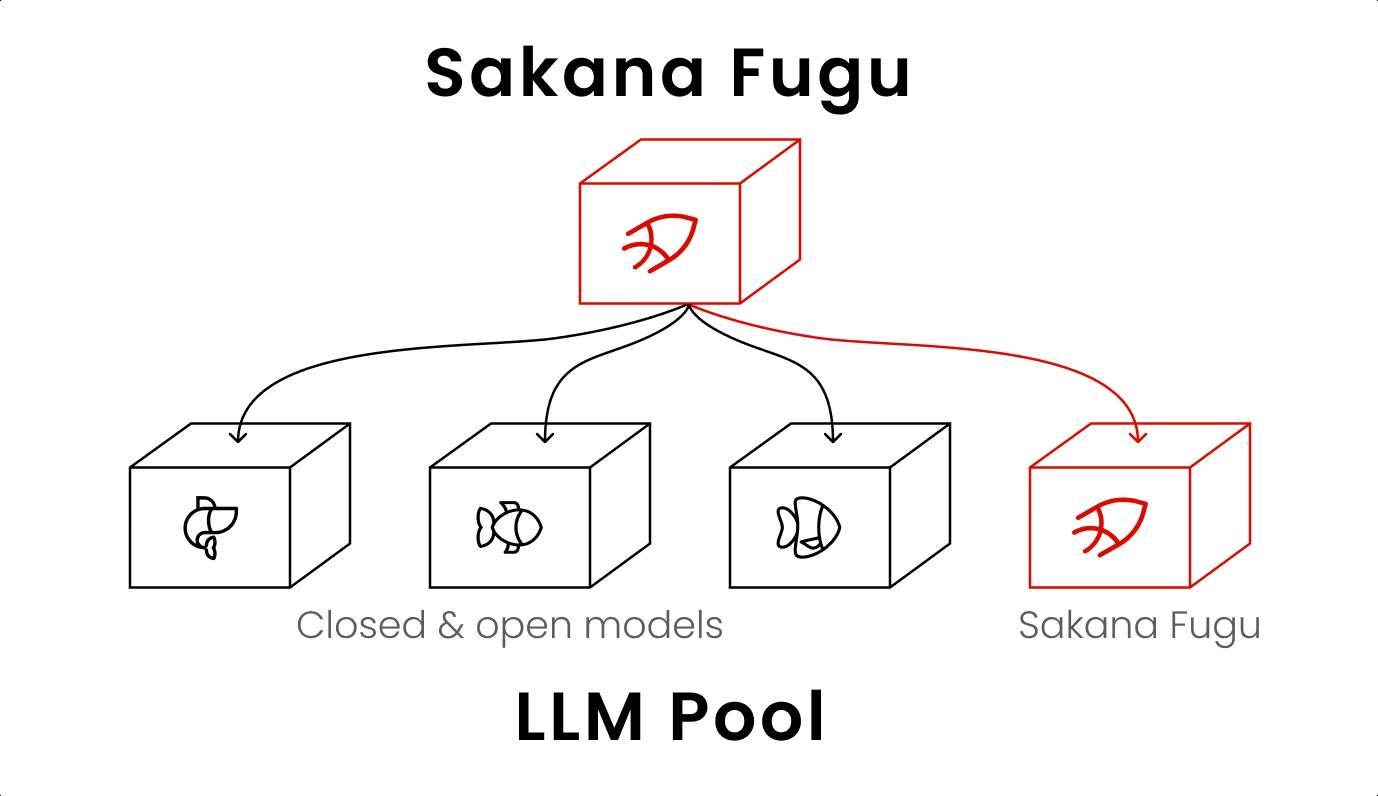
The design principle Sakana emphasises is that Fugu learns how to assemble and coordinate agents rather than following a hand-prescribed workflow. In practice this means the system can, in principle, get better simply by improving which models are in its pool and how well Conductor has learned to direct them - which is exactly the lever v1.1 pulls.
What's New in v1.1
Sakana's release note for v1.1, published 24 July 2026, is characteristically brief: the system has been "upgraded to incorporate the latest frontier models, resulting in stronger performance across every benchmark shown, including gains of up to 7.9 points over v1.0." The company says integrating a new top-tier model into the pool takes roughly two weeks of evaluation, which sets a rough cadence for how often future point releases like this one should be expected.
Two things changed beyond the model pool. First, a new Claude Code-compatible endpoint lets developers call Fugu's multi-agent orchestration directly from inside Claude Code, covered in more detail below. Second, pricing was held flat despite the capability gains - Sakana's framing is "the frontier keeps moving, and Fugu keeps getting better," at no extra cost to existing customers.
Benchmarks: The Real Numbers
Sakana's v1.1 release chart compares Fugu-Ultra v1.1 against v1.0, Claude Fable 5, OpenAI's GPT-5.6 Sol and Moonshot's Kimi K3 across five benchmarks. This is the most useful artefact in the announcement, and the gains over v1.0 are real and specific rather than a single vague percentage.
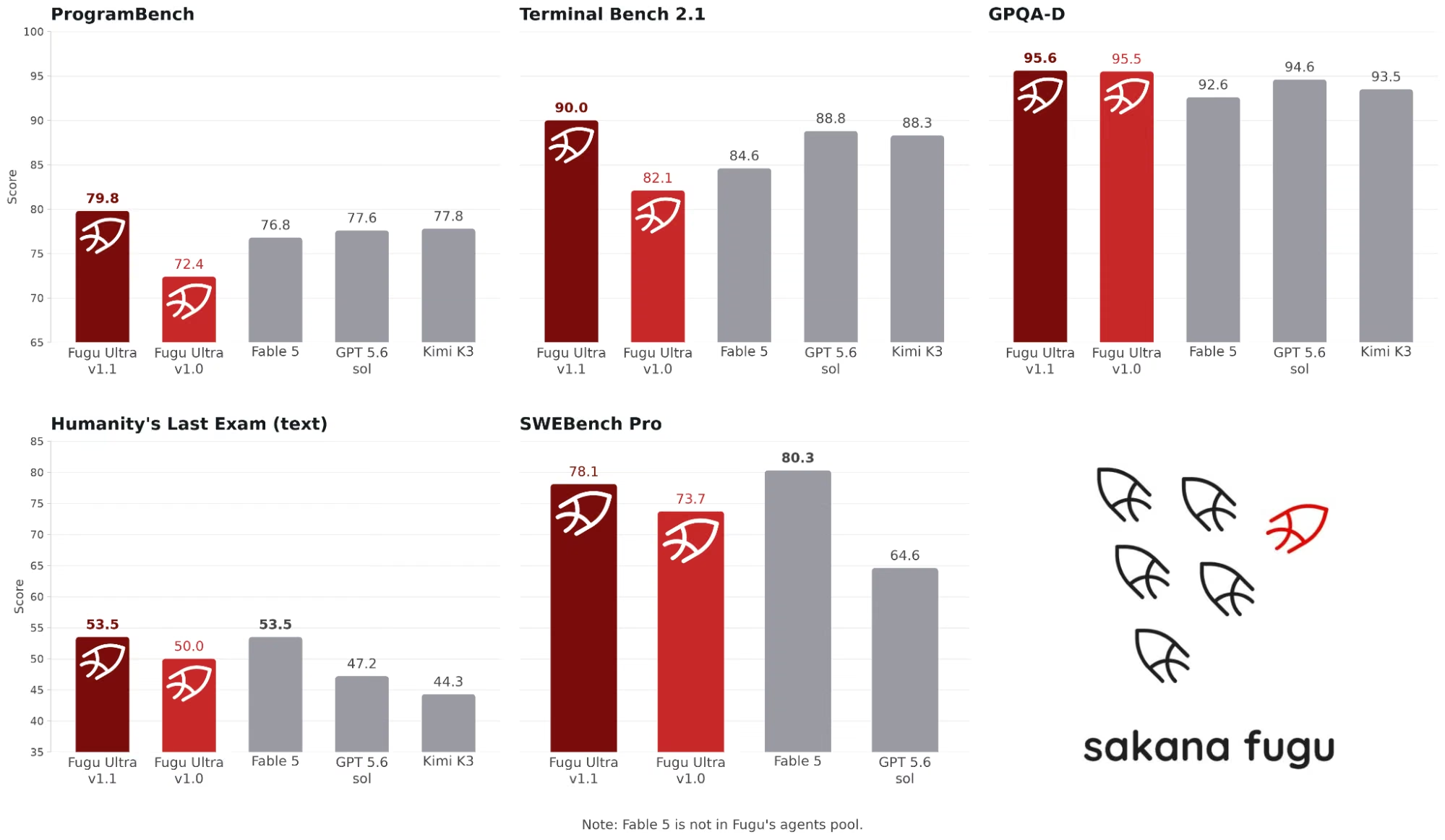
- ProgramBench: 79.8% (v1.1) vs 72.4% (v1.0) - a 7.4-point jump, and ahead of Fable 5 (76.8%), GPT-5.6 Sol (77.6%) and Kimi K3 (77.8%).
- Terminal Bench 2.1: 90.0% (v1.1) vs 82.1% (v1.0) - the largest gain on the card, comfortably ahead of GPT-5.6 Sol (88.8%), Kimi K3 (88.3%) and Fable 5 (84.6%).
- GPQA-D: 95.6% (v1.1) vs 95.5% (v1.0) - essentially flat, but still ahead of GPT-5.6 Sol (94.6%), Kimi K3 (93.5%) and Fable 5 (92.6%).
- Humanity's Last Exam (text): 53.5% (v1.1) vs 50.0% (v1.0) - level with Fable 5 (53.5%), ahead of GPT-5.6 Sol (47.2%) and Kimi K3 (44.3%).
- SWEBench Pro: 78.1% (v1.1) vs 73.7% (v1.0) - a clear gain, though still behind Fable 5's 80.3% and well ahead of GPT-5.6 Sol's 64.6%.
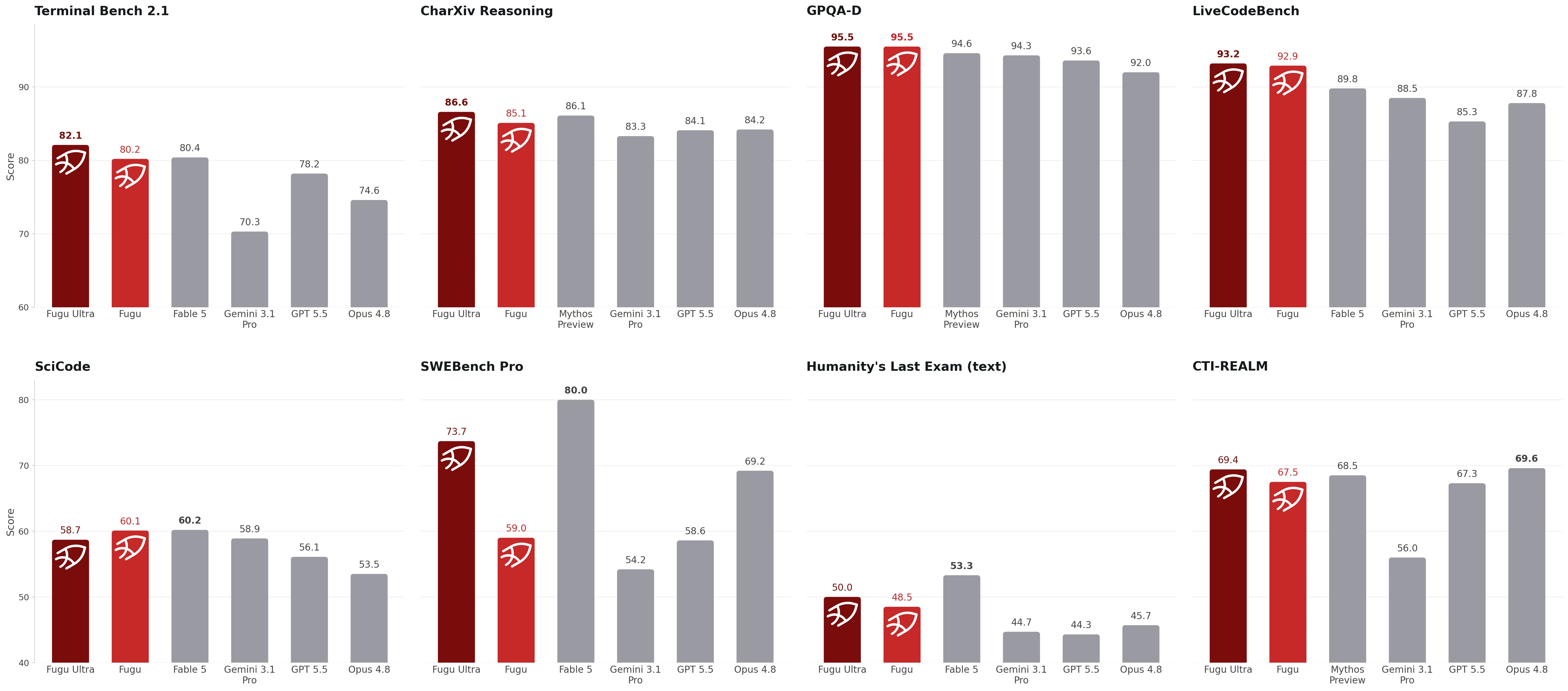
A separate, earlier benchmark card from the original Fugu launch adds useful context on where the family sits against a wider field including Google's Gemini 3.1 Pro and Anthropic's Opus 4.8: Fugu Ultra led or matched the field on GPQA-D (95.5%), LiveCodeBench (93.2%) and CharXiv Reasoning (86.6%), while sitting behind Fable 5 on SWEBench Pro (73.7% vs 80.0%) - the same gap that persists in the v1.1 chart above.
The Fable 5 Caveat
This is the detail that separates a fair reading of the launch from a marketing headline. Fugu's v1.1 benchmark chart carries a footnote stating plainly: "Fable 5 is not in Fugu's agents pool." That means every result showing Fugu-Ultra v1.1 ahead of Fable 5 is Fugu, as a complete orchestrated system, outperforming Fable 5 as a single model - not Fugu using a piece of Fable 5 internally and still coming out ahead.
That is a legitimate and fairly common way to benchmark a product against a competitor. The reason it is worth flagging is that Fugu's entire pitch is "we orchestrate the best available models," which can create an impression that beating a model means beating it while including it - the more remarkable claim. Independent coverage of the launch made exactly this point: Sakana's framing invites the reader to notice that Fugu edges out Fable 5 on several benchmarks despite not needing Fable 5 to do it, which is a genuine result on its own terms, just not the one a skim-read of the marketing copy might imply.
Fugu Cyber: Security Benchmarks
Fugu Cyber, the security-specialised variant, ships with its own benchmark card measuring vulnerability research and threat-intelligence tasks rather than general coding or reasoning.
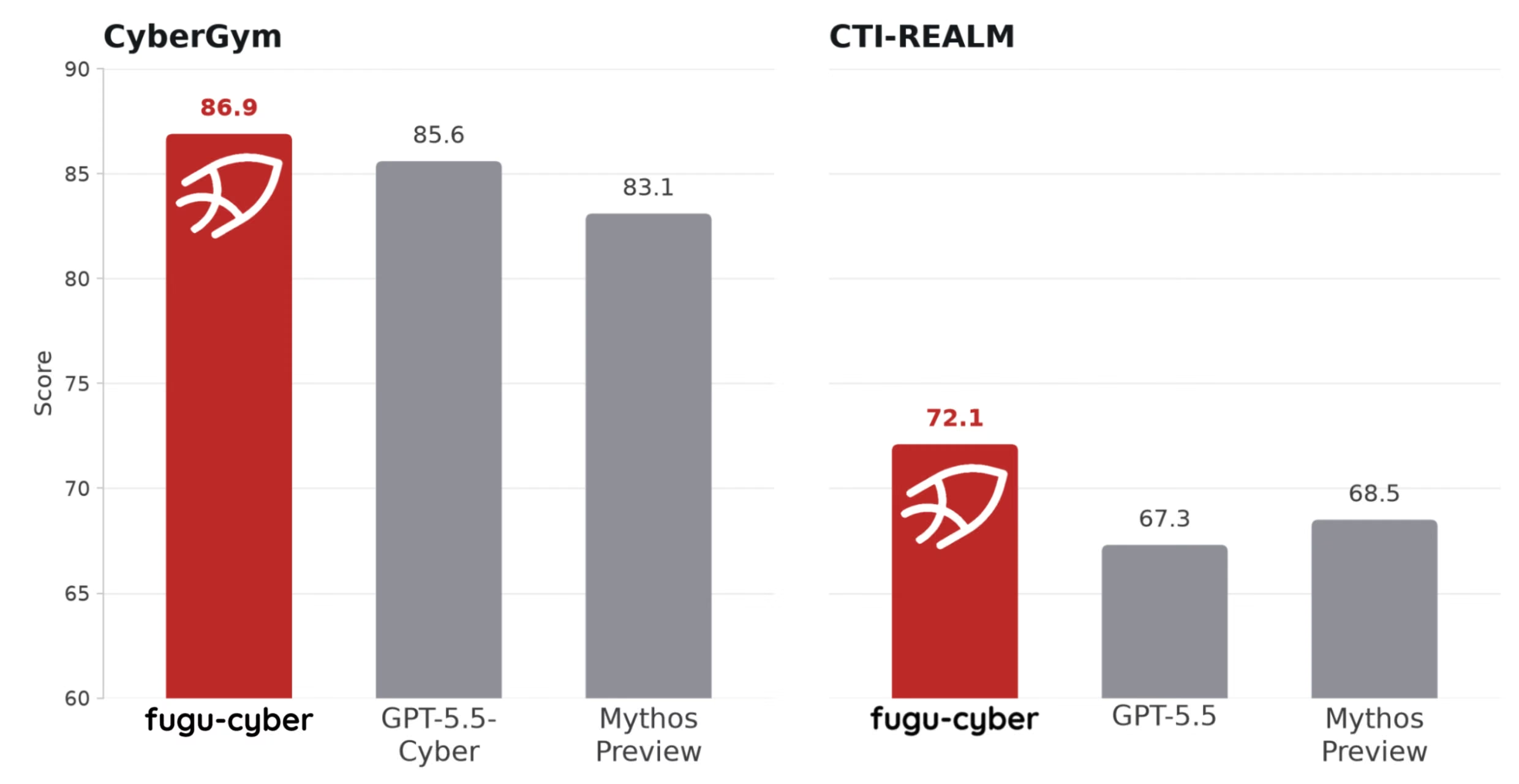
On CyberGym, a benchmark for practical vulnerability discovery and exploitation skills, fugu-cyber scores 86.9%, narrowly ahead of GPT-5.5-Cyber (85.6%) and Mythos Preview (83.1%). On CTI-REALM, which tests cyber-threat-intelligence reasoning, it scores 72.1% against 67.3% for GPT-5.5 and 68.5% for Mythos Preview. These are Sakana's own internal evaluations and, as with the general-purpose benchmarks above, have not yet been independently reproduced.
The Claude Code Integration
The most practically useful addition in v1.1 for working developers is a new Claude Code-compatible endpoint. Sakana describes it as letting developers "orchestrate a diverse pool of state-of-the-art models directly from your terminal" - in effect, pointing Claude Code at Fugu instead of a single model, so that Fugu's routing and role assignment happen transparently underneath the same terminal workflow developers already use.
This matters more than it might first appear: it removes the friction of adopting Fugu as a separate product, and instead offers it as a drop-in alternative back end for an existing agentic coding workflow. For teams already standardised on Claude Code, trying Fugu becomes a configuration change rather than a new tool to learn.
Real-World Reception vs the Benchmark Card
It is worth weighing the v1.1 numbers against how the original Fugu was actually received. Independent coverage of the first release noted a "lukewarm reception," with users citing high token usage, slower response times, and output quality that did not consistently match the benchmark claims. Orchestrating multiple models is, almost by definition, more expensive in tokens and latency than calling one model directly - that is the structural trade-off Fugu is making in exchange for its accuracy gains, and it is a trade-off that showed up in real usage last time.
None of that invalidates the v1.1 improvements, which are specific and plausible given the mechanism - a better-curated model pool and a more refined Conductor policy should indeed lift scores. But as with any benchmark released by the vendor itself, treat the numbers as a strong signal of direction rather than a guarantee of experience, and budget for the token overhead that multi-model orchestration inherently carries.
Pricing and Availability
Fugu-Ultra is available on a subscription or pay-as-you-go token plan. Subscriptions run Standard at $20/month (around £15.80) for lightweight daily use, Pro at $100/month (around £79) for 10x the Standard allowance, and Max at $200/month (around £158) for 20x the allowance. On the token plan, Fugu-Ultra costs $5 per million input tokens (around £3.95) and $30 per million output tokens (around £23.70), rising to $10/$45 above a 272K context window; cached input is discounted to $0.50/$1.00 per million tokens at the same thresholds. Fugu Cyber costs slightly more at $6/$36 per million tokens, or $12/$54 above 272K.
Fugu is accessed through an OpenAI-compatible API and is available via OpenRouter, the Vercel AI Gateway, and Sakana's own console. It is not available in the EU or EEA, which Sakana attributes to GDPR compliance requirements; access elsewhere is subject to local regulations.
Limitations
- Vendor-reported benchmarks only: every number in this review comes from Sakana's own evaluations; independent reproduction had not landed at time of writing.
- Fable 5 comparison caveat: Fugu beats Fable 5 on several charts without including it in its model pool - a fair but different claim from beating it while using it.
- Mixed track record on v1.0: early users reported high token usage, latency and inconsistent quality; whether v1.1 fixes the underlying experience, not just the benchmark card, remains to be seen.
- Loses on SWEBench Pro: Fugu-Ultra v1.1 (78.1%) still trails Fable 5 (80.3%) on this specific coding suite.
- No EU/EEA access: a hard blocker for teams that need in-region deployment for compliance reasons.
How It Compares
Against a single frontier model like Claude Opus 5 or Fable 5, Fugu's value proposition is different in kind: you are not choosing "a smarter model," you are choosing "a system that picks smarter models for you, task by task." That can pay off on benchmarks that reward matching the right specialist to the right sub-problem, which is visible in Fugu's strong showing on ProgramBench and Terminal Bench 2.1. It is less obviously an advantage on tasks that are already well served by one strong generalist model, where the routing overhead buys little and costs tokens.
Against other router-style or multi-agent products, Fugu's differentiator is the learned coordination from TRINITY and Conductor rather than hand-written routing rules, plus the two-week model-refresh cadence that keeps its pool current. Whether that compounding advantage is durable depends on how quickly rivals adopt similar learned-routing approaches - a question the market will answer over the next few release cycles rather than this one.
It is also worth situating Fugu within the wider shift toward orchestration-layer products this year. As frontier labs converge on similar capability levels - see our roundup of the mid-2026 model wars - a growing number of products are betting that the next efficiency gain comes from routing between models rather than training a single bigger one. Fugu is one of the more research-grounded entrants in that category, given Sakana's published TRINITY and Conductor work, but it is competing against both dedicated routers and the increasingly common built-in routing features that frontier labs are adding to their own platforms.
Who Should Use It
Try Fugu-Ultra v1.1 if you already use Claude Code, OpenRouter or the Vercel AI Gateway and want to test a drop-in router against your current single-model setup on coding-heavy or reasoning-heavy workloads, particularly terminal and program-synthesis tasks where the gains over v1.0 are largest.
Hold off if you need EU/EEA deployment, you are latency-sensitive and cannot absorb the token overhead of multi-model orchestration, or you want benchmark claims backed by independent reproduction before committing budget - none of Sakana's numbers here have third-party verification yet.
The Bottom Line
Fugu-Ultra v1.1 is a real, specific upgrade to an unusual product: a router that tries to make "which model should answer this" someone else's problem. The gains over v1.0 are concrete rather than vague, the new Claude Code endpoint lowers the barrier to trying it, and the headline claim of beating Fable 5 is genuine on Sakana's own numbers - as long as you read the footnote that explains what that claim actually means.
The honest version of this review is: promising mechanism, real point-release gains, entirely vendor-reported evidence, and a first version that did not fully live up to its own hype in daily use. Worth testing on your own workload before switching your default, especially anywhere token overhead or EU deployment is a constraint.
Last updated: July 2026. This review is based on Sakana AI's official Fugu-Ultra v1.1 announcement and benchmark disclosures, plus independent coverage of the launch; all benchmark figures are Sakana's own and had not been independently reproduced at time of writing.
Get the free guide: Claude vs ChatGPT, Gemini & Grok
A 20-page playbook covering everything you need to choose and use the big four AI models in 2026, full cost and feature comparisons, what each is best (and worst) at, and how-tos for images, vectors, building a website, Claude Code and more.