 AI Tools Review Editorial Team
Two recent videos from tech creator Bilawal Sidhu, covering radio-based sensing that can measure a heartbeat through a wall and AI models that build a picture of a room from WiFi alone, sound like a stretch. They are not. The underlying research is real, dates back to 2013, and has quietly moved from MIT and Carnegie Mellon labs into products already installed in millions of homes.
This is not thermal imaging and it is not a hidden camera. It is deep learning applied to a signal every home already has: the WiFi router. Here is how the technology actually works, who is building it, what changed in 2025 and 2026 to make it mainstream, and why security researchers are treating it as a live privacy problem rather than a hypothetical one.
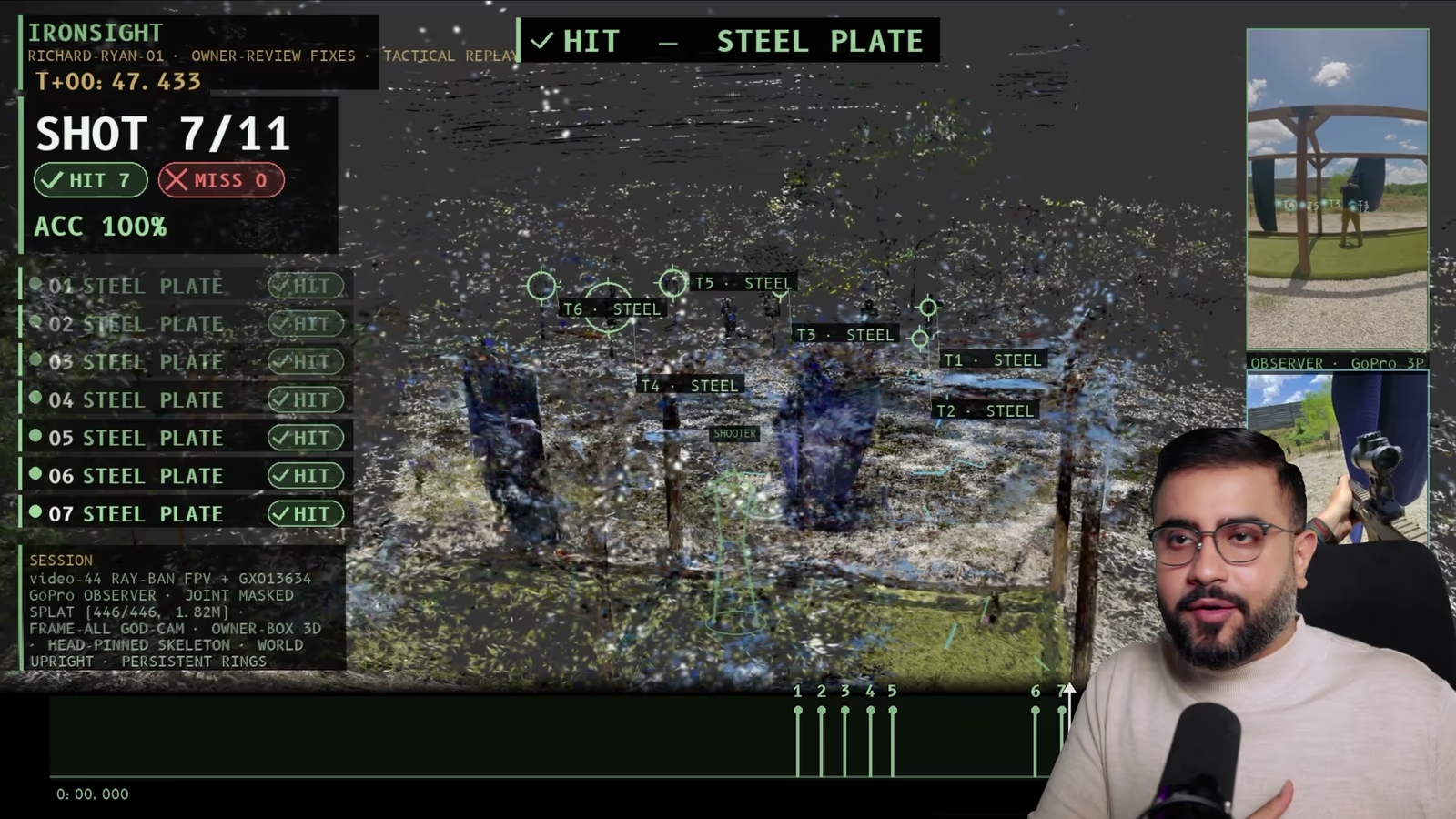
Bilawal Sidhu's introduction to AI-powered WiFi sensing, the video that prompted this explainer.
The claim: seeing through walls with WiFi
The core claim sounds implausible until you separate what is actually being measured from what headlines imply. No system here decodes a camera-quality image through a wall. What these systems do is detect that a wall-penetrating radio signal changed in a specific, learnable way because a human body moved through, or near, its path, and then use a trained model to translate that change back into a skeleton, a location, a breathing rate, or an identity.
That distinction matters for calibrating how impressive, and how concerning, this actually is. It is not video. It is a statistical reconstruction, built from a physical signal that was never designed to carry this information, extracted by a neural network trained specifically to find it.
How RF sensing actually works
Every WiFi transmission carries Channel State Information (CSI): a measurement of how the radio channel between transmitter and receiver altered the signal's amplitude and phase as it travelled, including every reflection off walls, furniture and people. Two other physical effects do most of the remaining work. Doppler shift captures the tiny frequency change caused by a moving reflector, such as a chest wall expanding with each breath, which is precise enough to isolate a heartbeat from background motion. Dedicated radar systems, using FMCW (frequency-modulated continuous wave) or UWB (ultra-wideband) pulses rather than repurposed WiFi packets, trade the convenience of existing hardware for cleaner range and Doppler resolution, which is why several of the medical-grade products described below use dedicated radar chips instead of a home WiFi router.
None of these signals arrive as anything resembling a picture. Raw CSI is noisy, drifts with room layout, and looks completely different for the same person standing in a different spot. That gap between a noisy radio measurement and a usable human-pose estimate is exactly where AI comes in.
From MIT's RF-Pose to today
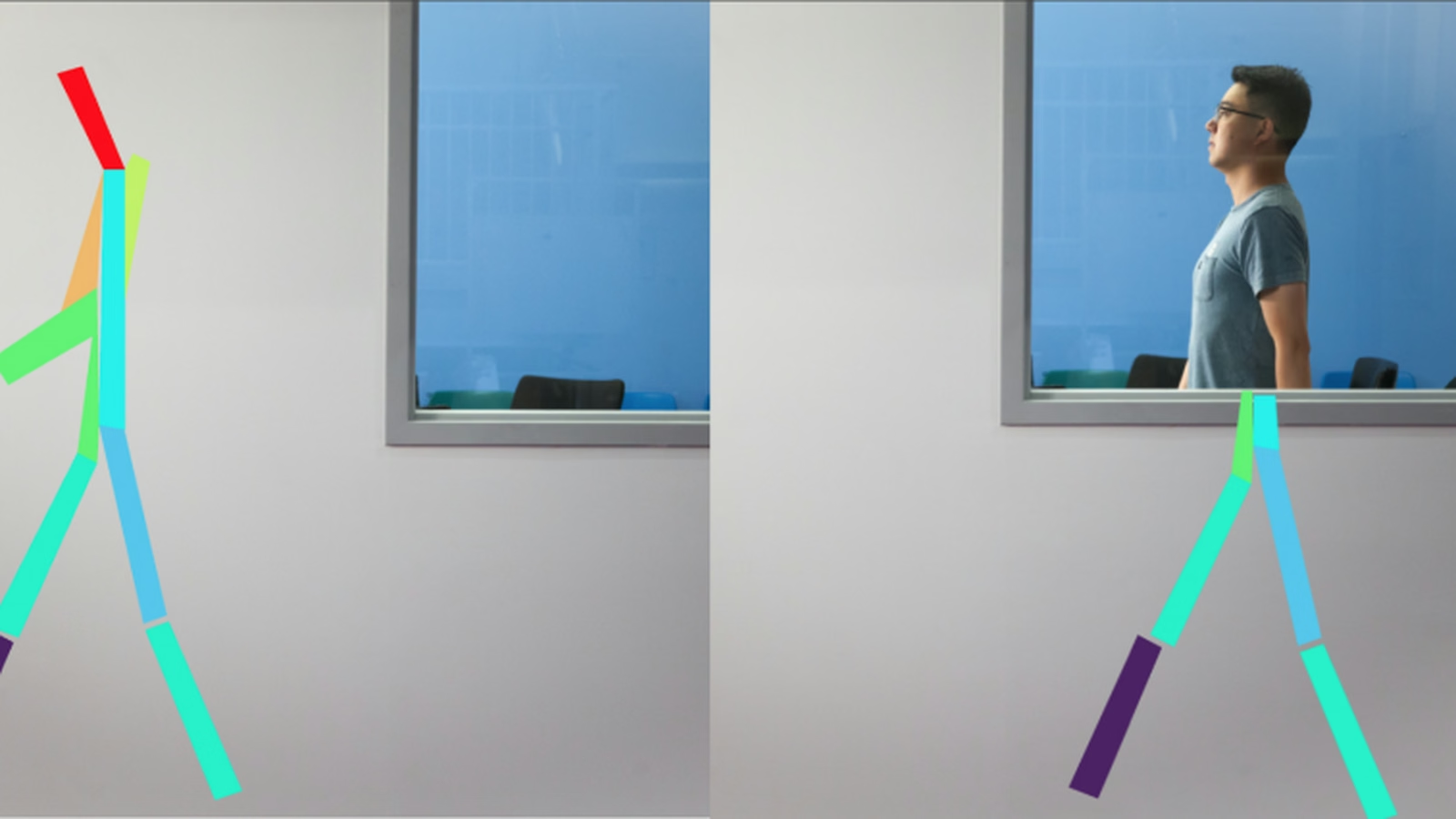
The lineage starts with Fadel Adib and Dina Katabi at MIT, whose 2013 paper "See Through Walls with WiFi!" (Wi-Vi) first showed that ordinary WiFi hardware could localise a moving person on the other side of a wall. Katabi's lab followed up with RF-Pose (CVPR 2018), which used a neural network to estimate a full 2D human skeleton through walls from radio reflections alone, then RF-Pose3D, extending that to three dimensions.
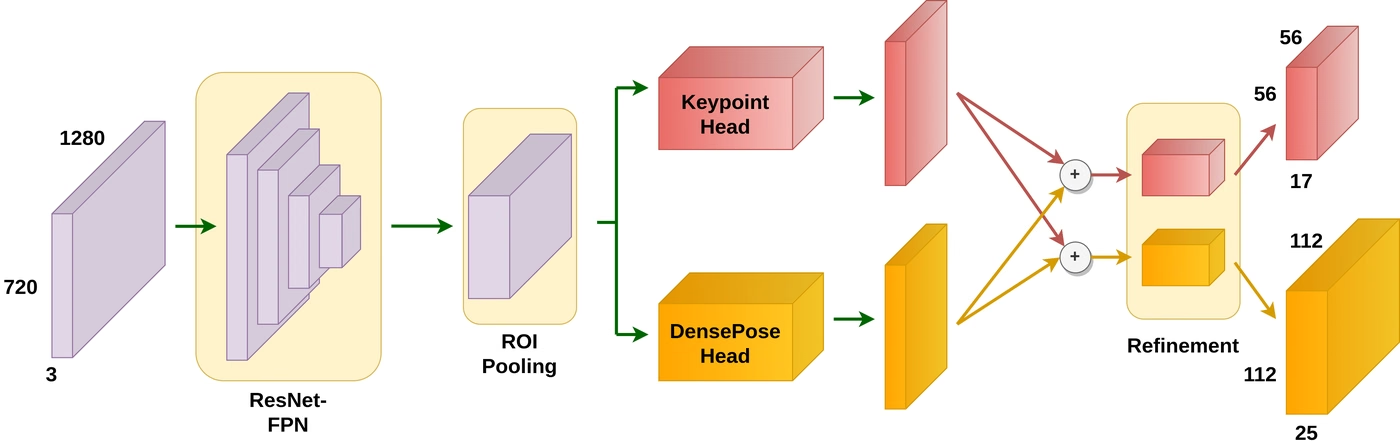
The next major leap, and one that is frequently misattributed to MIT, is DensePose From WiFi (2022), from Jiaqi Geng, Dong Huang and Fernando De la Torre at Carnegie Mellon University's Robotics Institute, not MIT. Using just two consumer WiFi routers, their system estimates dense body-surface pose, mapping WiFi phase and amplitude to 24 distinct body regions rather than a simple skeleton.
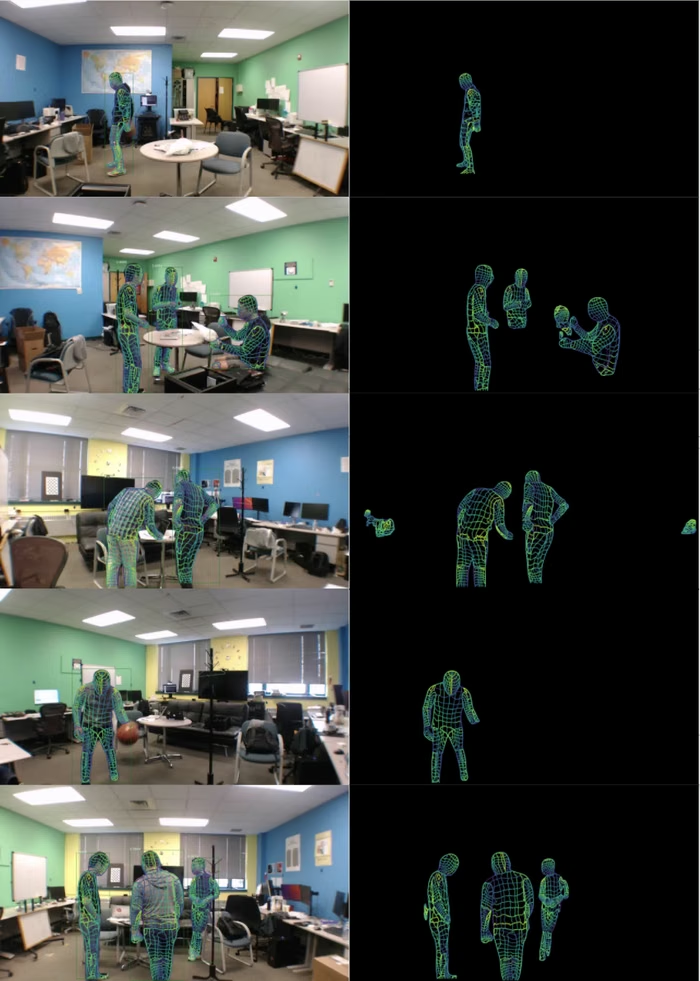
Research has accelerated sharply since. Person-in-WiFi 3D (CVPR 2024) used a Transformer architecture to localise multiple people in 3D simultaneously, reporting joint localisation error of 91.7mm for a single person rising to 125.3mm with three people present, on a testbed of roughly 97,000 frames. WhoFi, from La Sapienza University of Rome (July 2025), applied a Transformer-based CSI encoder to WiFi-based person re-identification, distinguishing individuals by how they perturb a signal rather than by their face. A July 2026 paper, WiLHPE, introduced a lightweight "dynamic kernel attention" network aimed at making pose estimation practical on cheaper hardware, while DT-Pose (2025-2026) focused specifically on the field's biggest practical weakness: models trained in one room generalising poorly to a different layout.
Why this needs AI, not just radio
The trick that makes all of this possible is a training method called cross-modal supervision. Researchers cannot hand-label a stream of raw CSI numbers with "left elbow at this angle", so instead they set up a room with both a WiFi sensing rig and an ordinary camera running at the same time, use a separate, well-established camera-based pose model to automatically label what the camera saw, and then train a second network to predict that same label using only the radio data. Once trained, the camera can be switched off entirely: the network has learned to translate RF patterns into pose without ever needing a camera again at inference time.
In practice, current systems combine convolutional networks for denoising and "sanitising" the raw phase signal (unwrapping distortions introduced by imperfect hardware synchronisation) with Transformer or attention-based encoders for the actual pose or identity prediction, and CNN-LSTM hybrids where continuous activity recognition over time matters more than a single frame. None of this works on raw CSI without that deep learning layer in between; it is the difference between a signal that fluctuated and a specific claim about where your arm is.
IEEE 802.11bf: sensing built into WiFi
The single biggest reason this went from research demo to mainstream feature in the past year is standardisation. IEEE 802.11bf, the WiFi Sensing amendment, was formally published on 26 September 2025. It defines how WiFi 6 and WiFi 7 hardware should support sensing at the MAC and physical layer, covering both bistatic setups (one device transmits, another listens) and multistatic setups (several devices cooperate), across frequency bands from roughly 1 GHz up through 45 GHz and beyond.
Standardisation matters because it turns sensing from a bespoke research pipeline requiring specialist antennas into a feature chipmakers can build into ordinary consumer WiFi silicon. NIST's own explainer frames 802.11bf explicitly as the mechanism for "widespread adoption" of WiFi sensing, and the commercial moves detailed below all accelerated in the months immediately around that publication date.
Bilawal Sidhu's follow-up video, covering vital-sign detection and the commercial sensing products described below.
From the lab to your router
Commercial WiFi sensing is no longer a niche. Origin AI (formerly Origin Wireless, founded by Ray Liu) built its TruPresence and TruShield products around exactly this technology, turning existing home WiFi signals into presence, motion and security detection without a dedicated sensor. Home security company ADT acquired Origin AI for $170 million in cash, announced 24 February 2026, explicitly to power "AI Sensing and Ambient Intelligence" across its product line. Weeks earlier, Origin AI partnered with chipmaker NXP to embed its sensing software directly into i.MX 9 silicon, and launched a "Compatible With Origin" certification programme for other chipset makers, the clearest sign yet that this is moving from add-on software to embedded hardware feature.

Origin AI is not alone. Cognitive Systems' WiFi Motion technology is deployed through more than 160 internet service providers, and the company is now expanding into consumer smart-plug hardware sold on Amazon. Aura Home sells a camera-free WiFi Motion product aimed specifically at remote elder care. And a newer entrant, ZaiNar, emerged from nine years of stealth development in February 2026 with more than $100 million raised and a reported valuation above $1 billion, focused on sub-10cm positioning using synchronised WiFi and 5G timing rather than body-pose imaging, a related but distinct application of the same underlying signals.
Heartbeats, breathing and home health
Vital-sign detection is where this technology moves from convenience feature to genuine medical tool. Pulse-Fi, a 2025 project from UC Santa Cruz researchers Katia Obraczka and Nayan Bhatia (with contributions from high-school researcher Pranay Kocheta), used cheap ESP32 and Raspberry Pi hardware combined with a trained model to estimate heart rate from WiFi CSI to within roughly half a beat per minute over a five-second window, tested across 118 participants in 17 different body positions at distances up to ten feet, and published at IEEE DCOSS-IoT 2025.
MIT spinout Emerald Innovations, founded by Wi-Vi co-creator Fadel Adib, takes a different technical path, using dedicated FMCW radar rather than WiFi CSI, operating at roughly 0.1% the signal strength of WiFi according to IEEE Spectrum's reporting on the system. Emerald's sensors are already deployed in more than 200 homes in partnership with Boston Medical Center, Brigham and Women's Hospital and Massachusetts General Hospital, tracking disease progression in Alzheimer's, Parkinson's and multiple sclerosis patients passively, without a wearable. The company has also reported emotion-recognition accuracy of 87% for trained subjects (73% for untrained subjects) using radar-derived physiological signals, a research claim from Emerald's own reporting that has not been independently replicated at that specificity, worth noting as a company-reported figure rather than a settled result.

A cautionary tale: fake WiFi-sensing hype
Not everything claiming to do this actually does, and one example is worth flagging precisely because it shows how easily AI-sensing hype can outrun substance. A GitHub repository called wifi-densepose claimed a working, open-source implementation of WiFi-based DensePose estimation, reporting 94.2% accuracy and accumulating more than 8,000 stars. An independent audit found the project's core CSI-parsing function generated random arrays instead of reading actual hardware output, that no trained model weights, dataset or working training pipeline existed anywhere in the repository, and that the GitHub issue documenting these findings was subsequently deleted by the maintainer. Treat any specific accuracy claim you encounter for this technology, on GitHub, in a video, or anywhere else, with the same scepticism until you can trace it to a named lab, a published paper, or a company willing to put its name behind the number.
The privacy problem researchers are raising
The people building this technology are, in several cases, the ones sounding the loudest alarm about it. Researchers at Germany's Karlsruhe Institute of Technology (KIT), led by Thorsten Strufe with Julian Todt and Felix Morsbach, published work in November 2025 (ACM CCS '25) showing that beamforming feedback information, ordinary, unencrypted background WiFi traffic that most modern devices already transmit, can identify specific individuals with accuracy the researchers report as approaching 100% within their test group of over 160 participants. Their own framing is unambiguous: they call this "a privacy attack", not a feature, and warn it works without the target carrying any WiFi device of their own and without any visible indication it is happening, flagging particular risk in authoritarian contexts.
MIT Technology Review's 2024 investigation into this field identified the structural reason this is harder to defend against than an ordinary data-privacy problem: a data payload can be encrypted, but the physical radio properties a sensing system reads, signal timing, phase, amplitude, cannot be, because the sensing system is not reading your data, it is reading the physical effect your body has on radio waves in the room. And unlike a hidden camera, which a careful person can sometimes spot, a WiFi router capable of sensing is visually indistinguishable from one that is not.
The research community is not treating this as a hypothetical threat. A November 2025 paper called PrivyWave, from researchers including Cornell-affiliated authors, proposes a cryptographic "decoy heartbeat" defence specifically against unauthorised RF and acoustic vital-sign sensing, deliberately injecting a false signal that only an authorised, key-holding receiver can filter out, reporting that unauthorised sensors were pushed to over 20 beats-per-minute error while authorised receivers stayed within roughly six to ten beats-per-minute. The existence of an active defensive research agenda is itself evidence that specialists consider unauthorised RF sensing a live, not theoretical, threat model.
Who should care, and what to do about it
Smart-home and security buyers evaluating Origin AI, ADT, Cognitive Systems or similar WiFi-sensing products are looking at a genuinely useful, already-shipping capability for presence detection, fall detection and remote elder care, but should ask any vendor directly what data leaves the device, how long it is retained, and whether the sensing model can be disabled per-router rather than only at the account level.
Healthcare and eldercare providers watching Emerald Innovations' hospital partnerships are looking at a credible, non-wearable alternative to continuous monitoring for neurological conditions, still early-stage and not yet a substitute for clinical diagnosis. Developers and researchers building on this technology should read the KIT and PrivyWave papers before shipping anything that touches CSI or beamforming feedback in a product, and should specifically avoid unverified "working implementation" claims of the kind the fake wifi-densepose repository demonstrates can accumulate thousands of stars without containing real code.
Everyone else should simply know this exists: as 802.11bf-compliant routers become the default over the next few years, a growing share of ordinary home WiFi hardware will ship sensing-capable by default, whether or not the owner ever enables a specific sensing feature, and the KIT team's finding that identity-level inference is already possible from background traffic is the reason that matters even for people who never buy a dedicated sensing product.
The bottom line
AI-powered RF sensing is real, well-sourced, thirteen years deep into serious academic research, and now standardised, funded and shipping. It is not the dystopian camera-replacement some headlines imply, current systems reconstruct pose, presence, motion and vitals, not a photographic image, but it is a genuinely new sensing modality moving into millions of homes largely without the public debate that cameras and microphones already went through. The technology deserves the excitement it is getting in AI-creator coverage. The privacy question deserves at least as much attention, and right now it is getting far less.
Sources
- MIT CSAIL, RF-Pose project page
- Geng, Huang & De la Torre, "DensePose From WiFi," Carnegie Mellon Robotics Institute
- IEEE 802.11bf WiFi Sensing standard
- ADT's official announcement of the Origin AI acquisition
- UC Santa Cruz, Pulse-Fi research announcement
- IEEE Spectrum on Emerald Innovations
- MIT Technology Review, WiFi sensing privacy investigation
- KIT/SciTechDaily coverage of the beamforming-feedback identity-inference research
- PrivyWave: cryptographic defence against unauthorised RF vital-sign sensing
Published 4 August 2026. This article distinguishes peer-reviewed and company-confirmed claims from unverified figures throughout, and will be updated if the underlying research or products change materially.
Get the free guide: Claude vs ChatGPT, Gemini & Grok
A 20-page playbook covering everything you need to choose and use the big four AI models in 2026, full cost and feature comparisons, what each is best (and worst) at, and how-tos for images, vectors, building a website, Claude Code and more.