
 AI Tools Review Editorial Team
Important: this device is unannounced
Apple has never confirmed that an AI Pin exists. Everything below is either sourced reporting, which we attribute explicitly, or clearly-labelled informed speculation about where ambient computing is heading. Where you see a specific component, supplier or performance figure without a named outlet attached to it, treat it as unverified prototype chatter rather than a specification.
For over a decade, the glass rectangle has been the centrepiece of our digital lives. But according to a steady drip of reporting from Bloomberg and The Information, Apple is quietly building a device designed to make you look at it less.
The rumours regarding an "Apple AI Pin" have reached a fever pitch. Unlike previous attempts at AI wearables that felt like half-baked prototypes, Apple's approach to ambient computing is built on its greatest strengths: custom silicon, tight hardware-software integration, and a ruthless commitment to user privacy as a marketing position.
We aren't just looking at a new accessory; we are looking at the foundational transition from Mobile Computing to Ambient Computing. A world where the interface isn't a screen you tap, but a context-aware layer that exists around you.
That framing matters more than the hardware itself. A screenless pendant is not interesting because it is small; it is interesting because it forces a different contract between you and the software. A phone waits to be asked. An ambient device has to decide, continuously and unprompted, whether the thing it just saw or heard is worth interrupting you for. Getting that judgement wrong in either direction, too chatty or too silent, is what killed the first generation of AI wearables. It is also the single hardest problem Apple has to solve, and no amount of custom silicon solves it on its own.
Where the Rumours Actually Come From
Before getting excited about any of this, it is worth separating the reporting from the fan fiction, because the two have become badly tangled in coverage of Apple's wearables roadmap.
The substantive reporting comes from two places. The Information's Wayne Ma and Qianer Liu described an Apple "AI pin" project in January 2026, characterising it as being at an early stage of development. Bloomberg's Mark Gurman then picked up the thread in his Power On newsletter through February and again in early April 2026, adding the physical description that most subsequent coverage has been built on.
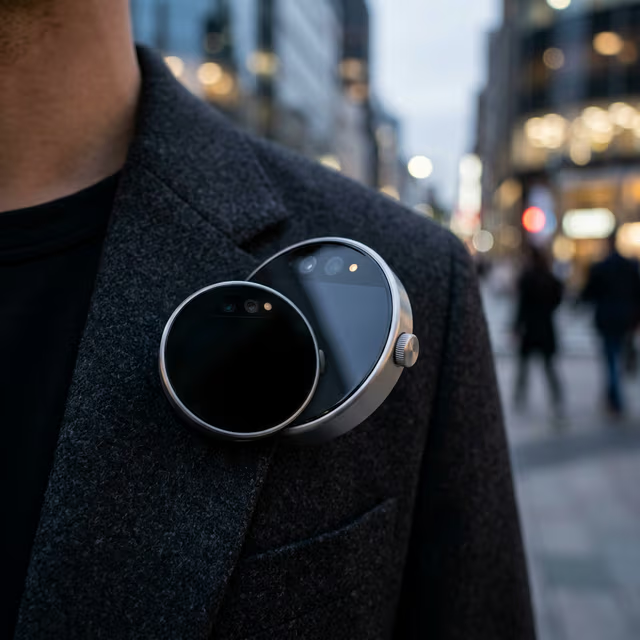
Per that reporting, the device is a thin, flat, circular disc with an aluminium-and-glass shell, roughly the size of an AirTag. It carries two cameras, three microphones and, possibly, a speaker, which Apple was reportedly still debating. It clips to clothing or hangs from a cord threaded through a hole in the body. Crucially, it has no display and no laser projector, the two features that defined and doomed the Humane AI Pin.
What is reported vs what is speculation
- Reported: aluminium-and-glass disc, two cameras, three microphones, no display, clips or hangs, its own chip with limited performance, heavy reliance on a paired iPhone, possible 2027 launch, and a real chance of cancellation.
- Not reported: any chip name, megapixel count, ultra-wideband generation, battery chemistry, price or release date. Anyone quoting those with confidence is guessing.
The "relies on the iPhone for processing" detail is the one that gets under-read. It tells you the pendant is not a phone replacement and was never designed as one. It is a sensor package with a radio, and the intelligence lives in your pocket. That is a far more conservative and far more likely-to-work product than anything Humane attempted.
AI Revolution X covers Apple AI Pin in this video.
Hardware Leak: Dual Cameras & Apple Silicon
Unconfirmed prototype chatter
None of the figures below appear in Bloomberg or The Information's reporting. They circulate in supply-chain and developer forums and should be read as rumour, not specification.
- Processor:Custom S12-tier 'Neural Engine' optimized for sub-1W power draw.
- Optics:Dual-lens array: 48MP Standard + 12MP Ultra-Wide 'Environmental' sensor.
- Tracking:U2 Ultra-Wideband (UWB) for 1cm-precise indoor positioning.
- Audio:Triple-beamforming microphones with active spatial filtering.
Reports from The Information suggest the device is a thin aluminium and glass disc, roughly the thickness of two AirTags. It doesn't have a screen. Instead, it relies on voice, audio feedback, and potentially a virtual overlay surfaced through its connection to future Apple Vision Pro or AR glasses.
Set the rumoured internals aside for a moment, because the reported detail that actually constrains the product is the one about the chip. Gurman's reporting says the pendant has silicon of its own, but that its performance is limited enough that the device leans on a paired iPhone for anything heavy. That single constraint cascades through the whole design. It means the pendant's own processor is there for wake-word detection, sensor fusion, camera gating and radio work, not for running a language model. It means the device is useless out of Bluetooth or ultra-wideband range of your phone. And it means battery life becomes a radio problem rather than a compute problem, which is a far more tractable engineering challenge than the one Humane set itself.
It also explains why Apple would ship this at all. A pendant that is functionally an external eye and ear for the iPhone does not need to justify itself as a computer. It needs to justify itself as an accessory, in the same bracket as AirPods or an Apple Watch cellular module, and the bar for that is dramatically lower.
One Pin, Three Devices: The Wider Roadmap
The pin does not exist in isolation. Bloomberg's February 2026 reporting described Apple accelerating work on three AI wearables at once, all built around Siri and all dependent on a paired iPhone: camera-equipped AirPods, display-free smart glasses with a high-resolution camera, and the pendant itself.
AirPods with cameras
Reported as the earliest of the three, potentially as soon as 2026. The camera is described as low-resolution and intended for context rather than photography.
Smart glasses
Targeting 2027, with production reportedly potentially starting late 2026. A high-resolution camera for capture, plus a second camera feeding visual context to Siri.
The pendant
Earliest stage of the three, possibly 2027, and the most likely to be cancelled. Lower-resolution always-on camera intended for AI insight only, with no photo or video capture.
Read as a set, these are not three competing products. They are three positions on a single spectrum of how much of the world you are willing to let a camera see, and how obviously you are willing to advertise that you are wearing one. Glasses see the most and are the most socially conspicuous. AirPods see the least and are effectively invisible. The pendant sits awkwardly in between, which is exactly the position Humane occupied.
The connective tissue across all three is Visual Intelligence, Apple's on-device scene understanding layer, which Tim Cook has repeatedly described on earnings calls as one of the company's most popular features. Apple already ships the software. What it does not yet ship is a camera that is pointed at the world by default rather than held up deliberately. That, in one sentence, is the entire product thesis. It is also worth reading alongside OpenAI's own move into ambient audio hardware, which attacks the same problem from the opposite end of the spectrum.
Context Awareness: Seeing What You See
A phone is fundamentally reactive. It knows what's happening *inside* the device, but it has no idea what's happening in your physical world until you open the camera or type a prompt. The Apple AI Pin flips this script.
Sample Scenario: The Grocery Store
"Your Pin sees the brand of pasta you just picked up. It knows your dietary preferences and health goals from Apple Health. Without you saying a word, a soft voice in your earbud says: 'That brand contains high-fructose syrup. The organic alternative is on the aisle behind you.'"
This is Actionable Intelligence. By combining its dual-camera vision with UWB indoor tracking, the Pin understands where you are and what you are looking at in real-time.
The Privacy Wall: On-Device Processing
The biggest hurdle for AI wearables is the "Creep Factor." Nobody wants a device that's constantly streaming video and audio to a remote server. This is where Apple's Private Cloud Compute (PCC) and on-device Neural Engines come into play. Camera-based sensing is not the only route to ambient awareness either: researchers are increasingly using AI models trained on ordinary WiFi and radio signals to detect presence and pose through walls, without a lens at all.
Local Logic
Basic vision processing, voice triggers, and health data stay 100% on-device, never touching the internet.
Encrypted Cloud
Complex LLM tasks are processed via Apple's PCC, where the data is wiped instantly and cryptographically unreadable by Apple.
Lessons from Humane and Rabbit
Apple is not the first to this party. The Humane AI Pin and Rabbit R1 were the pioneers, and ultimately the cautionary tales. Both devices suffered from thermal throttling, extreme latency, and a "solutions looking for a problem" approach.
Apple has presumably waited for three key technological breakthroughs to reach maturity before entering the race:
- Latency: With 5G-Advanced and S12 silicon, the 'round-trip' time for a query is now sub-500ms.
- Battery: Modern solid-state or ultra-dense battery tech allows for a full day of "Active Seeing" in a tiny form factor.
- Integration: The Pin isn't a standalone gadget; it's a new input method for your existing ecosystem (Mac, iPhone, iPad).
The Humane Post-Mortem, in Numbers
It is easy to wave at Humane as a cautionary tale. It is more useful to look at what actually happened, because the numbers explain precisely which parts of the category were broken and which were merely badly executed.
- PriceRoughly £550 ($700) for the hardware, plus a subscription of about £19 ($24) a month for the cellular service the device could not work without.
- SalesHumane reportedly projected 100,000 units in the first year and achieved roughly a tenth of that.
- FundingThe company raised in the region of $230m.
- ExitHP acquired Humane's assets for around $116m, folding the team and IP into a new AI division rather than continuing the product.
- ShutdownThe AI Pin's servers went dark on 28/02/2025, which bricked the core functionality of every unit sold.
Three lessons fall out of that. The first is the subscription. Humane required its own cellular plan because it insisted on being standalone, which meant the device carried a recurring cost before it had earned any trust. Apple's reported design sidesteps this entirely by riding your existing iPhone connection. There is no second data plan to sell you and no second phone number to manage.
The second is the server dependency. Because nearly all of Humane's intelligence lived in the cloud, the company's balance sheet was a single point of failure for the hardware. When the servers were switched off, thousands of devices became e-waste more or less overnight, and the physical design made them difficult to recycle. Any ambient device that wants to be trusted has to degrade gracefully when the vendor loses interest, and on-device processing is the only credible route to that.
The third is the reviews. Marques Brownlee's assessment, memorably titled around the phrase "the worst product I've ever reviewed", travelled further than any of Humane's own marketing. A screenless device has almost no surface area for a good first impression: if the latency is bad or the answer is wrong, there is nothing else for the user to look at. Apple's tolerance for that kind of launch is essentially zero, which is a decent argument for why the pendant may never ship at all.
The Ambient Ecosystem: HomePod and CarPlay
The AI Pin is just the most visible part of the "Ambient" strategy. In 2026, we expect Apple to roll out Apple Intelligence 2.0 across all hardware. Your car (CarPlay) will know exactly what the Pin was "listening to" at lunch, allowing it to give you a summary or directions to a mentioned location automatically as you start the engine.
Whether any of that materialises depends almost entirely on Siri, and Siri is the weak link in this story. The more capable, context-aware version of the assistant that all three reported wearables are built around has slipped repeatedly. Bloomberg's own coverage flags the awkward possibility that the hardware becomes ready before the software does, which is a recognisable Apple failure mode: shipping excellent industrial design attached to an assistant that cannot reliably act on what it is told.
This is why the pendant is best read not as a product announcement in waiting but as a hedge. If Siri lands, Apple has a sensor layer ready to feed it. If Siri does not, the pendant quietly disappears from the roadmap along with a dozen other projects that never left Cupertino.
Five Questions Apple Has Not Answered
Even taking the reporting at face value, the gap between a working prototype and a shipping consumer product is enormous. These are the five things we would want resolved before treating an Apple pendant as inevitable.
- How does it tell other people it is recording? Google Glass failed socially long before it failed commercially, and the reason was consent. An always-on camera worn on the chest raises the same problem in a country with the UK's data-protection expectations. A recording indicator light is the obvious answer, and also the one that makes the device conspicuous in exactly the way Apple would prefer it were not.
- What is the actual battery life under continuous vision? Bloomberg's reporting confirms a low-power chip and iPhone offload, but nobody has published a figure. The honest position is that we do not know, and every number circulating online is invented. A device that needs charging at lunchtime is a device you stop wearing.
- Who owns the footage? Apple's privacy architecture is genuinely strong, but the interesting question is not whether Apple can read your camera feed. It is whether third-party apps, insurers, employers or law enforcement can compel access to derived data that never leaves your phone but is nonetheless indexed and searchable.
- What does it cost? There is no reported price. Humane's £550 ($700) plus subscription proved unsustainable. An accessory priced like AirPods behaves very differently in the market to one priced like a Watch, and Apple's entire strategy here depends on which of those it turns out to be.
- Will it ship at all? The reporting is unusually blunt on this point: the project is early stage and could still be cancelled. Apple kills more hardware than it ships, and the pendant has the profile of a project that exists to keep an option open rather than one with a locked launch date.
Is the iPhone Dead? 2030 Vision
The short answer: No. The iPhone will remain the "Base Station." But its role will shift from being the screen you stare at to the heavy-compute processor in your pocket that feeds your Ambient devices.
That shift is already visible in the reported architecture. Every one of the three wearables Bloomberg describes is explicitly tethered to an iPhone and explicitly built around Siri. Apple is not building a post-phone product line; it is building peripherals that make the phone more valuable while making you handle it less. Commercially, that is a far better position than the one Humane took, because it raises the value of the install base Apple already has rather than asking 1.5 billion people to abandon it.
Our own view is that the pendant is the least likely of the three to ship, the camera AirPods are the most likely, and the glasses are the one that actually matters. But all three depend on the same unresolved dependency, which is an assistant good enough that ambient sensing produces something useful rather than something noisy. Until Siri clears that bar, everything here remains a roadmap rather than a product.
"The most successful technology is the one that disappears."