 AI Tools Review Editorial Team
For years, the public perception of Artificial Intelligence has been largely confined to chatbots, image generators, and screen-based software assistants. However, as we move through 2026, a massive paradigm shift is occurring behind the closed doors of manufacturing plants, logistics hubs, and AI has transcended the screen and entered the physical world, bringing about the long-promised Industrial AI Revolution. Much like the Apple AI Pin is doing for personal computing, industrial AI is moving logic from the interface to the environment. This leap isn't driven by simple predictive algorithms, but by hyper-accurate Digital Twins, autonomous robotics, and continuous self-healing systems.
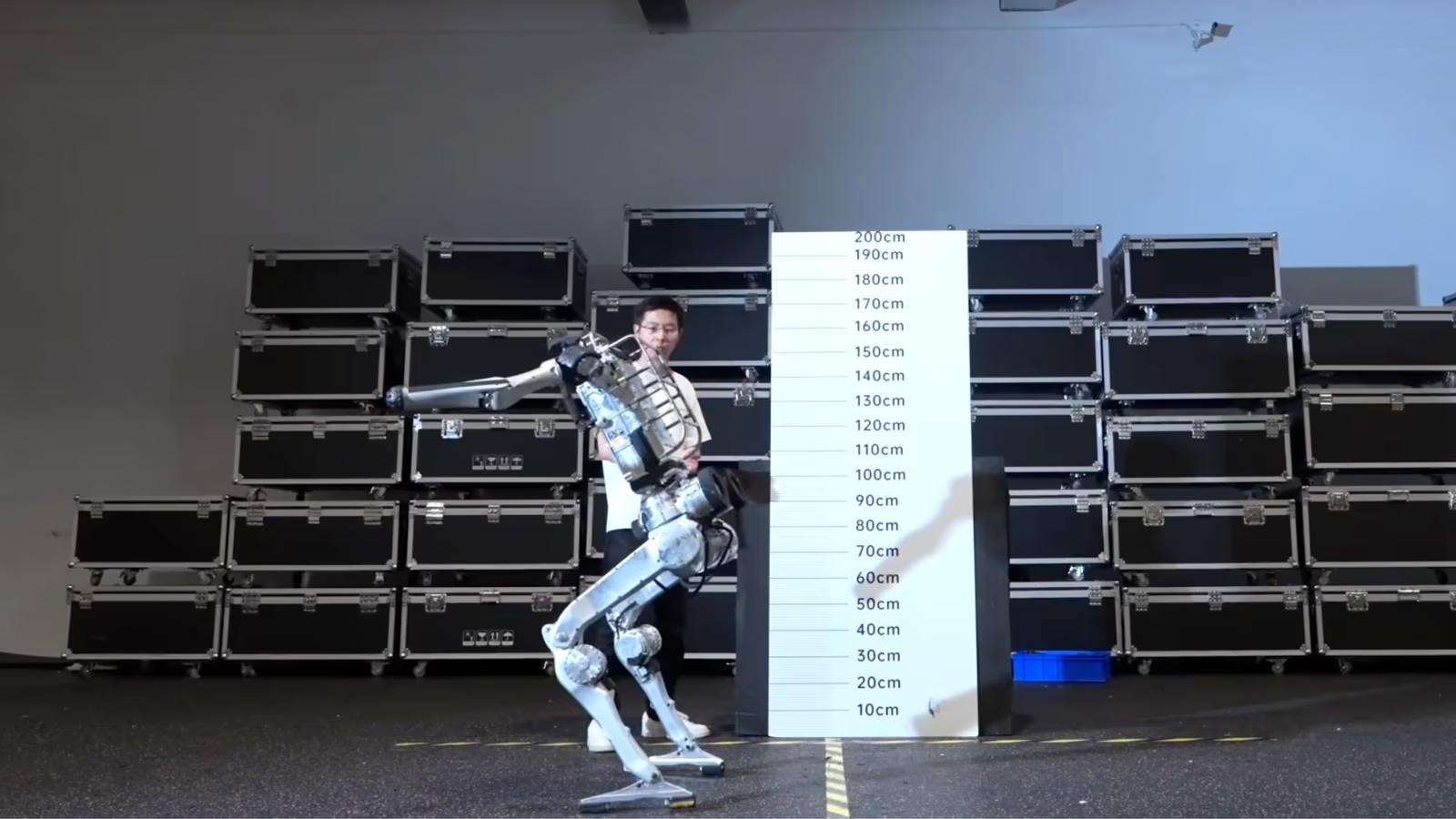
Matthew Berman covers Industrial AI in this video.
The Death of "Dumb" Manufacturing
Historically, industrial automation was rigid. A robotic arm programmed to weld a car chassis would perform that exact action endlessly until a defect occurred, at which point an alarm sounded, the line halted, and human intervention was required. The "smart" factories of the early 2020s introduced sensors that could predict when a machine might fail, but the remediation was still entirely manual.
In 2026, the concept of "dumb" manufacturing is rapidly becoming extinct. The introduction of multimodal industrial models, AI systems that can simultaneously process vision, sound, thermal data, and vibration, has given factory floors a central nervous system. These systems don't just predict failures; they autonomously orchestrate the fixes.
Key Shift: Reactive vs. Autonomous
2023: A sensor detects a temperature spike in a milling machine. It alerts a technician via a dashboard. The machine runs sub-optimally for 2 hours before repair.
2026: A multimodal AI detects a microscopic acoustic anomaly 2 minutes before the temperature spikes. It autonomously adjusts the coolant flow, slows the spindle speed by 4% to mitigate the acoustic resonance, and pre-orders a replacement bearing for the next scheduled downtime, with zero human intervention.
This level of micro-optimization, applied across millions of variables per second, is fundamentally altering the unit economics of physical goods production. Companies leveraging these industrial models, like Tesla and Siemens, are reporting efficiency gains that were previously thought mathematically impossible.
Digital Twins as the New Operating System
The engine powering this revolution is the Digital Twin. While the term existed in the 2010s as a buzzword for 3D CAD models, a 2026 Digital Twin is a living, breathing software replica of a physical system, synchronized in real-time.
| Capability | Legacy Digital Twin (2022) | Anthropic-Integrated (2026) |
|---|---|---|
| Sync Latency | 30-60 Seconds (Batch) | < 5ms (Real-time Stream) |
| Predictive Depth | Single-variable failures | Cross-system cascading effects |
| Autonomy | Dashboard alerts only | Self-healing orchestration |
Technical Dossier: The Silicon Micro-Farm

To achieve the sub-5ms latency required for industrial robotics, compute has moved out of the cloud and into Localised Micro-Farms. These are modular, high-density inference clusters deployed directly on the factory floor:
- Air-Gapped Privacy: Mission-critical logic never leaves the physical facility, mitigating corporate espionage and external cyber-attacks.
- Liquid-Cooled Density: Utilizing direct-to-chip cooling to pack 4 times the compute per square foot compared to standard data centres.
- Redundant Power: Integrated battery storage and thermal energy recovery systems ensure the AI brain stays online even during grid failures.
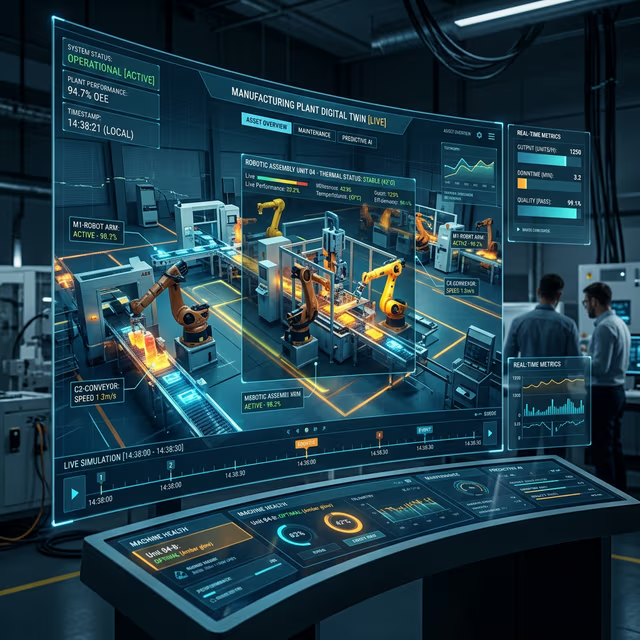
Digital Twin overlays bridging the gap between physical machinery and cloud-based AI simulations.
These systems act as the operating system for the industrial world. By feeding physical sensor data into a continuous simulation, the AI can fast-forward time to see the consequences of current actions. If a supply chain delay means a specific part will be late, the Digital Twin of the entire factory runs thousands of simulations to reorganize the assembly line schedule, ensuring other products are built first to minimize idle time.
The true breakthrough of 2026 has been the democratization of this technology. Previously requiring massive supercomputers, edge-deployed models running on localized inference chips can now maintain these sophisticated twins on site, ensuring near-zero latency and robust security even if the facility loses connection to the global cloud.
The Autonomous Supply Chain
The impact of AI extends far beyond the four walls of the factory. The global supply chain has historically been a fragile web of localized decisions. When a ship gets stuck in a canal, or a raw material shortage hits a specific region, human planners historically spent weeks untangling the mess via endless spreadsheets and phone calls.
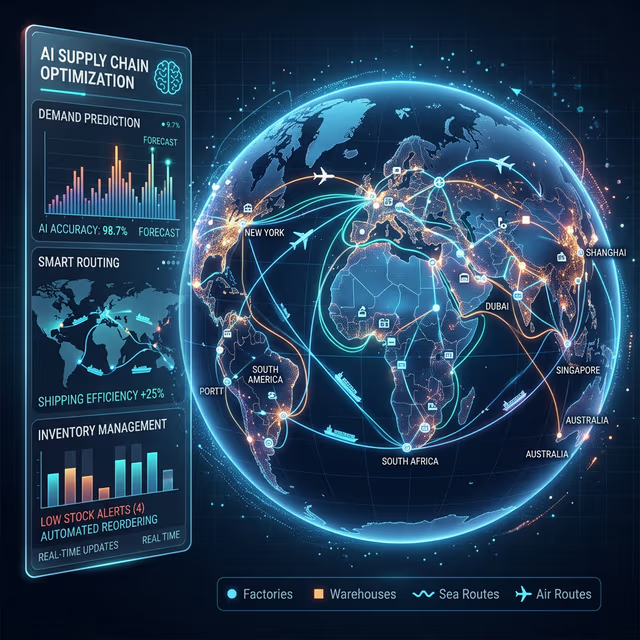
AI-driven supply chain platforms continuously re-route logistics based on real-time global risk data.
Today, the supply chain is an interconnected graph managed by specialized AI agents. These agents don't just react to problems; they proactively hedge against risks. Utilizing vast arrays of alternative data, satellite imagery of ports, local weather anomalies, geopolitical sentiment analysis, and even local social media traffic, the AI can predict a disruption before it is officially reported.
When a disruption is modeled, the AI supply chain agent autonomously executes alternative contracts, reroutes container ships mid-ocean to alternative ports, and adjusts the pricing of final goods dynamically to reflect the change in logistics costs. The result is a supply chain that bends but never breaks, drastically reducing the "bullwhip effect" that plagued industries post-2020.
Robotics: The Physical Interface of AI
If the Digital Twin is the brain, robotics provide the hands. The defining characteristic of 2026 industrial robotics is Generalization. Unlike the highly specialized, single-task robots of the past (which required months of coding to teach them how to pick up a slightly different shaped object), modern robots utilize embodied AI models.
These models are trained in physics-accurate virtual simulations long before they are deployed to physical hardware. They "learn" how to grasp, move, and assemble by succeeding and failing millions of times in the simulation. When the software is finally loaded onto the physical robot, it inherently understands spatial reasoning, force feedback, and object manipulation.
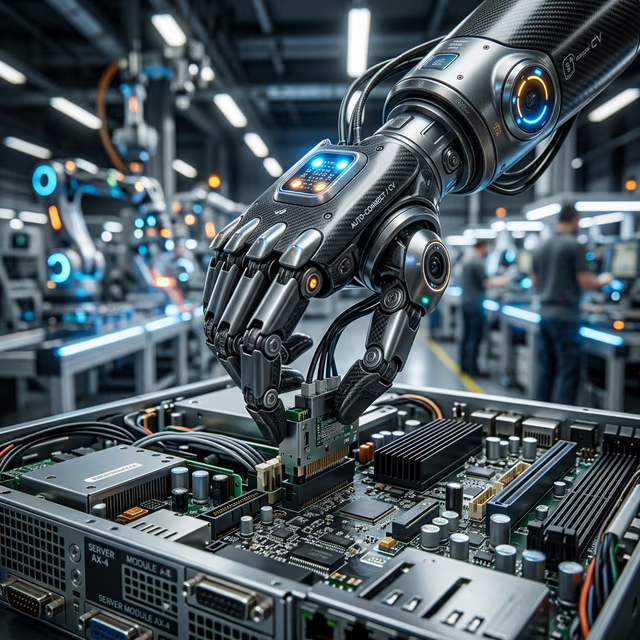
General-purpose robotic manipulators can seamlessly switch tasks based on visual cues, without reprogramming.
This means a factory no longer needs to scrap its robotics infrastructure when transitioning to a new product line. Instead of re-tooling hardware, companies simply download a new "skill" into the robot's neural network. A robotic arm that was sorting electronic waste in the morning can be tasked with precisely assembling optical lenses in the afternoon. This flexibility is the holy grail of high-mix, low-volume manufacturing.
Energy Optimization and the Green Mandate
Heavy industry accounts for a massive percentage of global energy consumption. The industrial AI revolution is proving to be the most effective decarbonization tool currently available. AI models trained on thermodynamics and grid economics operate facilities at an unprecedented level of energy efficiency.
- Dynamic Load Shifting: AI monitors the spot price of electricity and the availability of renewable energy on the grid. It shifts energy-intensive production phases to moments when power is cheapest and greenest, acting as a massive flexible battery for the grid.
- Thermal Optimization: In chemical and metallurgical plants, AI predicts exactly how much heat is required for a specific reaction, reducing fuel consumption by up to 20% compared to human-set safety margins.
- Waste Minimization: By catching defects instantaneously via computer vision, the amount of raw material wasted on doomed production runs has plummeted.
For many enterprise clients, the deployment of industrial AI pays for itself within months simply through the reduction of utility bills and raw material waste.
The Human Element: Augmented, Not Replaced
A common fear surrounding the Industrial AI Revolution is the mass displacement of blue-collar labor. The reality on the ground in 2026 is far more nuanced. While repetitive, dangerous, or highly precise tasks have been ceded to automation, the nature of industrial work has shifted toward "exception management" and strategic oversight.
The role of the factory worker has evolved from a machine operator to an AI pilot. Armed with Augmented Reality (AR) headsets or ruggedized tablets connected to the facility's Digital Twin, workers are guided to exactly where their human ingenuity is required. When the AI encounters an edge case it cannot solve confidently, perhaps a severely misaligned incoming part that risks jamming a feeder, it pauses, summons a human operator, and presents its top three recommended solutions.
The "Cobot" Paradigm
This collaborative environment has given rise to the "Cobot" (Collaborative Robot) paradigm. Rather than being caged off for safety, modern industrial robots are force-limited, sensor-rich, and designed to work shoulder-to-shoulder with humans. The AI handles the heavy lifting and precise repetition, while the human provides the strategic adaptability and final quality assurance judgment.
This transition, however, is requiring a massive reskilling effort. The industrial workforce of today must be comfortable interpreting data streams, interfacing with AI models, and troubleshooting complex software systems. Companies that invest in upskilling their workforce to harness these AI tools are vastly outperforming those who attempt to simply replace human capital with automation.
Security: The Industrial Cyber Battleground
With the industrial world now fully digitized and interconnected, the attack surface for cyber threats has expanded exponentially. The implications of a successful cyberattack on an AI-driven factory or power plant are catastrophic, potentially resulting in physical damage or loss of life, not just data theft.
As a result, industrial AI models are increasingly isolated within "air-gapped" networks or zero-trust architectures. The trend toward deploying powerful frontier models locally, via appliances like the Moltbook or dedicated Clawdbot server nodes, is largely driven by this security mandate. Heavy industry simply cannot afford the latency or the vulnerability of routing mission-critical decision-making algorithms through the public internet.
Furthermore, AI is fighting AI on the security front. Threat detection systems utilize identical multimodal logic to establish a baseline of "normal" operational behavior for a facility. Any deviation, whether it's an unusual packet of data being sent, or a valve opening 2% faster than it usually does, is instantly flagged, quarantined, and simulated in a sandbox to determine if it is a targeted attack.
Looking Forward: The Self-Replicating Factory?
As we look toward the end of the decade, the trajectory is clear. The convergence of generative AI logic, robust digital twins, and generalizable robotics is paving the way for "lights out" manufacturing, facilities that can operate entirely without human intervention.
However, the more fascinating development is the concept of the Self-Optimizing Factory. We are beginning to see environments where the AI overseeing a plant can redesign the physical layout of the facility to improve throughput, issuing work orders to human contractors to move conveyor belts or install new robotic cells based on its own simulated discoveries.
The Industrial AI Revolution is arguably the most significant economic force of our era. By driving efficiency, sustainability, and unprecedented agility into the physical world, it forms the foundation for the next chapter of global growth. For companies navigating this landscape in 2026, embracing industrial AI is no longer a matter of competitive advantage, it is a matter of pure survival.