 AI Tools Review Editorial Team
Quick Answer:
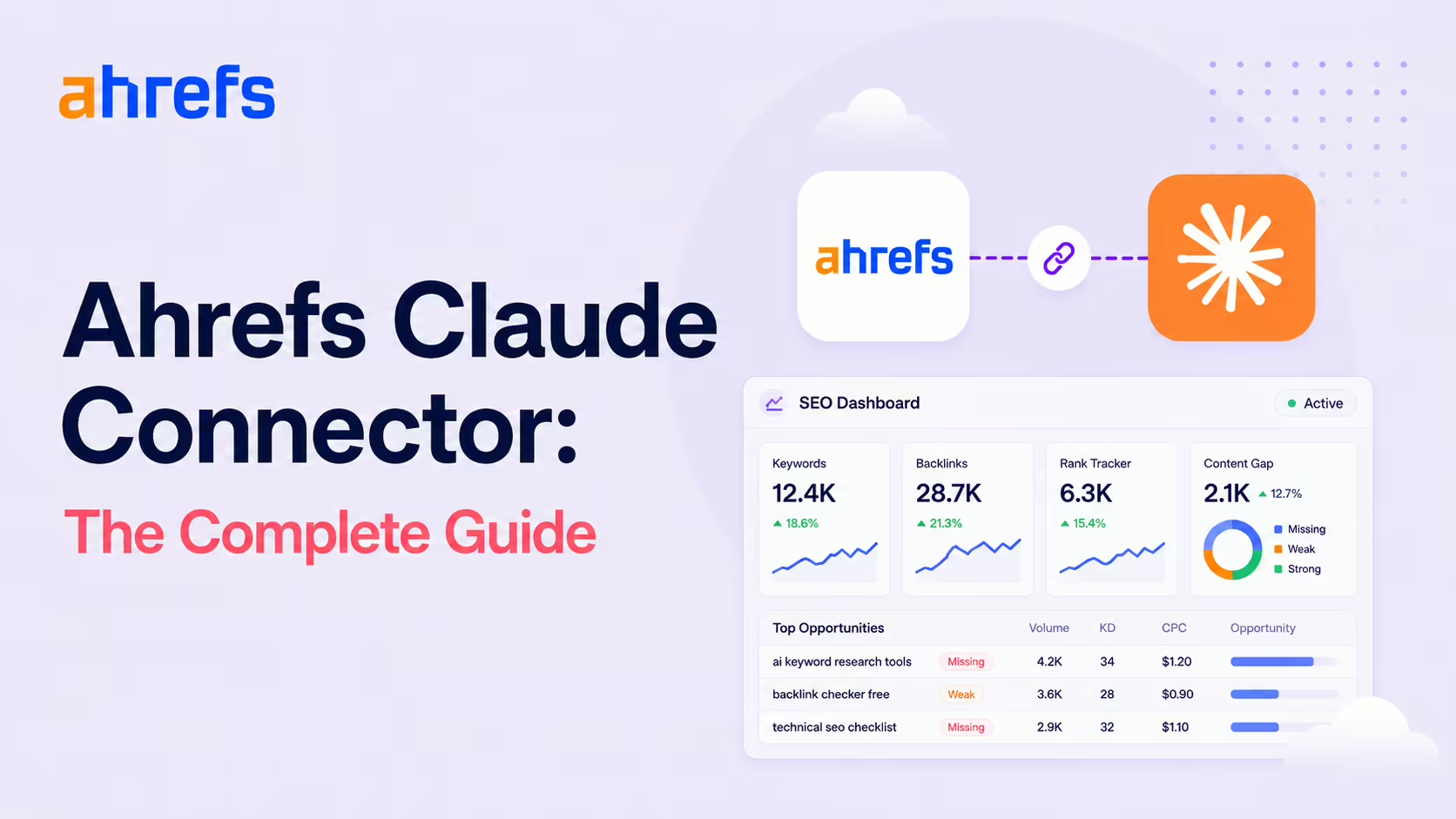
The Ahrefs MCP brings live SEO data into Claude. Run keyword, backlink and competitor research, query domain ratings, check search volumes by country, pull anchor text and referring domains - all in plain English. Ahrefs' own use-cases blog reports teams seeing a 45% productivity increase versus manual CSV exports. Find it in the Claude Connectors Directory.
SEO research is the original CSV-export workflow. The Ahrefs MCP makes it a conversation instead.
Volume, difficulty, SERP, backlinks - all answered by Claude inside one prompt, with the underlying data straight from Ahrefs.
Overview
The Ahrefs MCP connector lets you connect Ahrefs to Claude and run keyword, backlink and competitor research requests from one chat. It's Ahrefs' own implementation of the Model Context Protocol - the same standard the rest of the connector ecosystem uses - so you get live Ahrefs data alongside whatever else Claude is doing in the conversation.
The coverage is broader than most people assume. Ahrefs' MCP page describes integration across its whole product surface: search marketing tools (Site Explorer, Keywords Explorer, Rank Tracker, GSC Insights and Brand Radar), website performance tools (Site Audit, Web Analytics and Bot Analytics), content marketing tools (Content Explorer, AI Content Helper and Social Media Manager), reporting (Dashboard, Portfolios and Report Builder) and even local SEO via the GBP Monitor. Ahrefs lists Claude alongside ChatGPT, Cursor and Copilot Studio as supported clients, so the same server powers your whole AI stack - though for Claude users the official connector listing at claude.com/connectors/ahrefs is the cleanest entry point.
Ahrefs' own framing of the server is task-shaped rather than tool-shaped. The official MCP page pitches it at six recurring jobs - keyword research, competitive analysis, backlink audits, content planning, content gap analysis and on-page SEO recommendations - and highlights multi-site work that's painful in the UI, such as tracking organic traffic over time for any list of competitors or pulling backlink profiles across several sites in one request. Full client-by-client setup guides live at docs.ahrefs.com/mcp, with dedicated walkthroughs for Claude, ChatGPT, Cursor and Copilot Studio.
What the Claude Connector Does
- Query domain ratings and authority metrics for any website.
- Pull comprehensive backlink data including anchor text and referring domains.
- Check search volumes for keywords across different countries.
- Analyse competitor link profiles without switching between tools.
- Generate content briefs with volume, difficulty, SERP and related terms.
- Run rank-tracking digests on a schedule.
- Batch analysis - compare SEO metrics across up to 100 domains or URLs at once.
Real Use Cases
- Automated content brief generation: when a target keyword is added to a planning spreadsheet, an agent pulls volume, difficulty, top-ranking pages and related terms - the brief writes itself.
- Weekly rank tracking digest: an agent pulls the latest keyword positions on a schedule, compares them to prior weeks, and flags significant changes in Slack.
- Backlink audits: "show me the worst-quality backlinks pointing at this URL in the last 90 days".
- Competitor link profile analysis: compare topical authority and link velocity across rivals.
- Content-gap analysis: "what keywords are my top three competitors ranking for that I'm not?".
A Worked Example: Brief in 90 Seconds
- You give Claude a target keyword: "content brief for 'best AI image generators'".
- Claude queries Ahrefs for search volume across markets, keyword difficulty and SERP composition.
- It pulls top-ranking pages and their content patterns.
- It surfaces related terms and "people also ask" queries.
- You get a structured brief in well under two minutes.
The 45% Productivity Number
Ahrefs' own use-cases blog reports teams using the Ahrefs MCP inside Claude seeing a 45% productivity increase versus manual CSV exports. Take any vendor's productivity claim with a pinch of salt - but the underlying reason is sound. A meaningful share of SEO work is "export, filter, summarise, paste"; the MCP collapses that loop into a single conversation.
Real-World Experience
Reception across Ahrefs' own MCP product page, Anthropic's connector listing, the Composio Claude Code and Agent SDK toolkits, GetPassionfruit's "MCP Connectors for Marketing" overview, Xseek's "Best SEO Tools that integrate with Claude Code" piece, Merge.dev's setup walkthrough and Shinzo's "5-minute setup" guide is strong - particularly for the content-brief and rank-tracking digest workflows.
Honest counterpoint: the connector inherits Ahrefs' pricing and rate limits. Heavy use against large keyword sets still costs - just less time-wise than the manual path.
It's also worth noting that the experience differs by tier in ways that show up day to day. The per-request row cap (100 rows on Lite, 250 on Standard, 500 on Advanced, uncapped on Enterprise) is the figure practitioners bump into first: a Lite account doing competitor research across a large keyword set will see truncated tables long before it exhausts its monthly unit pool. Teams that plan around the cap - top-N requests, country filters, date bounds - report far smoother sessions than those that ask for everything at once.
How to Set It Up
Ahrefs now runs a remote-only MCP server - the older local-install route has been retired, so there is no package to run and no token to keep in a config file. For Claude Code, add the hosted endpoint over HTTP:
claude mcp add ahrefs https://api.ahrefs.com/mcp/mcp -t httpRun /mcp, choose Ahrefs, and authenticate against your Ahrefs account. For the no-code path, open Settings → Connectors on claude.ai or Claude Desktop, find Ahrefs (or paste the same URL as a custom connector), and complete the sign-in.
Pilot the content-brief workflow first - one keyword, one brief - before wiring up an automated weekly rank digest. The remote server uses your Ahrefs API access under the hood, so the data the agent sees is exactly what your plan entitles you to.
Security and Permissions
The connector operates with your Ahrefs auth and account scope. Ahrefs data is generally non-PII, but as ever scope team access carefully - keyword strategy and link profiles can be commercially sensitive in agencies and competitive industries.
Common Problems and Fixes
- Looking for the local server: older guides reference an npm package or stdio install. That route is gone - only the remote server at
api.ahrefs.com/mcp/mcpis supported now. If a local config won't connect, switch to the HTTP endpoint. - Connection refused on a free account: the Ahrefs MCP requires a paid plan (Lite, Standard, Advanced or Enterprise). A free or trial account can't authenticate the server.
- Queries burn through API rows fast: Ahrefs meters data by rows returned. A broad backlink or keyword pull can consume a large slice of your quota in one prompt - constrain by date, country or top-N to keep usage sane.
- Batch analysis truncated: the batch tool compares up to 100 domains or URLs at once. Larger lists are silently capped - split them into batches of 100.
- Stale numbers versus the Ahrefs UI: some metrics update on Ahrefs' own crawl cadence, not in real time. A figure that differs from the dashboard is usually an index-refresh lag, not a connector bug.
- OAuth window never returns: if
/mcpkeeps prompting, the browser sign-in didn't complete - finish authentication in the tab before returning to the client.
Pricing and Availability
There is no separate charge for the MCP server, but it is gated to Ahrefs' paid plans - Lite, Standard, Advanced and Enterprise. Usage draws on your existing Ahrefs API allowances, metered by rows of data returned, so heavy automated research consumes quota exactly as it would through the API directly. That's the real cost to watch: the connector saves time, not API rows.
The allowances scale steeply by tier, per Ahrefs' own MCP page: Lite gets 100 rows per request and 100,000 API units a month; Standard raises that to 250 rows and 400,000 units; Advanced to 500 rows and 1 million units; and Enterprise removes the per-request row cap entirely with 2 million units a month. In practice that means a Lite account can run plenty of one-off briefs and digests, whilst an agency automating daily pulls across a client portfolio will want Standard or above - the per-request row cap is what truncates broad backlink and keyword pulls on the lower tiers.
On the Claude side, the connector works across Claude Code, Desktop and claude.ai with your normal Claude access. Because the server is remote and auto-updating, you always get Ahrefs' latest tool set without reinstalling anything.
Limitations
- Plan-dependent quotas: Ahrefs' usage limits apply via the MCP too - monthly API unit pools range from 100,000 on Lite to 2 million on Enterprise.
- Per-request row caps: a single tool call returns at most 100 rows on Lite, 250 on Standard and 500 on Advanced; only Enterprise is uncapped. Broad pulls get truncated, not refused, so sanity-check totals.
- Paid plans only: free and trial Ahrefs accounts cannot authenticate the server at all.
- SEO judgement still needed: the data is fast; the strategic call is still yours.
- Vendor-shaped: deep on Ahrefs metrics, narrower for cross-tool SEO orchestration.
Who It Is For
SEO managers, content strategists, growth marketers, performance agencies and anyone whose week includes recurring Ahrefs queries. The weekly rank-digest pattern alone justifies the setup for most in-house SEO teams.
The Bottom Line
The Ahrefs connector collapses one of the most common manual workflows in SEO - export, filter, summarise - into a conversation with Claude. Content briefs in 90 seconds, weekly rank digests on a schedule, competitor link profiles on demand. For SEO and content teams it's one of the highest-leverage marketing connectors in the directory.
Wire it up, automate one weekly digest, and watch a category of busywork disappear. Browse more in the complete Claude Connectors Directory.
Sources: Ahrefs (ahrefs.com/mcp, ahrefs.com/blog/mcp-use-cases), Anthropic (claude.com/connectors/ahrefs), Composio, GetPassionfruit, Xseek, Merge.dev, Shinzo. Images: Ahrefs. Last updated: June 2026.