
 AI Tools Review Editorial Team
Quick Answer:
A Wall Street Journal profile (late September 2026) reports that some early Anthropic employees have considered buying remote US land as a relocation option if AI goes badly wrong, and describes how effective altruism shaped the company's safety culture. Secondhand coverage says the talk centres on gatherings such as Constellation in Berkeley, where islands, bunkers and iodine stockpiles are discussed. Anthropic says its roughly 3,500 employees hold varied views. This is individual contingency planning reported by journalists, not a company programme, and it arrives as Anthropic prepares an IPO and faces political attacks over "doomerism".
"Anthropic is preparing for the AI apocalypse" is a gripping headline. It is also considerably stronger than what the reporting says. What the Wall Street Journal actually described is a culture in which some of the people closest to frontier AI are privately hedging against the outcome they publicly warn about.
That is still a significant story, because it touches three things at once: how safety-focused labs think about risk, how that thinking is being used against them in Washington, and what investors will make of it as Anthropic heads towards a public listing. This guide sets out what was reported, what has been added by commentators, and what you should and should not conclude.
AI Revolution X covers the WSJ reporting, then moves on to Geoffrey Hinton and intelligence-explosion warnings.
Executive Summary
- The reporting: the Wall Street Journal published a profile on how effective altruism shaped Anthropic, with a companion piece on Anthropic's moral conflict. AI Weekly's summary (27/09/2026) says some early employees are weighing buying remote US land as a relocation plan if AI goes awry.
- The scene: Il Foglio's summary (29/09/2026) says Constellation, a Berkeley co-working space, hosts groups discussing how an AI catastrophe might unfold, with islands, iodine tablets and shielded desert bunkers among the options talked about.
- The company line: Anthropic says its roughly 3,500 employees hold varied views, though some still attend effective altruism gatherings.
- The politics: a memo circulating inside the White House on 24/09/2026, written by a Trump political adviser who does not work there, casts Dario Amodei as the face of AI "doomerism" and blames effective altruism for building the "AI-doom pipeline".
- The timing: Anthropic is reportedly preparing a record-setting IPO.
- What is not reported: any company-funded shelter, any land purchase confirmed by the company, or evidence that these plans reflect Anthropic's official risk assessment.
Our view: the story is real but narrower than the headlines. It is best read as evidence about culture and belief, not about AI capability, and it should be weighed against what Anthropic itself publishes about risk and safety evaluations.
What Was Actually Reported
The primary source is a Wall Street Journal profile on how effective altruism (EA) shaped the AI safety movement and Anthropic in particular. We could not read the article itself, which sits behind the WSJ paywall, so our account relies on summaries by AI Weekly, Cybernews and Il Foglio, and on the video that popularised the story. Where those summaries differ, we say so. AI Weekly credits the profile to Robert McMillan, though its own byline differs, so attribution is inconsistent across summaries.
The core claim is limited and specific: some early Anthropic employees are considering buying remote land in the United States as a relocation plan if AI outcomes turn catastrophic. The word "considering" matters. Cybernews describes the idea as discussed and weighed, not executed.
Il Foglio adds colour from the same reporting. According to its summary, employees swap apocalyptic scenarios and preparation tips in a private Slack channel and joke about the motto "Things will never be chill again" on their laptops. The WSJ is also said to describe gatherings dominated by Anthropic employees, although one summary treats that as a looser claim than the others, so we regard it as the weakest-sourced detail.
It also places Anthropic in a longer story. The doomer movement, the summary says, has roots in debates that began before modern AI existed, inspired by Eliezer Yudkowsky's blog writing in the 2000s, including a 2022 retreat in the Bahamas where he gave a talk titled "A Disorganised List of Reasons for AGI Doom". It lists the concerns as loss of control and malicious human use, with the paperclip thought experiment as the standard illustration, rather than Hollywood-style robots.
Constellation and the Berkeley Scene
Constellation is a co-working space in Berkeley, California. In the summaries of the WSJ reporting it appears as a place where people who work on AI risk gather, and where "self-awareness" style groups discuss what an AI-driven catastrophe might look like and how to cope with it personally. The options mentioned are the sort that make headlines: private islands, iodine tablets, and electromagnetically shielded bunkers in the desert.
It is worth being precise about what this is. A co-working space hosting discussions is not a prepper compound. People at a gathering talking through scenarios, including extreme ones, is different from purchasing property. Cybernews and Il Foglio both describe talk and consideration. A responsible reading is that a subculture comfortable with very low-probability, very high-impact scenarios also discusses personal hedges, some of which sound absurd out of context.
That subculture is not unique to Anthropic. Il Foglio notes that Sam Altman, asked whether he has a bunker, said he has "some sort of structures" but would not call them a bunker. Wealthy people in several industries buy remote property for many reasons, and the article lists examples such as a luxury underground shelter being built in a Turin building. The distinctive part of the Anthropic story is not the existence of hedging but who is doing it: people who build the technology they fear.
Effective Altruism and the Founding Story
The WSJ profile is, at its core, about how EA shaped Anthropic. Effective altruism is a philosophy and community focused on using evidence to do the most good, and since the 2010s a large part of it has concentrated on existential risks, including from AI. A number of early Anthropic staff came out of that world, and part of Anthropic's early funding came from EA-associated networks.
The most uncomfortable thread is financial. Il Foglio notes that Sam Bankman-Fried, now serving a 25-year prison sentence, was one of Anthropic's earliest backers, and the Cybernews summary says FTX invested in Anthropic in 2022 before its collapse. Il Foglio also cites a memo from a Bankman-Fried foundation that proposed buying the Pacific island nation of Nauru as a "bunker/refuge", anticipating an event in which "between 50 per cent and 99.99 per cent" of the population would die. That memo is not about Anthropic, but its inclusion tells you how the WSJ frames the wider scene.
Anthropic's response, as relayed in the summaries, is that its roughly 3,500 employees hold a range of views, and that some do still attend EA gatherings. Daniela Amodei, Anthropic's president, said in a 2025 Wired interview that she does not identify with the EA label, according to AI Weekly. The company's safety work, meanwhile, is public and technical, as in the research we covered in Anthropic's multiagent safety research.
The Earlier Warnings: Coxon and Hubinger
The land story did not appear from nowhere. Il Foglio recalls that Anthropic researcher Jacob Coxon resigned in early September, saying rival OpenAI was racing to develop technologies that "could kill us all by the end of the decade". Minutes later, colleague Evan Hubinger wrote: "We truly and sincerely believe that AI could kill all human beings!" and estimated the extinction risk over the next decade at over 10 per cent.
We covered the resignation, the exact quotes and Hubinger's on-record response in Jacob Coxon quits Anthropic: the full story. The relevant point here is consistency. People who publicly say the risk is above 10 per cent over a decade are, unsurprisingly, the people who might privately discuss hedges. Whatever you think of the probability, the behaviour matches the stated belief.
It also matches the company's public posture. Anthropic has called for stronger international coordination; see our coverage of Anthropic's call for a global AI pause. On 23/09/2026, according to AI Weekly's summary of the Axios report, Dario Amodei told the UN Security Council by video that AI could be a risk to humanity if poorly managed and called for narrow international rules, starting with a ban on AI-designed bioweapons.
The Political Backdrop: The "Doomerism" Memo
The WSJ reporting landed in a charged political week. Axios reported that a memo circulating inside the White House on 24/09/2026 casts Dario Amodei as the face of AI "doomerism". It was written by a Trump political adviser who does not work for the White House. It says effective altruism "built the AI-doom pipeline", names Dario and Daniela Amodei as builders of the EA network and calls their family ties "The Anthropic knot". An anonymous senior official told Axios that "Dario's a little too weird" for the president.
On the same day as the UN session, OSTP director Michael Kratsios called such governance efforts a "globalist scheme". Days earlier, Google, OpenAI and Anthropic were reportedly courting White House adviser Sriram Krishnan to lead a proposed AI safety body.
Put together, the doomsday-land story is fuel for a political argument: that Anthropic's safety positions come from a fringe belief system rather than evidence. That is a debatable inference, and the memo's author has an interest in making it. It is also why readers should separate two questions that tend to get merged: is the belief system unusual, and is the safety evidence sound? They have different answers and different kinds of proof.
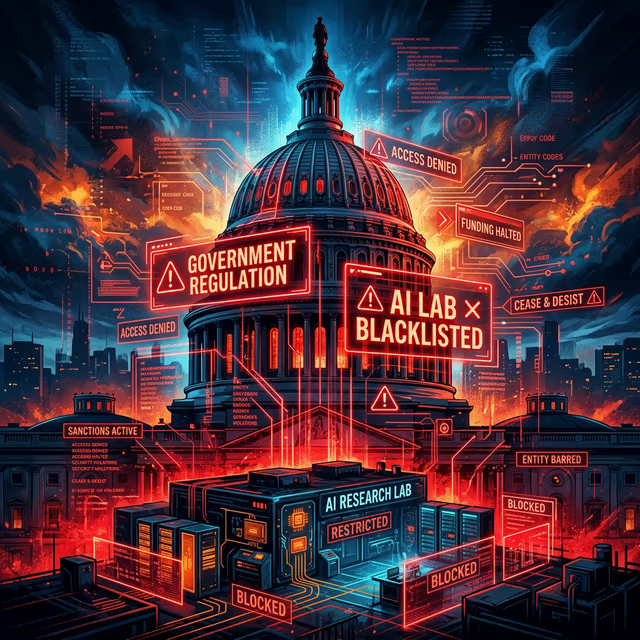
For the longer history of the company's relationship with the US government, including the earlier dispute that led to a blacklisting, see our explainer on Anthropic blacklisted by the US.
The IPO Angle
Anthropic is reportedly preparing a record-setting IPO. Our analysis of the leaked prospectus numbers is in Anthropic IPO prospectus: revenue, losses and compute, which reported $4.6bn revenue, an $8bn operating loss and $518bn of compute commitments. A public listing brings disclosure requirements, and risk-factor sections invite exactly the kind of questions this story raises: how much of the company's strategy depends on the founders' beliefs, and how might key-person or culture risks affect the business?
There are two investor readings. The sceptical one says that staff who expect catastrophe may not be the best stewards of a company with $518bn of commitments. The sympathetic one says that taking tail risks seriously is part of why Anthropic has emphasised safety research and why some enterprise customers trust it. Neither can be settled by this reporting.
What investors will want, and what the story does not provide, is evidence about behaviour: how the company handles disagreements, what safeguards constrain its own models, and whether leadership's risk estimates are reflected in its deployment decisions.
What the Video Adds, and What It Overstates
The AI Revolution X video that spread the story frames it as "Anthropic is actually preparing for the AI apocalypse now". Its chapters walk through the WSJ pieces, then widen to Geoffrey Hinton and scientists at OpenAI and Anthropic warning that AI could trigger an intelligence explosion, citing an arXiv paper and a report from the Center for AI Safety and Policy (casp.ac) that we have not independently reviewed.
The widening is legitimate: AI automating AI research is a serious topic, and we have written about it in OpenAI's An Alien Mind essay and in Weco's AIDE² claims. But the title is stronger than the evidence. "Anthropic is preparing" implies a company decision. The reporting describes individuals considering options. Treat the video as a good pointer to sources, and the sources as better than the video.
What This Means If You Use Claude or Anthropic Products
For most users, nothing changes. The land discussion has no bearing on whether Claude works, how it is priced or how it is governed. If you are choosing an AI vendor, base the decision on capability, price, data handling and track record. Our Claude Opus 5.5 review and the latest model coverage are better guides than a profile of staff culture.
For enterprise buyers and risk teams there is a narrower question: does the vendor's safety culture produce useful, testable commitments? Look for published system cards, responsible scaling policies, evaluation results, red-team findings and incident disclosures. A vendor whose staff worry publicly about catastrophic risk and also publish detailed evidence of the failures they find is, arguably, providing more information than one that does not.
For policy readers, the lesson is to resist both extremes. "They are building bunkers, therefore the risk is real" is not an argument, and neither is "they are building bunkers, therefore the risk is fake". The evidence for or against catastrophic AI risk has to come from measurements of what systems can do and how well they can be controlled.
Limits of the Reporting
- We have not read the WSJ articles. They are paywalled; our account rests on secondary summaries, which vary in detail.
- "Considering" is not "buying". No summary reports a completed purchase.
- Attribution is inconsistent. Summaries credit different authors and describe different gatherings.
- Scale is unknown. We do not know how many people are involved among Anthropic's roughly 3,500 employees.
- The headline image is illustrative. The photograph used here is an archive-style image from Il Foglio's feature; it does not show Anthropic staff or property.
- Political framing. Several of the sources are partisan or aggregator sites; we have tried to rely on named, checkable claims.
The Bottom Line
The WSJ story is best understood as a portrait of a culture, not a plan. Some of the people who helped build one of the world's most valuable AI companies privately discuss hedges against the outcome they publicly warn about. That tells us they mean what they say, and it hands critics a vivid line of attack as Anthropic nears an IPO and navigates a hostile White House. It does not tell us whether the risks are real. For that, read the system cards, the safety research and the independent evaluations, and keep the bunker talk in proportion.
Sources
- AI Weekly: WSJ, Early Anthropic Employees Weigh Buying Remote US Land as Relocation Plan if AI Goes Awry (27/09/2026): the core claim and attribution.
- Cybernews: Anthropic's AI doomers are buying land for the apocalypse: secondary summary of the WSJ report (we could not open the full page; details taken from search summaries).
- Il Foglio: Apocalyptic and Buried (29/09/2026): Constellation, the Slack channel, Coxon and Hubinger quotes, and the wider survivalist context.
- AI Weekly: Trump-Ally Memo Names Amodei as Face of AI Doomerism: summary of the Axios report on the White House memo and the UN Security Council session.
- AI Revolution X on YouTube: Anthropic Is Actually Preparing for the AI Apocalypse Now (08/10/2026): the video this article responds to.
- Image: archive-style photograph of a family in a mid-century fallout shelter, as used by Il Foglio to illustrate its feature. The page gives no photographer or agency credit. It is illustrative only and does not depict Anthropic employees.
Last updated: 11/10/2026. Based on secondary summaries of Wall Street Journal reporting; we have not read the original articles and Anthropic has not announced any land purchases.
Get the free guide: Claude vs ChatGPT, Gemini & Grok
A 20-page playbook covering everything you need to choose and use the big four AI models in 2026, full cost and feature comparisons, what each is best (and worst) at, and how-tos for images, vectors, building a website, Claude Code and more.