 AI Tools Review Editorial Team
Quick answer:
On 27 August 2026, Anthropic opened a research preview of the Model Hardware Standard (MHS): a shared specification that lets Claude discover and safely operate physical lab and manufacturing equipment - microscopes, liquid handlers, robotic arms, laser systems - through standard "read" and "write" drivers instead of bespoke, device-by-device integration. In early partner testing it compressed hardware integration from weeks to hours, ran a real qPCR pollution study, and pushed a quantum computer's laser stabilisation success rate from 58% to 99.3%. It is not open source yet, and Anthropic is upfront that current models still need human guidance on physical failure modes.
Every model release this year has been about what Claude can reason through on a screen. MHS is Anthropic's first serious move into what Claude can physically touch - and the case studies published alongside it are unusually specific for a research preview: real institutions, real instruments, real failure logs.
This article separates what MHS actually is from the hype around "AI running the lab", walks through every published case study with its real numbers, and covers the safety caveats Anthropic itself flagged rather than glossing over them.
Primary source: Anthropic's Model Hardware Standard research preview announcement. Additional reporting from CNBC and Fortune.
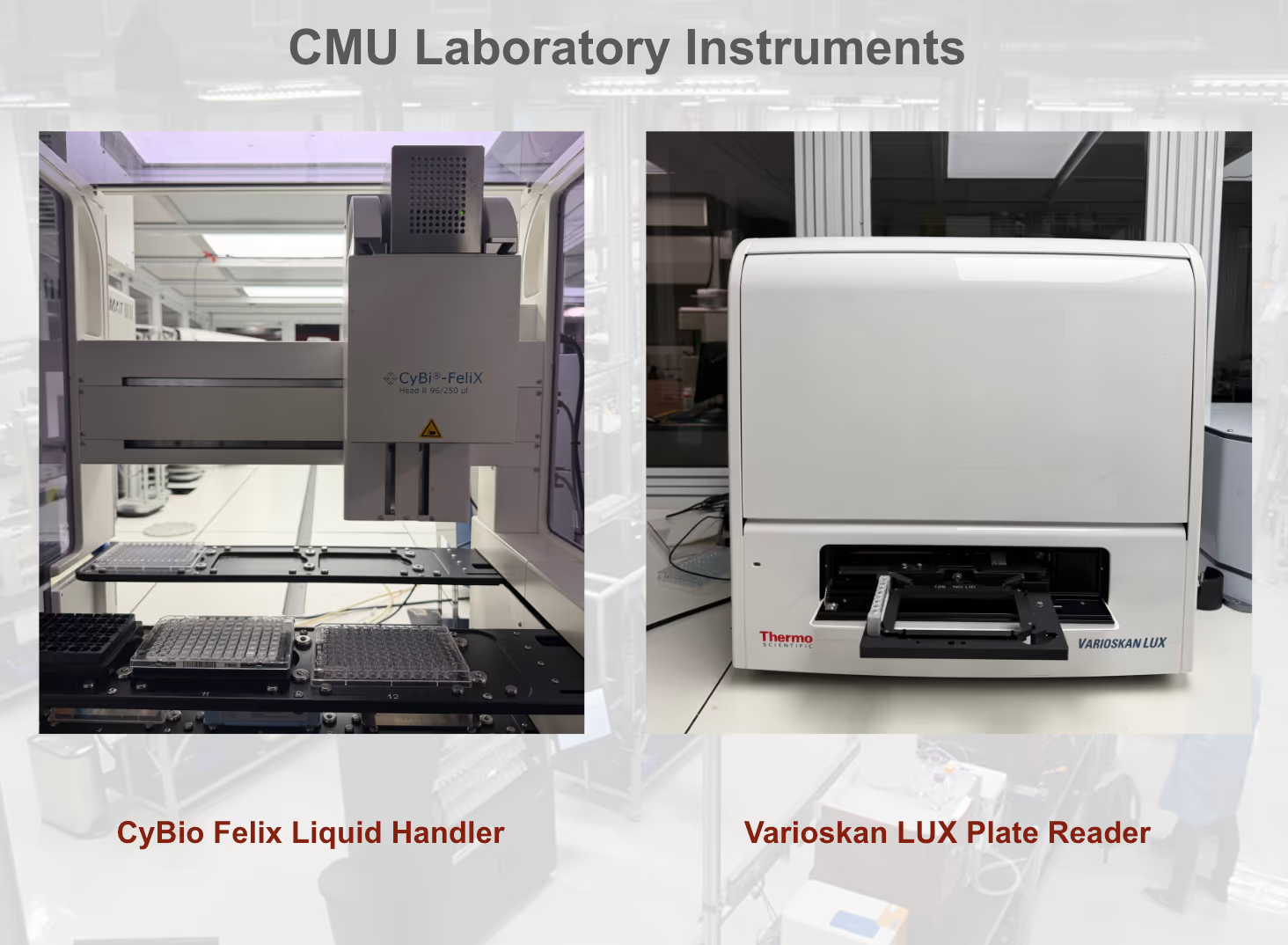
Anthropic's own walkthrough of MHS: the driver architecture, the safety limits, and a look at the connected lab instruments.
Executive summary
- MHS is a driver standard, not a robot. It translates between an AI agent and any device with a programmable interface, using simple read/write primitives rather than a bespoke integration per instrument.
- Integration drops from weeks to hours. Carnegie Mellon connected a full liquid-handling and imaging setup in about eight hours; a typical vendor integration takes weeks.
- The QuEra result is the headline number. Laser stabilisation on a quantum computer improved from 58% success (150 seconds to recover) to 6 seconds and 96% in development testing, and 99.3% (695 of 700 trials) in a later blind test.
- It produced a real scientific finding. A qPCR water-quality study using MHS-controlled instruments detected human-specific faecal contamination markers in a real creek sample.
- It is model-agnostic by design. MHS runs over the Model Context Protocol, so any agent harness can use it - though every published result so far used Claude, since Anthropic built and operates the preview.
- Anthropic is candid about the gaps. Models still struggle with physical judgement calls - bubble formation, fluid-detection ambiguity - that Anthropic says require human-defined failure modes for now.
- It is not open yet. MHS is a research preview shared with named partners; Anthropic says it plans to open-source the standard once safety evaluations mature.
What the Model Hardware Standard actually is
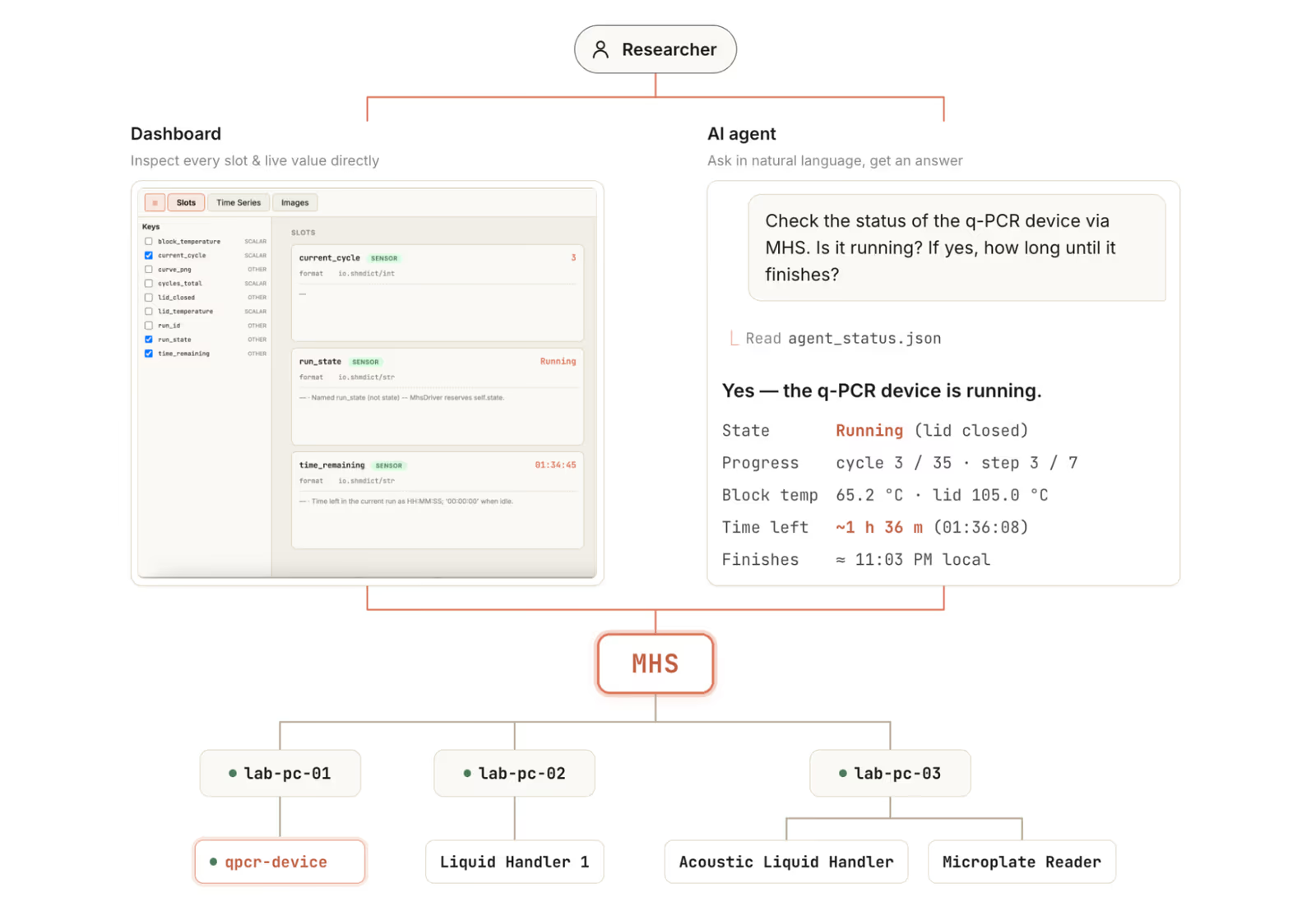
Connecting an AI agent to a piece of lab or factory hardware has, until now, meant bespoke engineering for every single device: a custom driver for the liquid handler, a different one for the robotic arm, another for the microplate reader, each written by hand and rarely reusable across labs. Anthropic's pitch with MHS is that this doesn't need to be true anymore. Most instruments already expose some programmable interface - a command-line tool, an API, a serial protocol - and MHS wraps that interface in a standardised driver that speaks a common language: simple "read" commands to check a device's state, and "write" commands to change it.
On top of that, MHS keeps a shared state dictionary in memory so an agent can see what every connected device is doing at once, attaches natural-language tags describing each device's characteristics so a model can reason about what it's controlling, and auto-generates a reference file of each device's specifications rather than requiring a human to document it. The result, in Anthropic's own framing, is that hardware becomes discoverable: an agent can find out what's connected and what it can do, rather than a human pre-wiring every possible action in advance.
This matters because the actual bottleneck in automating a lab or a manufacturing line has rarely been the AI reasoning - it's been the plumbing. Anthropic says a typical hardware integration project takes days to weeks even before any experiment starts; several of the partner case studies below cut that to single-digit hours.
How MHS works under the hood
Technically, MHS sits between an agent harness and physical hardware in three layers. First, a device-specific driver - the only genuinely device-specific piece - handles the low-level translation to whatever interface the manufacturer actually exposes (a command-line tool, code files, or a proprietary API). Second, a standard protocol layer exposes those drivers to any agent using the Model Context Protocol (MCP), the same open standard Anthropic uses elsewhere in Claude's tool-use stack. Third, a safety layer enforces device-level limits before any physical movement happens - for example, capping how much power a laser is allowed to output, or refusing a liquid-handling command that would exceed a safe volume.
Because the protocol layer is standard MCP, MHS is explicitly model-agnostic: Anthropic's documentation states any agent harness can access connected hardware through it, not only Claude. In practice, every case study published in this research preview was run with Claude, since Anthropic is the one operating the preview and working directly with partners - but the architectural claim is that a lab isn't locking itself into one AI vendor by adopting MHS drivers.
The discovery mechanism is what makes this different from a normal API integration. In a conventional setup, an engineer decides in advance exactly which functions an AI system is allowed to call on a given device, and codes each one by hand. MHS flips that: once a driver exists for a device class, an agent can query the shared state dictionary to find out what is physically connected to a given lab bench right now, read the auto-generated reference file to understand what that device can do, and then decide for itself which read/write calls are relevant to the experiment in front of it. That is a meaningfully different division of labour - the human still designs the experiment and sets the safety limits, but the agent works out the plumbing of which instrument to talk to and when, rather than following a fixed sequence a human pre-scripted.
Anthropic also lists a growing set of hardware vendors and platforms MHS already works with or has been tested against, including AWS's Strands Robots library, Universal Robots, Tecan's Fluent liquid-handling platforms, QIAGEN's QIAsymphony Connect, Danaher, Doosan Robotics, MBF Bioscience's ScanImage, Automata's LINQ platform, Hugging Face's LeRobot, and even hobbyist-grade Raspberry Pi setups - a deliberately wide net spanning enterprise lab automation and DIY robotics alike.
What partners have actually built with it
This is the part most coverage of MHS skips past in favour of the headline framing. Anthropic published six named case studies with specific numbers, not just demo footage - worth walking through individually, because the failures are as informative as the successes.
Genentech: automating a protein assay
Genentech used MHS to automate a bicinchoninic acid (BCA) protein assay - a standard drug-discovery measurement - across a liquid handler, a robotic arm and a microplate reader working together. Claude tuned the liquid-handling flow rates itself during the run: water dispensing settled around 140 µL/second with a 0.016 root-mean-square error, and the more viscous BSA protein solution at 10 µL/second with a 0.181 error. The more notable result wasn't the tuning, though - it was that the system recovered from real equipment failures mid-run, including a tip pickup failure and a fluid-detection error, without a human intervening.
University of Washington: six instruments in a week
The Baker and Pinglay labs at the University of Washington integrated six separate instruments in under a week using MHS - a timeline that would typically run to months for a from-scratch academic lab automation project. The system handled real-time qPCR monitoring with curve analysis as it ran, and coordinated handoffs of microplates between a liquid handler and a robotic arm without the two colliding - a genuinely hard robotics coordination problem when two independently-controlled arms are working the same physical space.
Carnegie Mellon: faster dose-response testing
Carnegie Mellon ran serial dilution dose-response experiments - preparing a descending series of drug concentrations to test against a biological sample - roughly three times faster than their previous manual process, after an integration that took about eight hours rather than the typical multi-week vendor timeline. The system achieved an R² above 0.98 on its concentration curves and autonomously adjusted its concentration range mid-experiment when early results suggested the original range wouldn't capture the interesting part of the dose-response curve. Just as tellingly, when researchers deliberately introduced six artificial error conditions to test the safety layer, the system correctly blocked all six.
HHMI Janelia: weeks of microscopy in a day
The Howard Hughes Medical Institute's Janelia Research Campus used MHS to unify seven separate vendor microscopy programs that previously had no shared interface - each speaking its own proprietary software language. Anthropic says this reduced hardware integration work from a multi-day project to minutes, and enabled "online analysis" where the same data-processing transforms could be reused live across different instruments' data streams, including live heart-rate tracking with predictive, phase-locked stimulation timed to that signal - a use case that depends entirely on instruments being able to talk to each other in real time, not just individually.
QuEra: stabilising a quantum computer's lasers
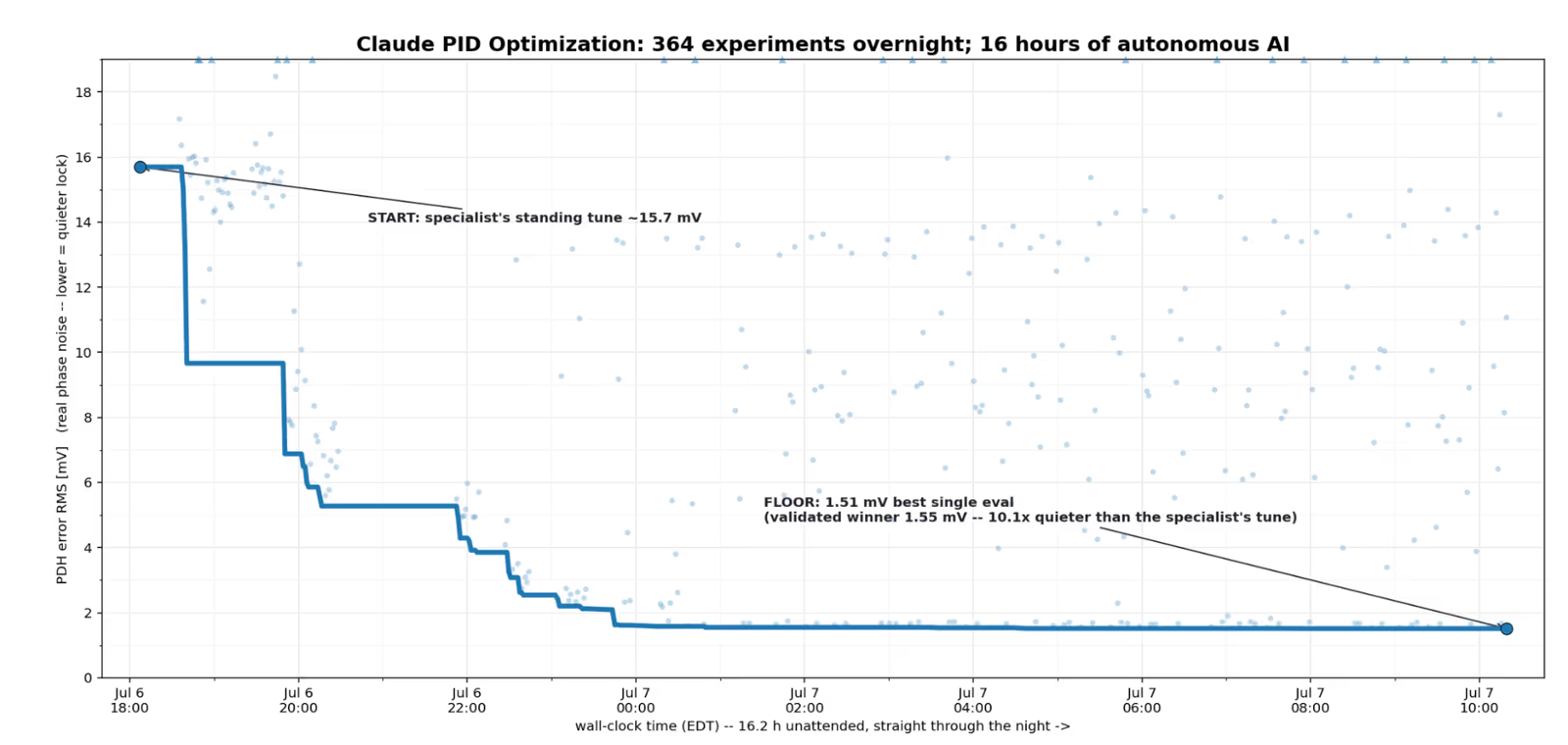
The most dramatic numbers in the whole preview come from QuEra Computing, which used MHS to automate laser frequency stabilisation on its quantum computers - a delicate physics problem where lasers drift out of alignment and need constant correction to keep qubits stable. Before automation, recovering from a laser losing lock took about 150 seconds with a 58% success rate. With Claude operating the laser system through MHS, that fell to 6 seconds and rose to 96% success in development testing, and Anthropic's later blind test - run without the model knowing it was being formally evaluated - hit 99.3% (695 of 700 trials). On PID control-loop tuning specifically, residual error dropped roughly tenfold, from 15.7 mV to 1.55 mV, and over a 19-hour stability run the system recorded zero unlock events, against roughly 1.6 unlocks per hour for a specialist's manual tuning.
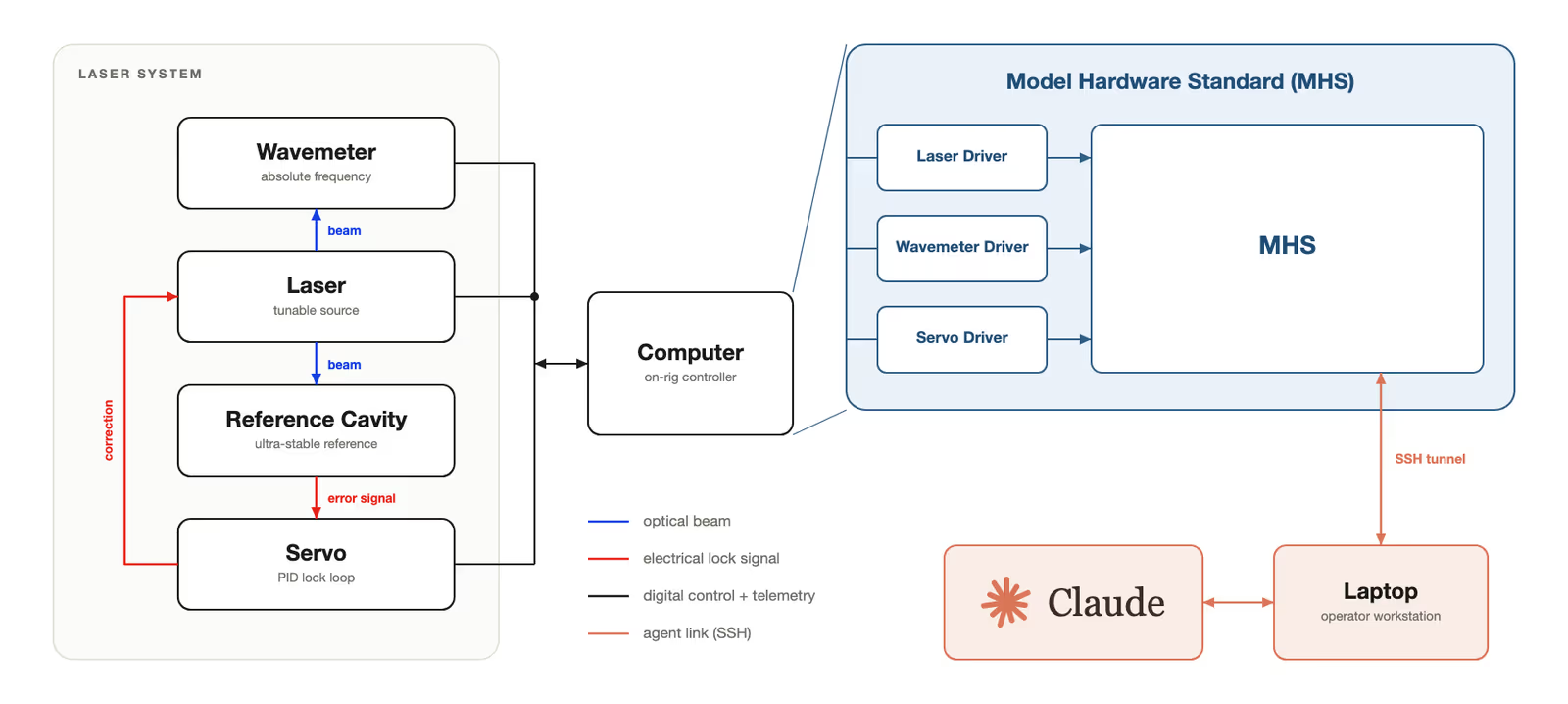
Anthropic's own description of the behaviour here is worth quoting directly, because it's an unusually candid research note for a company also selling the product: Claude "interacts with experiments and hardware in an exploratory manner, much as a scientist would" - trying settings, observing the result, and adjusting, rather than following a fixed script. The chart below shows exactly that kind of exploratory tuning run.
Tetsuwan Scientific: a real pollution study
The most unusual case study is also the most scientifically concrete. Tetsuwan Scientific tested an MHS-controlled qPCR workflow across 9,143 individual liquid dispenses spanning 300 unique transfer types, and found the system's dispensing precision beat the manufacturer's own specification by roughly 12% across 31 of 45 test runs. That workflow was then pointed at a real environmental question: water samples from San Pedro Creek were tested for human-specific faecal contamination using the HF183 and BacH genetic markers - both indicators of Bacteroides bacteria specific to human waste, not animal. The qPCR amplification curves the automated system produced detected exactly those human-specific markers, meaning MHS didn't just automate a lab exercise - it was used to generate a real, if preliminary, water-quality finding.
Anthropic's second MHS video, focused on the exploratory, scientist-like way Claude runs and adjusts live experiments.
Safety, oversight and where models still fail
The safety design has two layers. Device-level limits are enforced in the driver itself, before any physical action happens - Anthropic gives the example of a hard cap preventing excessive laser power, regardless of what an agent requests. Above that, MHS is meant to block a request outright if it would put a device into an unsafe state, rather than executing it and hoping monitoring catches the problem afterward.
What's more interesting is what Anthropic admits doesn't work yet. The research preview's own write-up says current models "struggle with physical and chemical constraints" that an experienced human scientist would take for granted - the specific example given is recognising bubble formation in a protein sample, a visual judgement call that requires understanding what a bubble means for a downstream measurement, not just detecting one. Anthropic's stated position is that researchers still need to brief agents on physical failure modes in advance, because the models don't yet reliably infer them from first principles.
That is why Anthropic is treating the current phase explicitly as a research preview rather than a product launch: it is sharing an early version of MHS with partners specifically so they can jointly build out safety evaluations and best practices for AI systems operating physical equipment, before the standard becomes open source. Given that MHS is, by design, going to end up controlling things that can genuinely hurt people or destroy expensive equipment - lasers, robotic arms, chemical handling - that sequencing (safety evaluation first, open release second) is the right order, even if it means the standard stays gated for longer.
Limitations and honest caveats
- It is not open source, and there is no public release date. Access is currently limited to research-preview partners who apply through Anthropic.
- Every published result used Claude. The model-agnostic claim is an architectural one about MCP compatibility, not something independently demonstrated with a competing model yet.
- The case studies are Anthropic's own selection. They are specific and numeric, which is unusually good for a vendor announcement, but they are still the successes Anthropic chose to publish, not an independent audit of failure rates across the whole preview.
- Anthropic itself flags the physical-judgement gap. Bubble detection and similar failure modes are exactly the kind of thing that goes wrong quietly in a real lab, and the fix right now is human-authored guidance rather than a solved capability.
- This is inference on hardware Anthropic doesn't manufacture. MHS depends on device makers exposing a programmable interface at all; older or fully proprietary equipment without one simply can't be wrapped by a driver yet.
How this fits the wider physical-AI picture
MHS is not a robotics platform, and it is not trying to compete with dedicated lab-automation vendors like Tecan or Automata on hardware - it is explicitly built to sit on top of that existing hardware. That positioning is closer to what Claude's computer-use and Skills API did for software tools earlier this year: rather than Anthropic building its own browser or its own file manager, it built a standard interface for Claude to operate the tools that already exist. MHS applies the same philosophy to instruments you can actually touch.
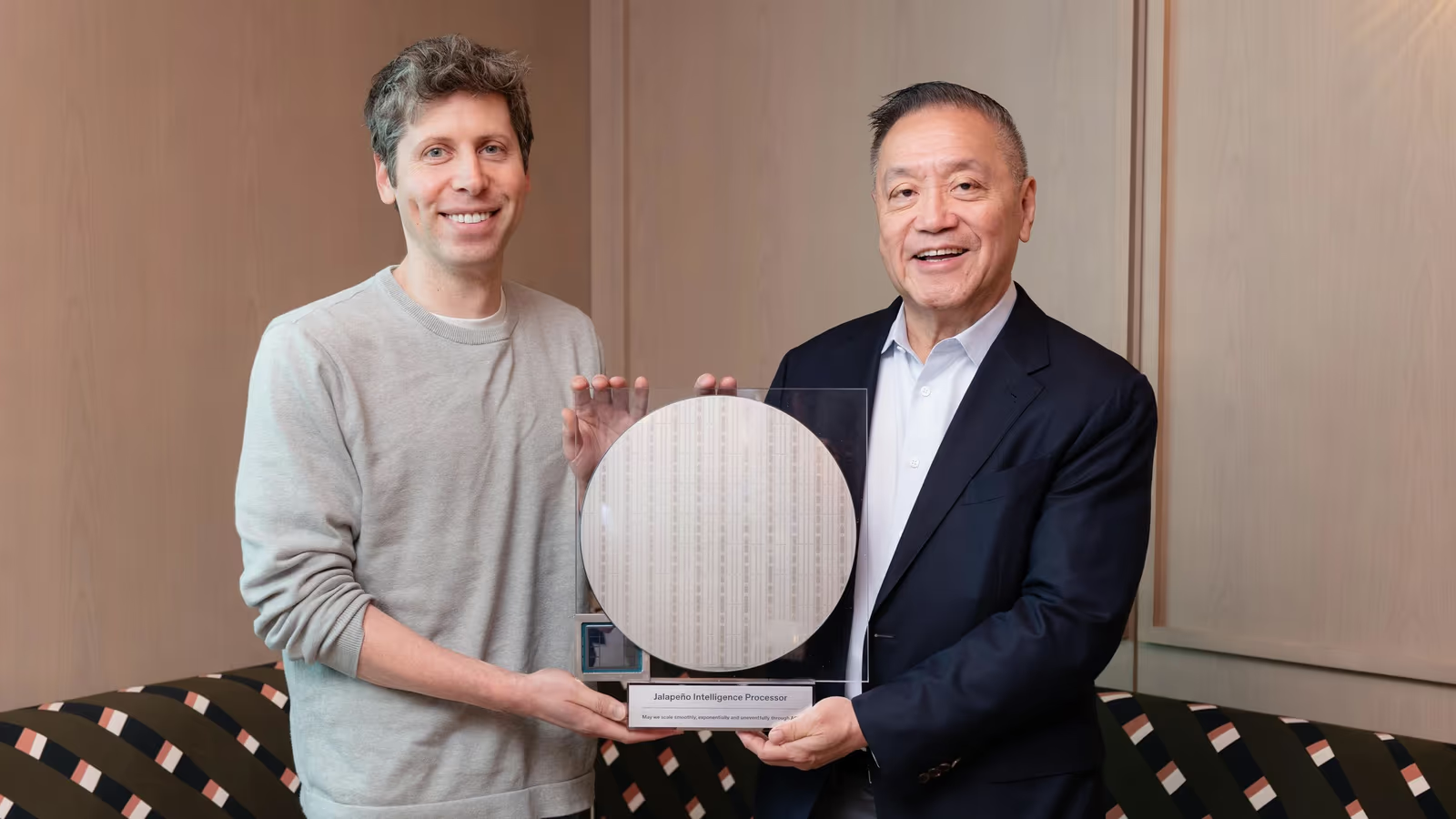
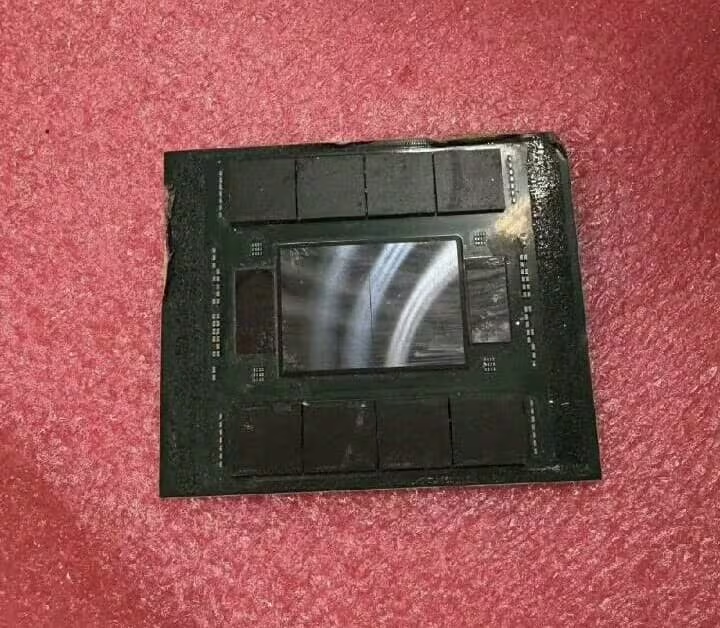
It also arrives at a moment when the chip and infrastructure side of AI is moving in a similarly practical, plumbing-first direction - see our coverage of OpenAI's new Jalapeño inference chip, announced the same week, which is about squeezing more useful work out of existing model deployments rather than a bigger, flashier model. Physical-world integration and inference efficiency are two very different problems, but both are symptoms of the same industry phase: 2026's AI news is increasingly about making already-capable models actually useful in the messy real world, not about a new headline benchmark score.
It is also worth being precise about what MHS is not. It is not a humanoid-robotics play in the vein of Figure AI or Tesla's Optimus programme, and it is not a generalist embodied-control model in the vein of Google DeepMind's Gemini Robotics work - both of those are about a single physical body learning to manipulate the world. MHS instead assumes the physical hardware - the liquid handler, the robotic arm, the laser - already exists and already works, and its job is purely to give a language model a standard way to read and command it. That narrower scope is arguably why the case studies feel more concrete than most robotics demos: nobody had to teach a Claude model new motor skills, only how to talk to equipment scientists were already using.
Who should care about this now
If you run a wet lab, a small-scale manufacturing line, or an academic research group with a pile of instruments that don't talk to each other, MHS is worth applying for the research preview now - the case studies suggest integration timelines measured in hours rather than the weeks a typical vendor project takes, even accounting for Anthropic's obvious incentive to showcase its best results. If you're building agent tooling generally, the MCP-based, model-agnostic architecture is worth understanding even if you never touch a laser or a liquid handler, because it is a template for how Anthropic expects "the physical world as a tool" to be exposed to agents going forward.
If you're simply a Claude user with no lab equipment in sight, none of this changes anything about ChatGPT-style chat or coding use today - MHS is currently a partner-gated research preview, not a consumer feature, and there is no timeline yet for when, or whether, it reaches ordinary Claude.ai or API accounts in any directly usable form.
The bottom line
Strip away the "AI runs the lab" framing that spread across YouTube and social media in the days after the announcement, and what Anthropic actually shipped is narrower and more credible: a standard driver interface that turns hardware integration from a bespoke, weeks-long engineering project into something closer to plugging in a peripheral. The QuEra laser result and the Tetsuwan pollution study are the two pieces of evidence that move this beyond a demo - one is a hard physics problem solved with a tenfold error reduction, the other produced an actual environmental finding from real creek water.
The honest caveats matter just as much as the results: this is Anthropic's own selected case studies, every one used Claude, it is not open yet, and Anthropic itself says the models still need human-defined guardrails for the physical judgement calls a human scientist makes without thinking. Worth tracking closely over the next few months, not worth treating as a solved problem today.
Last updated: 28 August 2026. Primary source: Anthropic's Model Hardware Standard research preview announcement, supplemented by reporting from CNBC, Fortune and Investing.com. This article will be revised if Anthropic publishes further safety evaluations or opens the standard more widely.
Get the free guide: Claude vs ChatGPT, Gemini & Grok
A 20-page playbook covering everything you need to choose and use the big four AI models in 2026, full cost and feature comparisons, what each is best (and worst) at, and how-tos for images, vectors, building a website, Claude Code and more.