 AI Tools Review Editorial Team
Quick Answer:
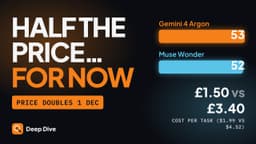
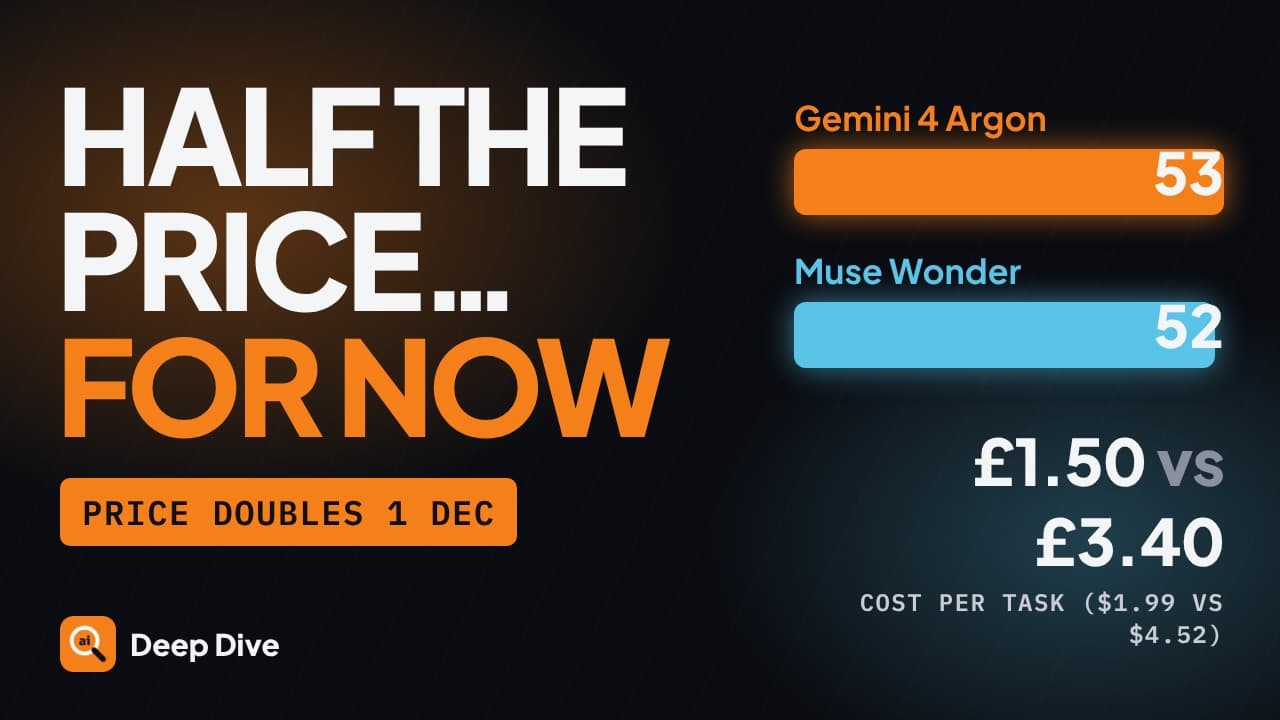
Gemini 4 Argon and Muse Wonder are one point apart on the Artificial Analysis Intelligence Index (53 vs 52), but Argon costs about £1.50 ($1.99) per task against £3.40 ($4.52) and hallucinates less. That gap is temporary: Argon’s introductory price ends on 30/11/2026 and doubles on 01/12/2026, which by our estimate brings it to about £3 ($3.98) per task, within roughly 10% of Muse Wonder. If you can self-host, Meta’s free 816B Muse Spark Open changes the question entirely.
For about a fortnight in October, the two most talked-about AI models in the world were effectively tied on the leading independent index. One of them cost less than half as much to use. That sounds like the end of the conversation, but it isn’t.
This is the written companion to our first AI Tools Review deep dive. It covers what Meta and Google actually launched, the numbers side by side, why Muse Wonder’s bill is driven by what it reads rather than what it writes, what Google’s 1 December price rise does to the comparison, and why Meta’s free open-weights giant may matter more than either paid model. Every price is in pounds first, converted at roughly $1 = £0.75.
Our 11-minute deep dive. Full transcript at the end of this article.
Executive Summary
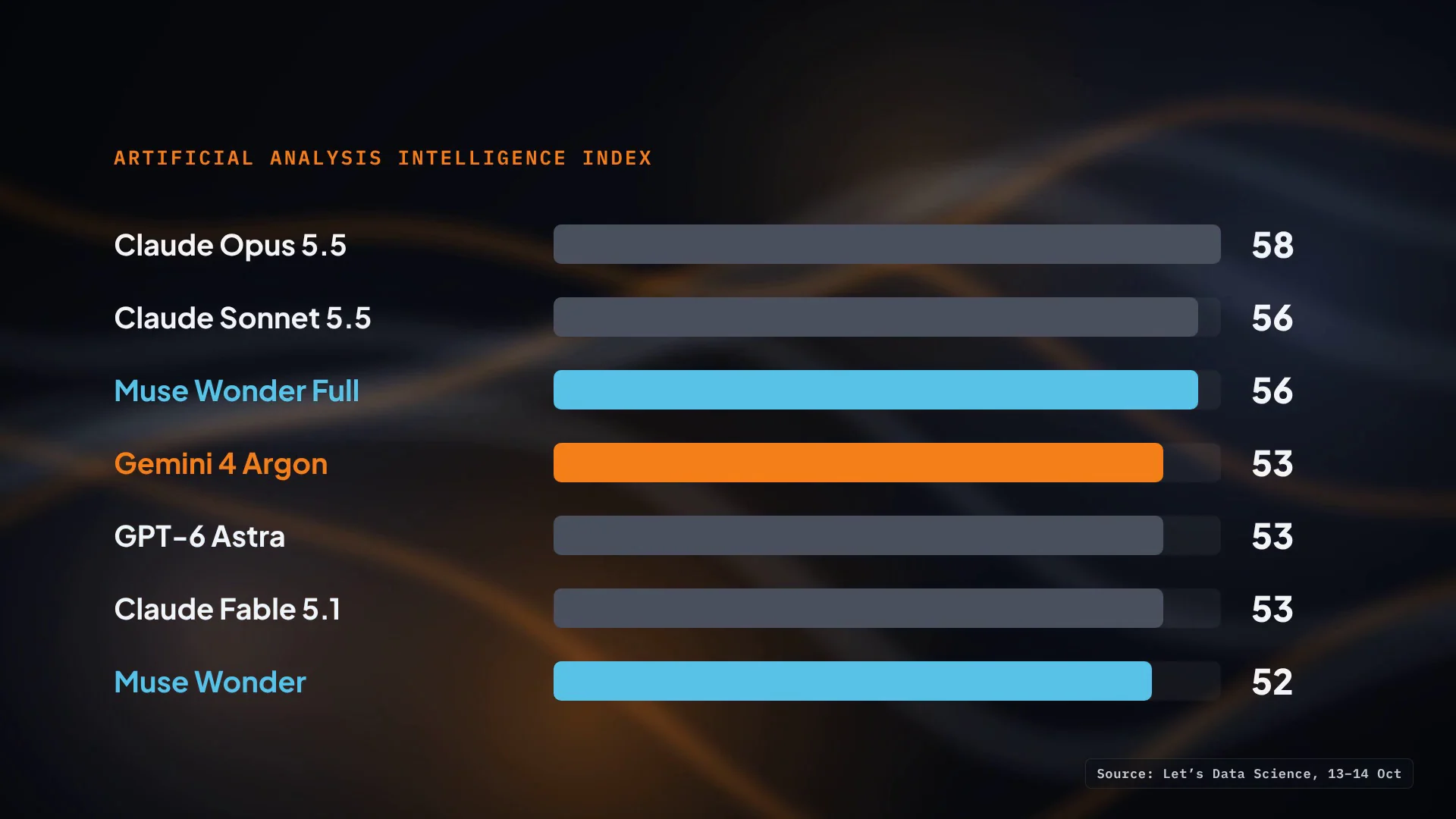
- Intelligence: effectively a tie. Artificial Analysis scores Gemini 4 Argon 53 and Muse Wonder 52. Meta’s bigger Muse Wonder Full scores 56 but is not available through the API.
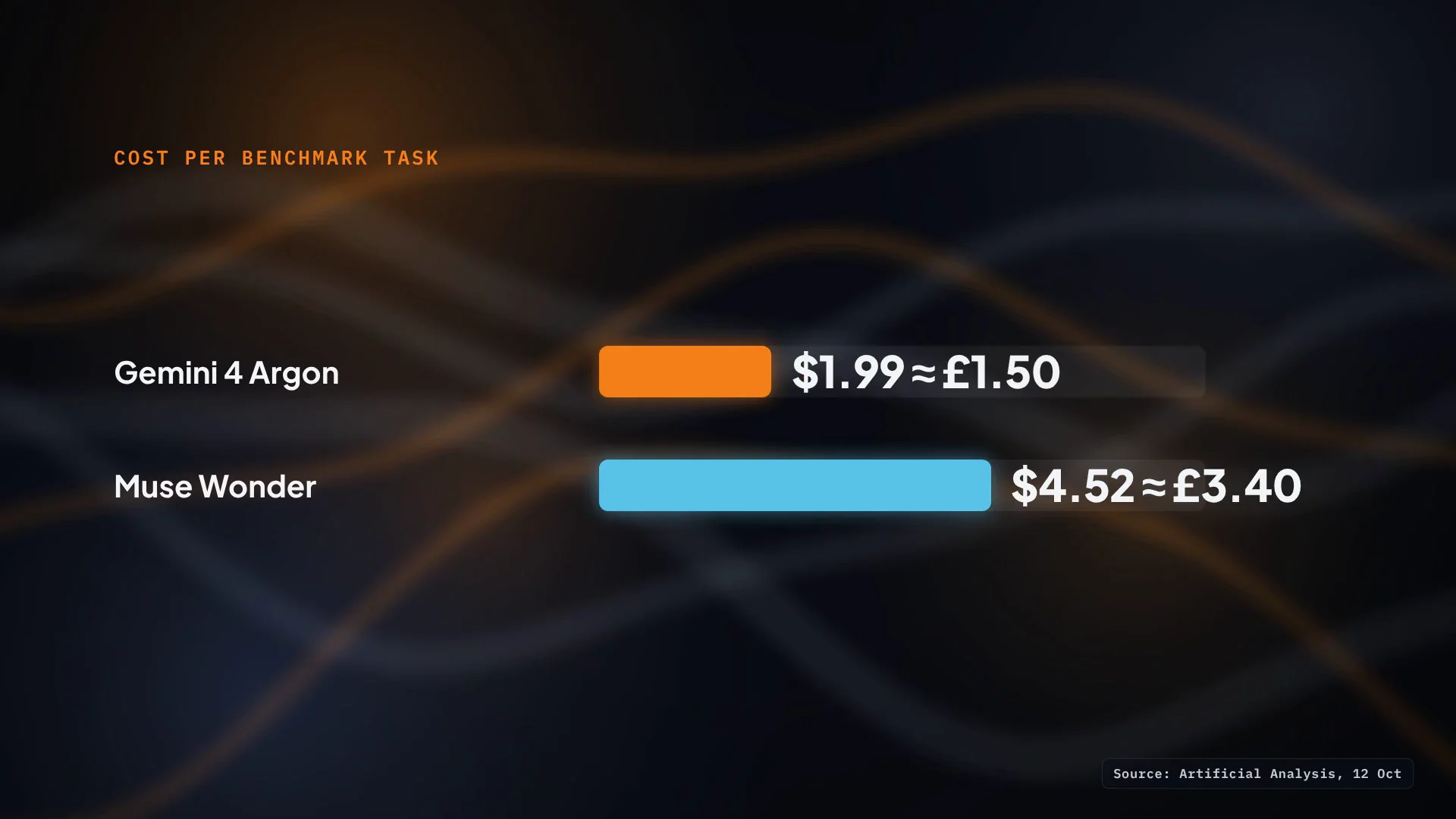
- Cost per task today: Argon about £1.50 ($1.99), Muse Wonder about £3.40 ($4.52), measured across Artificial Analysis’s full index. That is 2.3 times the cost for one point less.
- Why Wonder costs more: it writes less (about 54,000 output tokens per task against Argon’s 62,000) but reads far more, about 7.7 million input tokens per task. Around 76% of its bill is input.
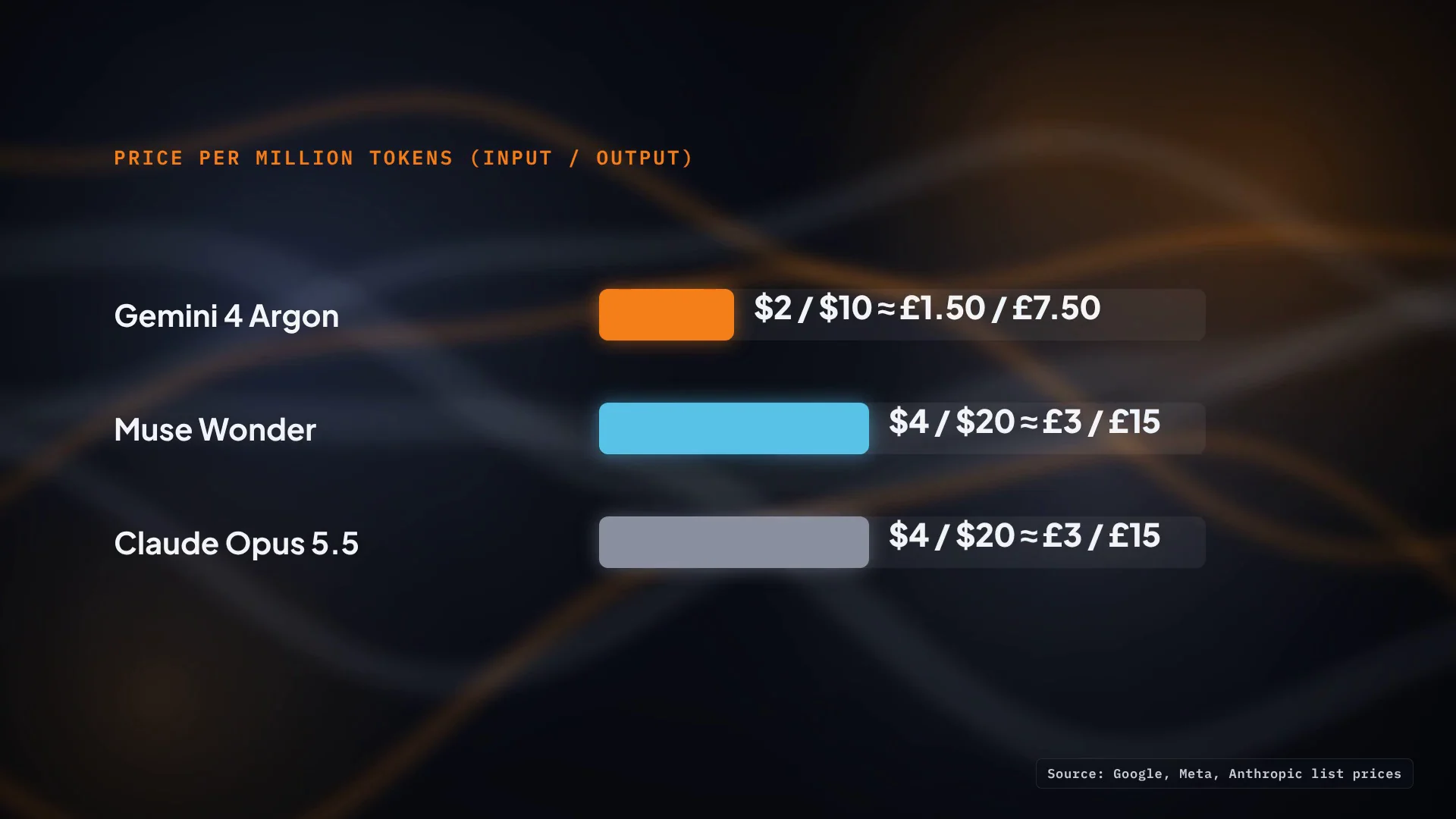
- The sell-by date: Argon’s $2 / $10 per million tokens (£1.50 / £7.50) is introductory. From 01/12/2026 it is $4 / $20 (£3 / £15), the same as Muse Wonder. Our estimate puts Argon at about £3 ($3.98) per task after that.
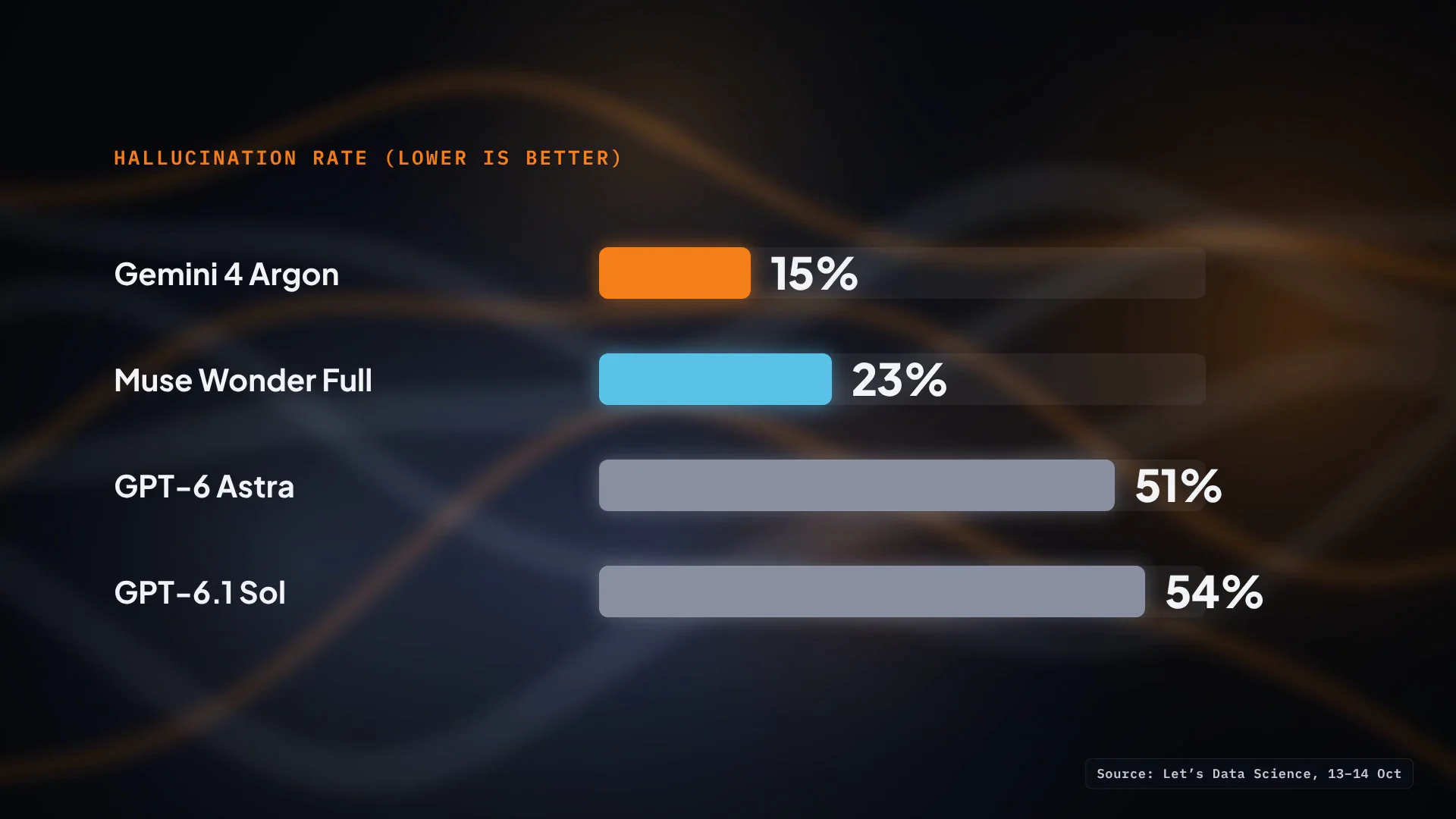
- Accuracy: Argon has the lowest hallucination rate in the top tier at 15%. Muse Wonder Full is 23%, down from 33% for Muse Spark 1.3.
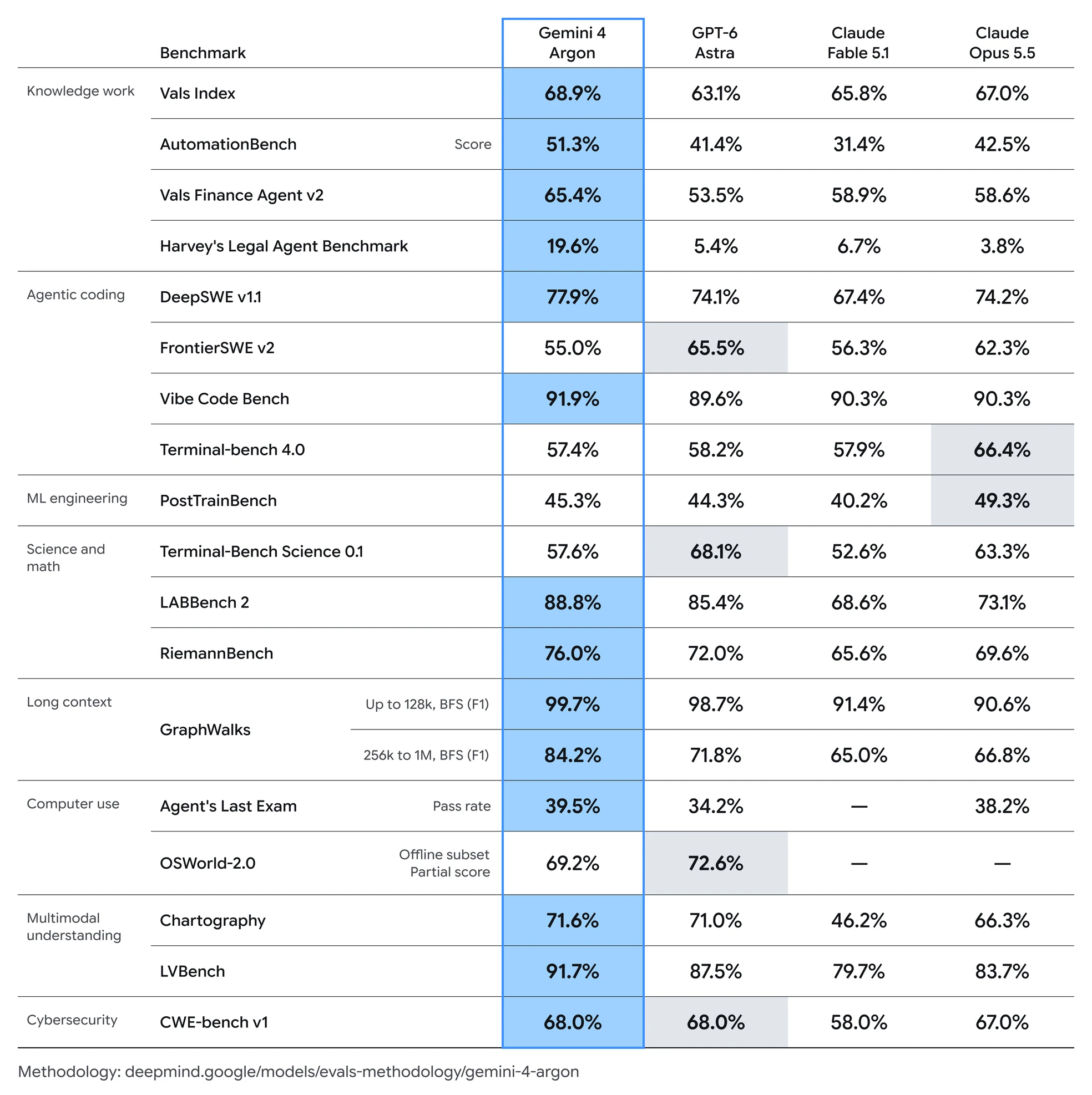
- Where neither wins: heavy terminal and command-line work. On Google’s own table, Claude Opus 5.5 leads Terminal-Bench 4.0 with 66.4% against Argon’s 57.4%.
- The wild card: Muse Spark Open, an 816B-parameter open-weights model (42B active), free to download, fine-tune and sell products on, with conditions.
Our view: today, Argon is the better buy for most read-heavy work, but plan for December. Choose Muse Wonder for its memory and persistence, not its price. And if your data cannot leave your building, Muse Spark Open is the most interesting release of the month.
Argon vs Muse Wonder at a Glance
| Measure | Gemini 4 Argon | Muse Wonder |
|---|---|---|
| Released | Announced 30/09/2026; open to all from 13/10/2026 | 12/10/2026 |
| AA Intelligence Index | 53 | 52 (Wonder Full: 56) |
| Cost per benchmark task | £1.50 ($1.99) | £3.40 ($4.52) |
| Price per million tokens (in / out) | £1.50 / £7.50 ($2 / $10) until 30/11; then £3 / £15 ($4 / $20) | £3 / £15 ($4 / $20) |
| Output tokens per task | ~62,000 | ~54,000 |
| Input tokens per task | Far fewer: Wonder uses 2–7 times what Argon and OpenAI’s latest models use | ~7.7 million |
| Hallucination rate | 15% | 27% (Wonder Full: 23%) |
| Vals Index | 68.9% (1st) | – |
| Signature features | Low hallucination, coding, knowledge work, cybersecurity, science | Active Memory, Active Focus, speech and video input |
Sources: Artificial Analysis, Google, Meta and Let’s Data Science; see the Sources section. Pound figures are conversions at roughly $1 = £0.75.
Meta Walks In: Muse Wonder
Fourteen months ago Meta tore up its AI effort and started again, with a new lab, a new stack and a restructure led by Alexandr Wang, the founder of Scale AI. Since then it had shipped Muse Spark, a lightweight model built for speed, and the Muse agent. Useful, but nothing that could sit at the top table. On 12/10/2026 that changed with Muse Wonder and Muse Wonder Full, which TechCrunch described as Meta’s first real attempt at a frontier model. Meta says both were trained at Prometheus, its gigawatt-scale data centre in Ohio.
Meta’s pitch is not that Wonder is cleverer than everything else. It is two features. Active Memory carries what matters to you across conversations. Active Focus is persistence: trying another route when a task gets hard, recovering from errors, and checking in before doing anything important. The launch demos lean into this, with a playable kitchen game built from a few photos, a running plan worked out across your apps, custom merchandise designed from an Instagram feed and a wedding seating chart. In Meta’s launch video, AI research scientist Kavya Kopparapu says the team “put a tremendous amount of effort into making sure that our model can remember what’s important to you over days, weeks, months, and beyond.”
The independent numbers back up a real step forward. Artificial Analysis scores Wonder Full at 56, eight points up on Muse Spark 1.3, which came out just six weeks earlier. The biggest jump was on Terminal-Bench 4.0, from 33% to 57%. On the Coding Agents Index, Wonder Full scores 68, level with Claude Code running Sonnet 5.5. Meta’s own testing puts Wonder ahead of Claude, GPT-6 and Fable on its MemoryBench, but that is a vendor benchmark, so treat it with caution. Knowledge remains a relative weakness, yet Wonder Full pushed its score up mostly by making things up less: its hallucination rate fell from 33% to 23%. For the full launch details, see our Muse Wonder review.
Google’s Locked Door: Gemini 4 Argon
Google announced Gemini 4 Argon on 30/09/2026, and then most people could not use it. For two weeks it sat behind the Fairwind Program, a gated rollout for approved partners plus a government pre-release review. As one router company put it, the best-value model on the leaderboard was a set of numbers rather than an API. On 13/10/2026 it opened up across the Gemini API, AI Studio, the Gemini app and the Pro and Ultra subscriptions. Our Argon global release coverage has the rollout detail, and our launch piece covers the announcement.
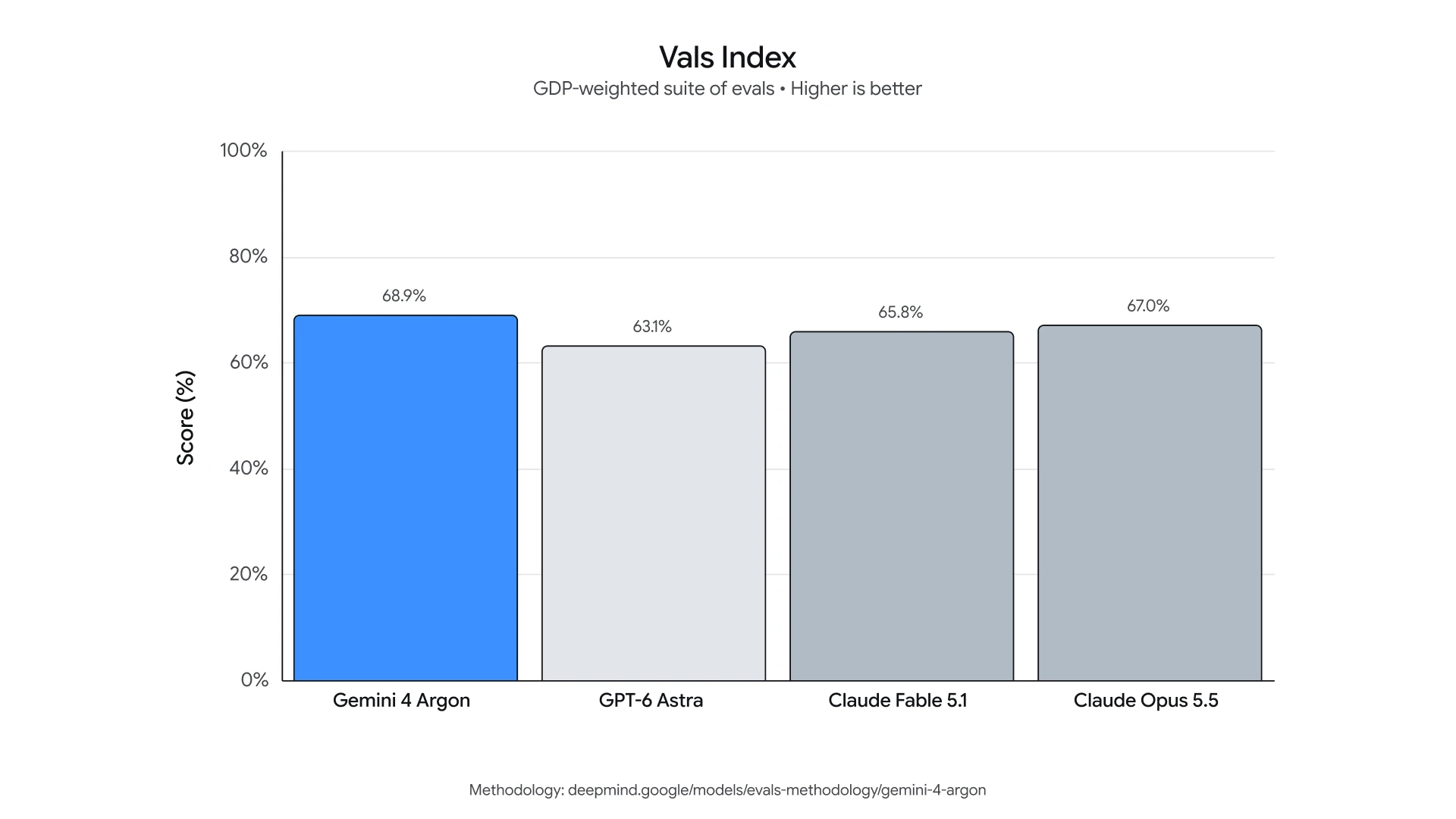
Google is pitching Argon at heavy work: complex coding, knowledge work, cybersecurity and science. The numbers are strong. Argon scores 53 on the Intelligence Index, eighth out of 216 models, and first on the Vals Index at 68.9%. The Vals Index weights finance, legal, tax and coding tasks by their share of the US economy.
The result we like most is accuracy. On Artificial Analysis’s hallucination test, Argon makes things up 15% of the time. GPT-6 Astra’s figure is 51%. Artificial Analysis calls Argon’s rate the lowest of any model in the top tier.
Not everything is a win, and Google deserves credit for showing it. On Terminal-Bench 4.0, the command-line test where Meta just made its biggest jump, Argon scores 57.4% against 66.4% for Claude Opus 5.5, and that comes from Google’s own comparison table. Google’s internal claims go further, with more than a third more code submissions in its Antigravity tool and help refactoring around six million lines of Chrome. Those are interesting but unverified. Business Insider also reports that further Gemini 4 variants, apparently called Barium and Carbon, are already in testing; see our Gemini 4 Carbon coverage.
Benchmarks, Side by Side
Put the independent figures together and the picture is close. A one-point gap on a composite index is about the size of the variation you get from running the same tests twice, so it should not decide anything on its own.
| Benchmark | Gemini 4 Argon | Muse Wonder | Muse Wonder Full | Claude Opus 5.5 |
|---|---|---|---|---|
| AA Intelligence Index | 53 | 52 | 56 | 58 |
| Hallucination rate (lower is better) | 15% | 27% | 23% | – |
| Terminal-Bench 4.0 | 57.4% | 52% | 57% | 66.4% |
| Vals Index | 68.9% | – | – | 67.0% |
| Coding Agents Index | – | – | 68 (level with Claude Code + Sonnet 5.5) | – |
Argon and Opus 5.5 Terminal-Bench and Vals figures are from Google’s table; Muse figures and hallucination rates are from Artificial Analysis. A dash means no comparable published figure.
Meta makes a similar point itself. Its launch blog describes two models with similar scores where one handles unfamiliar tasks far better, and even uses the internet’s shorthand for it: “benchmaxxing” versus “big model smell”. When labs start quoting Reddit, the leaderboard is clearly not the whole story.
The Hidden Bill: Cost per Task
Start with list prices. Argon is $2 per million input tokens and $10 per million output (about £1.50 and £7.50). Muse Wonder is $4 and $20 (about £3 and £15), exactly double and the same as Claude Opus 5.5.
But nobody really pays per token; you pay per job. Artificial Analysis ran both models through its entire index and added up the bill. Argon cost about $1.99 (£1.50) per task and Muse Wonder about $4.52 (£3.40): 2.3 times the cost for one point less on the index.
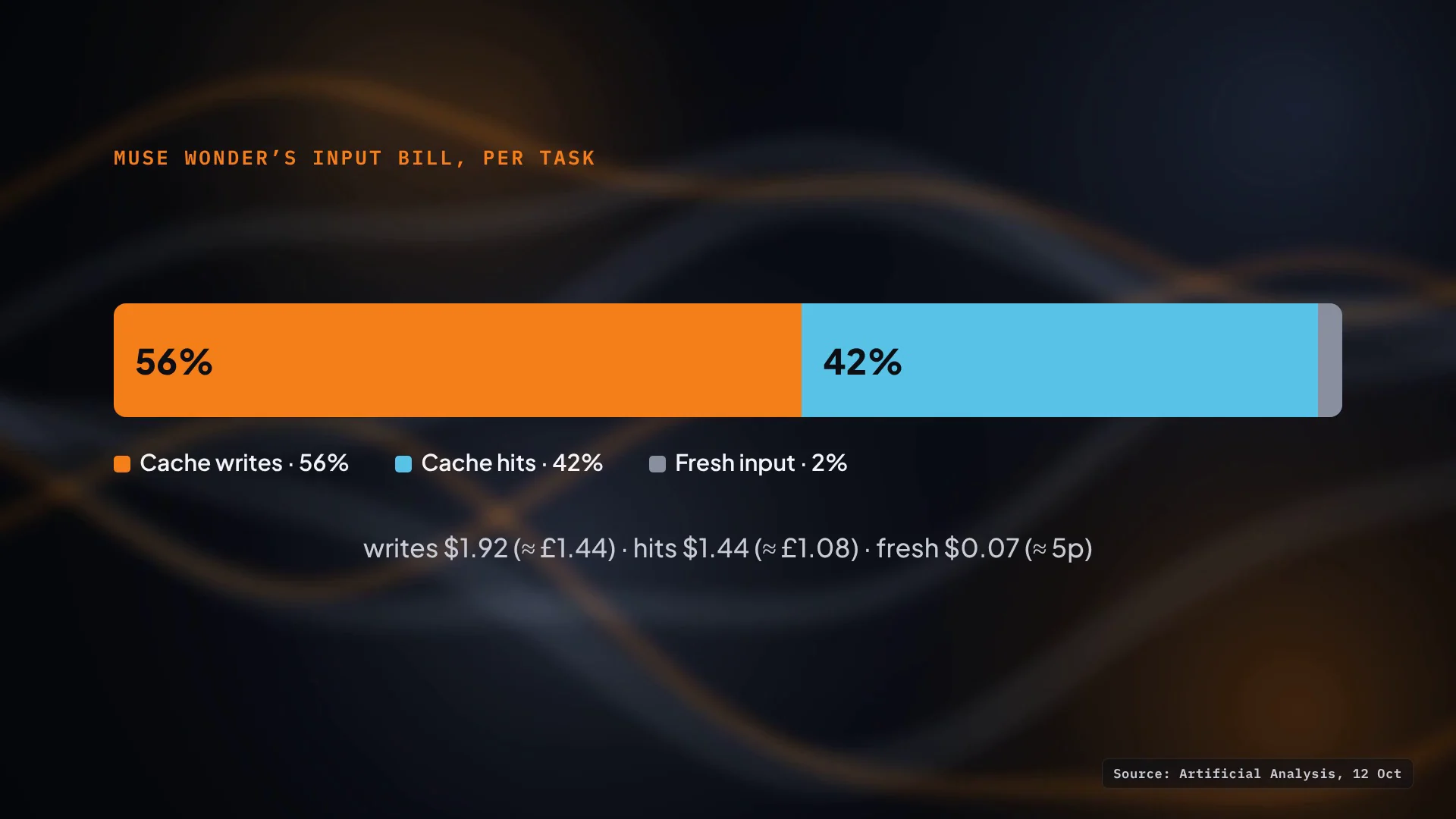
The surprise is where Wonder’s money goes. It is thrifty with its answers, at about 54,000 output tokens per task against Argon’s 62,000. The cost is in the reading. Wonder pulls in about 7.7 million input tokens per task, two to seven times what Argon and OpenAI’s latest models use, and 76% of its $4.52 bill is input: about $3.43 (£2.57) of input against $1.08 (£0.81) of output.
Most of that reading is cached and billed at a large discount; both providers take about 95% off cached input. Of Wonder’s input bill, cache writes account for $1.92 (£1.44), cache hits $1.44 (£1.08) and fresh input just $0.07 (about 5p). Even at a discount, seven and a half million of anything adds up. Wonder writes less but reads a lot more, a bit like a colleague who reads every attachment before replying to an email.
If you use Wonder through the API, it has a reasoning effort dial from minimal to max, and every bit of thinking is billed as output. Run simple work such as extraction, sorting and tagging at minimal, and save max for jobs that genuinely need it. That alone can move your bill more than the choice of model. For other ways to keep costs down, see our guide to Muse Spark 1.3, the cheaper option in Meta’s range.
The 1 December Price Rise
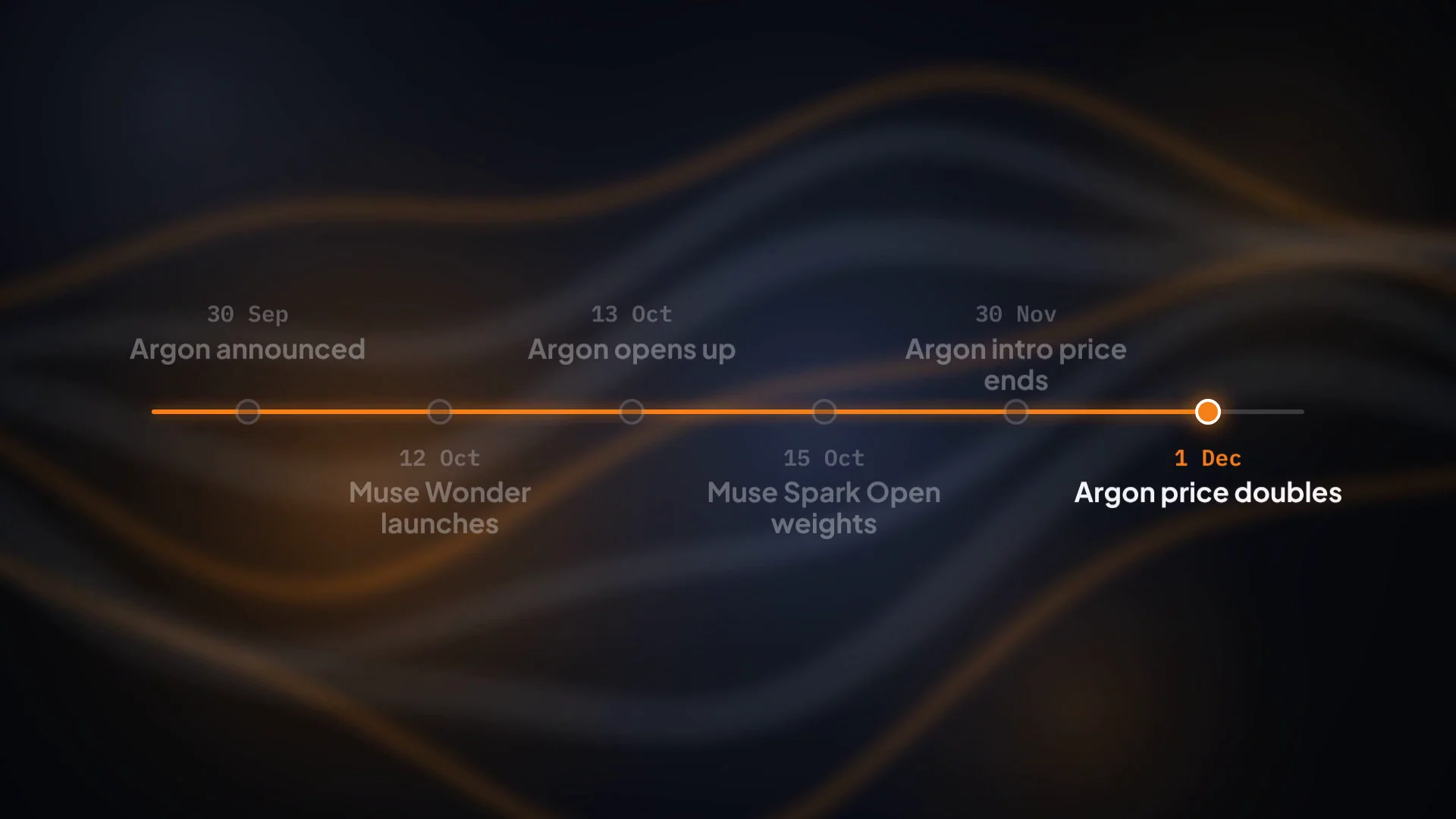
Argon’s price has a sell-by date. The $2 / $10 rate is introductory and runs until 30/11/2026. From 01/12/2026, Google doubles it to $4 in and $20 out per million tokens (about £3 and £15), exactly Muse Wonder’s price.
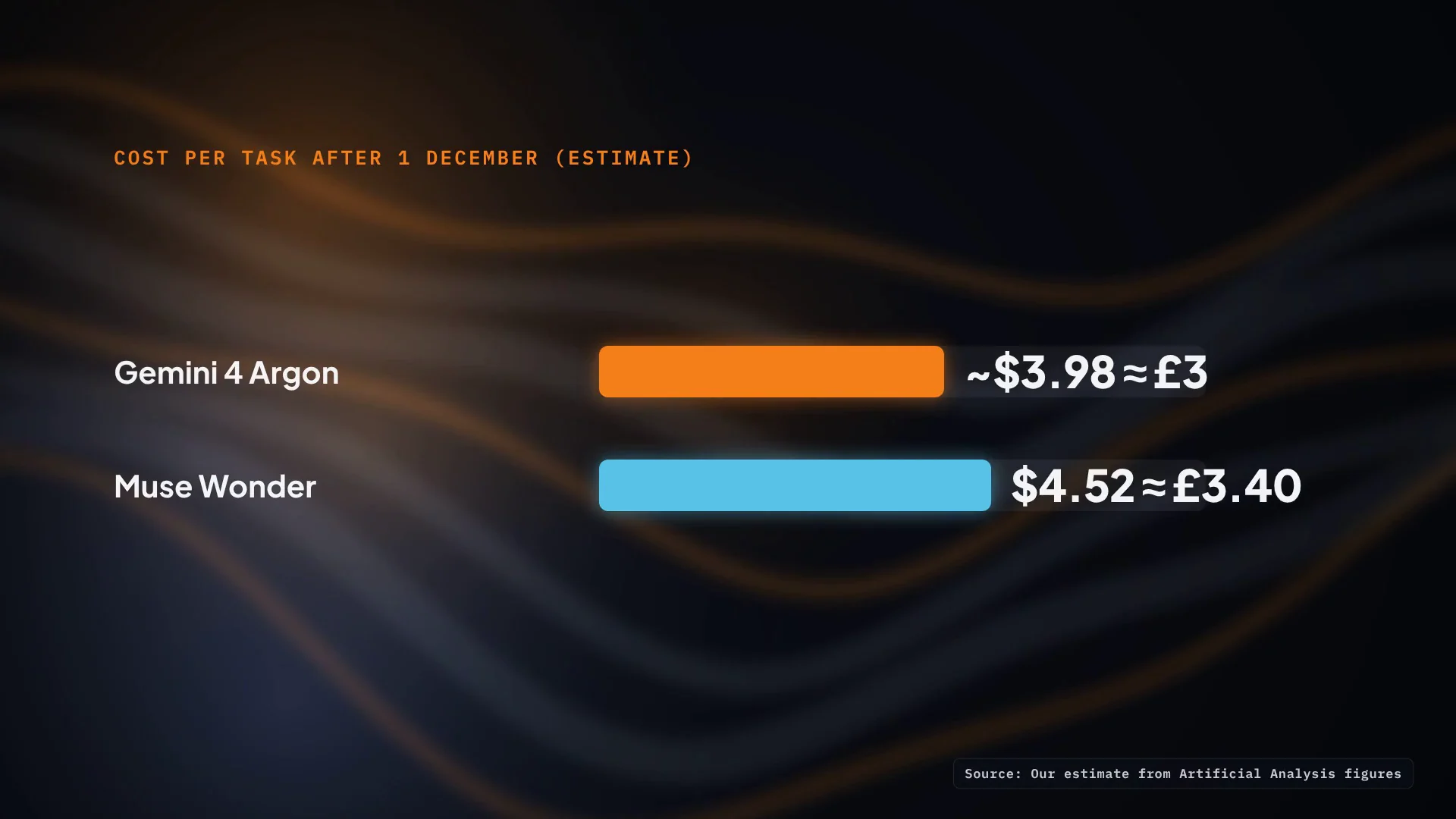
Run the same maths on cost per task and Argon goes from about $1.99 (£1.50) to about $3.98 (£3). Muse Wonder stays at $4.52 (£3.40). The gap that looked enormous shrinks to about 10%.
That is our back-of-the-envelope estimate, not a re-run of the benchmark. Caching changes the sums, and Artificial Analysis measured Argon at high effort and Wonder at max. But the direction is clear: if you are choosing on price, you are choosing on a price that expires in six weeks.
The Free Giant: Muse Spark Open
Three days after Wonder, on 15/10/2026, Meta released the weights for Muse Spark Open: 816 billion parameters, free to download, free to fine-tune and free to build products on. There are two conditions. You have to show “Built with Muse Spark Open” somewhere in your product, and if you run it as a paid API business turning over more than $20 million (about £15 million) a year, you need a separate deal with Meta.
It is a mixture-of-experts model. There are 256 experts inside, and only eight are active for each token, so of the 816 billion parameters only about 42 billion are working at any one moment. Within days Hugging Face listed 20 quantised versions and seven fine-tunes. Meta says the open version had extra safety training, because once the weights are out there is no hosted system around them to catch problems, and it recommends adding your own guardrails.
Meta says it runs on two Mac Studios, though that means M5 Ultra models with a very large amount of memory, and full precision still needs about 2 TB of GPU memory. It will not run on a laptop. Our Muse Spark Open on Apple MLX piece covers local inference in more detail.
The strategic point is what it does to the price argument. Google is charging rent; Meta has handed out the keys to a very large house. For many businesses, the question stops being which API is cheaper and becomes whether they need an API at all.
Which Should You Use?
| If you need… | Our pick | Why |
|---|---|---|
| Long documents, big codebases, research | Gemini 4 Argon | Lowest hallucination rate and far lower cost per task today. Put 01/12/2026 in your calendar. |
| A model that remembers you and keeps going on long, messy tasks | Muse Wonder | Active Memory and Active Focus; also takes speech and video input directly, which Argon’s published inputs do not. |
| Coding inside a subscription | Muse Wonder Full (Muse Code) | Level with Claude Code on the Coding Agents Index, but subscription only, with no API access. |
| Data you cannot send anywhere, or very high volumes | Muse Spark Open | Not cheap to host, but nobody can double the price on you in December. |
| Heavy terminal work, command-line agents, DevOps | Neither | Claude Opus 5.5 still leads Terminal-Bench 4.0 (66.4%). |
Whichever you lean towards, test it on your own work. Run fifty real tasks through each model and look at the bill, not the benchmark. Our Claude Opus 5.5 review is the obvious third comparison if coding agents matter most to you.
Limitations and Caveats
- The post-December cost is an estimate. We applied Google’s new list price to Artificial Analysis’s token counts. Caching discounts and effort settings will change real-world figures.
- Effort settings differ. Artificial Analysis measured Argon at high effort and Muse Wonder at max, which affects both scores and token use.
- Vendor numbers. MemoryBench, Google’s Antigravity claims and both companies’ comparison tables are self-reported.
- Exchange rate. Pound figures use roughly $1 = £0.75 and exclude VAT.
- Fast-moving market. Google has more Gemini 4 variants in testing, and Meta’s pricing and access may change.
The Bottom Line
The top of the leaderboard is a crowd now. Google, Meta, OpenAI and Anthropic are all within a few points of each other, and both of these models read a million tokens at a time, cache, and code well. On raw ability the differences are hard to see, so the fight has moved to price, memory and who lets you take the model home.
Google is betting you will keep paying rent once you have settled in. Meta is betting you would rather own the place. We will find out who read that right on 01/12/2026, when Argon’s price doubles. Until then, Argon is the value pick, Muse Wonder is the memory pick, and Muse Spark Open is the one to watch.
Full Video Transcript
Narration transcript of the video, with chapter timestamps. Figures are spoken in words; quotes from people featured are read by our narrator. Download the captions (SRT).
Show the full transcript
0:00 · Two models, one point apart
So for about a fortnight, the two most talked-about AI models on the planet were basically tied. Google’s Gemini four Argon scored fifty-three on the Artificial Analysis Intelligence Index. Meta’s Muse Wonder scored fifty-two. One point. Which, honestly, is about the difference you get from running the same test twice. But one of them costs less than half as much to actually use. About one pound fifty a task, against three pounds forty. And that sounds like the end of the conversation. Cheaper model, same brains, job done. It isn’t. Because Google’s price has a sell-by date. Meta’s biggest move this month isn’t even the model you can buy. And the number that really decides your bill isn’t the one on the pricing page. I’ll get to all three. But first, let’s be clear about who just walked into this fight.
0:51 · Meta walks in
Fourteen months ago, Meta basically tore up its AI effort and started again. New lab, new stack, and a restructure led by Alexandr Wang, the founder of Scale AI. Since then, they’d shipped Muse Spark, a lightweight model built to be quick, and a Muse agent. Useful. But nothing that could sit at the top table. On the twelfth of October, that changed. Muse Wonder, and Muse Wonder Full. TechCrunch called it Meta’s first real attempt at a frontier model. And it was trained at Prometheus, Meta’s gigawatt-scale data centre in Ohio. Now, Meta’s pitch isn’t really, we’re cleverer than everyone. It’s two features with very Meta names. Active Memory, which is remembering what matters to you across conversations. And Active Focus, which is basically not giving up when a task gets hard. Trying another route, recovering from errors, and checking in before it does anything important. And Meta’s launch demos lean right into that. A playable kitchen game built from a few photos. A running plan worked out across your apps. Custom merch designed from your Instagram. And a wedding seating chart. Which, if you’ve ever had to do one, is genuinely the hardest problem in artificial intelligence. One of their research scientists put it like this. We put a tremendous amount of effort into making sure that our model can remember what’s important to you over days, weeks, months, and beyond. Fine. Every lab says something like that. So, receipts. Artificial Analysis, who are independent, scored Wonder Full at fifty-six. That’s eight points up on Muse Spark one point three, which came out just six weeks earlier. The biggest jump was on Terminal Bench, which tests command-line coding. Thirty-three percent, to fifty-seven. That’s not a tweak. On coding agents, Wonder Full scored sixty-eight, level with Claude Code running Sonnet five point five. Meta’s own testing also puts Wonder ahead of Claude, GPT six and Fable on its memory benchmark. Vendor numbers, so pinch of salt. But here’s the bit I didn’t expect. Knowledge is still a relative weakness for Wonder. Yet it pushed its score up mostly by making things up less. Its hallucination rate dropped from thirty-three percent to twenty-three.
2:58 · Google’s locked door
Now, Google. Argon was announced on the thirtieth of September. And then, well, you couldn’t use it. For two weeks it sat behind something called the Fairwind Program, a gated rollout for approved partners, plus a government pre-release review. So for a fortnight, the best-value model on the leaderboard was, as one router company put it, a set of numbers rather than an API. On the thirteenth of October, the door opened. The Gemini API, AI Studio, the Gemini app, and Pro and Ultra subscribers. Google’s pitching it at the heavy stuff. Complex coding, knowledge work, cybersecurity, and science. And the numbers are good. Fifty-three on the Intelligence Index, eighth out of two hundred and sixteen models. And first on the Vals Index, which weights finance, legal, tax and coding work by how much of the US economy they represent. Sixty-eight point nine percent. And this one I genuinely like. On a test of how often a model makes things up, Argon’s hallucination rate is fifteen percent. The figure for G P T six Astra is fifty-one. Artificial Analysis called it the lowest of any model in that top tier. Now, not everything’s a win. On Terminal Bench, the command-line test where Meta just jumped, Argon scores fifty-seven point four. Claude Opus five point five scores sixty-six point four. And that’s from Google’s own comparison table, so, fair play to them. Google’s internal claims are bigger again. More than a third more code submissions in their Antigravity tool, and help refactoring around six million lines of Chrome. Interesting. Unverified. File under nice if true. And, according to Business Insider, Google already has more Gemini four variants in testing, apparently called Barium and Carbon. Because of course they do. The periodic table is a long list.
4:43 · The hidden bill
Right. Money. This is where most of the coverage stops reading. Price per token first. Argon, two dollars per million tokens in, and ten dollars out. About one pound fifty, and seven pounds fifty. Muse Wonder, four in, and twenty out. Exactly double. The same as Claude Opus five point five. But nobody really pays per token. You pay per job. So Artificial Analysis ran both models through their entire index, and added up the bill. Argon, about one dollar ninety-nine per task. And for Muse Wonder, it’s four dollars fifty-two. That’s two point three times the cost, for one point less on the index. So why’s the gap so big? Here’s the bit that genuinely surprised me. Wonder is actually quite thrifty with its answers. About fifty-four thousand output tokens per task. Fewer than Argon’s sixty-two thousand. It’s the reading. Wonder pulls in about seven point seven million input tokens per task. That’s two to seven times what Argon and Open A I’s latest models use per task. Seventy-six percent of its bill is input. Now, most of that reading is cached, which means it’s billed at a big discount. Both models knock about ninety-five percent off cached input. But even at a discount, seven and a half million of anything adds up. So it writes less, but it reads a lot more. Which, if you’ve ever worked with someone who reads every single attachment before replying to an email, you’ll recognise. And now, the sell-by date. Argon’s price is introductory. It runs until the thirtieth of November. On the first of December, Google doubles it. Four dollars in, twenty out. Exactly Muse Wonder’s price. So run the same maths on cost per task, and Argon goes from about two dollars, to about four. Wonder is at four fifty-two. The gap that looked enormous, shrinks to about ten percent. Now, that’s my back-of-the-envelope, not a re-run of the benchmark. Caching changes things, and Argon was measured at high effort while Wonder was at max. But the direction is pretty clear. If you’re choosing on price, you’re choosing on a price that expires in six weeks.
6:51 · The free giant
And then Meta did something that, to me, is the bigger story. Three days after Wonder, on the fifteenth of October, they released the weights for Muse Spark Open. Eight hundred and sixteen billion parameters. Free to download. Free to fine-tune. Free to sell products built on it. With a couple of strings. You have to show, built with Muse Spark Open, somewhere in your product. And if you run it as a paid API business turning over more than twenty million dollars a year, you need a separate deal with Meta. Here’s the clever part. It’s what’s called a mixture of experts. There are two hundred and fifty-six specialists inside it, and for each word, only eight of them wake up. So of those eight hundred and sixteen billion parameters, only about forty-two billion are working at any one moment. Huge model, small active core. And people jumped on it. Within days, Hugging Face was already listing twenty quantised versions, and seven fine-tunes. Meta also says this open version had extra safety training, because once it’s out there, there’s no system around it to catch things. They recommend adding your own guardrails on top. Which is fair. Which is why Meta says it runs on two Mac Studios. Two. Not a data centre. Though, to be fair, they mean the M five Ultra ones with a frankly silly amount of memory. And the full-precision version still wants about two terabytes of graphics memory. So no, you’re not running it on the laptop you’re watching this on. But think about what that does to the whole price argument. Google is charging rent. Meta just handed out the keys to a very large house. And for a lot of businesses, the question stops being, which API is cheaper. It becomes, do we need an API at all.
8:30 · So which should you use?
So, if you’re actually choosing, and this is the sort of thing we test at AI Tools Review, here’s how I’d think about it. If you’re building something that reads a lot, long documents, big codebases, research, Argon, today, is the obvious pick. Lower hallucination, much lower cost per task. Just put a reminder in your calendar for the first of December. If you want a model that remembers you, and keeps going on long, messy tasks, that’s exactly what Meta built Wonder for. It also takes speech and video in directly, which Argon’s published inputs don’t. If you’re a coder, Wonder Full inside Muse Code is now level with Claude Code. But it’s subscription only. You can’t call Wonder Full from the API at all. And a tip if you do use Wonder through the API. It has an effort dial, from minimal right up to max, and every bit of thinking is billed as output. So run the simple stuff, extraction, sorting, tagging, at minimal, and save max for the jobs that genuinely need it. That alone can move your bill more than the choice of model. If you’ve got data you can’t send to anyone, or volumes that make API bills scary, Muse Spark Open is the interesting one. Not cheap to host. But nobody can double the price on you in December. And if the job is heavy terminal work, command-line agents, dev ops, the honest answer this week is neither. Claude Opus five point five still leads that test. One more thing. A one-point difference on an index is noise. Meta actually makes this point themselves, which I didn’t expect. Their blog talks about two models with similar scores, where one just handles unfamiliar tasks far better. They even use the internet’s words for it. Benchmaxxing, versus big model smell. When the AI labs start quoting Reddit at you, you know the leaderboard isn’t the whole story. Test on your own work. Run fifty real tasks through each one, and look at the bill, not the benchmark.
10:16 · The fight has moved
Zoom out, and the shape of this month is pretty clear. The top of the leaderboard is a crowd now. Google, Meta, OpenAI, Anthropic, all within a few points of each other. Both of these models read a million tokens at a time. Both cache. Both code well. On raw ability, the differences are getting hard to see. Which means the fight has moved. It’s not really about who’s smartest any more. It’s about price, memory, and who lets you take the model home. Google’s betting you’ll pay rent once you’ve settled in. Meta’s betting you’d rather own the place. And we’ll find out who read that right around the first of December, when that price doubles. Anyway, that’s it for this one. Tell me in the comments which one you’re actually using. Full comparisons and pricing are on AI Tools Review dot co dot UK. See you in the next one.
Sources
- Artificial Analysis: Muse Wonder: Intelligence Index, cost per task, token use, hallucination rates.
- Meta: Introducing Muse Wonder and Meta Newsroom (12/10/2026): Active Memory, Active Focus, demos, launch video.
- Google: Gemini 4 Argon: positioning, Vals Index chart and benchmark table (Source: Google).
- TechCrunch: Meta releases its first frontier model, Muse Wonder.
- Let’s Data Science: Gemini 4 Argon independent tests and Argon pricing.
- OrcaRouter: Muse Wonder vs Gemini 4 Argon: rollout and access.
- Hugging Face: Muse Spark Open 816B-A42B: architecture, licence conditions, hardware.
Last updated: 21/10/2026. Post-December cost figures are our estimate from Artificial Analysis data and Google’s published pricing. Charts marked AI Tools Review are our own, drawn from the cited data.
Get the free guide: Claude vs ChatGPT, Gemini & Grok
A 20-page playbook covering everything you need to choose and use the big four AI models in 2026, full cost and feature comparisons, what each is best (and worst) at, and how-tos for images, vectors, building a website, Claude Code and more.