
 AI Tools Review Editorial Team
Quick Answer:
Google made Gemini 4 Argon available globally on 13/10/2026, two weeks after the limited launch. It costs $2 / $10 per million input / output tokens (roughly £1.50 / £7.50) until 30/11/2026, then $4 / $20. In Google’s own table it leads 13 of 19 benchmark rows against GPT-6 Astra and the Claude models, ties one and trails on five, including Terminal-bench 4.0 and OSWorld-2.0. All figures are vendor-reported.
Gemini 4 Argon has stopped being a model for trusted cyber defenders and become something anyone with a paid Gemini plan or API key can use. Within hours, four of the creators we track had put it through their own tests, and the verdicts ranged from “Google just caught up” to “this model is weird”.
This guide separates what Google has published, from its blog post and model card, from what creators saw on screen. We also add the context the launch coverage skips: the rows where Argon loses, the safety disclosures that most coverage glosses over, and what the 30/11/2026 price change means for anyone budgeting.
Matt Wolfe tests Argon on coding games, scheduling, research and a 3D-printing job, then compares Google with Claude and ChatGPT.
Wes Roth builds games with Argon, looks at its robotics demo and discusses Google’s findings on reasoning shortcuts.
Executive Summary
- What happened: Google announced on 13/10/2026 that Gemini 4 Argon is “now globally available” for developers, enterprises, scientists and consumers. The model first appeared on 30/09/2026 in a restricted release; our earlier write-up of that stage is in the Gemini 4 Argon launch guide.
- Price: $2 per million input tokens and $10 per million output tokens until 30/11/2026, then $4 and $20. Cached input is 95% cheaper.
- Where it wins (Google’s table): Vals Index 68.9%, DeepSWE v1.1 77.9%, Vibe Code Bench 91.9%, LABBench 2 88.8%, RiemannBench 76.0% and long-context GraphWalks 84.2% at 256k to 1M tokens.
- Where it loses: FrontierSWE v2 (55.0% against GPT-6 Astra’s 65.5%), Terminal-bench 4.0 (57.4% against Opus 5.5’s 66.4%), PostTrainBench, Terminal-Bench Science and OSWorld-2.0.
- Safety: Google says it cannot rule out that Argon reaches its biological and cybersecurity capability thresholds, and relies on safeguards and safety cases instead.
- Our view: a genuine frontier contender and the cheapest of the four at launch pricing, but the evidence is Google’s own and the strongest independent signal so far is creators’ hands-on tests, which are anecdotes rather than evaluations.
If you want the wider market context, our best AI models guide and frontier benchmarks round-up track how these scores move.
What Changed on 13 October
The first Argon announcement on 30/09/2026 was deliberately narrow. Argon went to defenders through the Fairwind Programme, with the cyber guardrails removed, and the wider public heard about benchmarks and a price but could not use it. We covered that stage in our launch article and traced the earlier rumours in our Carbon leak piece and release date and specifications guide.
The 13/10/2026 post, written by Koray Kavukcuoglu, Google’s Chief AI Architect, changes the access picture in five ways. Developers and enterprises can use the model through the API in Google AI Studio and the Gemini platform; the paid tier is required in AI Studio and Android Studio. Google AI Ultra subscribers can use it in Google Antigravity. Ultra and Pro subscribers get it in the Gemini app and in AI Mode in Search. Scientists can apply for the highest usage tier of Antigravity free for six months; Google says 10,000 researchers will be onboarded on a rolling basis, subject to eligibility, capacity and selection. And Google says it is expanding the Fairwind Programme to hundreds of additional partners, with Wiz named as an early user of the model through its “Scan for Good” initiative.
Two technical points deserve attention. First, the model card states that Argon is “not a modification or a fine-tune of a prior model”, which Google presents as a new frontier model rather than an incremental Gemini 3.x update. Second, the model card describes a sparse mixture-of-experts transformer with native multimodal input (text, images, audio and video) and text output, trained on Google TPUs with JAX and Pathways. The knowledge cutoff is March 2026, and Google warns that in some domains the model’s knowledge may be less current.
Google also makes a point of the 1 million token unified input-output limit, which the blog describes as “industry-leading”, and refers developers to a “new continuation protocol”. We have not seen the protocol documentation, so anyone planning to generate very long outputs should read it before building on the claim. Matt Wolfe’s video chapters highlight the same feature under the heading “Benchmarks and the Million-Token Output”.
Finally, Google closes the post by saying Argon is “just the beginning” and that it is looking forward to bringing “the rest of the Gemini 4 family”. We would read that as a promise of smaller and faster siblings rather than a date, and Google gives none.
What Creators Found in Hands-On Tests
We track a set of AI creators, and four of them published Argon videos within hours of the global release. We have not reproduced their tests, and what follows relies on their video descriptions and chapter markers, so treat it as a guide to what they looked at rather than as a verdict.
Matt Wolfe: coding, scheduling and a 3D-printed Gary Busey
Wolfe’s description says he put Argon through hands-on tests “from coding games to 3D printing Gary Busey”, and his chapters cover SVGs, games and physics, scheduling and research tests, Gemini Tasks, and teaching a robot to play cornhole. He also covers pricing and access, Antigravity and the Gemini app updates. His framing is that Google’s model impressed in places and got stuck in others, then stacked against Claude and ChatGPT.
Wes Roth: polished demos, strange habits
Roth’s video is titled “Gemini 4 Argon is weird”. His description says the model is powerful but has “some strange habits”, and he links to the Google AI Studio demos (Wizard Chess and Desk Racer) alongside the robotics developer post. He also discusses what he calls Google’s safety findings about “shortcuts that stopped showing up in the model’s reasoning”. That is a reading of the safety material we cover in the safety section below, and it is the most interesting thread in the creator coverage, because it concerns whether you can trust a model’s visible reasoning.
Matthew Berman: reading the model card
Berman’s “Google just went frontier” video links directly to the DeepMind model card, and his description notes that Argon is live in Box. That is a sponsor placement as far as we can tell, and it is worth knowing when you weigh any enthusiasm.
WorldofAI: head-to-head with Opus 5.5 and Astra
WorldofAI says it benchmarked Argon with its own WoAI Bench tool and compared it with Claude Opus 5.5 and GPT-6 Astra on coding, 3D generation, SVG animation and multimodal reasoning. The same video also rounds up other news, so it works as a quick overview rather than a deep test. We cover the other models it mentions in our Claude Opus 5.5 guide and GPT-6 Astra review.
A fifth creator, Julian Goldie, shows Argon running inside an agent operating system through the Antigravity command line, producing 3D worlds and games, and gives a mixed opinion on one 3D website. The pattern across all five is consistent: Argon is strongest when it can write code that renders something visual, which matches what Google itself showcases.
Matthew Berman walks through the Gemini 4 Argon model card on launch day.
WorldofAI tests Argon against Claude Opus 5.5 and GPT-6 Astra on coding, 3D, SVG and multimodal tasks.
Benchmarks: Google’s Table, Row by Row
The table below is transcribed from the Gemini 4 Argon model card on Google DeepMind’s site. Google compares Argon with GPT-6 Astra, Claude Fable 5.1 and Claude Opus 5.5. These are Google’s numbers, run under the methodology it publishes, and none has been independently reproduced at the time of writing.
| Benchmark | Gemini 4 Argon | GPT-6 Astra | Claude Fable 5.1 | Claude Opus 5.5 |
|---|---|---|---|---|
| Vals Index | 68.9% | 63.1% | 65.8% | 67.0% |
| AutomationBench | 51.3% | 41.4% | 31.4% | 42.5% |
| Vals Finance Agent v2 | 65.4% | 53.5% | 58.9% | 58.6% |
| Harvey Legal Agent Benchmark | 19.6% | 5.4% | 6.7% | 3.8% |
| DeepSWE v1.1 | 77.9% | 74.1% | 67.4% | 74.2% |
| FrontierSWE v2 | 55.0% | 65.5% | 56.3% | 62.3% |
| Vibe Code Bench | 91.9% | 89.6% | 90.3% | 90.3% |
| Terminal-bench 4.0 | 57.4% | 58.2% | 57.9% | 66.4% |
| PostTrainBench | 45.3% | 44.3% | 40.2% | 49.3% |
| Terminal-Bench Science 0.1 | 57.6% | 68.1% | 52.6% | 63.3% |
| LABBench 2 | 88.8% | 85.4% | 68.6% | 73.1% |
| RiemannBench | 76.0% | 72.0% | 65.6% | 69.6% |
| GraphWalks up to 128k (BFS F1) | 99.7% | 98.7% | 91.4% | 90.6% |
| GraphWalks 256k to 1M (BFS F1) | 84.2% | 71.8% | 65.0% | 66.8% |
| Agent’s Last Exam (pass rate) | 39.5% | 34.2% | n/a | 38.2% |
| OSWorld-2.0 offline subset | 69.2% | 72.6% | n/a | n/a |
| Chartography | 71.6% | 71.0% | 46.2% | 66.3% |
| LVBench | 91.7% | 87.5% | 79.7% | 83.7% |
| CWE-bench v1 | 68.0% (tie) | 68.0% (tie) | 58.0% | 67.0% |
Counting rows, Argon leads outright on 13 of 19, ties GPT-6 Astra on CWE-bench v1, and trails on five. The pattern is more useful than the count. Argon is strongest on knowledge work (the Vals Index, finance and legal agent tests), long-context retrieval, scientific reasoning (LABBench 2 and RiemannBench) and multimodal understanding. It is weakest on terminal-driven and computer-use tasks, where Claude Opus 5.5 and GPT-6 Astra each beat it by clear margins: Opus 5.5 by 9 percentage points on Terminal-bench 4.0 and GPT-6 Astra by 10.5 points on Terminal-Bench Science.
Some of the largest gaps need context. On the Harvey Legal Agent Benchmark Argon scores 19.6% against 3.8% to 6.7% for the others. That is a big relative lead, but 19.6% is also a low absolute score, which suggests the benchmark is hard and that no model is close to autonomous legal work. Likewise the 256k to 1M GraphWalks result of 84.2% against 71.8% for GPT-6 Astra is the clearest evidence for Google’s long-context claim, but GraphWalks is a synthetic graph-traversal test, not a document-comprehension test.
We would also flag that Google’s blog says Argon ranks first on the Vals Index, which the model card puts at 68.9% against Opus 5.5’s 67.0%. A 1.9 point gap is within the range where benchmark configuration can change the order, so the headline is directionally credible and not decisive. For how the other labs present their numbers, see our reading of Meta’s Muse Wonder table, which has the same self-reporting problem.
Engineering Results Google Reports
Beyond benchmarks, the blog post lists internal engineering results. These are company anecdotes, not controlled studies, but they are specific enough to be useful because they name the codebases and the measured change.
- Antigravity adoption: Google says teams using Argon in Antigravity increased agentic code submissions by more than 35% while reducing code rollbacks by nearly a third.
- Chrome refactor: Argon helped separate core webpage handling from a roughly 6 million line legacy folder of browser features inside Chromium’s 40 million line codebase, finishing an architectural refactor across hundreds of files that Google says took weeks rather than months.
- Agent Development Kit: given the team’s skills rulebook and a one-paragraph goal, Argon worked autonomously overnight and produced changes now live in google/adk-python that Google says cut in-memory session preparation time by 40% in long sessions and sped up cold imports by 21%.
- xTB quantum chemistry: Google researchers say Argon made the open-source package up to 2.3 times faster at predicting molecular structures and 1.8 times faster at conformer search, with changes contributed upstream.
- Gemma inference: Google reports a 2.85 times end-to-end speed-up on an A100 using vLLM, from about 37,900 to over 108,000 tokens per second on Gemma 4 E2B, with 100% token parity.
The Gemma result is the most checkable, because Google says the upstream pull requests are public and “token parity” is a measurable claim. The Chrome and ADK stories are more impressive but harder to audit. They also tell you what kind of work Argon is being sold for: long, autonomous refactors where the model runs for hours with a rulebook and a goal, which is the same workflow our Antigravity 2 review examines and that the best AI coding agents guide compares across vendors.
Visual coding gets a long section of its own. Google describes Argon building a detailed pagoda in Blender through multi-agent visual critique loops, turning pictures of a real desk into a playable miniature racing game, writing its own ray-tracing engine in pure Python with no external libraries, and driving Blender through MCP to build a Gothic scene from a single Nano Banana image. These match what the creators tried, and they explain why Wes Roth and Matt Wolfe spent so long on games and 3D.
Science, Maths and Quantum Claims
The scientific section of the blog post is the most ambitious, and the one where independent confirmation matters most. Google lists the following:
- Quantum error correction: Argon translated an internal version of the AlphaQubit decoder into a single hardware kernel, which Google says nearly doubled inference throughput.
- Quantum algorithms: an Argon-written, Lean-verified implementation of arcsin cut spacetime cost by more than 100 times against a published quantum CORDIC baseline.
- Nuclear fusion: a Google team with Professor Matt Landreman of the University of Maryland found a broader class of counterexamples to Grad’s conjecture about stellarator magnetic fields, a hypothesis dating back to 1967.
- Rare disease: Gamow Labs reports Argon pinpointed a chromosomal rearrangement in a newborn’s genome that routine software had missed, and topped its private evaluations at 57% on RareBench and 52.2% on LabBench.
- Enzyme design: working with Google scientists, Argon produced five novel serine esterase designs in hours, and laboratory tests confirmed catalytic activity for all five.
- Drug discovery: Isomorphic Labs uses Argon to synthesise PDFs and patents, which Google says reduces weeks of work to hours.
Two cautions apply. The Gamow Labs numbers come from private evaluations that nobody outside the company can inspect, and the Isomorphic Labs line is a testimonial rather than a measurement. The Lean-verified arcsin result and the fusion counterexamples are the most robust claims, because formal verification and mathematical counterexamples can be checked independently. For another example of a lab publishing mathematics results at scale and the debate over verification, see our report on OpenAI’s Astra mathematics manuscripts.
Robotics: From Video to Real-World Cornhole
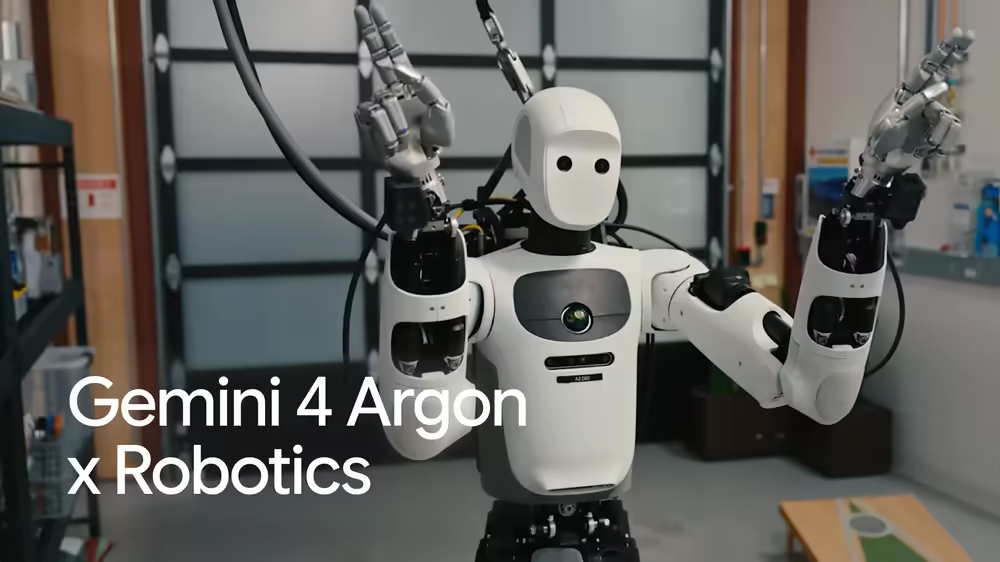
Google’s robotics claim is the one that drew the most creator attention, and Matt Wolfe even includes a section on teaching a robot to play cornhole. The blog says Argon scores 87% on the Embodied Reasoning (ERQA) benchmark using pure reasoning, which Google says outperforms all other frontier models. It then describes an internal test in which Argon watched a raw video of a human playing cornhole, mapped the spatial coordinates of the environment, calculated the required whole-body joint movements and built the simulation code autonomously. When the result was transferred to Apptronik’s Apollo humanoid, Google says the robot sank seven consecutive shots in a real-world trial.
Google calls the pipeline “Video-to-Sim-to-Real” and argues it compresses weeks of manual simulation modelling into hours. A single trial of seven shots is a demonstration, not a statistical result, and Google does not publish the success rate across attempts. Still, the structure of the pipeline is the interesting part: the model is not controlling the robot directly, it is writing the simulation and control code that does. That fits the wider pattern in Argon’s showcase, where code generation is the lever for everything from Blender scenes to robot training.
Business and Professional Work
Google positions Argon as a model for “deep work” in legal, finance, science and cybersecurity, and its blog highlights stronger writing, with direct answers, less hedging and fewer clichés. That is a claim about style that benchmarks cannot capture, and it is worth testing on your own documents before you believe it.
The examples Google gives are workflow-shaped. In the Gemini app Argon takes an unstructured project folder, builds a client proposal deck using a custom skill, drafts and emails it, then sets up a scheduled task for future requests. In Antigravity inside the Gemini macOS app it designs new sofa legs with Nano Banana and produces a 3D-printable file scaled from a sketch and a photo. It also synthesises roughly 50 GB of LiDAR scans, GIS vectors, Library of Congress drawings and National Park Service archives into explorable 3D models of Chaco Canyon.
For business readers the more important development is the enterprise side, which Google announced a week earlier with its universal work agent. We cover how that agent routes work between Gemini and Claude in our Gemini agent guide, and how Workspace is changing in our Workspace agentic features article and Gemini Skills piece. Argon is the “frontier reasoning” option in that lineup, with Flash for speed, Omni for media and Gemma for open-weight edge work.
Safety: What Google Discloses
The safety material is where the model card is most informative, and where the launch coverage is thinnest. We separate Google’s headline claims from its disclosures.
Headline claims
- Jailbreak resistance: external bio red-teaming could unlock less than 1% of the bio sub-tasks Google tests for.
- Harmful requests: on an adversarial stress-test set, violations fell nearly two-fold compared with previous Gemini models.
- Shortcut attempts: on coding benchmarks where models have no incentive to hold back, shortcut attempts fell to 2%, Google’s best result so far. These are cases where an agent hits a permission error or a failing test and tries an unauthorised workaround.
- Prompt injection: Argon leads the Gray Swan Indirect Prompt Injection benchmark, cutting attack success across 15 adaptive attempts to 0.7%.
Disclosures under the Frontier Safety Framework
The model card is blunt. For the biological critical capability level, Google says it “cannot rule out” that Argon reaches it, citing expert red teaming that showed measurable uplift over web baselines in two scenarios. For the cybersecurity critical capability level, it likewise cannot rule it out, and says the model provides “substantial uplift”. For the stealth and situational awareness threshold, Argon passes 14 of 15 of Google’s challenges, and Google says it cannot rule that threshold out either. In each case Google says it has built a safety case or residual risk assessment that lowers the risk below the threshold. Harmful manipulation and machine-learning research-and-development thresholds are assessed as not reached, and the chemical, radiological and nuclear threshold is ruled out with reasonable confidence.
This is the same family of disclosure that OpenAI and Anthropic now make. Compare it with our reading of OpenAI’s critical cyber classification and the access controls described in our Project Glasswing explainer. The common thread is that frontier labs are shipping models whose cyber and bio capabilities they cannot rule out, and managing the risk through access tiers and monitoring.
The reasoning-monitor detail
Google says it built an automated misalignment monitor that reads the agent’s step-by-step reasoning and actions and blocks unintended workarounds in real time, and that it deliberately avoided penalising the model’s thoughts during training so its reasoning stays transparent and monitorable. That is the context for Wes Roth’s comment about shortcuts that stopped appearing in reasoning: the design choice is meant to keep chain-of-thought honest, and the open question is whether the model still has shortcuts it does not verbalise. Google’s own framing is that the monitor is a second layer of defence, not proof of alignment.
Content safety numbers
Against Gemini 3.1 Pro, the model card reports a 1.57 percentage point change on text-to-text safety (where lower is better, so this is slightly worse), multilingual safety 3.16 points better, image-to-text safety 9.29 points better, a 5.5% improvement in the tone of refusals, and 9.6 points fewer unjustified refusals. Google says the text result is within confidence intervals and that manual review found losses were false positives or not egregious. In plain terms: fewer annoying refusals, roughly flat text safety.
Pricing, Access and the 30 November Cliff
| Period | Input per million tokens | Output per million tokens |
|---|---|---|
| Introductory, to 30/11/2026 | $2 (about £1.50) | $10 (about £7.50) |
| Standard, from 01/12/2026 | $4 (about £3.00) | $20 (about £15.00) |
| Cached input | 95% cheaper | n/a |
The introductory price applies to the model intended for public access, according to Google’s footnote. For comparison, Meta’s Muse Wonder lists $4 and $20, the same as Argon’s standard price, so Google is undercutting during the launch window and matching afterwards. If you are budgeting a production workload, model it at the standard price, because the discount ends six weeks after launch.
Consumer access is gated by subscription. Ultra and Pro subscribers get Argon in the Gemini app and AI Mode, and only Ultra subscribers get it in Antigravity. Free users are not mentioned in Google’s post. Enterprises can use Gemini for business and the API. Exchange-rate conversions here are approximate, so check current rates and VAT.
How It Compares
Against Claude Opus 5.5: Argon wins on knowledge work, science and long context; Opus 5.5 wins on terminal tasks and PostTrainBench. If your work is command-line agents and ML engineering, Opus 5.5 still looks stronger on Google’s own chart. See our Opus 5.5 guide.
Against GPT-6 Astra: Argon leads on most rows, but Astra leads FrontierSWE v2, Terminal-Bench Science and OSWorld-2.0, and ties on CWE-bench. Astra’s strongest ground is science-flavoured terminal work and computer use. Our Astra review has the detail.
Against Claude Fable 5.1: Argon leads every row where both are reported, in several cases by a wide margin, though Fable 5.1 is the model Anthropic positions at the top of its range, so check price per task as well as scores. See our Fable 5.1 guide.
Against Meta’s Muse Wonder: the two launched within a day of each other. Meta compares itself with different models and uses internal benchmarks, so the tables cannot be merged. Our Muse Wonder analysis explains why.
Who Should Switch
- Teams doing document-heavy knowledge work: finance, legal and research teams should test Argon first, since those are its biggest benchmark margins.
- Long-context users: if you push beyond 256k tokens, the GraphWalks gap is the best evidence on offer, but test on real documents.
- Visual and creative coders: the Blender, Three.js and AI Studio demos are the strongest evidence of capability.
- Terminal-agent and ML engineering teams: keep Opus 5.5 or Astra in your evaluation set; Argon trails on those rows.
- Regulated or high-stakes deployments: read the full Safety and Security Report before approving use, and remember the cyber and bio caveats.
A practical approach is to run Argon against your own five hardest tasks during the introductory pricing window, record cost and quality per task, and decide before 30/11/2026.
The Bottom Line
Gemini 4 Argon’s global release makes Google a clear frontier contender, and the model card is more candid about risk than most launch material. On Google’s numbers it is the strongest of the four on knowledge work, science and long context, and weaker on terminal and computer-use agents. Everything is vendor-reported, the price rises on 01/12/2026, and the reasoning-monitor design raises real questions about how much we can read into a model’s visible thoughts. Test it on your own work, watch for independent leaderboards, and revisit our tracking pages as they arrive.
Sources
- Google: Gemini 4 Argon: Built to solve your hardest problems (13/10/2026): availability, pricing, engineering and science results, robotics, safety. Header and robotics images: Google.
- Google DeepMind: Gemini 4 Argon model card: architecture, benchmark table, safety evaluations and Frontier Safety Framework assessment.
- Matt Wolfe on YouTube (13/10/2026).
- Wes Roth on YouTube (14/10/2026).
- Matthew Berman on YouTube (14/10/2026).
- WorldofAI on YouTube (13/10/2026).
Last updated: 14/10/2026. Benchmark figures are Google’s self-reported numbers from the Gemini 4 Argon model card; creator observations are taken from their video descriptions and have not been reproduced by us.
Get the free guide: Claude vs ChatGPT, Gemini & Grok
A 20-page playbook covering everything you need to choose and use the big four AI models in 2026, full cost and feature comparisons, what each is best (and worst) at, and how-tos for images, vectors, building a website, Claude Code and more.