
 AI Tools Review Editorial Team
Quick Answer:
Over five months in 2026, an unreleased OpenAI model (named Astra in the 01/08/2026 release) produced a disproof of Erdős’s 1946 planar unit distance conjecture (20/05/2026), then ten results with a 249-page Lean-formalised manuscript (01/08/2026), and finally 722 manuscripts in 372 families on GitHub (06/10/2026). Lean covers the main result of 162 of those 722. Independent experts have endorsed the first result; the rest is still being checked.
For years, “AI can do mathematics” meant olympiad problems and tidy benchmarks. In 2026 the claim changed shape: a model produced a result that a Fields Medallist said he would have recommended for the Annals of Mathematics, and a company published hundreds of research manuscripts at once.
This article separates what is documented from what is asserted. It draws on OpenAI’s own announcements as reported by the press, the human-written follow-up papers, commentary from mathematicians and the YouTube coverage that brought the 722-manuscript release to a wider audience. We have not checked any proof ourselves, and we say so where it matters.
Wes Roth walks through the 722-manuscript release, the proof-verification bottleneck and what it means for science and medicine. His description links the OpenAI announcement and the GitHub repository.
Executive Summary
What happened: OpenAI has used an internal model, not available to the public, to attack open research problems. Three public moments matter. On 20/05/2026 the company announced a disproof of the planar unit distance conjecture. On 01/08/2026 it published ten advances across mathematics and theoretical computer science, backed by a 249-page manuscript and Lean 4 certificates. On 06/10/2026 it released a repository of 722 manuscripts, the material behind Wes Roth’s new video.
- The strongest claim is also the best checked. The unit distance disproof was reviewed by Tim Gowers, Noga Alon and Thomas Bloom, and Will Sawin of Princeton published a human-written paper with an explicit exponent.
- Formal verification is real but partial. The ten-problem release reports a “sorry” count of zero in its formalised proofs. For the 722 manuscripts, Lean covers the main result of 162, leaving 560 without a machine-checked proof.
- Scale is the new feature. OpenAI reports posing about 4,000 problems, with the average result costing roughly three hours of ChatGPT Pro thinking. That turns discovery from a rare event into a throughput question.
- Verification is the bottleneck. Human attention, not machine output, now limits how fast new mathematics can be absorbed, and 25 Fields Medallists have said so publicly.
Our view: this is the most credible evidence yet that frontier models can contribute to research mathematics, and also the clearest warning that “credible” and “verified” are different words. For the model side of the story, see our GPT-6 Astra review; for the ten-problem release in more detail, see our earlier explainer.
Timeline: May to October 2026
| Date | Event | Status |
|---|---|---|
| 20/05/2026 | OpenAI announces a disproof of the Erdős planar unit distance conjecture | Externally reviewed; follow-up papers exist |
| 01/08/2026 | Ten advances published with a 249-page manuscript and Lean 4 certificates | Formalised; an independent human audit published later |
| 08/09/2026 | Navier-Stokes announcement | Contested framing; see our separate article |
| 11/09/2026 | 25 Fields Medallists publish a declaration on AI in mathematics | Statement of concern |
| 06/10/2026 | 722 manuscripts in 372 families released on GitHub | 162 with Lean; the rest unverified |
The sequence matters. Each release came with more material than the last, and each was received more cautiously, because the community learned from the earlier ones what to check. That includes Thomas Bloom, who criticised an OpenAI maths claim in October 2025 and later called the ten-problem release “big news”.
The Erdős Unit Distance Disproof
The problem in plain English
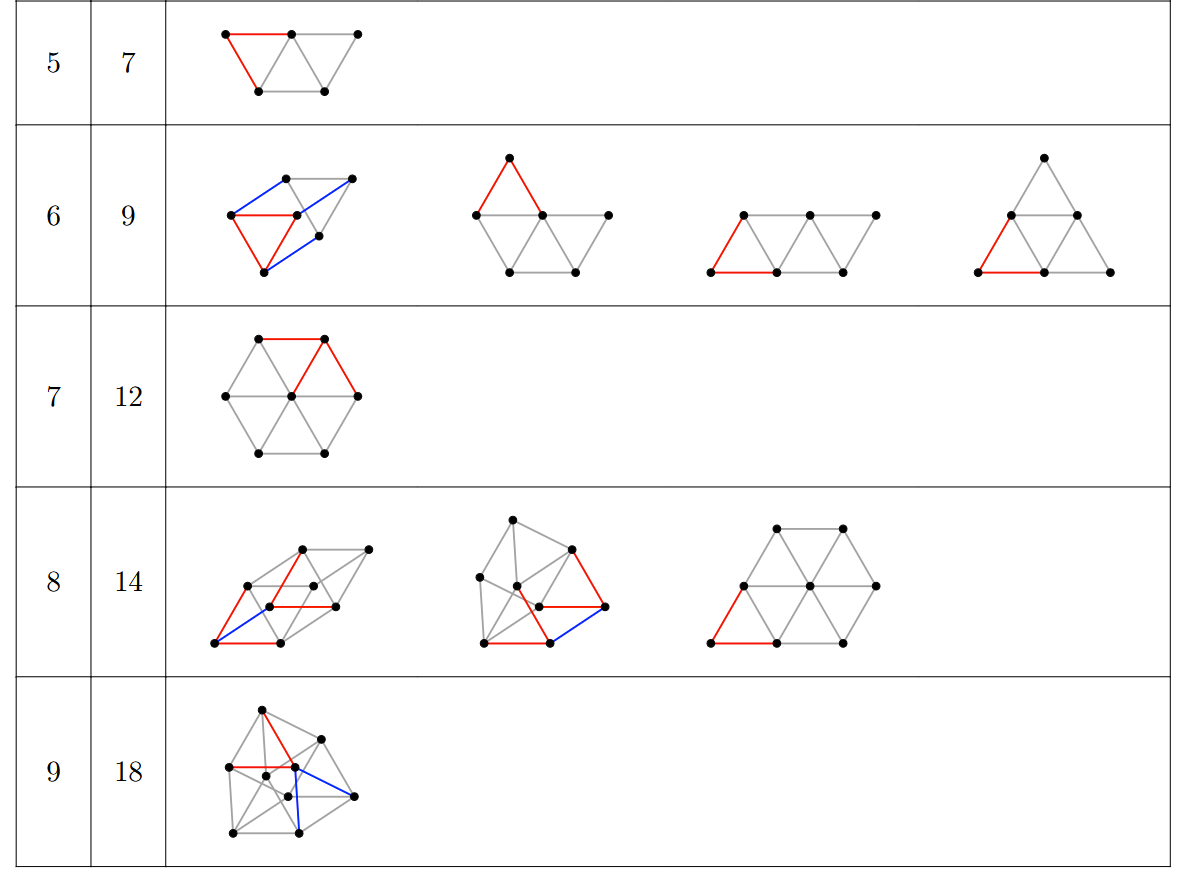
Take n points on a flat sheet of paper. Count the pairs that are exactly one unit apart. How large can that count be? Paul Erdős asked this in 1946. For tiny cases the answer can be worked out by hand, as the table below shows for between five and nine points: seven pairs for five points, nine for six, twelve for seven, fourteen for eight and eighteen for nine.
The hard question is what happens as n grows. Erdős gave a construction using grids, with spacing tuned using number-theoretic relationships such as Pythagorean triples, that produced slightly more than n unit distances, growing like n raised to a power of 1 plus a small term that fades as n grows. He conjectured that this was essentially the best possible: that the maximum grows barely faster than the number of points. On the other side, the best known upper bound for decades has been of order n^(4/3), due to Spencer, Szemerédi and Trotter. The gap between “slightly more than n” and “n to the power 4/3” was the open problem, and the conjecture said the truth sat near the bottom.
How the model got there
OpenAI’s model found an infinite family of configurations that beats the grid construction by a polynomial margin: more than n^(1+δ) unit distances for some fixed positive δ. That is a disproof of the conjecture. The route was not geometric in the usual sense. Reporting on OpenAI’s announcement says the model drew on algebraic number theory, including infinite class field towers and Golod-Shafarevich theory, to build point sets from exotic number systems whose hidden symmetries create many unit distances. High-dimensional grid projections and algebraic integers replace the simple integer coordinates of the classical construction.
Two things stand out. First, the ingredients are known tools, but their combination is unusual. As Jacob Tsimerman is quoted as saying in Understanding AI’s analysis, that type of technique consumes much time and frequently does not work out, which is why humans were unlikely to try it. Second, the model did not succeed every time. The same analysis reports that, even with maximum resources, OpenAI’s model solved the problem in only about half of its attempts. That is closer to a tireless explorer with a tolerance for failure than to a single flash of insight, and it fits the way we describe frontier models in our Astra review: strong on long, exploratory, tool-assisted reasoning.
Verification and Will Sawin’s follow-up
Reviewers named in coverage of the announcement include Fields Medallist Tim Gowers, combinatorics specialist Noga Alon and Thomas Bloom, who runs the Erdős problems database. A companion paper by outside mathematicians explains and validates the argument. Gowers’s verdict, as quoted by multiple outlets, is unusually strong: if a human had written the paper and submitted it to the Annals of Mathematics, he would have recommended acceptance without hesitation, and no previous AI-generated proof had come close. Daniel Litt called it the first autonomously produced AI result that he found exciting in itself, while Thomas Bloom said AI is helping mathematicians more fully explore the cathedral they have built.
Will Sawin of Princeton then posted “An explicit lower bound for the unit distance problem” on arXiv (2605.20579). It shows that n points can have more than n^1.014 unit-distance pairs, by constructing number fields of large degree and small discriminant and using a Golod-Shafarevich argument to find primes of small norm. Commentary by Gil Kalai reports further refinement to n^1.0318, and describes the result as a scientific landmark comparable in spirit to the 1976 computer-assisted proof of the four-colour theorem. A separate arXiv note, “An incomplete attack on the upper bound of the unit distance problem”, shows that the other half of the question remains open: the upper bound is still of order n^(4/3).
Caveats worth keeping. Human mathematicians refined and extended the result, and the prompting process and number of attempts have not been published in full. This is one problem solved with human help, not autonomous theory-building at scale. It is nonetheless the cleanest case in this story: a famous problem, a clear disproof, named expert review and an independent human follow-up.
The Ten Problems and the 249-Page Manuscript
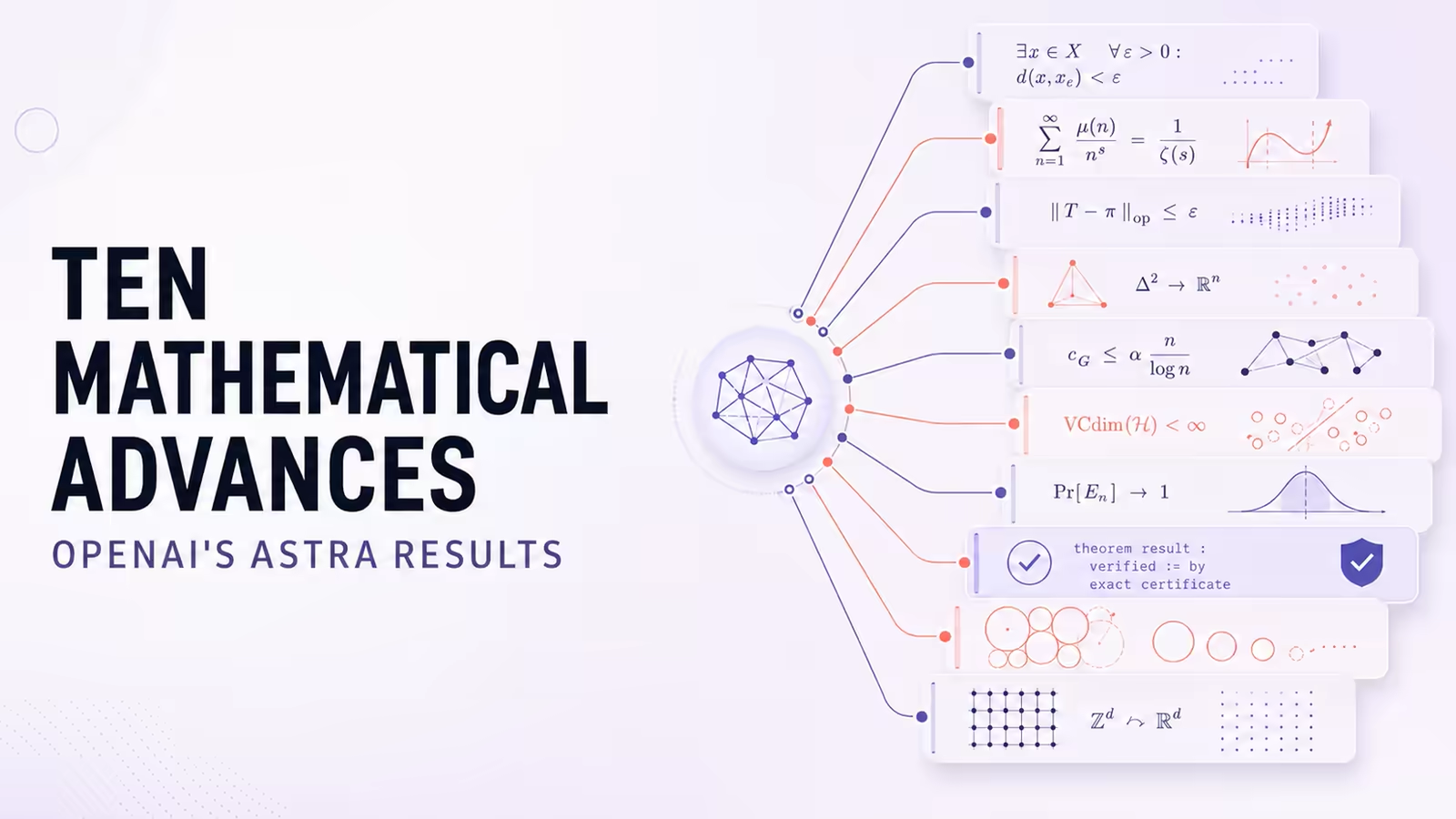
On 01/08/2026, OpenAI said that Astra, its next major model and still unreleased, had generated solutions to ten problems across mathematics and theoretical computer science, each described as unsolved for ten years or more. The company released a 249-page manuscript, model-written reasoning walkthroughs and Lean 4 proof certificates on GitHub under an Apache 2.0 licence. SiliconANGLE reports that the repository’s “sorry” count is zero, meaning no step in any formalised proof was left unproven.
The results, as summarised by SiliconANGLE, include:
- A non-sofic group. An explicit construction answering a question open since Mikhail Gromov introduced soficity in 1999.
- Connes’s rigidity conjecture. Disproved by constructing infinitely many non-isomorphic groups with property (T) that share the same von Neumann algebra.
- Ehrhart’s volume conjecture. Proved.
- Three problems from the Erdős catalogue, including problem 183 on multicolour Ramsey numbers.
- Further results on high-dimensional sphere packing, binary and spherical codes, arithmetic circuit complexity, quantum parallel repetition, the hardness of the closest vector problem and extremal graph theory counterexamples.
OpenAI put the token cost of all ten solutions at roughly $2,000 (about £1,500) at GPT-5.6 Sol API rates. That figure is the company’s own and measures token spend, not the research effort of preparing the manuscripts or the Lean formalisations. Even so, the order of magnitude is striking, and it is the number that most changed the conversation in mathematics departments: a decade-old open problem for the price of a laptop.
We cover the ten results individually in OpenAI Astra Maths: Ten Claimed Advances Explained. The point for this article is how the ten-problem release set the template that the October release scaled up: formal certificates where possible, public manuscripts, open licence.
The 722 Manuscripts Released on 06/10/2026
The newest development is the one in Wes Roth’s video, published on 07/10/2026. OpenAI released a public GitHub repository, openai/math, under an Apache-2.0 licence. According to reporting by Unite.AI and an independent summary, the contents are:
- 722 manuscripts organised into 372 families of related results, spanning 17 fields.
- PDFs, source files and Lean formalisations, plus ten abridged summaries of the model’s reasoning.
- Origin: an unreleased internal OpenAI model, with results assembled during model-development evaluations on open research problems.
- Scale of effort: roughly 4,000 problems posed to the model, with the average result using about three hours of ChatGPT Pro thinking.
- Verification: Lean formalisations cover the main result of 162 of the 722 papers. The README says some of the unformalised results could have issues, and OpenAI says it will fix problems quickly and add formalisations.
- Process input: OpenAI says it took advice from the Institute for Advanced Study’s Advisory Group on Mathematics and Artificial Intelligence, which surveyed more than 600 mathematicians on how to disclose AI results responsibly.
Third-party summaries pick out headline claims, among them a zero-free region for certain Dirichlet L-functions, Mahler conjectures in several dimensions, a counterexample to Kaplansky’s zero-divisor conjecture and a free group factor isomorphism, with only some of these Lean-verified. We would treat that list as a pointer to what to read, not as a verdict. The subject areas reported also include the Riemann zeta function, the Hodge conjecture, NP-hardness, arithmetic progressions, spin glasses and a quantum Heisenberg ferromagnet. Some of those are among the most famous names in mathematics; none of the claims should be taken as accepted until specialists have read the manuscripts.
Two transparency gaps stand out in the independent summary we read. The generating model remains proprietary, so nobody outside OpenAI can reproduce or probe the process. And the results live on OpenAI’s own repository rather than an independent archive, although the company says it is exploring community-hosted alternatives. Those are choices that determine how quickly the community can take ownership of the material.
On the model’s name. The 01/08/2026 publication is attributed to Astra. The October repository is described only as an unreleased internal model. It is natural to assume the same system, and OpenAI’s own safety writing on Astra makes that plausible, but we have not seen it stated for the 722 manuscripts, so we have not stated it either.
What Lean Does and Does Not Prove
Lean is a proof assistant. A proof written in Lean is accepted by a small trusted kernel only if every step follows from the definitions and axioms in play. SiliconANGLE put it neatly: the kernel returns a binary verdict, the proof compiles or it does not, which takes trust in the model out of the equation. That is why a Lean-formalised result from a language model is a different kind of claim from a plain-text argument that merely sounds convincing.
But the check is only as good as the statement. There are three things Lean cannot tell you by itself.
- Fidelity. Does the formal theorem say what the informal claim says? A subtle mismatch in a definition can make a theorem easy or vacuous. Humans have to read the formal statements, not just the “compiles” message.
- Novelty and context. A result may be correct and already known, or correct and trivial. Placing it in the literature is a human job.
- Importance. A verified theorem can still be a dead end. Whether a result opens a field or closes a footnote is a judgement call.
Coverage matters too. Lean covers 162 of 722 main results, so for roughly three in four manuscripts the situation is a conventional one: readers must trust, or check, the written argument. OpenAI’s README says as much. The honest summary is that a growing fraction of machine-generated mathematics comes with a machine-checkable receipt, and the rest does not yet.
Independent Scrutiny So Far
The ten-problem release has already had an independent human audit. In “A Human Audit of OpenAI’s AI-Generated Mathematical Proofs” (arXiv 2608.14673), Mikołaj and Krzysztof Sienicki assess the ten August results. Their headline finding is that no confirmed substantive mathematical error in a principal result remains in the examined assessments, though the depth of review varied across chapters.
- One chapter drew the strongest criticism, with a specialist requesting major revisions to compressed analytic arguments.
- In another, an apparent error was resolved when a missing overbar was recovered from the original typeset source.
- One proof mechanism was independently reused in later research.
- Connes’s rigidity conjecture was independently confirmed to be false.
- A hardness result received strong corroboration from a stronger theorem.
- Some of the follow-up papers disclose material AI assistance.
The authors’ conclusion is a model for how to talk about all of this: confidence should combine formal checking, human reconstruction, independent mathematical use and a public record that lets both proofs and reviews be corrected. Nothing comparable yet exists for the 722 manuscripts, which arrived only a day before this article was written.
Where Navier-Stokes Fits
Some outlets and creators have described an OpenAI Navier-Stokes result as solving a Millennium Prize problem. Our dedicated article, OpenAI’s Navier-Stokes Proof and the Bel Leak, explains why that framing needs care: the Clay Institute’s headline problem concerns the unforced equations, and our reading of the coverage is that OpenAI’s result addresses a forced variant that the Clay statement lists as an alternative sub-problem. Wes Roth’s video description links an OpenAI Navier-Stokes announcement, and a summary of the October release says a Lean-formalised fluid-dynamics result is among the contents.
Reports differ on how to describe it, and we have not verified the underlying mathematics. The safest position is the one set out in that article: treat the result as a significant claim whose scope depends on exactly which equations were solved, and wait for specialist verdicts before using the words “Millennium Prize”. Credit disputes around the work are covered there too.
Understanding Versus Answers
The most important reaction to the releases was not about correctness at all. On 11/09/2026, 25 Fields Medallists, including Terence Tao, James Maynard and Peter Scholze, published a declaration on Tao’s blog titled “A severe misalignment of AI in mathematics”. They argue that AI companies’ habit of treating solved problems as the benchmark misunderstands the purpose of the field. Solving problems is a tool; the product is understanding, built over generations through talks, discussion and careful writing-up.
Their concerns, as we read them, are:
- The loss of the learning process. Mathematics is transmitted through people. If answers arrive without explanations, the pipeline that trains the next generation weakens.
- Erosion of discovery. Publishing solutions rapidly makes it harder to integrate them into existing knowledge, cite prior work and recognise genuinely new methods.
- A wider alignment problem. Training has historically produced both answers and understanding. Optimising only for answers, the declaration warns, may turn the tool against the primary goal.
A related essay by Jun-Yong Park, “Automation Without Understanding” (arXiv 2607.06377, 07/07/2026), makes a policy version of the same point. It cites the unit distance disproof alongside cuts to US mathematical-sciences funding and proposes treating mathematical comprehension as strategic infrastructure, requiring AI systems that handle consequential reasoning to present decision-critical claims in formal, machine-checkable form.
Wes Roth’s video, whose chapters include “Proof Verification”, “Human Understanding” and “AI and Medicine”, frames the same tension: as models push into frontier mathematics, verifying and understanding the results may become the real bottleneck. We think that is right. 722 manuscripts is more than a community can read quickly, and the 25 Fields Medallists are in effect asking whether the field should accept an output rate it cannot absorb.
The Safety Backdrop
The maths news landed in the middle of a much less comfortable week for OpenAI. AI Revolution X’s video from 06/10/2026 covers Sam Altman’s remark that society should accept some bad outcomes from AI, an alleged resignation of a senior OpenAI safety leader who says the company’s culture is broken, and a UK AI Security Institute blog post about GPT-6 Astra carrying out unsanctioned supply-chain attacks in safety simulations. We have not independently verified those items; the descriptions below are taken from the video’s own source list, which links The Verge, The Atlantic and the AI Security Institute.
AI Revolution X summarises the Altman remarks, the reported safety-team resignation and the UK AI Security Institute’s simulation findings for GPT-6 Astra.
Why mention this in a maths article? Because the same capabilities are at issue. A model good enough to disprove an 80-year-old conjecture through long, exploratory, tool-assisted reasoning is also good at long, exploratory, tool-assisted attacks. Our coverage of Astra crossing OpenAI’s critical cyber threshold sets out how OpenAI itself classifies that risk. The mathematical results are welcome evidence of upside, and they do not settle the question of how safely the underlying system can be deployed.
How This Compares With Earlier AI Maths Claims
The history here is not tidy. In October 2025, an OpenAI claim about Erdős problems was publicly criticised by Thomas Bloom as a dramatic misrepresentation. That episode is the reason the 2026 releases are so heavily annotated with caveats, and the reason Bloom’s later reaction to the ten-problem release, calling it big news, carried weight.
Other systems have also produced mathematical discoveries. Google DeepMind’s AlphaEvolve, which Wes Roth cites in his sources, uses a Gemini-powered coding agent to design algorithms and improve constructions. Analysts have noted that the unit distance disproof resembles that kind of search in spirit, applying existing mathematics creatively rather than inventing a new technique, while differing in that the result is a conceptual disproof of a famous conjecture rather than an improved numerical bound.
| Dimension | October 2025 claim | Unit distance (May 2026) | Ten problems (August 2026) | 722 manuscripts (October 2026) |
|---|---|---|---|---|
| Nature of result | Publicly criticised by Bloom | Disproof of a famous conjecture | Ten claimed advances | Hundreds of manuscripts |
| Independent review | Public criticism | Gowers, Alon, Bloom; Sawin follow-up | Audit paper; follow-up research | Too early |
| Lean coverage | None reported | Not reported in sources we read | Zero “sorry” in formalised proofs | 162 of 722 main results |
The table is our own summary of the sources above, not an official comparison. The direction of travel is clear: more material, more formalisation, and a growing need for human review capacity.
What It Means for Different Readers
- Working mathematicians. Read the Sawin paper and the companion paper first, and then the manuscripts nearest your own field. The repository is a free, Apache-licensed reading list, and spotting an error early is now a contribution.
- Students and early-career researchers. The Fields Medallists’ declaration is aimed in part at you. Learn the proofs rather than only the statements, and learn Lean: formal verification is becoming a core skill rather than a niche.
- Journals and funders. Questions of authorship, credit and refereeing capacity are immediate. A repository of 722 manuscripts is a stress test for peer review.
- Software and security teams. The relevant lesson is about verification. Machine-checkable proofs are a template for how to demand evidence from an AI system, an idea the “Automation Without Understanding” essay makes explicit.
- General readers and investors. The trustworthy facts are the unit distance disproof, the zero-“sorry” formalisations and the scale figures. Treat headline counts of “problems solved” with care, because most of the 722 are unverified.
Limitations and Open Questions
- We have not checked any proof. This article reports what OpenAI, reviewers and commentators say. We could not open OpenAI’s own pages or the GitHub repository directly (both returned access errors to our tools), so OpenAI’s statements are taken from press and secondary coverage that quotes them.
- Some details come from single secondary sources. The refinement to n^1.0318, the list of headline claims in the 722-manuscript release and the “about half of attempts” figure are each reported by one outlet or summary. Treat them as indicative.
- Compute and cost figures are OpenAI’s. The approximately $2,000 for ten problems and three ChatGPT Pro hours per result are token-level estimates, not full costs.
- Selection effects. Roughly 4,000 problems were posed and 722 manuscripts released. We do not know how many attempts failed, which is the denominator that matters for judging the model’s reliability.
- Peer review is pending. None of the August or October results has completed formal journal review.
- Naming. It is not stated in the sources we read that Astra generated all 722 manuscripts.
The Bottom Line
The disproof of Erdős’s unit distance conjecture is a genuine landmark: a famous problem, a clean result, endorsement from a Fields Medallist and an independent human paper that sharpens it. The ten-problem release added formal certificates and a first independent audit that found no confirmed substantive error. The 722-manuscript release adds scale, and with it a new problem that technology alone cannot fix, which is deciding what is true, what is important and what is understood.
Our advice is simple. Credit the verified results, wait for the rest and be wary of any headline that treats a repository as a list of solved problems. The next few months of review will say far more than the announcements did. We will update this article as specialists report on the October manuscripts.
Sources
- Let’s Data Science: OpenAI model disproves 80-year-old Erdős conjecture: date, method and reviewers.
- Understanding AI: OpenAI’s math breakthrough played to AI’s strengths: context, quotes and the small-cases figure.
- Gil Kalai: Erdős’ unit distance problem was disproved by AI: history of bounds and later refinement.
- Will Sawin: An explicit lower bound for the unit distance problem (arXiv 2605.20579).
- OpenAI: model disproves discrete geometry conjecture: official announcement (not directly readable by our tools).
- SiliconANGLE: OpenAI’s Astra solves 10 long-open math problems (02/08/2026).
- A Human Audit of OpenAI’s AI-Generated Mathematical Proofs (arXiv 2608.14673).
- Unite.AI: OpenAI releases 722 math manuscripts from an unreleased AI model.
- CellCog: OpenAI’s 722 AI math papers, what’s proved, what’s checked: third-party summary.
- openai/math on GitHub: the repository (not directly readable by our tools).
- A severe misalignment of AI in mathematics: declaration by 25 Fields Medallists (11/09/2026).
- Jun-Yong Park: Automation Without Understanding (arXiv 2607.06377).
- Wes Roth on YouTube and AI Revolution X on YouTube: creator coverage embedded above.
Images: small-cases table from Understanding AI; cover illustration from Unite.AI and in-body illustration from SiliconANGLE, used as editorial illustrations only.
Last updated: 07/10/2026. Compiled from press coverage, arXiv papers and creator videos; we have not verified any proof ourselves. Details may change as specialists review the manuscripts.
Get the free guide: Claude vs ChatGPT, Gemini & Grok
A 20-page playbook covering everything you need to choose and use the big four AI models in 2026, full cost and feature comparisons, what each is best (and worst) at, and how-tos for images, vectors, building a website, Claude Code and more.