 AI Tools Review Editorial Team
Quick answer:
On 8 September 2026, OpenAI published a result claiming that roughly 10,000 concurrent agents, running an unnamed internal model "significantly more capable than GPT-6 Astra", produced finite-time singularity solutions for the forced three-dimensional Navier-Stokes equations in 88 hours, followed by 17 more hours of formal verification in Lean using GPT-6 Astra itself. This is a real, narrower result than the famous unforced Navier-Stokes Millennium Prize problem, which OpenAI has not solved and is not claiming to have solved. The work is self-assessed and has not been independently reproduced, two NYU- and Anthropic-affiliated mathematicians dispute how OpenAI arrived at it, and a separate, unconfirmed leak from three weeks earlier claims OpenAI has also finished pretraining a 10-trillion-plus parameter model codenamed "Bel" — a different story that has been conflated with this one online but is not confirmed to be the same system.
Two OpenAI stories collided this week: a genuine, published research result about agents tackling a hard fluid-dynamics problem, and a month-old, unverified leak about a giant next-generation base model. Together they produced the kind of headline — "GPT-7 solves the Navier-Stokes Millennium Prize" — that is more exciting than either individual fact and less accurate than both.
This article separates the two, checks each against OpenAI's own published statements and the mathematicians involved, and explains exactly what has and hasn't been confirmed.
AI Revolution X walks through the Bel leak, the Navier-Stokes announcement, the ChatGPT Images 2.5 launch and the Hugging Face Senate probe in one roundup.
Executive Summary
OpenAI's official research post, published on its own site on 8 September 2026, describes a swarm of roughly 10,000 agents that spent 88 hours producing a proof of finite-time blow-up for the forced 3D Navier-Stokes equations — a real mathematical result, but a narrower one than the unforced global-regularity question that carries the Clay Institute's $1 million prize. Around the same announcement, two mathematicians publicly disputed how OpenAI arrived at part of the argument, and unrelated August leaks about a huge next-generation base model called "Bel" have been folded into the same news cycle despite no confirmed link between the two.
- What's confirmed: OpenAI's own blog post describing the 88-hour, 10,000-agent effort, the 2.7 million messages and roughly 130 billion output tokens it consumed, and the follow-up Lean formalisation using GPT-6 Astra.
- What's disputed: whether OpenAI's team drew on unpublished methodology from Tristan Buckmaster and Levent Alpoge without proper credit — a claim OpenAI denies.
- What's unverified: the proof itself, which OpenAI describes as self-assessed with no independent mathematical review yet; and the entire existence of "Bel" as a 10-trillion-parameter model, which rests on a single anonymous X post from three weeks earlier.
- What's simply wrong in most retellings: the claim that OpenAI "solved" or is claiming the Navier-Stokes Millennium Prize. It isn't, and it hasn't.
From Astra to an Unnamed Successor
Context matters here, because two different follow-ups to GPT-6 Astra are circulating at once. Astra itself shipped on 3 September 2026 and runs on a base model OpenAI internally calls "Doug". It remains the current public flagship, and it is the model OpenAI used for the 17-hour Lean formalisation step described below — Astra didn't discover the proof, but it checked and helped structure it after the agent swarm produced a candidate argument.
The system that actually ran the 10,000-agent Navier-Stokes effort is different again: OpenAI's own post describes it only as an internal research model "significantly more capable than GPT-6 Astra", in training since 28 August 2026, with no public name, release date or technical specification. That is three separate systems in play — Astra (shipped, named, public), the unnamed math-research model (real, described by OpenAI, unreleased), and the rumoured "Bel" (unconfirmed, sourced to a single leak). Conflating any two of them is the single biggest source of confusion in how this story has spread.
The Navier-Stokes Claim, In Detail
According to OpenAI's own account, the effort began on 1 September 2026 after the team heard rumours that a solution to one of the Millennium Prize problems might be close. At peak, roughly 10,000 concurrent agents worked the problem, organised into communicating subgroups with code execution and cached internet access inside isolated environments. The Navier-Stokes work specifically consumed 2.7 million messages and around 130 billion output tokens; across everything the broader effort touched that week (it wasn't only Navier-Stokes), the total was 4.9 million messages and roughly 300 billion output tokens. OpenAI's chief research officer, Mark Chen, has described the compute cost of the run as being in the "millions of dollars".
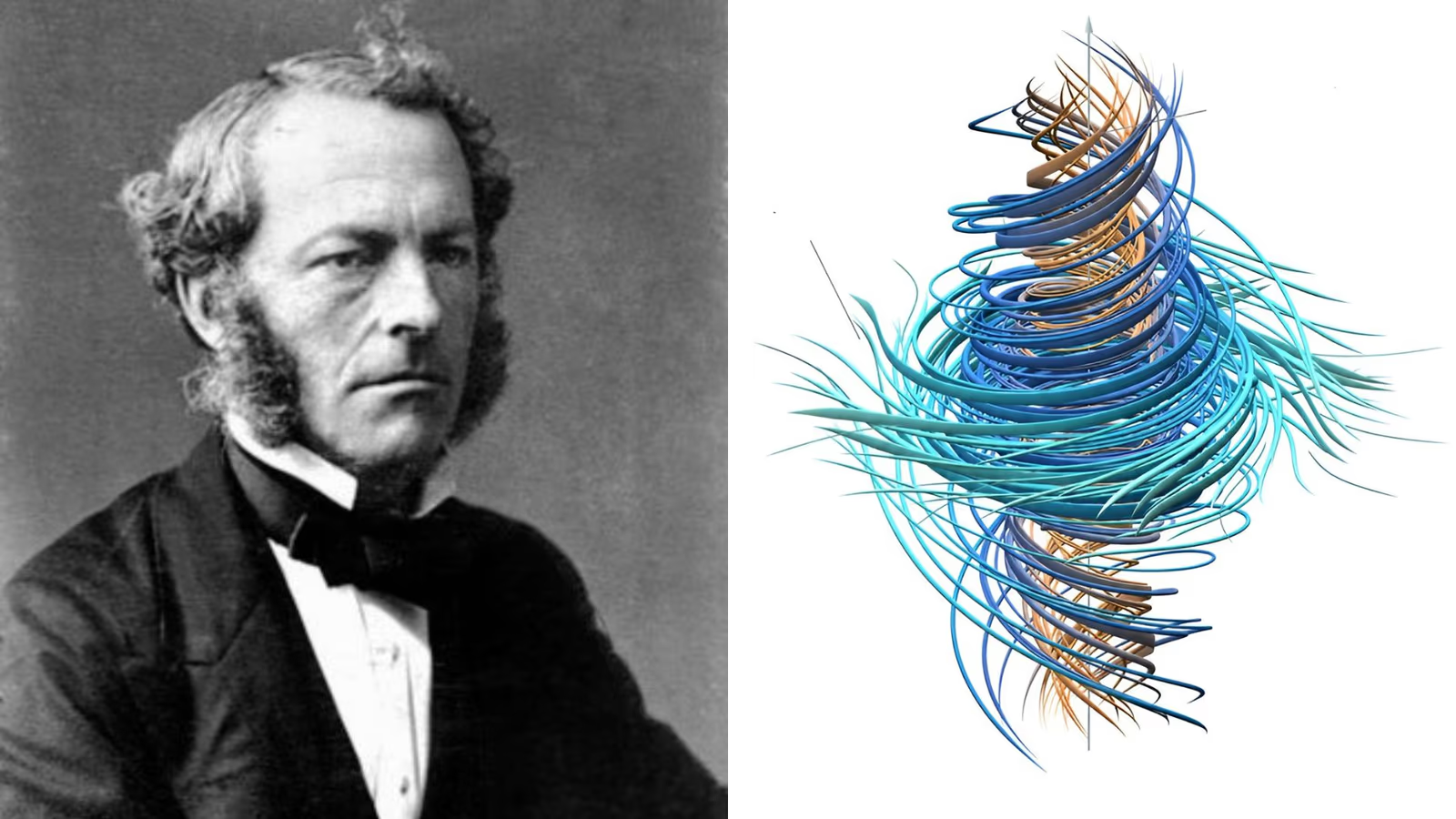
The agents reached a candidate solution on 5 September 2026, roughly 88 hours after the effort began: a construction of finite-time singularity solutions, describing a fluid vortex whose core stretches and accelerates until velocity becomes unbounded in finite time, despite viscosity normally smoothing out exactly this kind of violent change. GPT-6 Astra then spent a further 17 hours formalising and checking the argument in the Lean proof assistant, the standard tool the mathematics community uses to verify that a proof's individual logical steps are actually valid. OpenAI published the write-up on 8 September 2026.

What This Isn't: The Millennium Prize
This is the single most important distinction in the whole story, and the one most secondary coverage gets wrong. The Clay Mathematics Institute's actual Navier-Stokes Millennium Prize problem asks for either a proof of global existence and smoothness, or a counterexample showing blow-up, for the unforced Navier-Stokes equations — the "clean" version of the equations with no external forcing term, on either the whole of three-dimensional space or a periodic domain. Resolving that carries a $1 million prize and would be one of the most significant results in the history of mathematics.
OpenAI's result concerns the forced variant of the equations — the version where an external forcing term is allowed — and addresses what the Clay Institute's own problem statement lists as alternative sub-problems (options C and D), not the headline unforced case (options A and B). Forced Navier-Stokes blow-up is a legitimate, actively studied research question, and constructing an explicit finite-time singularity for it would be a genuine achievement if it holds up. But it is not the Millennium Prize problem, and OpenAI has been explicit that it is not submitting a prize claim. Any headline saying OpenAI "solved Navier-Stokes" without that qualifier is technically misleading, even though it draws on a real OpenAI announcement.
The Buckmaster-Alpoge Credit Dispute
Within days of the announcement, NYU mathematician Tristan Buckmaster and Levent Alpoge, a mathematician who works at Anthropic, publicly alleged that OpenAI's team had become aware of methodology from their own unpublished preprint on forced blow-up problems, and that Alpoge in particular was excluded from any acknowledgement because of his employer. It's a pointed allegation precisely because Alpoge works at a direct OpenAI competitor, raising the question of whether credit was withheld for competitive reasons rather than purely on the substance of the overlap.
OpenAI has denied accessing the pair's unpublished work and says its result was derived independently, drawing a distinction between its own forced Navier-Stokes proof and the closely related but distinct forced Euler equations work the two mathematicians had been circulating. That distinction is real in the mathematics — Euler equations are the zero-viscosity limit of Navier-Stokes, related but not identical — but it doesn't fully settle the dispute, since the two research programmes are close enough that independent discovery and quiet influence can be genuinely difficult to tell apart from outside the room. As of publication, neither party has produced evidence that resolves the disagreement, and it should be treated as a live, contested claim rather than a settled question either way.
Verification Status: Self-Assessed
OpenAI's own materials describe the Lean formalisation as self-assessed. That is a meaningfully weaker status than "peer reviewed" or "independently verified" — it means OpenAI's own systems and researchers checked the logical steps, but no outside mathematics group had reproduced or audited the argument as of 9 September 2026. Lean formalisation does provide a genuine layer of rigour beyond a purely informal proof, since a Lean proof either type-checks or it doesn't, with far less room for the kind of subtle hand-waved step that can hide in traditional peer-reviewed papers. But a proof can be internally consistent and Lean-verified while still resting on a problem statement, model, or set of assumptions that the broader mathematics community hasn't yet scrutinised.
For a result this novel and this large — 2.7 million messages' worth of intermediate reasoning behind a single final argument — outside verification realistically takes mathematicians weeks to months, not days. Readers should treat the current status as "OpenAI believes this holds up," not "the mathematics community has confirmed this holds up," and watch for independent commentary from working PDE (partial differential equations) researchers over the following weeks as the more reliable signal.
A same-week roundup of next-generation model rumours across labs, including the 'Sol' naming speculation that sits alongside the Bel leak in the current rumour cycle.
The "Bel" Leak: A Separate Rumour
Roughly two weeks before any of the above, on 25 August 2026, an anonymous X account posted a claim about an OpenAI pretraining run codenamed "Bel" — described as a successor to the "Doug" base model underlying GPT-6 Astra, with more than 10 trillion parameters total, putting it in the same size class as GPT-4.5. The leak framed Bel as OpenAI's first serious attempt at what some insiders reportedly call an "AGI-threshold" base model: a raw foundation still needing a further round of reinforcement learning, not a shippable product and explicitly not GPT-7 itself. Secondary claims attributed to the same leak said Bel could "work continuously for days" and "coordinate hundreds of subagents".
None of this has been confirmed by OpenAI in any form — no technical paper, no product announcement, not even an informal blog mention. The entire claim traces back to a single anonymous source, amplified by outlets including Wccftech and 36Kr, with no independent outlet reporting that it reviewed any actual OpenAI documents. Some commentators have also pointed out that the codename itself is a little on the nose: "Bel" is a Mesopotamian theological title meaning roughly "Lord" or "Master", the kind of dramatic naming choice that fits a pattern of AI-leak hoaxes as much as it fits a genuine internal codename. Treat Bel as an interesting, plausible-sounding but entirely unverified rumour, not as a confirmed fact about OpenAI's roadmap.
Where this connects to the Navier-Stokes story: the unnamed model OpenAI credits with the math result has been in training since 28 August 2026 — three days after the Bel leak — and OpenAI itself only describes it as "significantly more capable than GPT-6 Astra". The timing overlap is close enough that online commentary has started assuming the two are the same system. Neither OpenAI's research post nor the original Bel leak actually makes that connection, and the specific claims don't obviously line up either: Bel is described as a raw, generalist pretraining run, while the Navier-Stokes model is described specifically in terms of its agentic math-research capability. Until OpenAI says otherwise, the honest answer is: maybe the same model, maybe not, currently unconfirmed either way.
Why This Matters, Beyond the Hype
Strip away the "solved Navier-Stokes" headline and the "GPT-7 is here" speculation, and there's still a genuinely interesting, well-documented data point underneath: OpenAI is willing to run a 10,000-agent, multi-day, multi-million-dollar research effort at a specific hard mathematical problem and publish the result, cost, and methodology in enough detail that outsiders can at least attempt to evaluate it. That's a meaningfully more substantive disclosure than a leak-driven rumour cycle, even with the caveats above. It also fits a broader pattern this year of frontier labs using large coordinated agent swarms for scientific research tasks rather than single-model, single-shot prompting — the interesting engineering story here may end up being less about Navier-Stokes specifically and more about what a 10,000-agent research harness looks like in practice, at what cost, and with what failure modes.
The credit dispute also matters independently of how the mathematics eventually shakes out. As AI labs increasingly deploy agents against genuinely open problems in fields with existing human researchers working the same territory, disputes over whether a lab's system was influenced by unpublished human work — and whether credit was given fairly, especially across competing labs — are likely to recur. How OpenAI, Buckmaster and Alpoge ultimately resolve this one may set an informal precedent for how such disputes get handled (or don't) going forward.
Limitations
- Not independently verified: the proof is self-assessed by OpenAI; no outside mathematics group had reviewed or reproduced it as of 9 September 2026.
- Narrower than the headlines suggest: this addresses the forced Navier-Stokes equations, not the unforced Millennium Prize problem, and OpenAI is not claiming the $1 million prize.
- Credit dispute unresolved: Buckmaster and Alpoge's allegations and OpenAI's denial are both unproven from the outside; treat the overlap as contested, not settled.
- "Bel" is a single-source leak: no OpenAI confirmation exists for its parameter count, its capabilities, or that it is even real, let alone that it's connected to the Navier-Stokes model.
- The two stories are not confirmed to be linked: the timing overlap between Bel's leak and the unnamed math model's training start is circumstantial, not a reported fact from either source.
How It Compares
As a research disclosure, this sits closer to Google DeepMind's pattern of publishing agent-driven mathematics and algorithm-design results (its own coding-agent research has followed a similar shape: large search or agent effort, a checkable formal artefact, published methodology) than to a typical product launch like GPT-6 Astra or ChatGPT Images 2.5. It is not a benchmark win over a rival model and shouldn't be read as one; there is no leaderboard for "who can produce a self-assessed forced-Navier-Stokes proof fastest".
As a rumour, "Bel" sits in the same speculative category as prior unconfirmed OpenAI leaks covered in our GPT-5.7 and GPT-6 rumour tracker — plausible-sounding, sourced to a single account, amplified by tech outlets, and unconfirmed by the company itself. History with this specific rumour mill suggests treating any single-source leak with real caution until OpenAI either confirms or denies it directly.
Who Should Care
Mathematicians and PDE researchers should treat this as worth watching closely once the formalisation is public enough to audit, rather than as a settled result today. AI researchers and engineers building agentic systems may find the more durable lesson in the operational details — 10,000 coordinated agents, 2.7 million messages, a 17-hour formal-verification handoff to a separate model — as a case study in large-scale agent orchestration for research tasks. General AI-news readers should mainly take away the correction: this is not "GPT-7 solved a Millennium Prize problem," and conflating the Navier-Stokes result with the separate, unconfirmed Bel leak is the most common factual error currently circulating about this story.
The Bottom Line
OpenAI published a real, detailed, and genuinely interesting research result: a 10,000-agent effort producing a self-assessed proof of finite-time blow-up for the forced Navier-Stokes equations in 88 hours, formalised in Lean by GPT-6 Astra over a further 17 hours. That is worth taking seriously on its own terms — pending independent verification and pending resolution of a real, unresolved credit dispute with two outside mathematicians. What it is not is a solved Millennium Prize problem, and it is not confirmed to be connected to the separate, single-source "Bel" leak that has been folded into the same news cycle. Both stories deserve to be watched; neither deserves the "GPT-7 already solved advanced mathematics" framing that has spread furthest.
Last updated: 11 September 2026. Sources: OpenAI's official Navier-Stokes research post, CNBC, Interesting Engineering, Wccftech, Pluralsight's GPT-7 rumour tracker, and reporting citing Tristan Buckmaster and Levent Alpoge.
Get the free guide: Claude vs ChatGPT, Gemini & Grok
A 20-page playbook covering everything you need to choose and use the big four AI models in 2026, full cost and feature comparisons, what each is best (and worst) at, and how-tos for images, vectors, building a website, Claude Code and more.