 AI Tools Review Editorial Team
Quick Answer:
On 08/10/2026 Google Cloud announced the Gemini agent, a universal work agent that picks the best model per job, orchestrating across Gemini and Anthropic’s Claude models today. It adds four kinds of memory, sub-agents with their own identities, an agent firewall called Agent Gateway and per-project spend caps. Google’s post gives no price and no general availability date.
A year ago it would have sounded odd for Google to build its flagship work agent so that a rival’s model can sit underneath it. In Thomas Kurian’s own words, “Gemini is the agent, and the model underneath it is a separate choice.”
This guide explains what Google actually announced, which parts are architecture and which are marketing, and what the Claude detail signals about where enterprise AI is going. It draws on Google Cloud’s keynote post, two independent write-ups and a creator video, and it flags every claim that rests on Google’s word alone.
Julian Goldie summarises the Gemini agent and the idea that the AI “walled garden” is coming down.
Executive Summary
- What it is: one agent, one API and one prompt box for questions, knowledge work, media creation and code, announced at Gemini at Work 2026.
- The headline detail: it routes each job to the model that fits best, across Google’s Gemini family and Anthropic’s Claude models today, and “other leading private and open models in the future”.
- How it works: it runs persistently in the cloud, keeps session, semantic, procedural and episodic memory, and spawns temporary sub-agents with their own identities.
- Control layer: attested agent identities, audit trails, an Agent Sandbox and Agent Gateway, plus real-time spend caps that pause a project’s agent.
- Unknowns: pricing, plan tiers, general availability and the proportion of work routed to Claude are not stated in Google’s post.
- Our view: the most interesting part is not any single feature but the decision to separate agent from model. It matches a shift we have tracked across vendors, and it puts pressure on every competitor that sells a model-locked agent.
What the Gemini Agent Is
Google Cloud introduced the Gemini agent on 08/10/2026 in a keynote post by its CEO, Thomas Kurian, titled “Welcome to Gemini at Work 2026”. The post describes it as “a single, universal agent for work that answers your questions, handles your knowledge work, creates your images and media, and writes and runs code”. Google’s consumer-facing announcement describes the same thing as an agent that plans the work, uses skills and tools, connects to company systems and “brings back something finished” inside the documents, inboxes and developer environments people already use.
The post opens with scale claims, all Google’s own: in the last year nearly 500 Google Cloud customers each processed more than one trillion tokens, nearly 80% of Google Cloud customers use its AI products, and nearly 90% of the Fortune 100 use Gemini Enterprise. The argument is that organisations have moved past experimentation and now “run their business” on AI, so the interface for work is shifting to the prompt window.
Two phrases set the ambition. The first is “You give it objectives, not instructions”: the user delegates an outcome and returns to finished work. The second is that Gemini can act as a personal assistant or as a team member working on behalf of a group, such as a project manager within a team or an analyst in a finance department. This matches the direction of travel we describe in our piece on the human skills AI makes more valuable: less prompting, more delegating and reviewing.
The same week Google also made its frontier model generally available. Gemini 4 Argon is listed in the agent’s model lineup as the frontier reasoning option, and we analyse its benchmarks and safety disclosures in our Gemini 4 Argon global release guide.
Five Architectural Principles
Google frames the agent around five principles. They are worth reading closely because they define what is genuinely different from a chatbot with plug-ins.
- Unified agent: the same agent answers chat questions, works autonomously on assigned objectives and generates code. You can assign work, schedule tasks or have it respond to events.
- Omnipresent access: web, iOS and Android, Windows and Mac desktops, the command line, Google Workspace, Microsoft 365 and Slack. It can also run “headless” inside third-party applications with no interface of its own.
- Persistent execution: it runs in the cloud with one set of memories, context and personalisation graph regardless of device. Work that takes hours or days keeps running after you close your laptop.
- Multi-agent orchestration: it can create a roster of temporary, job-specific sub-agents, each with its own identity, to run parallel and sequential steps for hours or days. It can also act as a coworker agent with a persistent role.
- Deep context: it arrives knowing your tools, data and work history and improves with use. Teams can create dedicated projects to tune the context, skills and tools it uses.
Coworker agents are the most unusual idea. Google says each has a dedicated identity, including its own address at the agents.company.com domain, its own persistent storage, and access only to the context that users or teams provide. In practice that makes an agent a named participant in your organisation, which you can add to a chat space or mention in a document. It is also exactly the kind of feature that needs the governance controls described later, because an agent with an email address can be impersonated, over-permissioned or forgotten.
For a hands-on comparison with agents that run on your own hardware, see our explainers on Hermes Agent and Buzz, the Slack-style workspace for humans and agents. Those are open and self-hosted; Google’s is a managed enterprise product.
Model Choice: Why Claude Is in the Box
The line that drew the headlines is this one, from Google’s post: the agent “runs each job on the model that fits best — orchestrating across our Gemini family of models and Claude models from Anthropic today, and other leading private and open models in the future”. FourWeekMBA, one of the outlets covering the launch, points out that Claude is available as a model choice from day one even though Anthropic is a rival lab. Julian Goldie’s video frames it as the end of the AI “walled garden”.
Google gives its reasoning in plain terms. “The best model for the task is not always the largest one,” the post says. Matching the model to the work raises accuracy on difficult jobs and lowers cost on simple ones. And because “the leading model changes every few months”, keeping the choice open means “your context, your skills, and your data stay put” when the leader changes. That is a pitch to enterprise buyers who are worried about being locked to a single vendor whose model may fall behind.
There is a commercial logic too. If the agent layer is where context, memory, skills and governance live, then the model becomes a swappable component, and Google can sell the agent and the cloud that runs it whichever model does the thinking. FourWeekMBA reads the launch this way, as Google selling the agent while treating the model as a setting. We would add that Google also gains by including Claude: enterprises that already standardise on Claude can adopt Google’s agent without abandoning it.
Google names three customers as evidence for the multi-model approach: the sportswear brand On tested the dynamic model selection capability to speed up time to market, Shopify blends frontier models for millions of merchants, and PayPal routes 10 million multi-model requests every week. Note that Shopify and PayPal are cited as examples of large-scale multi-model strategies in general, not as users of the Gemini agent’s routing.
What Google does not say matters as much. It gives no share of work routed to Claude, no rules for how the router chooses, no information on whether customers can pin a model for compliance reasons, and no mention of how data handling differs between Google-hosted and Anthropic-built models. Those are the questions a procurement team will ask first. For Anthropic’s own flagship, see our Claude Opus 5.5 guide and Claude Fable 5.1 guide; for the current model landscape, our best AI models ranking.
Skills, Tools and Memory
Google says three capabilities let the agent understand a business: tools that connect it to systems, skills that teach it how work gets done, and context that lets it remember.
Tools and the tools registry
The listed connectors cover collaboration tools (Confluence, Microsoft Office, Teams, Slack and Workspace), development tools (Git and Jira), enterprise platforms (Salesforce and ServiceNow), databases (BigQuery, Databricks, Postgres and Snowflake) and files on a user’s desktop. The agent can also connect to “any Model Context Protocol (MCP) server inside or outside your company network”. Support for MCP is significant because it means the same tool servers that developers already build for Claude, Codex and other agents can in principle be reused here. An enterprise tools registry lets teams publish tools for the rest of the company.
Skills and the skills registry
Skills are described as reusable sets of instructions, knowledge or workflows stored as modular prompts that teach agents multi-step tasks. Gemini ships with a global library, teams can publish custom skills to a shared registry and individuals can build personal ones. Google also says the agent “continuously learns from each execution, improving its consistency, while saving token costs”. The skills pattern is now common across vendors, and our article on Gemini Skills replacing Gems covers the consumer side, while Claude’s computer use and skills release covers Anthropic’s version.
Four kinds of memory
- Session memory for the task in front of it, even when it runs for days.
- Semantic memory, a structured knowledge base built as it reads documents, talks to people and works with other agents.
- Procedural memory for how a job gets done, including skills it writes for itself.
- Episodic memory of everything it has done before.
Google adds that the agent “onboards itself the way a new hire would”, learning the user, tools and team before starting. Self-written skills and long-lived memory are powerful and also risky: an agent that edits its own procedures can drift, and a memory that persists across months can store mistakes or sensitive data. The post does not say how administrators inspect, edit or delete what the agent has learned, and that should be a day-one question in any pilot.
Inside Google Workspace
Gemini works inline in Gmail, Drive, Docs, Slides, Sheets, Chat and Calendar, with the same memory, skills and controls it has elsewhere. Google describes three modes. In personal assistance mode it arrives briefed on the user’s calendar, team and projects. In proactive delegation mode Workspace Intelligence flags tasks that could be delegated and offers a single-click handoff. In coworker mode it gets its own Workspace account, with email, calendar and Drive, appears in the company directory, acts under its own identity and sees only what is shared with it.
This builds on the Workspace changes we covered in our Workspace agentic features guide. The difference is that those were features inside individual apps, while the Gemini agent is a persistent layer that works across them, and across Microsoft 365 and Slack. That cross-suite reach is the strategic point: Google is extending beyond its own productivity suite into the place where most enterprises still do their work.
Data and Analytics Skills
Google also announced data skills aimed at both technical and non-technical users. Engineers can describe outcomes in plain language, and Gemini generates PySpark code, provides notebooks to edit and test it, trains models and troubleshoots pipelines. Business users can generate real-time operational reports through BigQuery and Knowledge Catalog integrations, and saved reports can be rerun on demand without token costs.
Three infrastructure pieces support this: Knowledge Catalog, which maps business definitions once for all agents and reads metrics in Databricks, dbt, LookML or SAP; Smart Storage, which enriches unstructured objects in place; and Borderless Lakehouse, which Google says queries Amazon S3 and Azure Data Lake with no variable egress fees and reads Salesforce Data 360, SAP, ServiceNow and Workday without copying data. The common thread is reducing the “semantic mismatch” that makes agents give wrong answers about company metrics, which is a real source of agent failures in practice, though Google offers no accuracy figures here.
Finance, Legal and Other Industries
Industry specialisations come with their own tools, skills, connectors and knowledge. The financial services version, in preview, draws on FactSet, LSEG, S&P Global, SEC filings and proprietary repositories, ships with more than 50 foundational skills, and is reported to be in use at CME Group and Deutsche Bank. The legal version, also in preview, inherits matter-level permissions and ethical walls from NetDocuments and iManage, with Harvey and Onit named as partners. Cooley is building a confidential-information redaction agent on it, aimed at cutting days of document review before filings go public. Government, healthcare and retail versions are listed as coming soon.
The legal and finance focus lines up with where Google says its new frontier model is strongest. On the Gemini 4 Argon model card, the Harvey Legal Agent Benchmark and Vals Finance Agent results are among Argon’s biggest leads, which is likely not a coincidence. We treat that as a plausible product strategy, not evidence that the agent delivers on those benchmarks in production.
Security and Governance
Google frames governance as four questions: who is the agent and what identity does it have, what is it allowed to do, what did it do and where can you see it, and what should it never touch. Identity, policy and observability answer the first three, and Agent Gateway answers the fourth.
- Identity: every agent gets its own cryptographically attested identity, governed like an employee with least-privilege permissions, stamped into the logs of its work and into any virtual machine spun up to run code on its behalf.
- Authorisation: fine-grained, role-based permissions approved by security administrators. When the agent connects to an external system its identity is mapped and propagated through standards such as OAuth.
- Auditing: every action is written to an audit trail attributed to the agent rather than a person, and logs can be monitored in real time to catch anomalous behaviour.
- Policy: all agents run inside an Agent Sandbox with its own network boundary. All traffic, in, out and between agents, passes through Agent Gateway, described as an AI network firewall that enforces policy in real time. Google’s example is a single rule such as “agents may not open documents classified Need to Know”, applied to every agent.
The write-the-policy-once model is the right shape for governing hundreds of agents, and attributing actions to agents rather than people is a real improvement for incident investigation. The weaknesses are the usual ones: policy is only as good as classification and labelling, a firewall cannot judge whether an allowed action is wise, and prompt injection remains a model-level problem that network policy only partly contains. Google does not quantify any of these controls. For a sense of how agent security failures look in practice, see our article on hallucinated package names and agent security.
Cost Controls
Google makes cost half of the agent story, saying two factors decide whether an enterprise agent programme succeeds or stalls: whether you can govern it and whether you can afford it. It says per-token prices have fallen sharply while enterprise AI volume has grown, and lists three controls.
- Multi-model orchestration that matches the model to the work.
- Smart Routing, which triages workloads to the model offering the best performance at the lowest cost.
- Real-time spend caps set per project in the Cloud Billing Console, which pause that project’s agent when triggered.
Google also says its TPU 8i system delivers 80% better price-performance than the previous generation. The model lineup behind the agent is Argon for frontier reasoning, Flash for speed and volume, Omni for generative media and Gemma for lightweight open-weight edge work.
Spend caps that pause an agent are a practical feature for anyone who has watched an autonomous loop burn through a budget overnight. The open question is what “pause” means for a half-finished task. If the agent stops mid-workflow, do side effects such as sent emails or partial database writes get rolled back? Google’s post does not say.
Customer Claims, Read Carefully
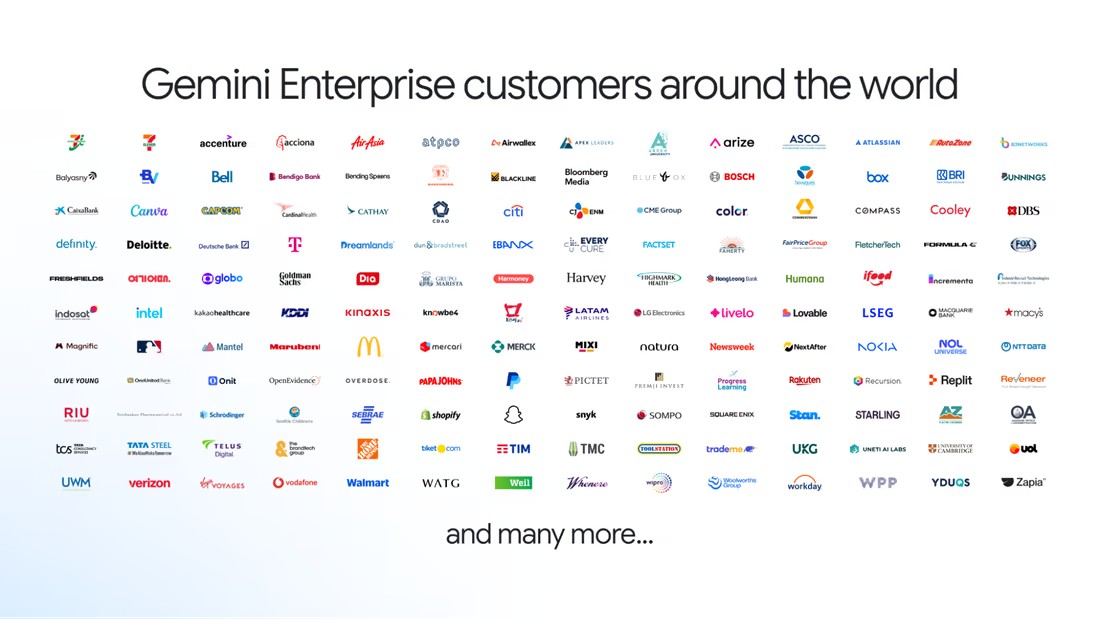
Google lists a series of customers for Gemini Enterprise, the platform the agent builds on. They are all company-reported, and most describe the platform rather than the new agent.
- BNP Paribas: deploying Gemini Enterprise into its internal assistant LLM@CIB for more than 65,000 employees, for tasks such as preparing credit memos.
- Bradesco: says document review time fell from one hour to five minutes, with a 60% reduction in risk inconsistencies and over 10% in financial efficiencies.
- Orange Spain: more than 1,000 custom agents built by employees across HR, IT, sales and customer service.
- SOMPO: over 10,000 custom agents across its 34,000 employees.
- Santee Cooper: expects to boost financial modelling speed by up to 75% across a $10 billion grid expansion budget.
- Merck: “exploring” molecular research with the potential to compress discovery timelines.
- Deloitte: a multi-agent blueprint it says can deliver up to a 3 times faster path to measurable business impact.
Look at the verbs. Some customers have deployed, some “expect”, some are “exploring”. Before relying on any figure, ask for the baseline, the sample size and whether the result came from the Gemini agent or the earlier Gemini Enterprise product.
How It Compares with Copilot and Others
The closest comparison is Microsoft’s push to make Copilot an autonomous worker on the PC and in Microsoft 365. Microsoft announced hybrid local and cloud intelligence for Copilot on Windows at its 07/10/2026 event, one day before Google’s keynote, and we cover its Autopilot concept in our Copilot Autopilot guide. The contrast is instructive: Microsoft’s pitch is the device and the operating system, Google’s is the cloud, the data platform and the agent identity layer.
OpenAI is pursuing the same ground with ChatGPT’s work features, which we cover in our ChatGPT Work guide. Where those products are tied to one vendor’s models, Google’s explicit multi-model position is a differentiator, provided the routing is transparent and the Claude integration is as deep as the announcement implies.
Against model-agnostic agent frameworks and open tools, Google’s advantage is integration and governance, and its disadvantage is that you run everything inside Google Cloud’s policy and billing model. If you are evaluating agent products more broadly, our best AI coding agents comparison covers the developer-focused end of the market.
What Google Has Not Said
- Price and plans: no per-seat price, usage price or plan tier appears in Google’s post.
- Availability: no general availability date. Some secondary coverage calls it a private preview; we could not confirm that in Google’s own text.
- Claude’s share: no information on how much work routes to Claude, whether customers can choose, or how Anthropic’s models are hosted and billed.
- Quality evidence: no benchmark or independent evaluation of the agent itself; the benchmark numbers Google publishes this week are for Argon, the model.
- Failure handling: no detail on rollback when spend caps pause an agent, or on how a user inspects and corrects what the agent has memorised.
- Third-party verification: the only detailed sources are Google’s own posts and write-ups based on them. We have not seen independent hands-on testing of the agent.
Who Should Pay Attention
- IT and procurement leaders already on Google Cloud: ask for the preview and test governance first, not features.
- Teams standardised on Claude: check whether you can keep Claude as a pinned model inside the agent and keep your data terms intact.
- Microsoft 365 shops: the cross-suite access is the point to test, because it determines whether you need to move anything.
- Security teams: evaluate Agent Gateway and identity attestation against your own policy, and demand audit-log samples.
- Individuals and small businesses: this is an enterprise announcement; for now, the Gemini app and Workspace features are more relevant.
The Bottom Line
The Gemini agent is less a new model than a new position: Google wants to own the agent layer that holds your context, memory, skills and governance, and to let the model underneath change as the leaderboard changes. Including Claude on day one is the clearest signal of that bet. The architecture is credible and the governance story is better developed than most competitors’. But there is no price, no availability date, no routing detail and no independent testing yet. Treat it as a serious roadmap statement, ask for a preview, and judge it on how it behaves with your data and your policies.
Sources
- Google Cloud: Welcome to Gemini at Work 2026: Introducing the Gemini agent (Thomas Kurian, 08/10/2026): architecture, model choice, skills, memory, governance, cost controls, customers. Hero and customer slide images: Google Cloud.
- Unite.AI: Google Cloud unveils Gemini, its universal agent for work: independent summary of the announcement.
- FourWeekMBA: Google’s Gemini agent will route work to Anthropic’s Claude: analysis of the model-routing decision.
- Windows Report: Microsoft is supercharging Copilot on Windows with hybrid intelligence: context for the Microsoft comparison.
- Julian Goldie on YouTube (14/10/2026).
Last updated: 14/10/2026. Based on Google Cloud’s announcement of 08/10/2026 and secondary coverage; Google had not published pricing or a general availability date at the time of writing.
Get the free guide: Claude vs ChatGPT, Gemini & Grok
A 20-page playbook covering everything you need to choose and use the big four AI models in 2026, full cost and feature comparisons, what each is best (and worst) at, and how-tos for images, vectors, building a website, Claude Code and more.