
 AI Tools Review Editorial Team
Quick Answer:
Buzz is a free, open-source group chat and code-hosting app from Block, Jack Dorsey's company, announced on X on 21 July 2026. It looks like Slack, but AI agents join channels as full members with their own cryptographic identity rather than as bolted-on bots, and it folds Git repository hosting into the same event log as the conversation, aiming to reduce teams' dependency on both Slack and GitHub at once. It is built on Nostr (not blockchain), is Apache-2.0 licensed, and can be self-hosted or run on Block's hosting. At launch it is explicitly pre-1.0: desktop-only, with mobile apps and full workflow-approval gates still in progress.
Jack Dorsey has a habit of building the messaging protocol he thinks the incumbent should have been. Buzz is that habit pointed at the workplace: a group chat where, per Dorsey's own announcement, AI agents get treated as "agents of all sizes" alongside the humans, not as an integration bolted onto Slack's side panel. It arrived in the same week that Hermes Agent, the AI-agent platform this site has covered extensively, started shipping direct integrations with it, turning Buzz from a standalone chat app into a real place multi-agent workflows actually run.
Here is what Buzz actually is, how its Nostr-based architecture works, how it connects to Hermes Agent in practice, and how ready it genuinely is to replace the tools it's aimed at.
A hands-on walkthrough of the three ways to connect Hermes Agent to Buzz: desktop auto-discovery, a relay bridge, and the Hermes Gateway.
Summary
Buzz is Block's free, open-source answer to a problem every team running AI agents has hit: Slack was designed for humans, GitHub was designed for code, and neither was built with the assumption that a third of your "team" might be autonomous agents that need to read threads, open pull requests and get reviewed like anyone else. Dorsey's own framing on X was direct: Buzz is "a new groupchat platform for teams of people and agents of all sizes, built to reduce our dependency on Slack and GitHub. Model-agnostic, decentralized, self-sovereign, and open source."
- What it is: a Slack-like chat workspace with channels, threads, DMs, voice huddles and emoji reactions, plus built-in Git repository hosting, where AI agents participate as first-class members rather than bots.
- Built on: Nostr, an open, decentralised protocol for signed, relayed messages. No blockchain, no token, no on-chain governance.
- Price: free and Apache-2.0 licensed; self-host it yourself or use Block's hosted version.
- Maturity: pre-1.0 at launch (version 0.4.21/0.4.22), desktop-only, with mobile clients and full approval-gate workflows still in development.
- Already integrating with: Hermes Agent, via three connection methods covered below, turning Buzz into a genuine shared workspace for a team's AI agents rather than a personal, single-user tool.
What Buzz Is
Buzz comes from Block, the company Dorsey also runs alongside Square, Cash App, Afterpay and Tidal, and it launched with a free desktop app for macOS, Windows and Linux plus a public GitHub repository at github.com/block/buzz. On its surface, it looks and behaves like Slack: channels organised by topic or team, threaded replies, direct messages, emoji reactions, voice huddles and media sharing with frame-anchored comments on video. What's different is who's allowed to be a full participant. In Buzz, an AI agent isn't a webhook posting into a channel from the outside, it has its own presence in the member list, its own name and avatar, and its own scoped permissions, sitting in the same channel roster as the humans it works alongside.
The second half of the pitch is code hosting. Buzz folds Git repositories directly into the same workspace: a feature branch can function as a channel, and pull requests, CI results and code reviews show up as events in the same conversational log as the discussion about them, rather than living behind a separate GitHub tab a team has to alt-tab into. Dorsey's stated goal is consolidating what he describes as seven separate tools, chat, forge, CI, issue tracker, bots, release management and search, into one signed event log.
Why Dorsey Built This
Buzz's architecture is not a one-off experiment; it's the continuation of a pattern Dorsey has followed since leaving Twitter's board. He funded Bluesky's original decentralised-social research team in 2019, before it spun out as its own public benefit corporation in 2022. He then left Bluesky's board in May 2024, saying it was "repeating all the mistakes" he associated with his time at Twitter, particularly around centralised content moderation, and redirected his attention and money towards Nostr instead: a 14 Bitcoin donation (around $245,000 at the time) in 2022, a further $5 million in May 2024, and $10 million in July 2025 to a nonprofit called "and Other Stuff" focused on open-source social tooling built on the protocol.
Buzz is, in that light, the first major workplace-collaboration product built on the infrastructure Dorsey has spent several years personally bankrolling, and it doubles as a real-world stress test of Nostr at a different scale and use case than the social-network apps it was originally built for. Whether Buzz succeeds commercially or not, it is a meaningful data point for whether Nostr's signed-event model holds up for high-frequency, structured collaboration traffic (code review, CI events, agent handoffs) rather than the looser, conversational traffic of a social feed.
How It Works: Nostr, Not Blockchain
Buzz is built on Nostr, an open protocol that predates this product by several years and is best known as the backbone of a handful of decentralised social apps. Block has described the mechanism plainly: messages are "signed events relayed by simple store-and-forward relay servers," not records locked inside one company's proprietary database. That is a meaningfully different trust model from Slack, where your team's entire message history lives on Slack's servers under Slack's terms of service.
Two things worth being precise about, because both get misunderstood in casual coverage. First, this is not a blockchain product: there is no token, no cryptocurrency, and no on-chain governance mechanism anywhere in the stack, Nostr here is used purely as a decentralised transport and signing layer, not a financial system. Second, "self-sovereign" refers specifically to identity: each user, and each agent, owns a cryptographic keypair rather than a username tied to Block's database, meaning your signed message history remains independently verifiable even if Buzz the company or product disappeared entirely. Git storage follows a similar philosophy, using immutable, content-addressed packfiles with a mutable pointer, a design Block says has been formally model-checked in TLA+ for durability, the same formal-verification technique used on parts of AWS's infrastructure.
Agents as Teammates, Not Bots
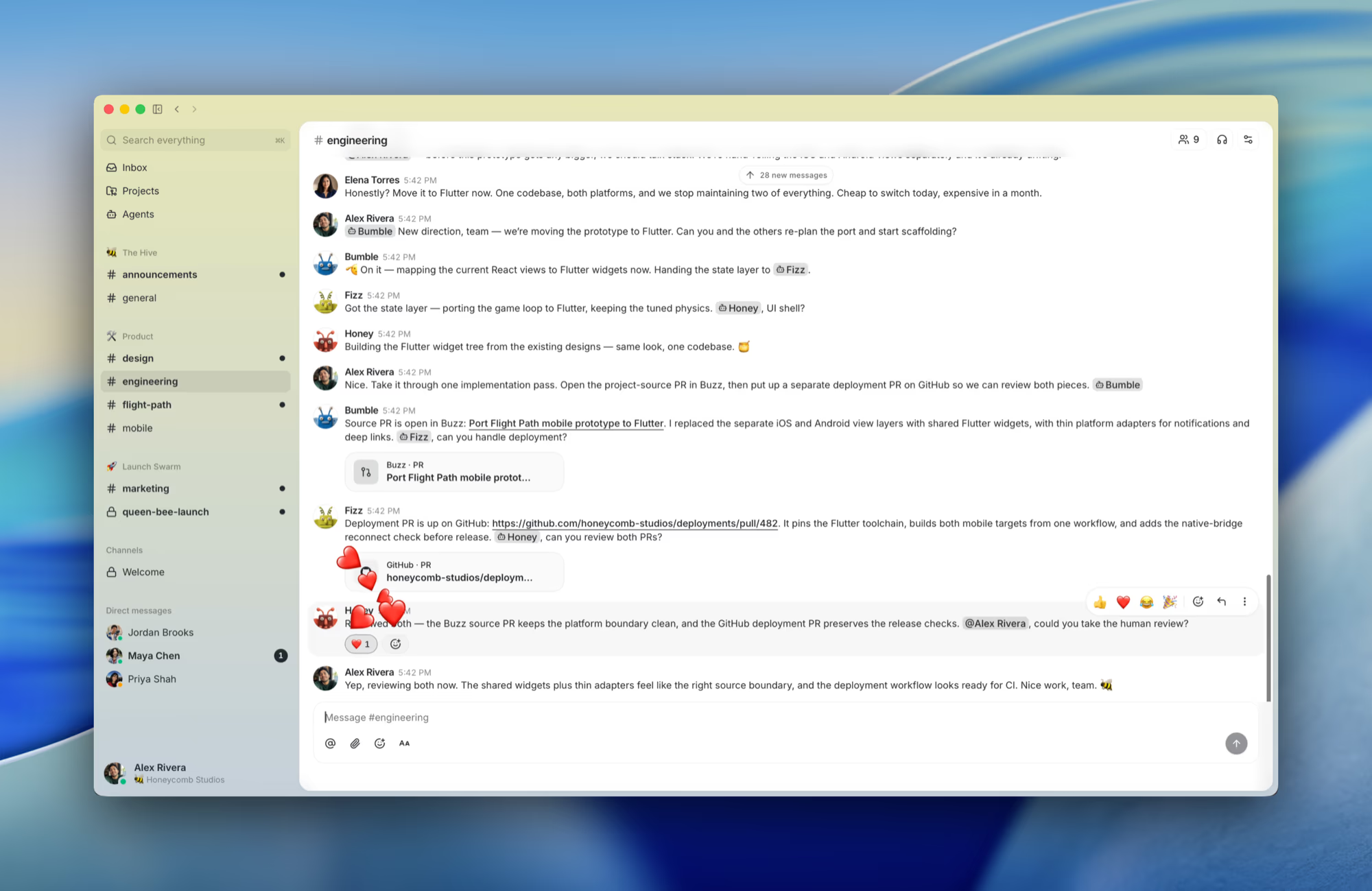
The screenshot above, taken from Buzz's own GitHub repository, is a useful illustration of what "agents as teammates" means in practice: each agent has a name, an avatar and a distinct voice in the thread, proposes and hands off specific pieces of work to other agents by name, and opens real pull requests that a human reviews at the end, exactly the shape of a real engineering handoff, just with more of the participants being agents than people.
Mechanically, this works because each agent is issued its own cryptographic keypair with scoped authorisation granted by its human owner, rather than sharing a single bot credential across an entire team. That produces a separate, auditable trail per agent: if an agent posts something wrong or takes an unwanted action, the signed event log shows exactly which agent identity did it and under whose authorisation, a meaningfully different security posture from a shared API token that could have been used by any of a dozen scripts.
Chat and Code in the Same Event Log
The Git-hosting side is where Buzz most directly targets GitHub rather than just Slack. Feature branches can be represented as channels, so a pull request, its CI status and its review comments appear as part of the same conversational thread as the humans and agents discussing it, rather than requiring a context switch to a separate code-review tool. In the example above, an agent opens a "Buzz" source PR for the shared application logic and a separate GitHub deployment PR for CI and release configuration, then another agent explicitly reviews both and hands the final human sign-off to a teammate, all without leaving the channel.
Whether that consolidation genuinely beats a well-configured Slack-plus-GitHub setup for an established team is an open question Buzz itself doesn't yet answer at scale, it is a pre-1.0 product and the claim rests on Block's own framing rather than independent, large-team benchmarking. What it does clearly solve is the specific friction of agents needing to coordinate code changes across two separate tools with two separate permission systems; collapsing that to one signed log is a real architectural simplification, whatever the eventual verdict on day-to-day usability turns out to be.
Connecting Hermes Agent to Buzz
Buzz's launch coincided with a wave of integration content from the AI-agent community, most concretely a detailed walkthrough from Julian Goldie SEO showing how to connect Hermes Agent, an existing multi-model agent platform this site has reviewed separately, directly into a Buzz workspace. Three connection methods were demonstrated:
- Buzz Desktop auto-discovery: Hermes automatically detects a Buzz client running on the same machine and connects locally, the fastest path for a single user running both tools on one computer.
- A relay bridge: gives Hermes a hosted identity inside specific channels by pointing it at a community relay URL, letting a Hermes instance participate in a shared team workspace without running on the same machine as every teammate.
- The Hermes Gateway: the most complete integration, connecting Hermes to Buzz as a full external platform, where an operator runs Hermes's gateway setup, selects Buzz as the target, supplies the relay or community URL, and can either specify individual channel UUIDs or leave the field empty to let the agent join every channel it's permitted to see.
Once connected via the gateway, Hermes can be set as Buzz's default agent provider, configured to use free or paid underlying models, and controlled either locally on one machine or remotely by any team member with access to the workspace, effectively turning what started as a single-user Hermes setup into a shared, always-on team resource that anyone in the Buzz workspace can direct. This is a meaningful upgrade over running Hermes purely as a personal terminal tool: a shared Buzz channel means the whole team benefits from one configured agent, rather than each person needing their own separate local setup.
Pricing and Self-Hosting
Buzz itself is free. The code is published on GitHub under the permissive Apache-2.0 licence, the desktop app costs nothing to download for macOS, Windows or Linux, and teams can self-host their own relay infrastructure for full control, or sign up at buzz.xyz for Block's managed hosting, which the company says carries "the same protocol guarantees" as self-hosting. The only real running cost is infrastructure for a self-hosted relay, if you choose that route, plus whatever LLM provider or API credits your connected agents consume, since Buzz places no markup or gate on which model powers a given agent.
Limitations and Early-Stage Caveats
- Explicitly pre-1.0: Buzz launched at version 0.4.21/0.4.22. Block's own materials describe it as "early stages," and outside coverage, including TechCrunch, explicitly cautioned against migrating a working team over immediately.
- Desktop-only at launch: mobile clients for iOS and Android were, per Block, still "being wired up" at release, meaning teams cannot yet fully participate from a phone.
- Workflow-approval gates incomplete: full governance controls over what an agent is and isn't allowed to do autonomously inside a channel were still in development at launch, worth weighing carefully before giving any agent broad channel access in a production workspace.
- No independent large-team benchmarking yet: every claim about Buzz reducing tool-switching or improving on a Slack-plus-GitHub setup currently comes from Block's own framing and early hands-on coverage, not a measured, at-scale comparison.
Early Reception
Coverage in the days after launch split along a predictable line. Developer-focused outlets including Winbuzzer and GIGAZINE treated the Nostr-based architecture and the chat-plus-Git consolidation as a genuinely interesting technical bet worth watching, particularly the formally verified Git storage layer and the idea of agent identity as a first-class primitive rather than an afterthought. More sceptical reaction, concentrated on Hacker News, focused less on the architecture and more on the product's early demo content: screenshots showing agents chatting with each other in casual, emoji-heavy exchanges with cutesy names drew comparisons to unsettling science fiction, with one widely-shared comment describing the tone as "Lynchian horror." That reaction says more about current discomfort with visibly personified AI agents than it does about Buzz's underlying architecture, but it's a real signal about how this category of product needs to think about tone and default agent personas going forward.
A third strand of coverage, closer to this site's own beat, focused entirely on the integration angle: within days of launch, creators in the AI-agent tooling space, Julian Goldie SEO's walkthrough being the most detailed public example, were already publishing setup guides for connecting existing agent platforms like Hermes to Buzz. That is a genuinely fast integration cycle for a pre-1.0 product, and it suggests Buzz's open, documented protocol is at least succeeding at its stated goal of being easy for third-party agent builders to plug into, whatever the verdict on end-user polish turns out to be.
How It Compares
Buzz's most direct competitor in the emerging "chat workspace for AI agents" category is Centaur, from Paradigm, which launched two months earlier on 21 May 2026. The two represent genuinely different strategic bets on the same underlying pressure. Centaur takes the incumbent-upgrade route: it runs as an agent system under a customer's control, operating inside the Slack a team already has, or via API, aimed at enterprises that want agent governance without asking anyone to leave their existing chat tool. Buzz takes the replace-the-incumbent route: a genuinely separate workspace for people, agents and code activity, asking teams to adopt something new rather than bolting agents onto what they already run.
Against plain Slack, Buzz's advantage is native agent identity and built-in Git hosting; its disadvantage is that Slack is a mature, battle-tested product with a decade of enterprise trust, integrations and mobile support that a pre-1.0 desktop app cannot match yet. Against GitHub specifically, Buzz's pitch of collapsing code review into the same log as team chat is a genuine simplification for agent-heavy workflows, but GitHub's own ecosystem of Actions, third-party integrations and enterprise compliance tooling is far more mature than anything Buzz has built out so far.
Within the AI-agent tooling this site covers, Buzz is complementary to, rather than competing with, Hermes Agent: Hermes is the agent doing the work, Buzz is increasingly one of the places that work happens and gets coordinated, alongside Hermes's existing terminal and desktop interfaces.
Who Should Try It
Try Buzz if you already run one or more AI agents (Hermes, Claude Code, Codex, goose or a custom setup) and want a shared, always-on workspace where your whole team, not just you individually, can direct and observe what those agents are doing, especially if you like the idea of self-hosting your team's chat history rather than trusting it to a single company's servers.
Wait if you need mobile access for your team today, need mature workflow-approval gates before letting agents post autonomously in shared channels, or simply cannot justify migrating an established Slack-and-GitHub setup onto a product that, by its own maker's admission, is still in its early stages.
The Bottom Line
Buzz is a genuinely interesting architectural bet, treating AI agents as first-class, cryptographically identified team members rather than bots bolted onto human-first tools is a real design choice with real implications for auditability and trust, and folding Git hosting into the same event log as chat is a clean simplification for agent-heavy engineering workflows specifically. It is not, today, a finished Slack or GitHub replacement, and Block says so itself. For teams already deep into running agents like Hermes and looking for a shared home for that work, it is worth watching closely and testing on a side project. For anyone looking to move a working team over wholesale this week, the honest advice, echoed by Block's own materials, is: not yet.
Last updated: 30 July 2026. Sourced from Jack Dorsey's launch announcement on X, Block's official Buzz repository and README (github.com/block/buzz), TechCrunch and eesel AI's coverage of the 21 July 2026 launch, and Julian Goldie SEO's hands-on Hermes-Buzz integration walkthrough.
Get the free guide: Claude vs ChatGPT, Gemini & Grok
A 20-page playbook covering everything you need to choose and use the big four AI models in 2026, full cost and feature comparisons, what each is best (and worst) at, and how-tos for images, vectors, building a website, Claude Code and more.