 AI Tools Review Editorial Team
Quick Answer:
On 24 July 2026, NVIDIA CEO Jensen Huang used his first-ever post on X to share a letter, "Open Weights and American AI Leadership", signed initially by 25 companies including Microsoft, Meta, Hugging Face and the Linux Foundation, arguing open-weight AI is strategic infrastructure that policymakers should not restrict. OpenAI and Google joined the expanded list within days; Anthropic and Amazon did not sign at all. Three days later, Anthropic CEO Dario Amodei published the company's own position: it has never called for banning open-weights models, but wants chip export controls, distillation crackdowns and mandatory safety testing applied to open and closed models alike. Here is what each side actually said, in their own words, with sources.
For a week in late July 2026, the most-watched fight in AI policy wasn't between the US and China. It was between two camps of the American AI industry itself, one arguing that open-weight models are a strategic asset the country cannot afford to restrict, the other arguing that openness without safeguards is a slower-motion version of the same risk. Both camps include serious people making arguments backed by real data. Neither camp is arguing what its critics claim it is arguing.
This is a sourced walk through what NVIDIA's letter says, who actually signed it and when, what Jensen Huang told Axios about Chinese models, what Anthropic's Dario Amodei said in response, and what the measured gap between open and closed models actually looks like right now.
Matthew Berman walks through NVIDIA's letter, the open-vs-closed argument, Jevons paradox, and Anthropic's response in the same week these stories broke.
Summary
In the space of six days, three of the AI industry's most powerful people staked out public, on-the-record positions on whether open-weight AI models should face restriction. On 22 July, NVIDIA CEO Jensen Huang told Axios that Chinese open-weight models "are excellent" and should be used by American companies. On 24 July, Huang posted his first-ever message on X to share a formal coalition letter arguing open weights are strategic American infrastructure. On 27 July, Anthropic CEO Dario Amodei published his own company's position, explicitly denying it has ever sought a ban on open models while proposing three narrower policy interventions instead.
- What happened: a 25-company coalition letter launched by NVIDIA argued against restricting open-weight AI; the list grew past 50 signatories within days as OpenAI and Google joined; Anthropic and Amazon remained absent.
- The flashpoint: Anthropic's non-signature drew direct criticism from White House AI adviser David Sacks, who accused the company of using safety arguments to protect its commercial position.
- Anthropic's actual position: not a ban, but chip export controls, restrictions on industrial-scale distillation, and safety testing requirements applied to open and closed models equally.
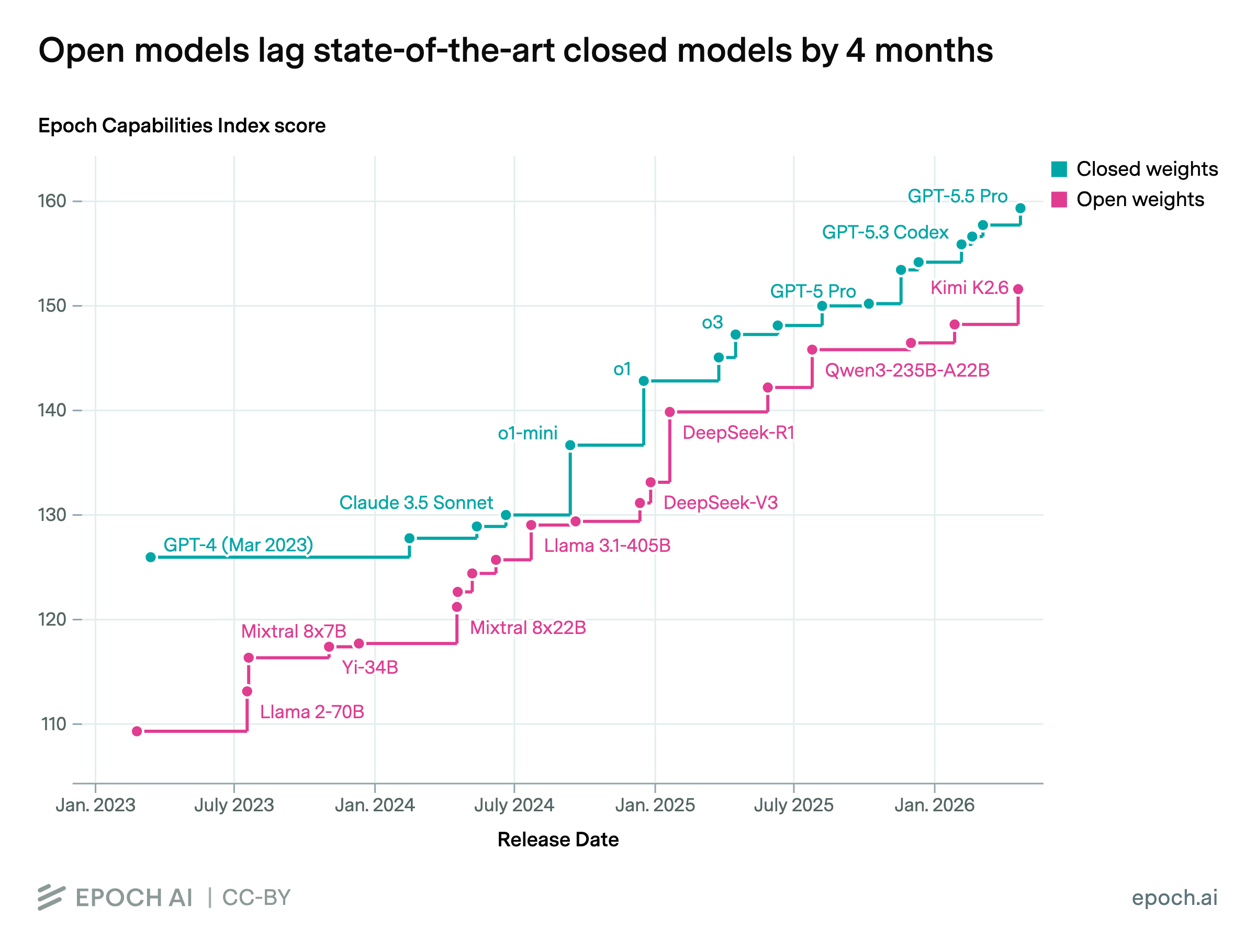
- The measured reality: independent tracking from Epoch AI shows the capability gap between the best open-weight and best closed model has narrowed to roughly four months, or about 8 points on the Epoch Capability Index, down from a much wider gap two years earlier.
The Timeline
The sequence matters here, because outside coverage has sometimes compressed a week of distinct events into a single "NVIDIA vs Anthropic" headline. It was not one event. It was four:
- 22 July 2026: Jensen Huang tells Axios, in an interview conducted in Fort Worth, Texas at the opening of a new phase of a Wistron plant building NVIDIA's AI infrastructure, that Chinese open-weight models "are excellent" and that American firms should "absolutely" be free to use them.
- 24 July 2026: Huang posts on X for the first time ever, linking NVIDIA's published PDF, "Open Weights and American AI Leadership," co-signed at launch by 25 organisations.
- 25–27 July 2026: The signatory list, hosted as a living document on Microsoft's corporate responsibility page, grows past 50 and then past 70 names as OpenAI and Google add their names. Anthropic and Amazon do not.
- 27 July 2026: Dario Amodei publishes Anthropic's position directly on the company blog, responding to several days of public pressure including comments from White House AI adviser David Sacks.
The same week also saw the escalating Kimi K3 export-control dispute, in which US officials alleged Moonshot AI used Thailand-routed Nvidia chips and may have distilled outputs from Anthropic's own Claude Fable 5. That story and this one are related but distinct: the Kimi dispute is about one company's specific conduct; this dispute is about the general policy question of whether open-weight models as a category should face restriction. Anthropic's distillation concern, discussed below, is the thread connecting the two.
NVIDIA's Letter: What It Actually Argues
NVIDIA's three-page letter, titled "Open Weights and American AI Leadership" and published as a PDF on 24 July 2026, defines open-weight models as systems "people can download, inspect, modify and run on their own infrastructure," explicitly distinguishing them from fully open-source models (which also publish training data and code) on one side and closed, API-only frontier models on the other. Its central claim is that downloadable model weights should be treated as strategic infrastructure, comparable to the open-source software movement of the 1980s, and that American leadership in AI will ultimately be judged not by which single lab has the best frontier model, but by "whether the United States builds a strong, open ecosystem that diffuses into every sector."
The letter advances three linked arguments. First, on security: closed models "can be breached, misused, or fail in ways that outsiders cannot detect," and a more distributed, inspectable ecosystem of open models reduces the risk of any single point of failure, a claim aimed squarely at cybersecurity researchers who rely on being able to audit model internals. Second, on sovereignty and competition: an economy that depends entirely on a handful of proprietary APIs is more brittle and less competitive than one where startups, universities and smaller companies can build directly on downloadable weights. Third, on economic diffusion: the letter calls for expanded compute access for researchers and startups, shared training datasets and evaluation frameworks, and explicitly asks policymakers to avoid "premature restrictions on open models that stifle competition," while addressing genuine model-extraction risks through "targeted legal frameworks rather than sweeping restrictions."
What the letter does not do is engage in detail with the specific national-security concern that has driven most of the actual policy debate in Washington in 2026: whether Chinese labs are using open releases, distillation, or chip smuggling to close the gap with the US frontier faster than legitimate competition would allow. That omission is precisely the gap Anthropic's response, covered below, tries to fill.
Who Signed, Who Didn't, and Who Joined Later
NVIDIA's original 24 July PDF carried 25 signatures: NVIDIA, Microsoft, Meta, IBM, Dell Technologies, Palantir, ServiceNow, CrowdStrike, Box, Telnyx, Hugging Face, Mistral AI, Black Forest Labs, Arcee AI, Reflection, Replit, Perplexity, Mozilla, the Linux Foundation, Arena, Mariana Minerals, Emergence Capital, Andreessen Horowitz, Y Combinator and the American Innovators Network. Four of the industry's biggest names were conspicuously absent from that first PDF: OpenAI, Google, Anthropic and xAI, every one of them a lab that primarily ships closed, API-gated frontier models.
The letter did not stay static. Because it lived as a continuously updated page on Microsoft's corporate-responsibility site rather than a fixed document, the signatory list kept growing after launch: past 50 names by the following weekend, and to 70 or more by 27 July, according to reporting from Forbes and ExplainX. OpenAI and Google both joined during that window, having been publicly reported as holdouts in the first 48 hours; Google CEO Sundar Pichai had separately voiced support for the open-weights stance ahead of Google's formal addition, citing the company's own Gemma model releases as evidence of consistency. That reversal undercut some of the initial framing of "OpenAI refused to sign" headlines, which had been accurate for the launch-day snapshot but stale within days.
Two names stayed off the list through the entire period covered by this article: Amazon and Anthropic. Amazon's absence drew comparatively little comment. Anthropic's did not, for reasons covered in the next two sections.
Huang on Chinese Models: "Excellent" and Misunderstood
Two days before the letter, in an Axios interview published 22 July 2026, Huang went further than the letter itself does on the specific question of Chinese open-weight models. Asked directly, he said "these Chinese models are excellent" and that "open-source models that are excellent should be used," adding that American companies should "absolutely" be free to run them. He pointed to open releases from DeepSeek, Alibaba, Tencent, MiniMax and Baidu as evidence that China's open ecosystem is competitive at the frontier, not a step behind it.
On the market reaction to Kimi K3 specifically, which had triggered a chip-stock selloff and a Moonshot AI capacity crunch the week before (covered in full in our Kimi K3 crisis piece), Huang was blunt: "the market misunderstood the impact of DeepSeek the first time," he said, and Wall Street had "misunderstood the impact of Kimi again this time." That is a striking position for the CEO of the company that sells the chips at the centre of the entire US-China AI compute dispute to take publicly, and it put him at odds with Trump administration officials who have pushed for tighter restrictions on Chinese AI access.
Anthropic's Response: Not a Ban, Three Different Asks
On 27 July 2026, Amodei published Anthropic's position directly, opening with a direct denial of the accusation that had been building for three days: "Anthropic has never advocated for a ban on open-weights models." He went further, stating plainly that open-weight models "that don't have dangerous capabilities are a public good," a sentence that is difficult to square with the caricature of Anthropic as reflexively anti-open-source that had circulated in the days before.
Where Amodei does disagree with the letter's signatories is narrower and more specific than a blanket ban: he rejects the claim that open-weights models inherently make defensive safeguards easier to build, or that broad access to model weights benefits defenders more than attackers, particularly around biological-weapon-relevant capabilities. Instead of restricting the open-weights category as a whole, Anthropic's post proposes three concrete, separable policy interventions:
- Chip export controls: restrict sales of powerful chips and chipmaking equipment to China and close down smuggling routes, addressing the threat directly at its hardware source rather than at the model-weights layer.
- Distillation crackdowns: target industrial-scale distillation specifically, the practice of training a new, cheaper model by learning from a frontier model's outputs at massive scale, which Amodei says can "bring the Chinese frontier to within a few months of the US frontier" regardless of how many original GPUs a lab has access to.
- Universal safety testing: require rigorous pre-release testing for cyber, biological and alignment risks on any sufficiently capable model, whether its weights are open or closed, rather than treating openness itself as the risk factor.
Read against NVIDIA's letter, the actual disagreement is narrower than the public framing suggested: both sides say they don't want a blanket ban on open weights. Where they differ is that NVIDIA's coalition treats openness itself as close to unambiguously good and wants policymakers to avoid restricting it, while Anthropic wants the restrictions aimed at chips and distillation techniques instead of at the open/closed distinction, alongside safety testing that would apply to NVIDIA-coalition members' own closed models too.
How Big Is the Open-vs-Closed Gap, Really?
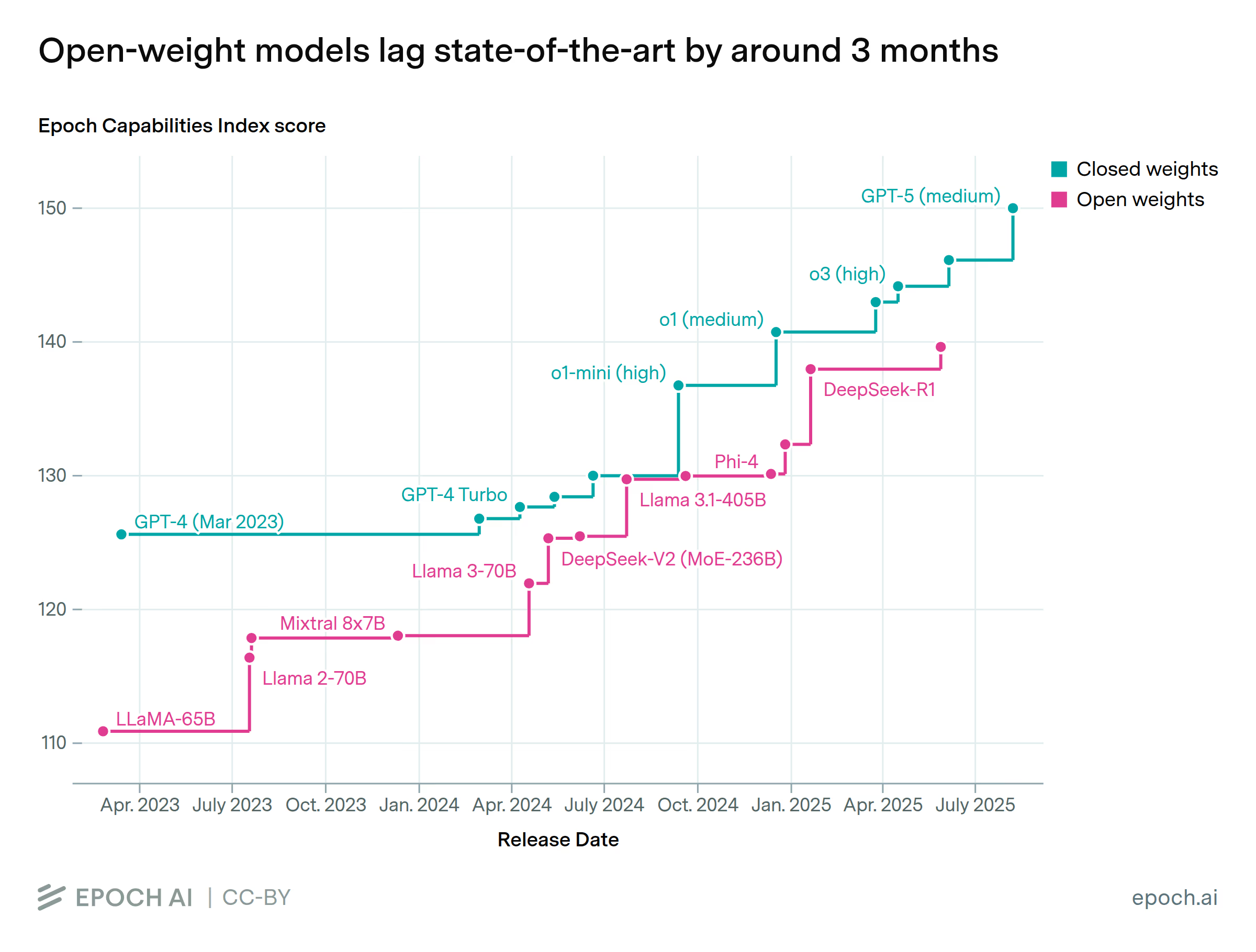
Both sides of this argument make claims that rest, implicitly, on how close open-weight models actually are to the closed frontier. Independent tracking gives a reasonably clear, non-partisan answer. Epoch AI, a research organisation that maintains the Epoch Capability Index (ECI) across major model releases, publishes a continuously updated comparison of the best available open-weight model against the best available closed model on any given day. As of its most recent update, the gap sits at roughly four months, or about 8 ECI points, with Kimi K2.6 the leading open-weight entrant against GPT-5.5 Pro on the closed side. That is measurably narrower than the gap Epoch measured as recently as May 2025, when it stood at closer to three months using an earlier snapshot of the same methodology, and dramatically narrower than the roughly one-year gap between GPT-4 and the first open-weight models capable of even loosely approaching it back in 2023.
This matters for the policy argument in a specific way: NVIDIA's letter is on stronger empirical ground when it argues open models are now genuinely competitive rather than a permanently second-tier category, a framing that would have been harder to defend credibly in 2023 or 2024. Anthropic's concern about distillation compressing that gap further and faster than organic research progress would predict is also consistent with the data, the pace of narrowing has itself accelerated, not just the absolute gap shrinking. Both readings of the same chart are defensible; they just support different policy conclusions.
The Political Backlash
Anthropic's three-day silence between the letter's publication and Amodei's response was not a quiet gap. White House AI adviser David Sacks used the interval to accuse the company of running a "regulatory capture strategy based on fearmongering," a pointed allegation that Anthropic's safety-focused public positioning is, in substance, a competitive strategy dressed up as a safety concern, using regulation to entrench Anthropic's position against faster-moving open-weight rivals rather than out of genuine risk concern. Other coverage, including from TechCrunch and Axios, framed Anthropic as "the only major US lab not supporting open models," a characterisation Amodei's post pushes back on directly by distinguishing "not signing this specific letter" from "opposing open models," two claims that are not logically the same thing even though the criticism treated them as equivalent.
It is worth noting the awkward timing for Anthropic separately: the company had recently shut down Claude Fable 5's open-weight-adjacent access in response to the same Kimi K3 distillation allegations discussed above, a decision that made Anthropic an easy target for "they only care about openness when it doesn't threaten them" criticism, fair or not. Amodei's post does not directly address that specific optics problem, focusing instead on the substantive policy distinctions.
Why This Argument Matters Beyond Twitter
This is not an abstract industry spat. The outcome of this argument will shape whether policymakers write export-control and AI-safety legislation around the open/closed distinction (NVIDIA's implicit framing, since the letter asks regulators to leave open models alone as a category) or around specific, narrower risk factors like chip access and distillation scale, regardless of a model's openness (Anthropic's explicit framing). Those are materially different regulatory designs with different downstream effects on which companies, American and Chinese, end up with a competitive edge.
It also intersects directly with the ongoing chip export control debate: if Anthropic's distillation-crackdown proposal gains traction, it would target exactly the kind of infrastructure arrangement US officials allege Moonshot AI used to train Kimi K3, discussed in our separate Kimi K3 sanctions coverage. NVIDIA, notably, sells the chips at the centre of that dispute and has a direct commercial interest in a policy outcome that keeps chip sales broad and open-model use unrestricted, a point critics of the letter have raised as a reason to weigh NVIDIA's advocacy alongside its balance sheet.
What Remains Unresolved
- No policy has actually changed yet: both the letter and Anthropic's response are advocacy documents, not legislation. As of this article's publication, no new export-control law, distillation restriction or mandatory safety-testing regime has been enacted as a direct result of either statement.
- The signatory list is still moving: because NVIDIA and Microsoft host the letter as a live, continuously updated page rather than a fixed document, any specific count of signatories in this article reflects the position as of late July 2026 and may be out of date by the time you read it.
- Anthropic has not detailed enforcement mechanics: the position paper names three policy directions (chips, distillation, testing) without publishing specific legislative or regulatory text, so how "industrial-scale distillation" would be legally defined and enforced remains unspecified.
- Motive is contested on both sides: NVIDIA's commercial interest in broad chip sales and unrestricted open-model use is as relevant to weighing its advocacy as Anthropic's commercial interest in a regulatory environment favourable to closed frontier labs is to weighing its own. Neither company is a neutral party, and neither claims to be.
Who Is Actually Right?
Stripped of the framing each side's critics apply, the two positions are less opposed than the headlines suggested. NVIDIA's coalition is right that open-weight models are now measurably competitive, the Epoch data backs that up, and that a policy response built around banning openness as a category would be clumsy and likely counterproductive given how fast the gap has closed. Anthropic is right that "open" and "safe" are not the same axis, and that the specific mechanism Washington should actually worry about, industrial-scale distillation compressing years of research advantage into months, is a real, separately measurable phenomenon that a pure open/closed framing does not address at all.
The more useful read of this week is not "NVIDIA vs Anthropic" but two different, partially compatible proposed regulatory designs competing for the same legislative attention, at the same moment that the Kimi K3 dispute made the abstract argument concrete and urgent. Which framing wins in Washington will likely matter more for the shape of the next two years of AI policy than either company's specific model releases will.
Frequently Asked Questions
The Bottom Line
The loudest version of this story, "NVIDIA backs open AI, Anthropic wants it banned", is not what either side actually said. NVIDIA's letter is a genuine, well-evidenced argument for treating open weights as strategic infrastructure, backed by data showing the open-vs-closed gap has narrowed to about four months. Anthropic's response is a genuine, specific rebuttal of the "ban" characterisation that focuses the actual policy fight on chips and distillation rather than openness itself. Both are worth reading in full rather than through the lens of who got angriest on X first.
Last updated: 30 July 2026. Sourced from NVIDIA's "Open Weights and American AI Leadership" letter (24 July 2026), Anthropic's official position statement by Dario Amodei (27 July 2026), Jensen Huang's Axios interview (22 July 2026), Epoch AI's Epoch Capability Index data insights, and reporting from Forbes, TechCrunch, Axios and ExplainX on the letter's expanding signatory list.
Get the free guide: Claude vs ChatGPT, Gemini & Grok
A 20-page playbook covering everything you need to choose and use the big four AI models in 2026, full cost and feature comparisons, what each is best (and worst) at, and how-tos for images, vectors, building a website, Claude Code and more.