 AI Tools Review Editorial Team
Quick Answer:
Nate B Jones argues that as AI gets smarter, five human skills become more valuable: taste, agency, focus, resourcefulness and follow-through. His thesis is that AI has expanded what people can do faster than people have changed what they are willing to attempt. The skills reinforce each other: taste gives you a reason to act, agency starts the work, focus exposes the hard parts, resourcefulness gets you through them and follow-through shows whether it helped anyone. We only had access to the free preview of his full post, so we describe the framework, not every detail.
The standard worry about AI and work is substitution: the machine does what you do, so what is left for you? Nate B Jones turns the question round. If personal apps and agents let one person build things that once needed a team, the scarce input is no longer ability but the human habits that decide what is worth building and whether it gets finished.
This guide sets out his five skills, adds practical ways to build each, links them to the tools and trends we cover elsewhere on the site, and is honest about where the framework is an opinion rather than evidence.
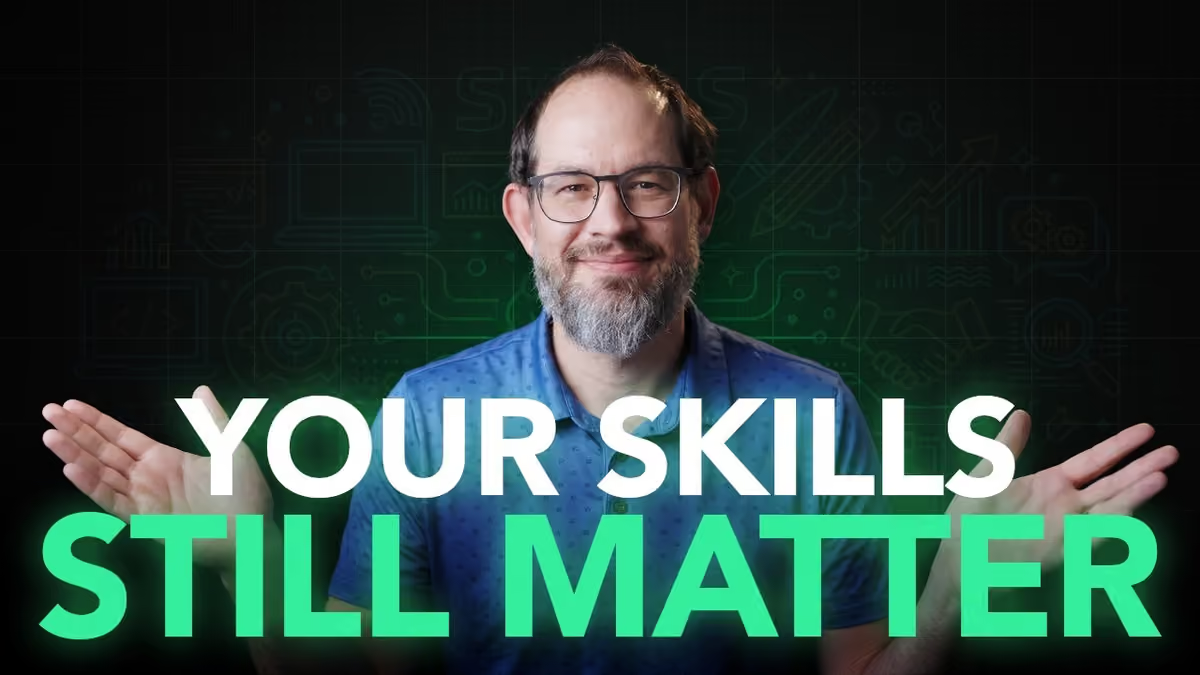
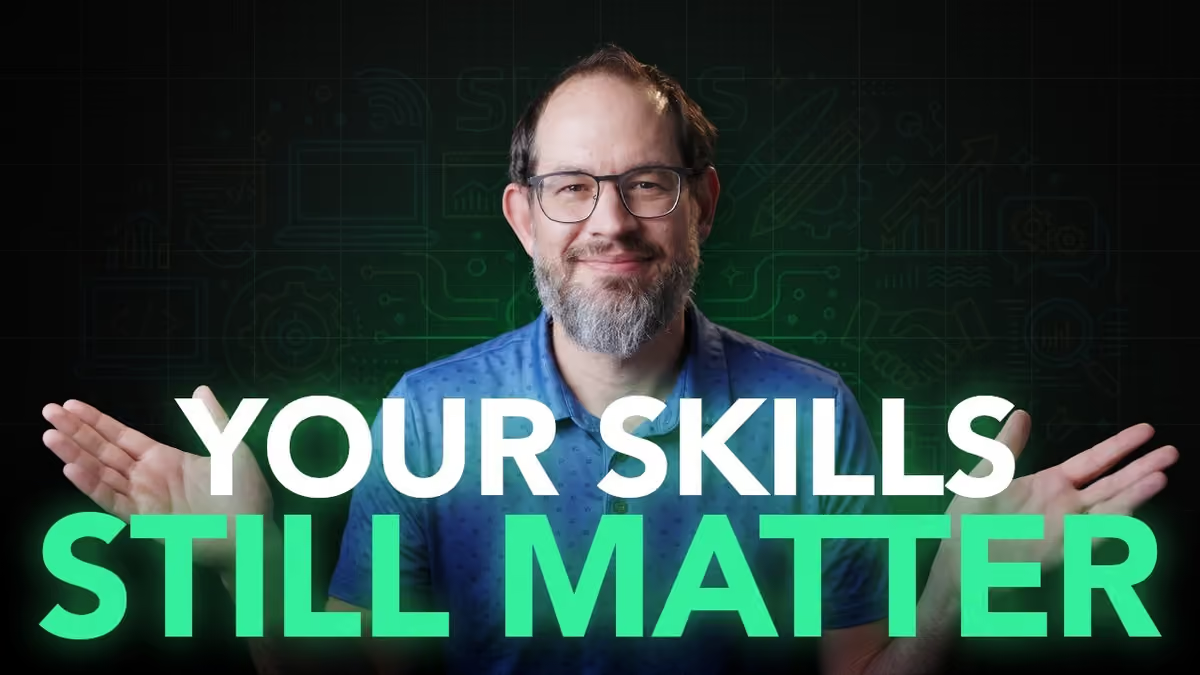
Nate B Jones explains taste, agency, focus, resourcefulness and follow-through, and how to decide which shelved project deserves a second look.
Executive Summary
- The claim: AI has expanded what we can do faster than many of us have changed what we are willing to attempt. The bottleneck has moved from capability to behaviour.
- Taste gives you a reason to act.
- Agency puts that judgment to work before you know everything the work will require.
- Focus exposes you to the difficult parts.
- Resourcefulness helps you learn your way through them.
- Follow-through shows you what actually helps the person you had in mind.
- The examples: Meta's Muse personal agent, a Reuters journalist who built an AI tutor for her son, and the solo developer of Stardew Valley who cut a system that worked.
- The evidence: the post preview contains no statistics. It is an argument from observation, not a study.
The Thesis: A Behaviour Gap, Not a Capability Gap
The common story, in Jones's framing, is that only geniuses on super teams, naming Alexandr Wang, Nat Friedman and the team at Muse, can build the best AI products. His counter is that personal apps and agents are widening what any one person can accomplish, and that he sees this pattern everywhere. The practical limit is that people carry old judgments about what is feasible, and those judgments often outlast the circumstances that produced them.
That last idea is the most useful in the framework. A task that was unrealistic for a solo worker in 2022 (building a small app, analysing a large document set, running a research monitor) may now take an afternoon. If you wrote it off then and never revisited it, you are working from an expired estimate. Jones ends the video with a method for deciding which shelved project deserves a second look, which is a sensible habit whatever you think of the rest.
The framing connects to what we have seen in our AI vs humans benchmark analysis and to the broader job-market debate in which jobs AI could replace by 2030. Those pieces ask what machines can do. This one asks what people will choose to do with them.
1. Taste
Taste, in the framework, is what gives you a reason to act. It is the ability to say that this is good, that is not, and this problem is worth solving. When AI can produce ten competent versions of anything in a minute, choosing between them becomes the work.
How to build it: look at a lot of excellent work in your field and write down why it is good. Make a habit of rejecting your first AI draft and stating exactly what is wrong with it. Taste improves when you can articulate a standard, because you can then give an agent a standard to meet. This is also where good prompting overlaps with editing; see Claude Skills explained for how teams encode a standard once and reuse it.
Where it falls short: taste is not purely individual. Organisations and audiences shape what counts as good, and a private sense of quality does not guarantee that anyone else will value the result.
2. Agency
Agency puts judgment to work before you know everything the work will require. It is starting while the path is unclear. Many people wait for a complete plan or permission, and AI makes waiting more costly because the cost of a first attempt has fallen.
How to build it: set a small, time-boxed attempt for something you would normally defer. Ask an agent to produce a prototype in an hour and judge it by what you learn, not by whether it is finished. The always-on assistants we cover, such as Abacus Personal Agents and Hermes Agent, lower the activation energy further because they can act while you are away.
Where it falls short: agency without safeguards is how people deploy unreviewed code or send unreviewed emails. Pair it with the checks discussed under follow-through.
3. Focus
Focus, per the framework, exposes you to the difficult parts. That is a different claim from the usual advice to avoid distractions. The argument is that staying with a problem is what reveals its hard core, whereas hopping between prompts yields the easy 80 per cent over and over.
How to build it: pick one project and work it for a defined period without starting another. Notice the moment you want to switch, because that is usually where the difficulty sits. With agents running in parallel, discipline matters more, not less. Our explainer on agent swarms shows how easy it is to launch many threads and lose the one that mattered.
Where it falls short: some people have jobs that are interrupt-driven by design. Focus is partly a personal skill and partly something an employer has to allow.
4. Resourcefulness
Resourcefulness helps you learn your way through the hard parts. Jones's example of a Reuters journalist who built an AI tutor for her son shows the pattern: a non-engineer meets a problem, finds tools, learns what she needs and ends up able to attempt more. The preview does not name her, and we have not independently confirmed the details.
How to build it: when stuck, ask the AI to teach you the concept and then try the task, rather than asking it to do the task. Keep a log of problems you solved so that each one lowers the cost of the next. Use documentation and community answers as well as the model. The strongest users of AI tools treat them as a tutor and a collaborator, not an oracle.
Where it falls short: resourcefulness assumes access to time, tools and some baseline of digital skill. It cannot be the only answer to inequality in who benefits from AI.
5. Follow-Through
Follow-through shows you what actually helps the person you had in mind. Finishing, shipping and getting feedback is where taste meets reality. Jones's Stardew Valley example, a solo developer who cut a system that worked, is a reminder that finishing sometimes means removing things. The preview does not say which system, so we will not guess.
How to build it: define who the work is for before you start, and check with that person after you ship. Write a short post-mortem for each project. Treat unfinished work as a cost, not a pile of options.
Where it falls short: persistence on the wrong project is not a virtue. The loop only works if taste and feedback can tell you when to stop.
How the Skills Work Together
The framework's strongest idea is that the skills reinforce each other. Taste without agency is commentary. Agency without focus is a lot of unfinished starts. Focus without resourcefulness stalls at the first hard problem. Resourcefulness without follow-through produces clever things nobody uses. Follow-through without taste ships mediocre work reliably.
Jones also says skills develop through doing, and that what people finish shapes what they try next. That is a plain and credible claim about how people learn, though the preview offers no data on it.
Meta's Muse, the personal agent he mentions, is built to carry out work across a browser and connected apps. Our coverage of Meta Muse Spark 1.3 and Muse for small business shows why this matters: as agents get better at execution, the human contribution shifts towards direction and judgment.
A Critical Reading
Three caveats are worth keeping in mind. First, this is a personal-development framework, and personal habits cannot offset structural changes in who gets hired. A worker with excellent taste and follow-through can still be displaced if an employer decides the role is no longer needed. Second, the examples are anecdotes and the post preview contains no data, so the strength of the claim rests on whether it matches your experience. Third, the five skills are old ones. Craftspeople, founders and good managers have always needed them. AI changes their relative price, not their existence.
None of that makes the list wrong. It makes it a lens. Use it to audit yourself: which of the five do you avoid, and what is the cheapest experiment that would exercise it this week?
A Related Video: Human Creativity Still Matters
On 12/10/2026 Matthew Berman published a short video titled "Human Creativity Still Matters". The feed carries no description, and we had no access to the transcript, so we make no claim about its content beyond the title. It sits in the same conversation, and you can find it in our video section alongside Nate's.
The Bottom Line
Taste, agency, focus, resourcefulness and follow-through are a good checklist for the AI era because they describe what remains after capability is cheap: deciding, starting, staying, learning and finishing. Treat the framework as a prompt for self-audit, not as a forecast of the labour market. Pick one shelved project, set a one-week experiment and see which skill gives way first.
Sources
- Nate B Jones: Human skills AI makes more valuable: full post is paywalled; we read the public preview only.
- Nate B Jones on YouTube: The AI Paradox: 5 Human Skills That Are More Valuable Than Ever (11/10/2026).
- Matthew Berman on YouTube: Human Creativity Still Matters (12/10/2026): title only.
- Image: video thumbnail from Nate B Jones's channel, used for illustration and credited to the creator.
Last updated: 12/10/2026. Based on the public preview of the original post and the video description; examples are as described there and not independently verified.
Get the free guide: Claude vs ChatGPT, Gemini & Grok
A 20-page playbook covering everything you need to choose and use the big four AI models in 2026, full cost and feature comparisons, what each is best (and worst) at, and how-tos for images, vectors, building a website, Claude Code and more.