 AI Tools Review Editorial Team
Quick Answer:
Abacus AI Personal Agents are always-on assistants that live in the Abacus.AI sidebar and can be reached from WhatsApp, Telegram, Discord and Slack. Each has a name, persona and long-term memory, and can run scheduled tasks. Abacus Claw is the hosted version of the open-source OpenClaw. Abacus lists the service at $20 per user per month (about £15) with 30,000 credits shared between hosting and model usage. The demos of agents fixing and deploying a broken app come from Abacus itself, so treat them as vendor claims until you test them.
Chat assistants wait for you to type. The newer idea, now spreading across the industry, is an agent that has its own identity, its own memory and its own schedule, and that messages you first. Abacus AI has packaged that idea as Personal Agents and a hosted OpenClaw called Abacus Claw.
This guide sets out what Abacus has actually published, how it compares with the self-hosted route we have covered before, what the pricing really means, and what the AI Revolution X video does and does not show. Where we are relying on the vendor, we say so.
AI Revolution X walks through Abacus Personal Agents, Abacus Claw and the agent-to-agent demos.
Executive Summary
- What it is: Abacus Personal Agents live in the Abacus.AI sidebar. Each has its own name, persona and long-term memory. The page lists four ready-made agents (Chief of Staff, Morning Brief, Email Triage, and Research Monitor and Personal CRM) and lets you create your own.
- Where you reach them: Telegram, Discord or WhatsApp from the agent settings. Abacus says Telegram setup takes about a minute.
- Abacus Claw: a hosted, managed version of OpenClaw at claw.abacus.ai, with WhatsApp, Telegram and Slack, a Linux terminal, a cloud computer with a browser, persistent file storage and a dashboard.
- Price: Abacus lists $20 per user per month (roughly £15) through ChatLLM Teams Pro, with 30,000 credits a month shared by hosting and model calls. Hosting costs 1 credit per 5 minutes while the cloud computer runs.
- Data: Abacus says conversations, settings and memory are encrypted, that it does not sell or share user data, and that "your data never trains models".
- What is unproven: the three-instruction demo in which connected agents investigate, fix and deploy a broken live app is a company demonstration. We have not reproduced it.
Our view: Abacus is selling convenience. If you would rather not run a server, the hosted route removes the setup. If you want control over where your data and keys live, the self-hosted tools we cover in our Hermes Agent guide and the OpenClaw 2.0 review remain the alternative.
What Abacus Actually Published
The primary sources are Abacus's own pages: the Personal Agents landing page and FAQ, the Abacus Claw help documentation, and a third-party overview from Robotics and Automation News dated 24/08/2026. The AI Revolution X video cites the same pages and a TechRound piece on Abacus expanding its platform.
The landing page describes personal AI agents that live in the sidebar of Abacus.AI. Every agent has its own name and persona, and every conversation adds to its long-term memory. Agents can run tasks on a schedule and message you proactively. Check-ins can run hourly, daily or weekly at a time you choose, which is the feature that separates an agent from a chatbot: it can act without a prompt from you.
The four template agents are a sensible reading of what people actually delegate. A Chief of Staff handles planning and prioritisation, a Morning Brief gathers news and calendar context, Email Triage sorts a busy inbox, and a Research Monitor doubles as a lightweight personal CRM. None of this is novel as a concept, and similar patterns appear in Meta's Muse for small business and in the always-on assistants covered in our Perplexity Lily piece. The difference is the packaging: a single subscription, no server to maintain, and a messaging app as the interface.
Memory is described as tied to your account. Deleting an agent removes its conversation history and its memory, which is a useful and clearly stated control. The page does not publish how memory is stored or searched, how long it is kept after account closure, or whether memory can be exported, so those are questions to ask before putting anything sensitive into it.
WhatsApp, Telegram and Slack: How the Channels Work
The channel list is the headline feature for most users, because it removes the need to open a separate app. The Abacus Claw documentation gives more detail than the marketing page.
Telegram
You create a bot with @BotFather and add its token. Allowlists use numeric Telegram user IDs. If the bot needs to read every message in a group, you must disable privacy mode, which widens what the bot can see. Do that only in groups where everyone knows an agent is listening.Slack
Socket Mode is recommended and needs no public URL. It uses an app-level token and a bot token. HTTP mode requires a public Request URL. The docs list the OAuth scopes you need, and we would grant the minimum.Connected tools
Tool integrations named in the documentation include Slack, Notion, GitHub, Gmail, Google Calendar and Google Drive, "and more". This is where capability and risk both rise. An agent that can read your email and write to GitHub is useful precisely because it can act, and for the same reason a prompt-injection attack hidden in an email or web page could make it act wrongly. Our piece on agent security and hallusquatting covers the class of attack to keep in mind.Abacus Claw: Hosted OpenClaw
OpenClaw is an open-source platform for always-on AI agents; our OpenClaw 2.0 review covers the project and the iMessage integration shows how far the channel idea goes. Abacus Claw is the managed version: you use it at claw.abacus.ai with no local setup.
Per the help documentation, the workspace includes a chat interface, a Linux terminal, a cloud computer with a browser, persistent file storage and an OpenClaw dashboard for monitoring sessions, cron jobs, channels and tools. The agent has persistent memory across sessions and channels, runs 24/7 so it answers even when your browser is closed, and supports cron jobs for recurring work such as a daily briefing or weekly report.
Two limits are stated plainly. Past sessions are read-only, so you start a new session to continue, although memory carries over. And hosting consumes credits for as long as the cloud computer is running, whether or not the agent is doing anything. That second point is the one most likely to surprise a new user, and we return to it under pricing.
It is worth noting the context. Anthropic restricted how third-party tools could use Claude subscriptions in a separate episode, which we covered in Anthropic blocks OpenClaw. Hosted services such as Abacus Claw sit on the other side of that line because they bill model usage through their own credits, or let you bring your own provider key.
Where Hermes Fits In
The Abacus overview mentions a second agent, Abacus Hermes, built for complex, multi-step task execution. It shares a name with the open-source Hermes Agent from Nous Research that dominates much of our video coverage, and we have not confirmed from Abacus's pages how the two are related, so we do not assume they are the same code.
If you want the open-source agent itself, our explainer Hermes Agent explained is the starting point, and the same week's Bart Slodyczka walkthrough shows a setup on a 16GB Mac Mini with a local model, Honcho for memory and Telegram for messaging.
The Agent-to-Agent Demo: What to Believe
The video's most striking claim is that, in company demos, connected agents investigate, fix and deploy a broken live app from just three instructions, and that agents can share memory and coordinate with other agents. The idea is plausible. Coding agents can read logs, edit files and deploy through a hosting integration, and several agents handing work to each other is a standard multi-agent pattern; our agent swarms explainer covers how it works and where it breaks.
What we cannot tell from the sources is how often it works. A demo is a best case, usually on a prepared app with known failure. The questions a buyer should ask are practical ones. What permissions did the agents hold? What happened when the fix was wrong? Was there a human approval step before deployment? How much did the run cost in credits? None of these are answered in the pages we read.
Our advice is to treat deployment by an agent the way you would treat deployment by a new junior developer: allowed on staging, reviewed before production.
Pricing: What $20 a Month Really Buys
Abacus lists Personal Agents as included with an Abacus.AI Pro subscription at $20 per user per month, with agent usage billed through the plan's credits. The Claw documentation gives $20 per user per month via ChatLLM Teams Pro, which also includes the Abacus AI Agent, and 30,000 credits a month.
Credits are shared. Hosting costs 1 credit per 5 minutes while the cloud computer is running, active or not. There are 288 five-minute blocks in a day, so a computer left running for a 30-day month uses 8,640 credits before any model usage. That is our arithmetic from the published rate, and it leaves roughly 21,360 credits of the 30,000 for model calls. The documentation advises stopping the computer to stop the hosting charge. Model calls are billed by model and tokens, and you can bring your own provider API key so model usage bills to your own account, although hosting credits still apply.
One more point of caution: the third-party Robotics and Automation News overview describes a pay-as-you-go credit system and does not match the exact subscription language on the official pages, and search results for the Claw page also showed a discounted first month. Pricing pages change, so check the live page before you commit.
Privacy and Security Questions to Ask
Abacus states that conversations, agent settings and memory are encrypted and stored on managed infrastructure, that it does not sell or share user data, and that your data never trains models. Those are useful commitments. They are marketing-page statements, though, not a published security audit. For a team handling client data, ask for the data processing terms, the retention policy and the location of the infrastructure.
Three practical habits reduce risk whatever the vendor promises. Give each agent the narrowest set of tool permissions that does the job. Keep production credentials out of agent memory. And keep a human approval step on anything that sends money, deletes data or contacts customers.
How It Compares
| Option | Hosting | Control | Best for |
|---|---|---|---|
| Abacus Personal Agents | Managed by Abacus | Low | Individuals who want zero setup |
| Abacus Claw | Managed OpenClaw | Medium (terminal, files, dashboard) | Teams wanting OpenClaw without a server |
| Self-hosted Hermes Agent | Your hardware | High | Privacy-minded users with local models |
Who Should Use It, and the Bottom Line
Abacus Personal Agents suit individuals and small teams who want an assistant in WhatsApp or Telegram without running infrastructure and who are comfortable with a vendor holding their memory. They are a poor fit for regulated data, for anyone needing auditable controls, or for people who want to run local models.
The bottom line: the product is real, the channel support is documented, and the $20 price is low, but the cost of leaving a cloud computer running and the unverified agent-to-agent demos deserve scepticism. Start with one low-risk agent such as Morning Brief, watch the credit meter for a week, and only then connect email or code.
Sources
- Abacus Personal Agents: features, templates, channels, pricing and data statements.
- Abacus Claw help documentation: channel setup, credits, hosting rate and limits.
- Personal AI Agents FAQ: Abacus.AI.
- Robotics and Automation News: Abacus AI complete guide (24/08/2026): third-party overview; billing wording differs from the official pages.
- AI Revolution X on YouTube: Abacus AI's New Personal Agents: the video this article responds to.
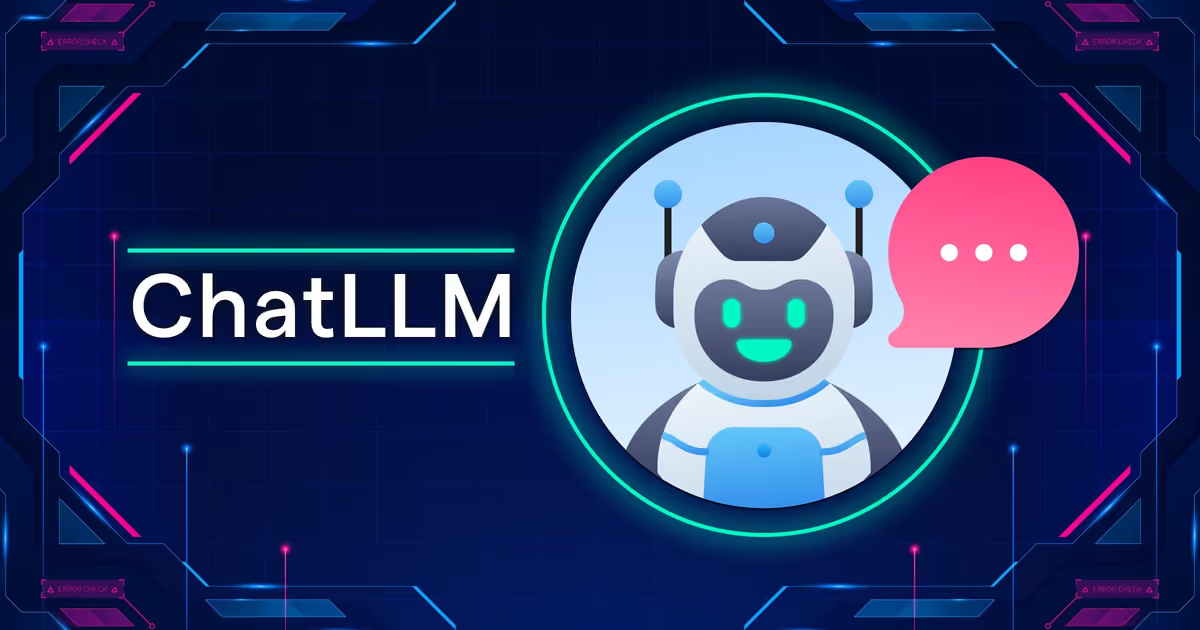
- Image: Abacus.AI Open Graph image from the Personal Agents page, used for illustration and credited to Abacus.AI.
Last updated: 12/10/2026. Figures are from Abacus.AI pages read on that date; the agent-to-agent demos are vendor demonstrations we have not reproduced.
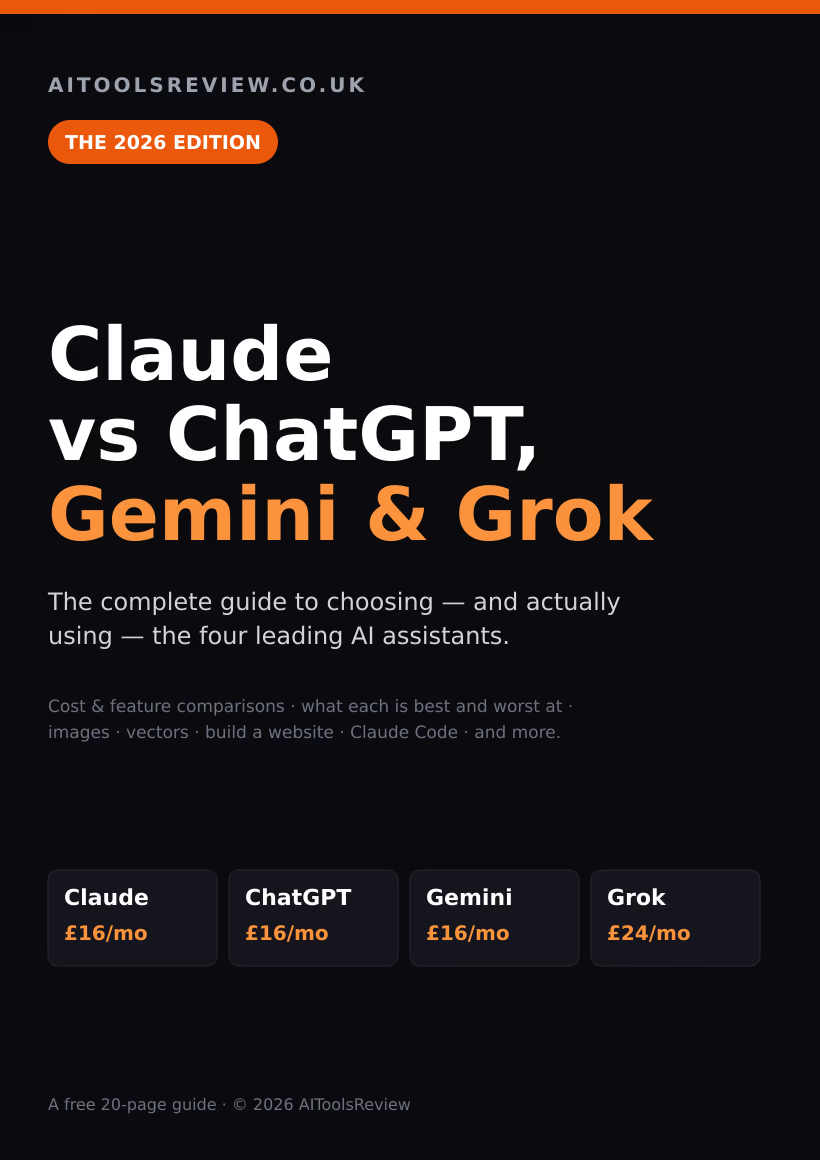
Get the free guide: Claude vs ChatGPT, Gemini & Grok
A 20-page playbook covering everything you need to choose and use the big four AI models in 2026, full cost and feature comparisons, what each is best (and worst) at, and how-tos for images, vectors, building a website, Claude Code and more.