 AI Tools Review Editorial Team
Quick Answer:
Gemini Skills are reusable instructions you run with a slash command, and they are replacing Gems. Gemini can build them from a chat, run them automatically, stack several at once and attach reference files (text, PDFs, images). Gems support ends in November 2026 for personal accounts, March 2027 for most Workspace customers and June 2027 for education, with automatic migration.
Google has decided that the custom-assistant idea behind Gems was the wrong shape. Instead of a separate assistant per task, Gemini will now offer small, reusable skills that you call with a slash, combine at will and let the model reach for on its own.
This guide sets out what Google has actually said, what press coverage adds, how the shutdown dates work, and how Gemini's version compares with Claude Skills. Where a detail is only reported, or not published at all, we say so. The first video below is the creator coverage that prompted this piece.
Julian Goldie SEO walks through the slash-command workflow, stacking, reference files and the Gems shutdown dates. Creator commentary, so check the dates against Google's own post.
Executive Summary
What changed: on 28/09/2026 TechCrunch reported that Google is shutting down Gems, the feature that let people build custom Gemini assistants. Two days later, on 30/09/2026, Google published its own post titled "Let skills in Gemini tackle your most repetitive tasks", written by Deven Tokuno, a senior product manager on the Gemini app. Skills are the replacement.
- What a skill is: a saved, reusable set of instructions you run by typing a forward slash and the skill name in the prompt bar.
- New capabilities: Gemini can help build a skill from a chat, can run a skill automatically when your prompt matches it, lets you stack several skills at once and, as of launch day, supports reference files such as plain text documents, PDFs and images.
- Still to come: Google says sharing and adding files from Google Drive and notebooks from Gemini Notebook will arrive "in the coming weeks". Press coverage also reports that the slash will eventually be replaced by an @ mention; we could not find that in Google's own post, so treat it as reported rather than confirmed.
- Timeline: Gems support ends in November 2026 for personal accounts, March 2027 for Workspace business, enterprise and nonprofit customers and June 2027 for Workspace education customers. Existing Gems migrate automatically. The in-app notice cited by TechCrunch gives 17/11/2026 as the start date for personal accounts.
- Who gets it: Google says skills are "available to all Google AI subscription tiers" and for users aged 18 and over, with under-18 access coming. Whether the free tier is fully included is covered in the availability section below.
Our view: this is a sensible consolidation that moves Gemini closer to the skills model that Anthropic popularised with Claude Skills, but it is a lighter-weight version. Google's skills are chat-native instructions with attached files, not folders of executable scripts. For most people writing newsletters, preparing presentations or applying a house style, that is exactly the right level. For developers, it is a very different thing.
Why Gems Existed, and Why They Are Going
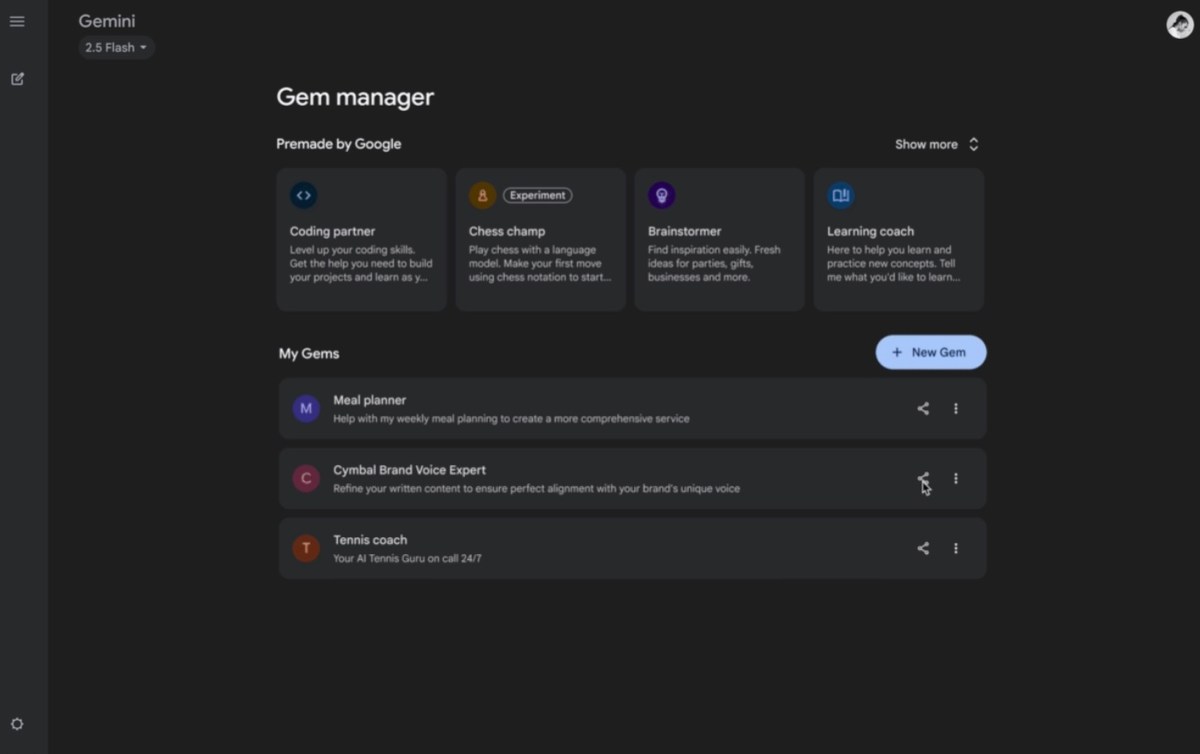
Gems launched in 2024 as Google's answer to custom GPTs. TechCrunch describes them as a way to "teach their AI to perform certain tasks without having to repeat the instructions". Google shipped premade versions, among them a learning coach, a brainstorming assistant, a career guide, a coding partner and an editor, and users built their own, such as a running coach, nutritionist or vacation planner. Gems could also be shared, which TechCrunch says Google hoped would make the Gemini app more popular.
The problem was structure. A Gem was a separate, named assistant with its own side-panel entry. You chose one Gem for a conversation and stayed inside it. If you wanted your brand voice and your presentation format and your audience brief, you had to cram everything into a single Gem, or copy and paste between several.
TechCrunch framed the shutdown against a wider shift: "As all-in-one AI agents like Meta's Muse and Instinct take off", a feature that builds task-specific assistants looks old-fashioned. We covered the Meta side of that shift in our Meta Muse Secure VM review. The same article also made a pointed design criticism, which we return to below: Google gives every new feature its own brand name and navigation slot, then merges them later.
Google's own post says skills "are already available in Gemini Spark, and they will soon replace Gems". Spark is Google's agent product, which we examined in Google Gemini Spark. That detail matters: skills did not start as a Gems upgrade. They arrived first in the agent surface, and are now being brought down into ordinary chat.
How Gemini Skills Work
The mechanics, as described in Google's announcement, are deliberately simple. There are four ideas to understand.
Slash-command invocation
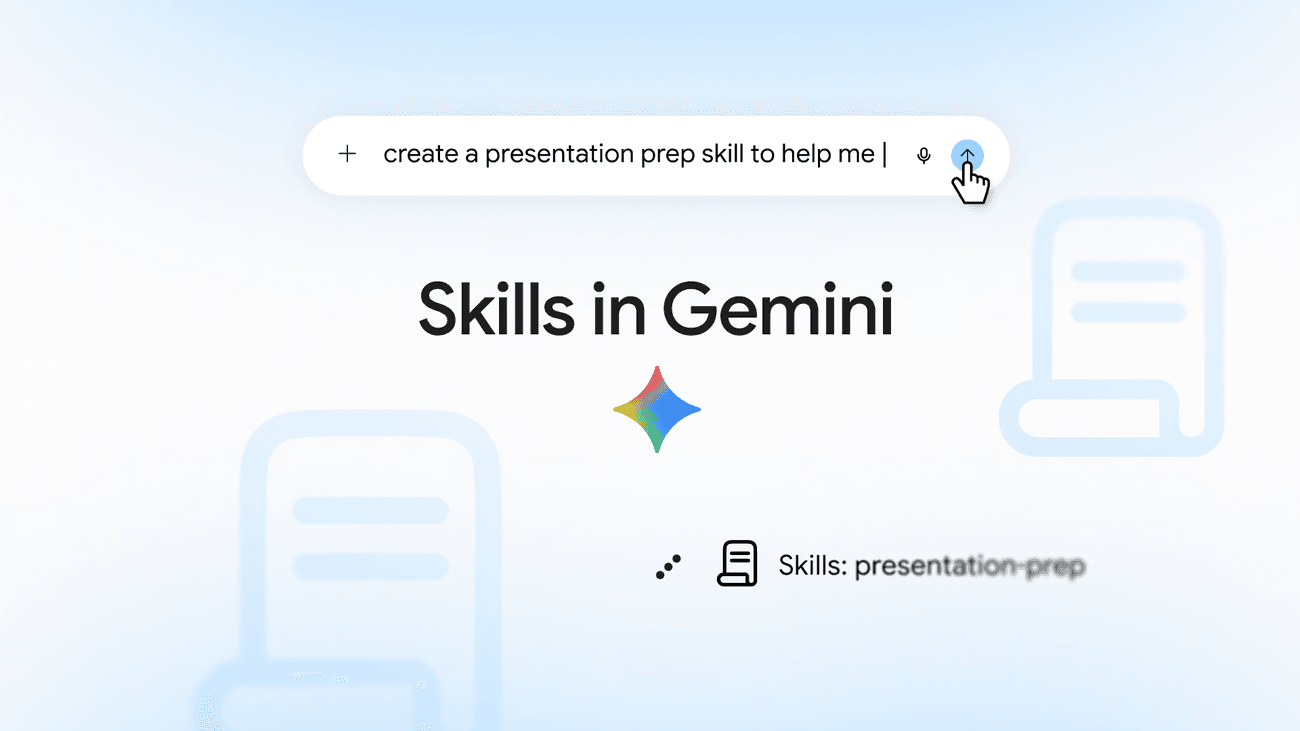
Once you have created a skill, you "can easily use it again just by typing a forward slash '/' and the skill's name directly in the prompt bar". A skill is therefore something you call inside any conversation rather than a separate assistant you open. The Google blog thumbnail shows the pattern: a prompt reading "create a presentation prep skill to help me", followed by a chip labelled with a skill name.
Building a skill from a chat
Google says "Gemini can help you build custom skills from your chats". In practice that means you can do a task well once, then ask Gemini to turn what worked into a reusable skill. Julian Goldie SEO demonstrates this in his live test, where Gemini builds a skill from a single prompt. We have not run an independent test of how good the generated instructions are, so judge the output yourself and edit it.
Automatic invocation
Gemini can also "automatically run them whenever you enter a matching prompt". This is the biggest conceptual change from Gems. With a Gem you decided, up front, which assistant to talk to. With skills, the model decides when a saved instruction is relevant. That is convenient, and it is also a source of unpredictability: if two skills could plausibly match, you will want to know which one fired. Google's post does not describe how matching is decided or how to see which skills ran, so that is an open question we flag in the limitations section.
Stacking
"For bigger tasks, you can stack multiple skills together at the same time", Google writes, with the example of "combining a writing style skill with a brand guidelines skill to create on-brand assets in your voice". This is the practical win. Instead of one giant Gem per project, you keep small, single-purpose skills and combine them: tone, brand rules, audience, output format.
Reference files
From launch day, "you can create skills that include reference files like plain text documents, PDFs, or images". A brand guidelines skill can carry the actual PDF; a presentation skill can carry a template image. Google has not published file-size limits, supported-format lists beyond those three types, or caps on the number of files in the post we reviewed, so we are not quoting any.
A second Julian Goldie SEO walk-through, covering skills versus normal prompts, automatic use, manual activation, stacking and adding your own files. Treat the business-opportunity framing as opinion.
The Gems Shutdown Timeline
The dates are staggered by account type, and the staggering is the most useful thing to plan around. Google says it will "remove support for Gems" on the following schedule, once skills have the features people liked in Gems:
| Account type | Gems support ends | Source |
|---|---|---|
| Personal accounts (individuals) | November 2026; in-app notice gives 17/11/2026 as the start of the change | Google blog; TechCrunch |
| Workspace business, enterprise and nonprofit | March 2027 | Google blog |
| Workspace education | June 2027 | Google blog |
| Opal (Google's mini-app experiment) | Turns down in November 2026 alongside Gems | Google blog |
Two details are easy to miss. First, Google says Gems will be automatically migrated into skills "when Gems go away", so you do not need to rebuild them, and the Gems themselves stay usable until then. Second, a footnote says "Gems by Google Labs will also turn down, though these will not migrate into skills". If you have a Labs-built Gem you care about, copy its instructions out before November.
The in-app message cited by TechCrunch gives 17/11/2026 as when Gems become skills for personal accounts. Google's blog says only "November". We therefore treat 17/11/2026 as the reported start date and the month as the official commitment. Google also links a help-centre page on moving Gems into skills; we have not reproduced its steps because we could not verify them.
Note also the sequencing logic. Google is not switching Gems off on the day skills launch. It is waiting until skills have sharing and Drive and Gemini Notebook support, the two things people used Gems for most. If those features slip, the dates may move, though Google has not said so. For the notebook side, see our explainer on Gemini Notebook.
Availability, Free Tier and Pricing
Google states skills are rolling out "directly into Gemini chat globally" with a footnote that they are "available to all Google AI subscription tiers; currently available to 18+ with U18 coming soon". Workspace business, enterprise, nonprofit and education customers get the functionality "in the coming weeks".
What the post does not say, in the text we reviewed, is a price. There is no separate fee for skills. The footnote refers to Google AI subscription tiers, and a search of press coverage returned conflicting framing: one outlet headlined that Gems were moving to a "paywalled" skills feature, while another reported that Google had dropped any Google AI Pro or Ultra requirement and opened skills to all users aged 18 or over. We could not open those articles in full, so we cannot confirm which reading is right. The safe summary is that skills work across Google AI subscription tiers, that free-tier access has been reported but is not spelled out in the part of Google's post we read, and that you should check your own account in the Gemini app.
For UK readers, usage limits and the cost of Google AI plans change regularly, so we are not quoting any £ prices here. Our Google AI wave overview tracks the wider plan landscape. The key point is that the feature itself carries no stated extra charge.
What Happens to Your Existing Gems
If you have Gems, this is the practical checklist.
- Do nothing urgent. Google says Gems migrate automatically and remain usable until their cut-off.
- Export what matters anyway. Copy the instructions of any Gem you depend on into a document. It costs five minutes and protects you against a migration that flattens or renames something.
- Check Labs-built Gems. Google says these will not migrate.
- Plan for Opal. If you used Opal for mini apps, it turns down in November too.
- Review after migration. A Gem written as a persona ("you are my tennis coach") becomes a skill you call with a slash. It may behave a little differently when auto-invoked or stacked with others, so test it.
- Workspace admins: your Gems support runs until March 2027 (business, enterprise, nonprofit) or June 2027 (education), but skills arrive for you in the coming weeks, so you have time to pilot.
Rethinking Gems as Skills
The biggest shift is conceptual. A Gem was a character; a skill is a procedure. The sensible way to rewrite a persona Gem is to ask what it actually did and split it up.
Take a "Brand Voice Expert" Gem like the one in the screenshot above. As a skill set, you would have one skill for tone of voice, one for formatting rules, one for banned phrases and a reference PDF holding the real style guide. When you draft a press release you stack tone and formatting; when you write a tweet you stack tone alone. That modularity is exactly what the stacking feature is for.
Julian Goldie SEO's videos give example use cases that line up with Google's: presentation preparation, a personal writing style and analysing a topic from multiple viewpoints. They are reasonable starting points. The key habit is to write a skill as a clear, narrow set of instructions with a defined output, not a loose personality.
A short template that tends to work for any skill: state the purpose in one line, list the steps, define the output format, add two or three examples through reference files and say what the skill must never do. That is our suggestion rather than Google guidance, but it matches how instruction-following models respond best.
Gemini Skills vs Claude Skills
The shared name invites comparison, and the overlap is real. Our Claude Skills explainer describes Claude's version: filesystem-based packages built around a SKILL.md file, loaded on demand through progressive disclosure, so that Claude sees only a short name and description until a skill becomes relevant. Gemini's model, as Google describes it, shares the auto-invocation idea but appears much more consumer-oriented.
| Dimension | Gemini Skills | Claude Skills |
|---|---|---|
| Invocation | Slash command in the prompt bar, plus automatic running on a matching prompt | Loaded automatically when relevant to the task; invoked by name in some surfaces |
| Stacking | Explicitly supported, several skills at once | Multiple skills can be active; Claude loads those relevant to the task |
| Reference material | Text documents, PDFs and images | Bundled reference files and scripts in the skill folder |
| Executable code | Not described in Google's announcement | Skills can include scripts Claude can run |
| Authoring | Build from a chat with Gemini's help | Author a SKILL.md and supporting files, or have Claude help |
| Sharing | Promised in the coming weeks | Distribution via files, plugins and the API |
| Replaces | Gems (and Opal turns down) | Not a replacement for a previous feature |
Be careful with the right-hand column: it summarises our earlier article and Anthropic's documented behaviour, and details differ between Claude.ai, Claude Code and the API. See also Claude computer use, skills and files GA, Claude for Finance skills and the Claude Code design skill for concrete examples of skills in use.
The honest takeaway is about audience. Claude's skills grew up in developer tooling and extend into code execution. Gemini's skills grew out of a consumer feature, Gems, and keep the chat-first feel. That is not a criticism: most people do not need scripts, they need their voice and their templates applied consistently. But a developer wanting a repeatable, version-controlled, testable capability will find Gemini's version thin, at least on the evidence of Google's launch post.
Interoperability is another unknown. Claude Skills are described as an open standard in our earlier coverage; Google has not said whether Gemini skills use the same format, so do not assume a Claude skill drops into Gemini, or the reverse. We found no statement on that either way.
Where Skills Fit in the Wider Assistant Landscape
Every major assistant now has some form of reusable instruction. OpenAI has custom GPTs and project instructions, covered in our ChatGPT Work piece; Anthropic has Skills; Meta's Muse and OpenAI's dots lean on always-on agents, which we discussed in OpenAI Dots Explained. Google's move is a convergence on a pattern: small, composable, reusable behaviour units that the model can pull in when relevant.
The agentic angle is also visible in Google's Workspace work, which we track in Gemini Workspace agentic features. Skills arriving in Workspace plans in the coming weeks suggests Google wants shared, organisation-level instructions, such as a company style or a compliance checklist, available to staff. We would expect sharing to be the feature that determines whether that works, and it has not shipped yet.
Model quality still matters. A skill is only as good as the model following it. For the underlying models, see Gemini 4 Argon, which TechCrunch noted in its related coverage as Google's most powerful model yet. We have not tested whether skill adherence differs between models.
Criticisms and Open Questions
TechCrunch's Sarah Perez made two criticisms worth repeating. The first is branding churn: "Google shouldn't be so quick to give every new AI feature its own brand name, icon, and prominent placement in its app's navigation — especially if it's going to shuffle things around over time". People who built a library of Gems have now had to relearn the name, the entry point and the interaction.
The second is usability. "Even as skills, the former Gems still aren't as consumer-friendly as just typing in text to a chatbot like Meta's Muse", she writes, because you must enter a forward slash to select a skill, "a user interface that engineers, not regular folks, tend to prefer". Google's automatic invocation partly answers that, since you may not need the slash at all, and press reports say an @ mention is on the way.
Our own open questions, which Google's announcement does not answer:
- Transparency: how will you see which skills Gemini applied automatically?
- Conflicts: what happens when stacked skills give contradictory instructions?
- Limits: how many skills, files and what file sizes are allowed?
- Sharing: what permissions will shared skills have, particularly in Workspace?
- Privacy: how are reference files stored and are they used for training? Check Google's Gemini privacy documentation for your account type.
- Migration fidelity: will complex Gems convert cleanly, including Gems with uploaded knowledge files?
- Portability: can you export a skill?
Getting Started: Five Steps
Julian Goldie SEO lists five simple steps in his first video. Here is our version, based on Google's description of the feature.
- Pick one repetitive task. Something you have typed the same instructions for at least three times.
- Do it once in chat and refine until the output is what you want.
- Ask Gemini to turn it into a skill, then read and edit the generated instructions.
- Attach reference files: a style guide PDF, a template, a screenshot of the layout you want.
- Call it with a slash next time, then try stacking it with a second skill and compare results.
Keep skills narrow and name them clearly, because the name is what you will type and what Gemini will use to decide relevance. Avoid putting sensitive personal or client data into reference files unless your account type and organisation policy allow it.
Who Should Care
- Regular Gem users: yes, because your Gems will convert. Review them after November.
- Marketers and writers: stacking voice and brand skills with reference PDFs is the clearest win.
- Workspace admins: plan a pilot for the coming weeks and prepare for sharing features.
- Developers: look at Claude Skills or Gemini Spark if you need executable, testable behaviour; Gemini chat skills are lighter.
- Casual users: you may never need to touch a skill, especially if automatic invocation works as described.
The Bottom Line
Gemini Skills are a tidy replacement for Gems rather than a revolution. They trade a character-style assistant for reusable, stackable instructions that Gemini can run on its own and that can carry reference files. The change is sensible, the migration is automatic and the timeline is generous: November 2026 for individuals, then March and June 2027 for Workspace customers.
The weak points are the ones Google has yet to answer: sharing and Drive support are still promised rather than delivered, the @ mention is only reported, the free-tier position is murky in the coverage we could open and Labs Gems will not migrate. Do the five-minute export of any Gem you rely on, build one narrow skill this week and judge it against your old Gem. We will update this article as sharing and Workspace availability land.
Sources
- Google: Let skills in Gemini tackle your most repetitive tasks (30/09/2026): feature description, reference files, timeline and availability footnotes.
- TechCrunch: Google is killing off Gemini's Gems in favor of 'skills' (28/09/2026): in-app notice, 17/11/2026 date, Gems history and criticism.
- Android Central: Google outlines timeline to phase out Gemini Gems: search-result summary only; page not read in full.
- Julian Goldie SEO on YouTube: creator walk-throughs (two videos embedded above).
Hero image: Skills in Gemini artwork from Google's announcement. Gem manager screenshot: TechCrunch.
Last updated: 05/10/2026. Sourced from Google's announcement (30/09/2026) and TechCrunch (28/09/2026). We have not tested Gemini Skills ourselves, and details such as @ mention support, sharing and free-tier access may change.
Get the free guide: Claude vs ChatGPT, Gemini & Grok
A 20-page playbook covering everything you need to choose and use the big four AI models in 2026, full cost and feature comparisons, what each is best (and worst) at, and how-tos for images, vectors, building a website, Claude Code and more.