 AI Tools Review Editorial Team
Quick Answer:
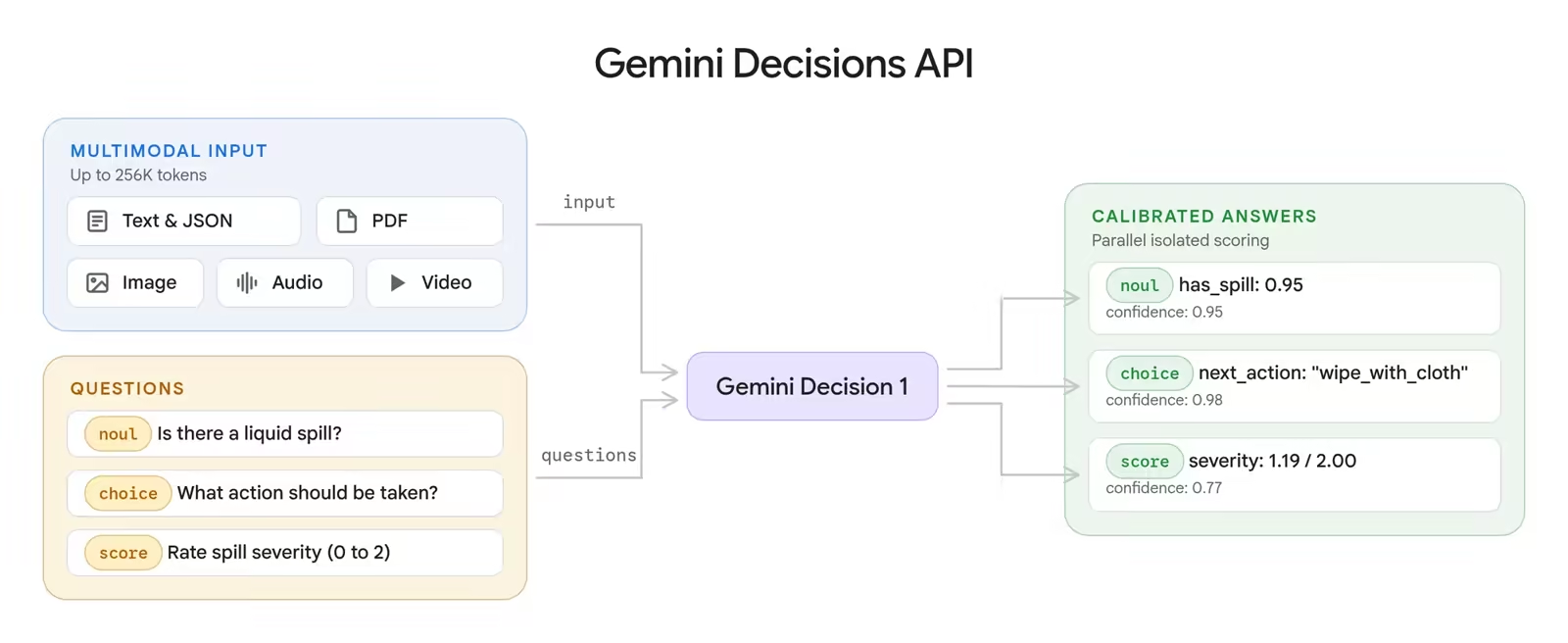
Gemini Decision 1, launched by Google DeepMind on 11/11/2026, is a model that picks answers rather than writing them. One request can carry up to 256K tokens of text, images, audio, video or PDFs plus up to 1,000 yes/no, multiple-choice or rubric questions, and returns calibrated probabilities in about 150 to 250 milliseconds for $0.10 per million input tokens, with output free. OpenAI's rival Decisions API on GPT-6 Luna costs the same but handles up to 400 questions and no audio or video. Google's benchmarks put Decision 1 ahead of both GPT-6 Luna and TypeSafe's Jev 1.14; independent tests from Artificial Analysis are more mixed.
Most of what an AI agent does all day is not writing. It is deciding: which tool to call, which model to route to, whether an answer breaks a policy, whether a photo shows damage. Using a full generative model for those choices is slow and wasteful. In the past three months a new category has emerged to fix that, and this week Google joined it with Gemini Decision 1, a fortnight after OpenAI took its own Decisions API out of beta. This is what decision models are, how the two biggest labs' versions compare, and where the numbers hold up.
Julian Goldie walks through six practical Gemini Decision 1 systems, from a store inbox sorter to a lead scorer and thumbnail picker.
Executive Summary
- What launched: the Gemini Decisions API and the
gemini-decision-1model, available now through the Gemini API (v1beta) in Google AI Studio, with Google Cloud support "coming soon". - Scale: one shared input of up to 256K tokens and up to 1,000 independent questions per request, across text, JSON, images, audio, video and PDFs.
- Speed: 50 to 100 ms median model compute and 150 to 250 ms end to end for inputs up to 16K tokens, roughly flat from 1 to 100 questions.
- Price: $0.10 per million input tokens, $0 output. Google says it is nearly five times cheaper than Gemini 3.5 Flash-Lite across its shared benchmark suite.
- Benchmarks (Google): 92.2% on JevBench against 90.9% for GPT-6 Luna and 90.0% for Jev 1.14; best calibration (top-1 ECE 0.0250) of the four models tested.
- Benchmarks (independent): Artificial Analysis scored it 66 on its Decision Index, tied with Jev 1.14 and behind Drex Max v1.1, and 9th of 18 models at launch.
- OpenAI's answer: the Decisions API on GPT-6 Luna, generally available since 22/10/2026, at the same $0.10 input price, up to 400 questions, and text, image and JSON input.
What a Decision Model Actually Is
A normal large language model answers a question by generating text one token at a time. If you ask it "is this support ticket about billing, shipping or a technical fault?", it writes out an answer, perhaps some reasoning, and you parse the result. That works, but it is slow (every token is a sequential step), expensive (you pay for every output token, including reasoning) and messy (the answer can arrive in the wrong format or with no sense of how sure the model is).
A decision model is given the possible answers up front. It reads the input once and scores every candidate option in a single forward pass, returning a probability for each. There is no generation, so latency is short and nearly constant, output costs nothing, the answer can only be one of the options you allowed, and you get a calibrated confidence score you can use to send uncertain cases to a human or a bigger model.
Think of it as the AI equivalent of a multiple-choice exam rather than an essay. It cannot write your email, but it can decide in a fifth of a second whether the email needs a reply, who should send it and how urgent it is, all at once.
How We Got Here: The Decision-Model Race
The category was popularised by TypeSafe's Jev, a non-autoregressive "System One" model that we reviewed in Jev: TypeSafe's System One Model. Jev set the template that everyone else now follows: closed-set questions, probabilities out, no output billing, and a headline input price of $0.042 per million tokens. TypeSafe also published JevBench, which has become the de facto shared benchmark, somewhat awkwardly for its competitors.
Since then the field has filled up quickly. OpenAI opened a public beta of its Decisions API on GPT-6 Luna in early October and made it generally available on 22/10/2026. Microsoft launched Microsoft-Decision-1, a post-trained 9B model, in Foundry on 09/10/2026. Liquid AI released its D1 decision model, and Nace AI's Drex Max now tops the independent leaderboard. Amazon released Strands Decider 2B as open source under Apache 2.0. Google is late to the party, but arrives with the broadest input support of any of them.
Google says Decision 1 started as an internal Google DeepMind prototype and that a small team shipped it in roughly six weeks. It launched alongside Gemini 4 Hydrogen, which is telling: Google's product line now has a model for deep reasoning (Carbon, Argon), one for fast execution (Hydrogen) and one for instant choices (Decision 1).
How Gemini Decision 1 Works
Decision 1 is built on Gemini's native multimodal architecture, so it processes text, images, audio, video and PDFs directly rather than transcribing or OCR-ing them first. You can mix modalities in one shared input: Google's examples include pairing a call recording with account metadata, or a scanned PDF insurance claim with damage photos. Resolution on image and video inputs is adjustable, which lets you trade visual detail against token cost.
The input field uses the same Content block format as Google's Interactions API, so existing Gemini code ports easily. Requests go through the google-genai SDK with client.decisions.create() on the v1beta API. Each question has a name, a type, instructions and, where relevant, named criteria. Google is explicit that every question is "evaluated independently": if one decision depends on another, you handle that in your own code or in a follow-up request.
Latency is the headline engineering claim. Because nothing is decoded, Google reports 50 to 100 ms of median model compute and 150 to 250 ms end to end for inputs up to 16K tokens, and says that stays nearly flat whether you ask 1 question or 100. That flatness is the whole point: in a generative model, ten questions mean ten times the output; here they cost almost nothing extra in time.
The Three Question Types
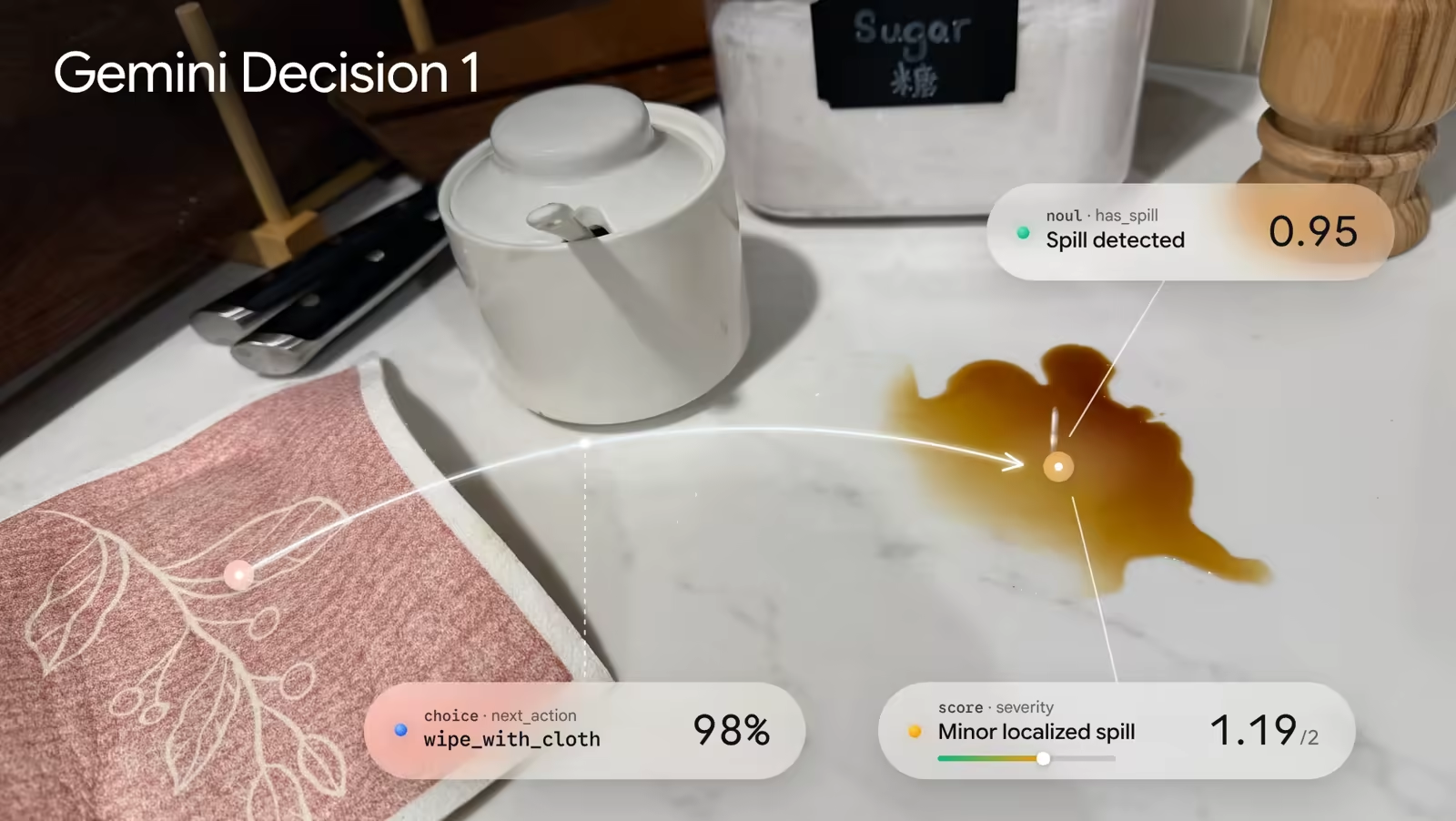
You can mix all three in a single request, and every answer includes a confidence score from 0 to 1.
| Type | What it returns | Example |
|---|---|---|
noul (yes/no) | Probability the condition holds, with optional true/false descriptions | "Is there an uncleaned liquid spill on the counter?" |
choice (multiple choice) | The winning option and normalised probabilities for 2 to 255 candidates | "Which cleanup action fits the scene?" |
score (ordered rubric) | A continuous weighted score from 0 plus per-level probabilities | "Rate the severity of the counter mess, 0 to 2." |
The rubric type is the quietly important one. Returning a continuous score (Google's diagram shows a severity of 1.19 on a 0-to-2 scale) rather than a single label means you can set your own thresholds and treat borderline cases differently, which is exactly what you want for content moderation or LLM-as-a-judge grading.
Benchmarks: Google's Table
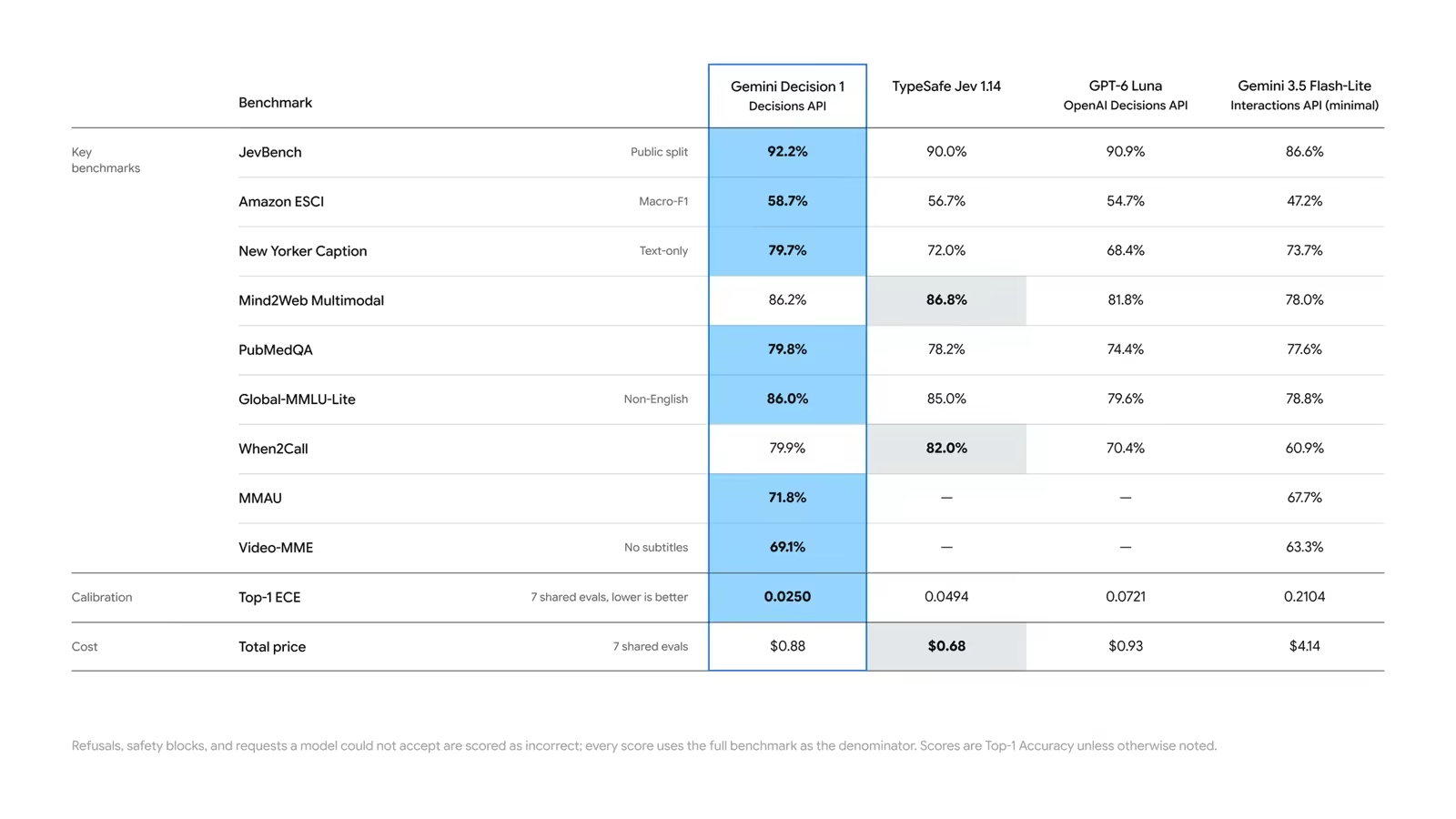
Google compared Decision 1 with TypeSafe Jev 1.14, OpenAI's Decisions API on GPT-6 Luna, and its own Gemini 3.5 Flash-Lite run through the generative Interactions API at minimal thinking. Refusals, safety blocks and requests a model could not accept were scored as wrong.
| Benchmark | Decision 1 | Jev 1.14 | GPT-6 Luna | 3.5 Flash-Lite |
|---|---|---|---|---|
| JevBench (public split) | 92.2% | 90.0% | 90.9% | 86.6% |
| Amazon ESCI (macro-F1) | 58.7% | 56.7% | 54.7% | 47.2% |
| New Yorker Caption (text-only) | 79.7% | 72.0% | 68.4% | 73.7% |
| Mind2Web Multimodal | 86.2% | 86.8% | 81.8% | 78.0% |
| PubMedQA | 79.8% | 78.2% | 74.4% | 77.6% |
| Global-MMLU-Lite (non-English) | 86.0% | 85.0% | 79.6% | 78.8% |
| When2Call (tool use) | 79.9% | 82.0% | 70.4% | 60.9% |
| MMAU (audio) | 71.8% | n/a | n/a | 67.7% |
| Video-MME (no subtitles) | 69.1% | n/a | n/a | 63.3% |
| Top-1 ECE (lower is better) | 0.0250 | 0.0494 | 0.0721 | 0.2104 |
| Total price, 7 shared evals | $0.88 | $0.68 | $0.93 | $4.14 |
Read across the rows and three things are clear. Against GPT-6 Luna, Decision 1 wins every shared test, often by five points or more, and with about a third of the calibration error. Against Jev 1.14 it is closer: Decision 1 wins five of seven, but Jev leads on Mind2Web Multimodal (web-agent action selection) and When2Call (deciding whether and which tool to call), the two tests most relevant to agent control. And Jev remains the cheapest across the suite at $0.68 against $0.88.
The calibration result deserves attention. Expected calibration error measures how well a model's stated confidence matches reality; if it says 80%, is it right 80% of the time? A low ECE is what makes confidence thresholds trustworthy, and it is arguably the most important number for production use. Decision 1's 0.0250 is half of Jev's and roughly a third of Luna's, on Google's measurement.
The audio and video rows have no competitor scores because neither Jev nor OpenAI's Decisions API accepts those inputs. That is a genuine differentiator rather than a benchmark win.
Matt Wolfe uses a decision model to sort and tag a photo library automatically, a practical example of closed-set image decisions.
Independent Results Are More Mixed
Artificial Analysis, which runs its own Decision Index across 18 models, summed up its launch-day results in four words: "Independent results are more mixed." Its findings, as reported by Latent Space and Dataconomy:
- Decision Index: 66, tied with Elephant 9B and Jev 1.14, and seven points behind Drex Max v1.1 and GLiDE v1.2. That placed it 9th of 18 at launch.
- Where it leads: AA-Omniscience-Decision (66) and HLE-MultiChoice (49), both knowledge-heavy tests.
- AA-Paperclip (the share of documents where every question is answered correctly): 33% for Decision 1, 35.5% for Jev and 63% for Drex Max.
- When2Call: Drex Max 94.6%, Jev 80.8%, Decision 1 75.2%.
- Cost and speed: $345 per million tasks against $156 for Jev and $103 for Drex Max; an average of 211 ms per task against 92 ms for Jev.
So outside Google's own suite, Decision 1 is a solid mid-pack model that is slower and pricier per task than the specialists, with an edge on knowledge and a unique multimodal reach. The gap between vendor and independent results is not unusual, but it is a reminder that JevBench is only one benchmark and that tool-selection decisions remain a weakness relative to Drex Max.
OpenAI's Decisions API on GPT-6 Luna
OpenAI's product works the same way conceptually. You call POST /v1/decisions with gpt-6-luna (currently the only supported model), an input and a list of questions. OpenAI's three types are predicate (a probability that a condition is true), choice (one of your values plus a probability array and confidence) and score (a probability-weighted average across 2 to 10 ordered levels).
According to OpenAI's documentation, the generally available version allows 1 to 400 questions per request, up from 200 in the public beta. Inputs can be a text string or an ordered array of messages, tool calls and tool outputs, with native input_json content parts and images, including images inside question instructions for reference-versus-candidate comparisons. It can evaluate conversation history and trigger decisions from GPT-Live voice transcripts. It does not accept files, audio or file_id inputs.
Pricing is $0.10 per million uncached input tokens with no output charge, plus standard GPT-6 Luna caching rates (reports put cache reads at $0.01 per million, with cache writes charged). Caching needs a reusable prefix of at least 1,024 tokens. OpenAI says the API is "about 10x faster than the Responses API" but publishes no absolute latency figures. On the enterprise side it supports Zero Data Retention, HIPAA-eligible use, data residency and regional processing in the US and Europe, which may matter more than benchmark points to regulated UK firms. For background on the model itself, see GPT-6 Sol and Luna.
Head to Head: Google vs OpenAI
| Gemini Decision 1 | OpenAI Decisions API (GPT-6 Luna) | |
|---|---|---|
| Status | Launched 11/11/2026, v1beta | Generally available since 22/10/2026 |
| Questions per request | Up to 1,000 | Up to 400 |
| Context | 256K tokens shared | Not stated on the guide; long-context multipliers apply |
| Inputs | Text, JSON, images, audio, video, PDF | Text, JSON, images, tool calls and outputs |
| Multiple-choice options | 2 to 255 | Your supplied values |
| Rubric levels | Ordered, from 0 | 2 to 10 |
| Input price | $0.10 / M | $0.10 / M uncached |
| Output price | Free | Free |
| Latency | 150 to 250 ms end to end (≤16K tokens) | "About 10x faster" than Responses API |
| Free tier | Yes, in AI Studio (200 RPM, 50K TPM) | No separate free tier stated |
| Enterprise | Google Cloud support coming | ZDR, HIPAA, data residency, Private Link |
On paper Google wins on scale, modality breadth and Google-reported accuracy. OpenAI wins on maturity, enterprise compliance and integration with its voice and agent stack. If your decisions are over audio, video or PDFs, Google is the only one of the two that can do it natively. If you are already on OpenAI and your inputs are text and images, Luna is good enough and you avoid a second vendor.
Pricing Maths: Why Batching Questions Matters
Both APIs bill the shared input once per request, regardless of how many questions you ask; each question only adds its own instruction tokens. Google's worked example makes the saving obvious. Take a 4,000-token record with 20 checks of about 50 tokens each:
- One request, 20 questions: about $0.50 per 1,000 records (roughly 40p).
- Twenty separate requests: about $8.10 per 1,000 records (roughly £6.40), before retries.
That is a 16-fold difference purely from request design. The practical lesson: design your decision layer around the input, not the question. Pull everything you might want to know about a document, call or image into a single request.
Against generative models the gap is larger still. Google says Decision 1 is nearly five times cheaper than Gemini 3.5 Flash-Lite on its shared suite ($0.88 vs $4.14). Compared with a mid-tier generative model such as Gemini 4 Hydrogen at $1.50 / $7.50 per million tokens, using a decision model for routing and classification can cut that part of your bill by one to two orders of magnitude.
Real-World Use Cases
Google described four internal deployments, which are more convincing than the demos:
- Model routing in Gemini Notebook: the Decisions API classifies each query and sends it to the right model tier and thinking level, serving everyday queries with up to 40% lower latency.
- Stitch rapid canvas: generates playable wireframes of a multi-screen product flow in about five seconds and applies voice or tap edits almost instantly.
- Emoji reactions in CC (Google Labs): picks the right emoji from more than 200 options in a fraction of a second.
- Safety for MCP tools in Search: detects adversarial behaviour and content inside Search's latency budget.
For UK businesses, the obvious early wins are triage jobs that currently burn generative tokens: sorting a shared inbox, scoring inbound leads, checking product listings and photos against brand rules, flagging complaints for escalation, and choosing which of several agents or tools should handle a request. Creators covering the launch, including Julian Goldie, built exactly these: a store inbox sorter, a listing photo inspector, a lead scorer and a brand-rules guard. If you are building agent workflows in Claude Code or Google Antigravity, a decision call in front of the expensive model is the cheapest optimisation available.
Ecosystem support is already broad: Google lists OpenRouter, LangChain (with day-zero support), Vercel, LiteLLM, Pydantic AI, Pipecat, LiveKit and OpenCode.
Limitations and Gotchas
- Closed sets only. If the right answer is not in your option list, the model will still pick one. Always include an "other" or "unclear" option and use the confidence score.
- No dependencies between questions. Each is scored independently. Chained logic needs your own code or a second call.
- Latency figures are for inputs up to 16K tokens. A 200K-token video will not come back in 200 ms.
- Beta API, no Google Cloud yet. Enterprises that need Vertex-style controls must wait. The free tier allows Google to use data for product improvement, subject to regional exceptions; the paid tier does not.
- Vendor benchmarks. Google chose the comparison set, and independent tests put Decision 1 mid-table, behind Drex Max, with weaker tool-call decisions than Jev.
- Per-task cost is not the lowest. Jev and Drex Max were cheaper per task in Artificial Analysis's runs.
Which Should You Use?
- Decisions over audio, video or PDFs: Gemini Decision 1. Nothing else on this list handles them natively.
- Many checks per document: Gemini Decision 1, for the 1,000-question ceiling and strong calibration.
- Already on OpenAI, text and images, regulated data: OpenAI's Decisions API on GPT-6 Luna, for ZDR, HIPAA and data residency.
- Agent tool selection at the lowest cost: test Jev 1.14 and Drex Max first; both beat Decision 1 on When2Call in independent runs.
- Self-hosting: Amazon's open-weight Strands Decider 2B or Microsoft-Decision-1 via Foundry.
The Bottom Line
Gemini Decision 1 confirms that decision models are now a standard part of the AI stack, not a niche. Google's version is the most flexible on offer, with 1,000 questions, 256K tokens and native audio, video and PDF input, and on Google's own tests it beats GPT-6 Luna across the board with excellent calibration. Independent results put it in the pack rather than at the front, and the specialists remain cheaper per task. If you are paying a generative model to make yes/no choices today, any of these will save you money; Decision 1 is the one to pick when your inputs are richer than text.
Last updated: 13/11/2026. Prices in US dollars as published by Google and OpenAI; sterling conversions are approximate at $1 = £0.79.