
 AI Tools Review Editorial Team
Quick Answer:
Jev is the first System One model from TypeSafe AI, the startup founded by ex-OpenAI researcher and ChatGPT contributor Diogo Almeida. It went into early access on 15 September 2026 after two years in stealth. It does not write text. It takes program state plus a schema of questions declared in advance, and returns typed answers with calibrated probabilities in a single parallel pass - 70-500ms end to end, against 3-329 seconds for the frontier LLMs TypeSafe benchmarked it against. On TypeSafe's own evaluations it posts 0% structured-output errors and 0% tool-call errors, at $0.042 per million input tokens with output free. The catch: it has no test-time reasoning, and at least one credible engineer argues most of the speed-up is an inference strategy the big labs could copy.
Every AI release of the past three years has been a variation on the same theme: a model that talks, and talks better than the last one. Jev is the first frontier launch in a long while that is interesting precisely because it refuses to say anything at all.
This is a full review of what TypeSafe has actually built, what its published evaluations do and do not prove, where the sceptics have a point, and which parts of your stack Jev genuinely belongs in.
Nate B Jones walks through why removing text generation is the point of Jev rather than a limitation of it.
Executive Summary
For most of the modern AI era, the industry has had exactly one general-purpose primitive: generate the next token, repeatedly, until a string appears. That primitive is astonishingly flexible, and it is also the source of nearly every operational headache in production AI - latency that scales with output length, JSON that occasionally is not JSON, categories the model invented on the spot, and confidence scores that mean nothing because the model was asked to produce them as text.
TypeSafe's argument is that a very large share of the AI calls running in production software today are not generation problems at all. They are decisions: is this ticket urgent, does this alert look unauthorised, which of these six branches should the workflow take, is this model output a jailbreak attempt. Those calls do not need prose. They need a typed answer and an honest probability, returned fast enough to sit inside a loop.
Jev is the model built for that job, and TypeSafe has coined System One for the category - a deliberate nod to Kahneman's fast, intuitive System 1 thinking, as against the slow, deliberative reasoning that chain-of-thought models perform. It is not a reasoning model, and it is not trying to be.
- Best for: classification, routing, scoring, extraction, branching, map-reduce over large datasets, and guardrail or jailbreak screening inside real-time loops.
- Headline numbers: 70-500ms end-to-end latency, 0% structured-output and tool-call error rates on TypeSafe's evaluations, 193.6x faster and 444.6x cheaper across four published workflow evals.
- Defining trait: it is architecturally incapable of returning a value you did not declare in advance.
- Main caveat: every headline figure comes from evaluations TypeSafe designed and ran, and the architecture may be less novel than the framing suggests.
Where System One Models Came From
TypeSafe AI emerged from two years of stealth with roughly $40 million in funding and an unusually credentialled founding team. Diogo Almeida was a researcher at OpenAI who worked on ChatGPT and contributed to the development of reinforcement learning from human feedback - the technique that turned raw language models into assistants people would actually use. He founded TypeSafe with Erik Gafni and Sasha Sheng.
That biography matters for reading the launch. RLHF was itself an argument that the objective you train against determines what kind of system you get; Jev is the same argument applied to a different objective. If you train a model to be preferred by humans reading text, you get something that writes well. If you train it to produce honest probabilities over a fixed set of options, you get something else entirely - and TypeSafe's claim is that the "something else" is what most production software has been badly approximating with chat models for three years.
The surrounding context is a market that has spent 2026 discovering how expensive conversational inference is when you put it in a loop. The rise of agentic systems - covered in our guide to agent swarms and in our review of browser automation agents - meant a single user request could fan out into dozens or hundreds of model calls. Most of those calls are small judgements. Paying frontier prices and frontier latency for each of them is the central economic problem of agentic AI, and it is the problem Jev is pointed at.
Architecture and Training
Jev is a transformer, but it abandons the autoregressive loop. A conventional LLM produces output one token at a time, each token conditioned on the ones before it; that sequential dependency is what makes generation slow and what makes latency scale with how much the model decides to say. Jev instead generates all of its outputs in parallel in a single query. Because the shape of the answer is fixed before inference begins, there is nothing to wait for.
The inputs are unstructured data - text, and in particular serialised program state. The outputs are type-safe structured values defined in advance through TypeSafe's schema system. Three question types are available in the current interface: boolean, score and choice. Choice questions support up to 255 options directly; higher-cardinality problems are handled through a two-stage scoring system rather than a single flat classification.
The training objective is the genuinely novel part. TypeSafe calls it Reinforcement Learning for Calibrated Decisions (RLCD), and the stated goal is to optimise for "epistemically honest probabilities on System One tasks" rather than for human preference (as in RLHF) or for verifiable rewards (as in the reasoning-model training runs of the past two years). According to TechCrunch's reporting, the model was trained exclusively on synthetic data.
The practical consequence of declaring outputs up front is that hallucination in the usual sense is designed out. The model cannot invent a category that is not in the schema, cannot emit a malformed payload, and cannot produce a type error - TypeSafe describes the latter as mathematically impossible rather than merely unlikely. It can still be wrong. It simply cannot be wrong in a way that breaks the calling code.
What Jev Actually Does
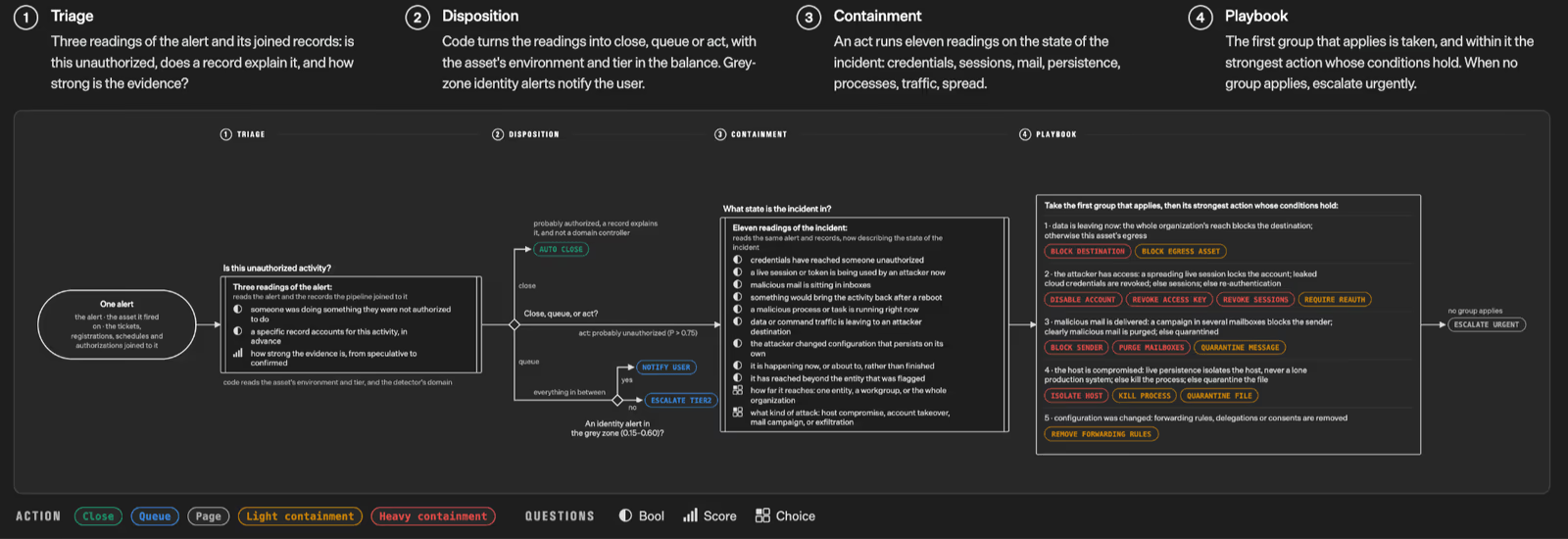
The clearest way to understand Jev is to look at how TypeSafe decomposes a real workflow. Its security-operations example takes a single alert and runs it through four stages, each built from small typed questions rather than one large prompt.
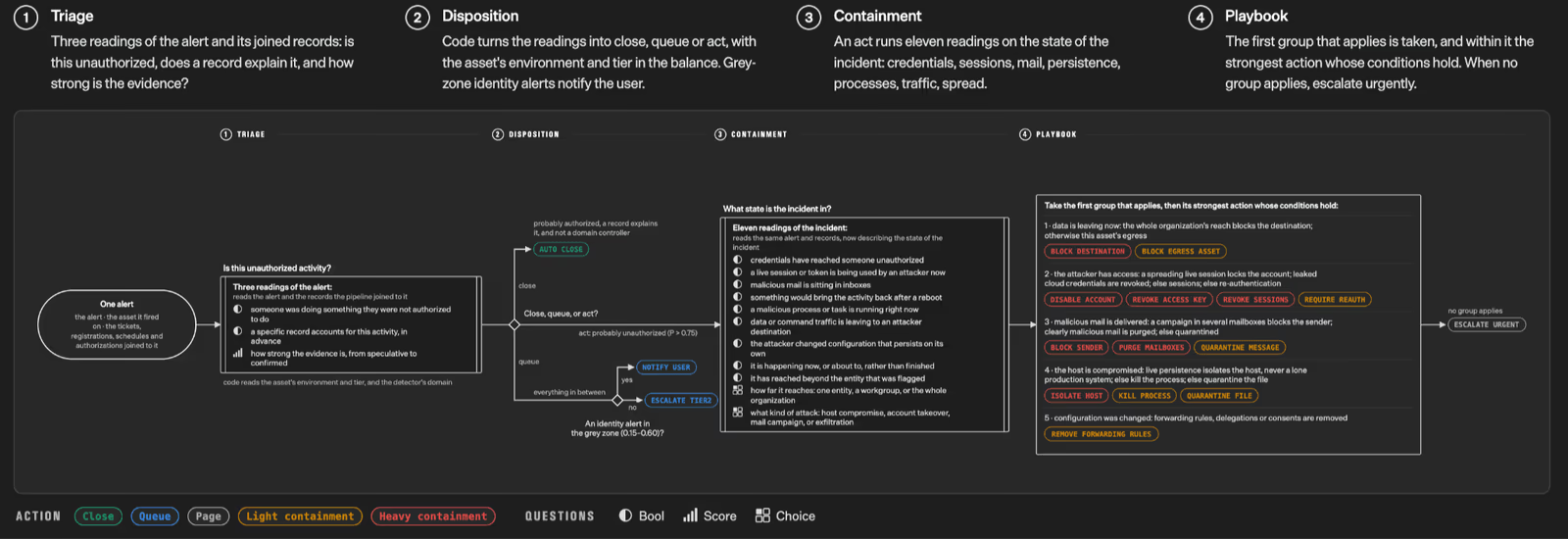
Stage one, triage, asks three questions of the alert and its joined records: was someone doing something they were not authorised to do, does a specific record account for the activity in advance, and how strong is the evidence on a speculative-to-confirmed scale. Stage two, disposition, is ordinary code - it turns those readings into close, queue or act, with the asset's environment and tier in the balance. Note the thresholds are explicit and live in the application, not the model: act at probability above 0.75, notify the user for identity alerts in a grey zone between 0.15 and 0.60.
Stage three, containment, runs eleven further readings on the state of the incident - have credentials reached someone unauthorised, is a live session being used by an attacker now, would the activity return after a reboot, how far has it spread. Stage four, playbook, takes the first group whose conditions hold and applies its strongest action, escalating urgently when no group applies.
This is the architectural point made concrete. The model is never asked to decide what to do. It is asked a series of narrow factual questions with typed answers and honest probabilities, and deterministic code - which can be read, tested, version-controlled and audited - makes the decisions. That is a materially different risk profile from handing an agent a tool belt and a paragraph of instructions, and it speaks directly to the failure modes we covered in our analysis of agent supply-chain attacks.
TypeSafe's published use cases follow the same shape: fuzzy decision rules inside workflows, map-reducing over large datasets, real-time applications needing sub-100ms responses, verification and guardrailing of LLM output, jailbreak detection, and deployment in settings where per-call human oversight is not feasible. The security example is well chosen: alert volume is exactly the kind of high-throughput triage problem where paying frontier latency per decision is untenable, and where the cost of missing something is high - as the Hacktron breach of OpenAI illustrated in July.
Matthew Berman digs into the launch claims and what a non-generative frontier model means for the rest of the field.
The Numbers, and What They Hide
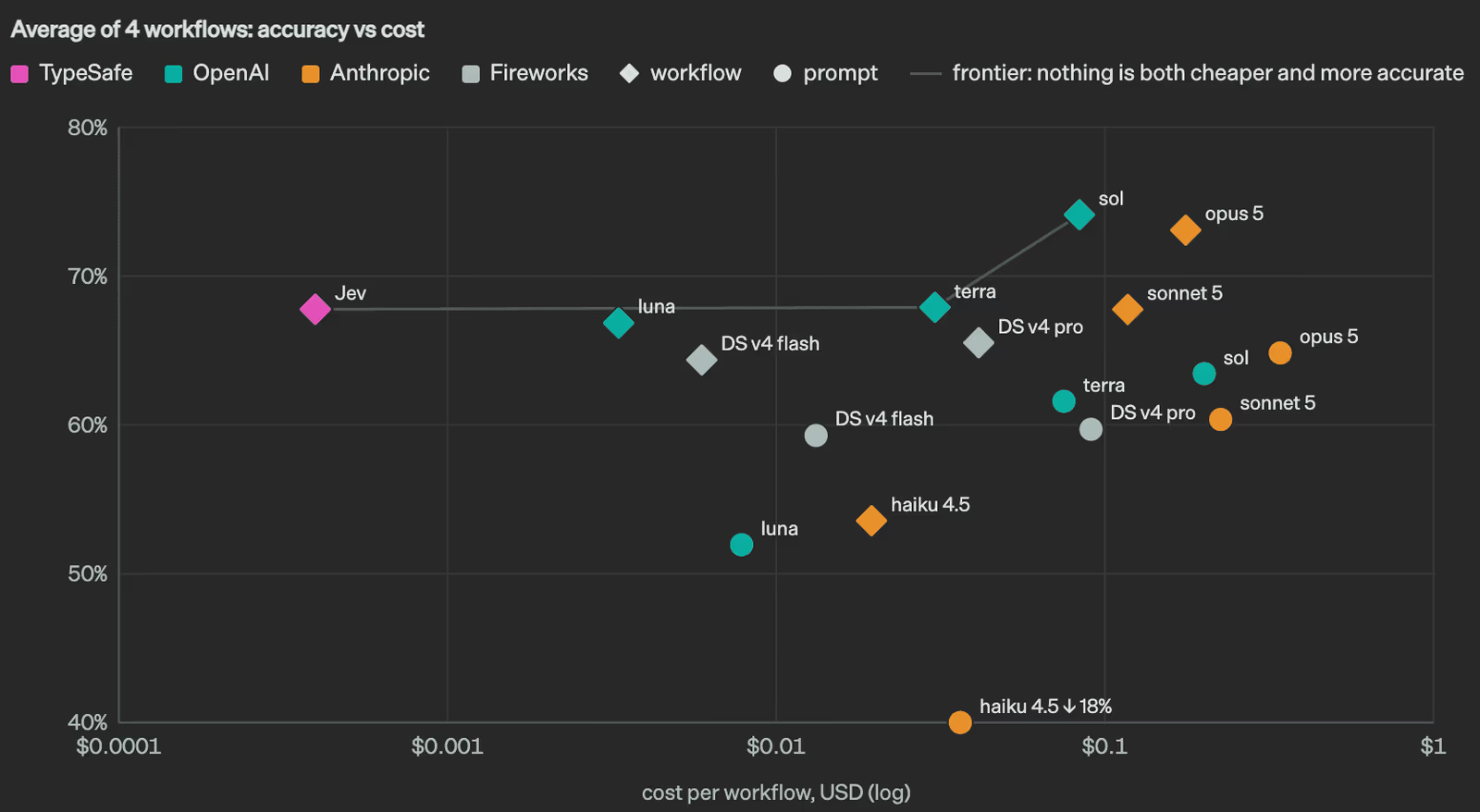
TypeSafe published four workflow evaluations at evals.typesafe.ai comparing Jev against frontier models from OpenAI, Anthropic, Google and others, in both single-prompt and decomposed-workflow configurations. The aggregate result is the chart below: accuracy against cost per workflow, on a logarithmic cost axis.
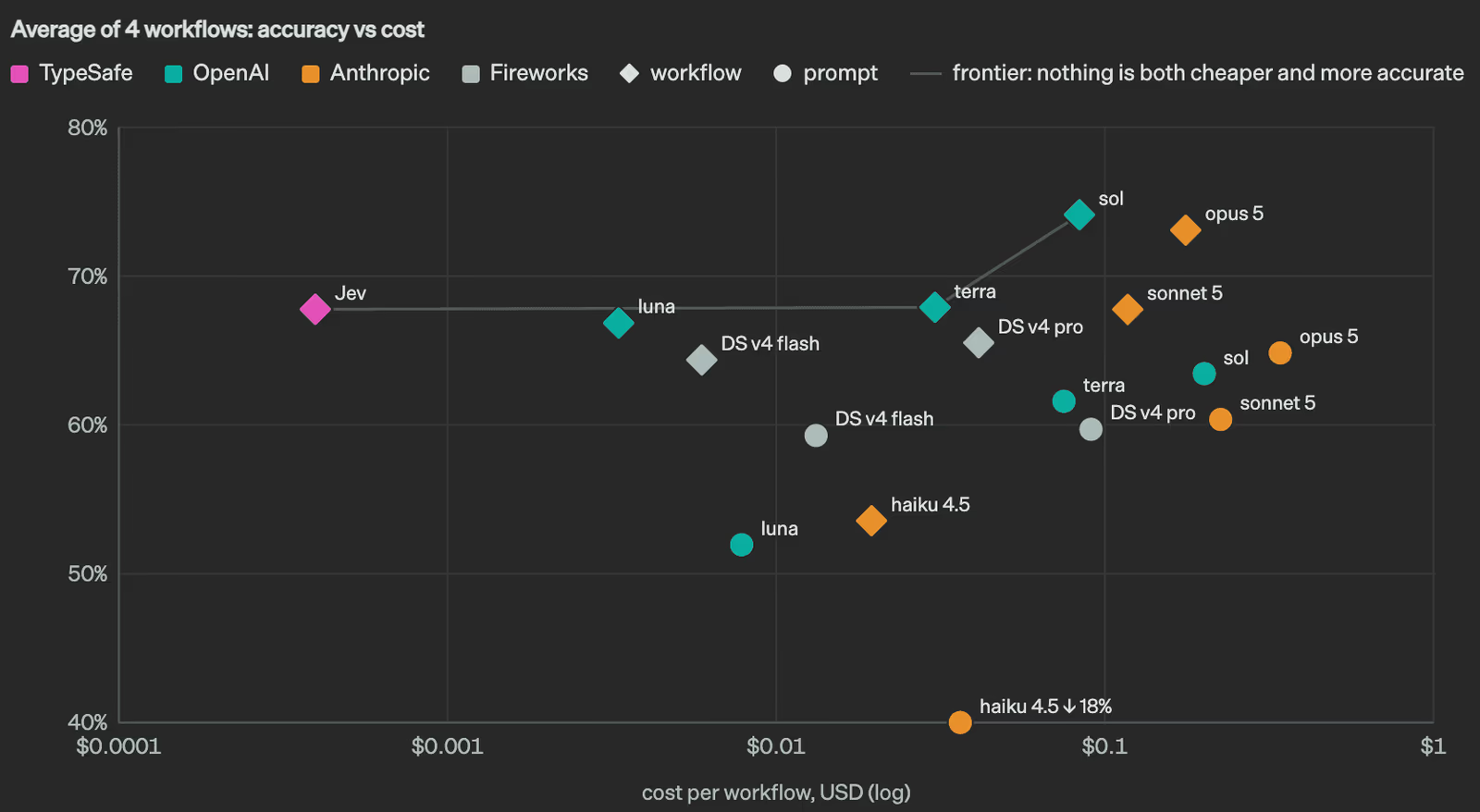
Read it carefully, because it is more honest than the headline figures suggest. Jev does not win on accuracy. It lands at roughly 68%, effectively tied with OpenAI's luna in workflow configuration, while the strongest points on the chart - sol in workflow mode at around 74%, and Anthropic's opus 5 at a similar level - are several points ahead. What Jev wins on is position: it sits at the far-left end of the cost axis, around two orders of magnitude cheaper per workflow than the models that beat it, which puts it on the efficient frontier where nothing is simultaneously cheaper and more accurate.
The chart also makes a second point that has nothing to do with Jev: for almost every model shown, the diamond (decomposed workflow) sits above the circle (single prompt). Breaking a task into small typed questions improves accuracy regardless of which model answers them. Haiku 4.5 is the extreme case, gaining 18 percentage points from decomposition alone.
On speed, TypeSafe reports 70-500ms end-to-end for Jev against 3-329 seconds for the LLMs it measured, summarising the comparison as 40x-200x faster at equivalent intelligence. Across the four workflow evaluations specifically, it reports 193.6x faster and 444.6x cheaper. The reference models named include GPT-5.6 Terra, GPT-6 Astra, Fable 5.1 and DeepSeek.
Two independent data points have since appeared. Vercel tested Jev and reported results arriving five to 18 times more quickly than OpenAI's Luna 5.6, with greater accuracy. Bryo AI found Gemini 10 to 20 times more expensive than Jev on comparable work. Neither is a controlled benchmark, but both come from outside the vendor and both land inside the claimed range rather than above it - which is the direction you would hope.
Reliability: The Zero That Matters
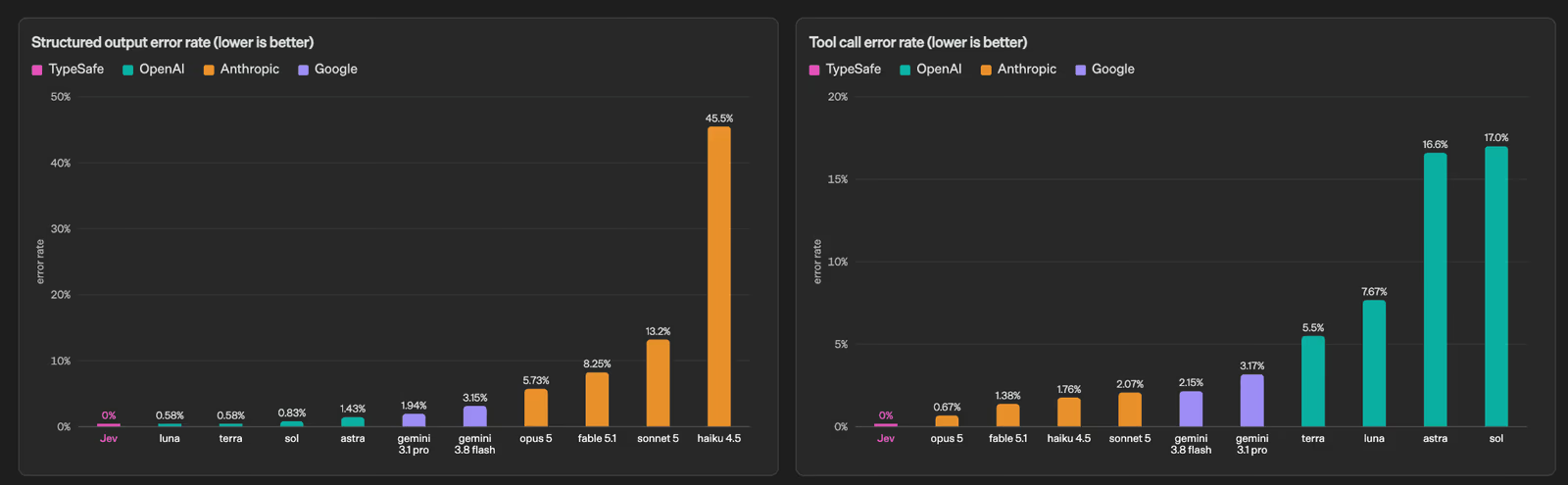
If the accuracy-versus-cost chart is the commercial argument, the error-rate chart is the engineering one - and it is the more striking of the two.
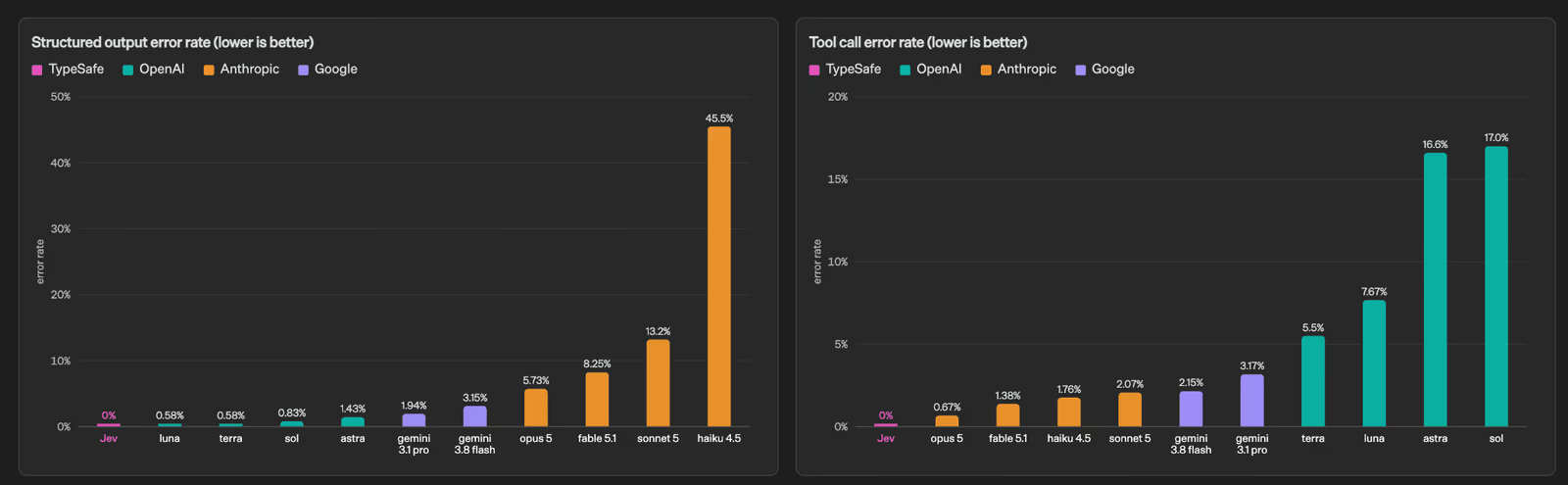
On structured output error rate, Jev records 0%. The comparison models range from 0.58% (luna and terra) and 0.83% (sol) through 1.43% for astra, 1.94% for gemini 3.1 pro and 3.15% for gemini 3.8 flash, up to 5.73% for opus 5, 8.25% for fable 5.1, 13.2% for sonnet 5 and a remarkable 45.5% for haiku 4.5.
On tool call error rate, Jev again records 0%. Here the ordering reshuffles entirely: opus 5 leads the LLMs at 0.67%, followed by fable 5.1 at 1.38%, haiku 4.5 at 1.76%, sonnet 5 at 2.07%, gemini 3.8 flash at 2.15% and gemini 3.1 pro at 3.17% - while terra (5.5%), luna (7.67%), astra (16.6%) and sol (17.0%) trail badly.
Three things are worth saying plainly about these zeroes. First, they are not an achievement of capability - they are a consequence of construction. A model that can only emit values from a declared schema cannot produce a schema violation any more than an integer variable can hold a sentence. Presenting this as a benchmark victory is a little like winning a spelling contest by only ever being asked to point.
Second, that does not make it unimportant. A 5.73% structured-output failure rate on opus 5 means roughly one call in seventeen needs a retry, a repair pass or a fallback path - and every one of those is latency, cost and a branch of code someone has to maintain. Removing that class of failure entirely removes a real and recurring tax on building AI software.
Third, note how badly the two charts agree with each other. A model near the top of one is often near the bottom of the other. That volatility is itself the finding: structured reliability in LLMs is not a stable property you can rely on across model versions, which is precisely the argument for taking it out of the model's hands.
Calibration and Epistemic Honesty
The claim TypeSafe leans on hardest, and the one that will take longest to verify independently, is calibration. Every Jev answer arrives with a confidence score, and the assertion is that those scores are epistemically honest - that when the model says 0.8, it is right about 80% of the time.
This is not what you get when you ask an LLM for a confidence score. A language model asked "how confident are you, from 0 to 1?" produces a token sequence that looks like a confidence score, sampled from a distribution shaped by how such sentences appear in training data. LLMs are documented as systematically overconfident in this mode and inconsistent across near-identical inputs. TypeSafe additionally claims Jev is more consistent than LLMs at returning similar answers for similar inputs - a property that matters enormously if you are setting numeric thresholds, because a threshold is only meaningful if the number underneath it is stable.
Calibration is what makes the security workflow above legitimate. The rule "act when probability exceeds 0.75" is either a principled risk decision or meaningless theatre, and which one it is depends entirely on whether 0.75 means anything. RLCD is TypeSafe's attempt to make it mean something by training directly against that target rather than hoping it emerges. Whether it succeeds at the claimed level is the single most important thing for independent evaluators to test, and as of this writing nobody outside TypeSafe has published calibration curves.
Real-World Use vs Vendor Demos
The demos that drove the launch were deliberately chosen to be things an LLM simply cannot do at speed. Jev plays Doom in real time - reading structured game state, not pixels, an important caveat TypeSafe discloses itself - and it runs a Wikiracing challenge against comparison models. Matthew Berman's coverage of it sorting 150,000 Skittles in five seconds captures the general flavour: high-volume, low-nuance decisions made in a tight loop.
Demand was sharp enough that TypeSafe briefly lost the ability to serve its API. That is a genuine signal of developer interest, though it is also a reminder that early-access capacity is not production capacity.
The honest translation for a working team is narrower than the demos imply. Jev is a drop-in replacement for the small model calls scattered through your pipeline - the ones currently handled by a cheap chat model with a JSON schema and a retry wrapper. It is not a replacement for the call that writes the customer email, plans the refactor or reasons through an ambiguous request. In most architectures it sits in front of the LLM, deciding what to escalate, and behind it, checking what came back.
Pricing and Access
Jev is priced at $0.042 per million input tokens - roughly £0.03 - with output tokens free. TypeSafe describes output as too cheap to meter, which follows from the architecture: there is no generated text to charge for, only typed values. TechCrunch noted the company meters input by the billion rather than the million, which tells you something about the volumes it expects.
For context, frontier LLM input pricing generally runs from about $0.20 to $10 per million tokens, with output typically charged at several times the input rate. Against the cheap end of that range Jev is roughly 5x cheaper on input alone; against the expensive end, and once free output is included, the gap becomes the two orders of magnitude visible on the cost axis of the accuracy chart.
Access is via an early-access programme, with developers being brought off a waitlist. The model is reached through TypeSafe's console and schema system rather than a conventional chat-completions endpoint - which is the correct design, but does mean adopting Jev is a small integration project rather than a base-URL swap.
The Sceptical Case
The most substantive technical criticism has come from engineer Sean Goedecke, and it deserves to be taken seriously rather than waved off.
His argument is that Jev may lack genuine technical differentiation. Constrained decoding and grammar-restricted generation already exist; what Jev adds, on his reading, is aggressive use of them - prefilling the expected response format and constraining generation to a single token, then batching the choices into one inference call. He reports achieving a 2x-3x speed-up himself using modest models and that approach. If the gap is inference strategy rather than architecture, a major lab could close much of it with engineering work rather than a new training run.
He also expects a hard ceiling. Because Jev has no test-time reasoning, he anticipates its performance caps out around that of non-reasoning models - which is fine for low-latency decisions but means System One is not a new scaling axis so much as a new efficiency point on an existing one. The accuracy chart is consistent with this: Jev is on the frontier, but it is on the cheap end of it, not the capable end.
A third open question is what Jev is built on. TechCrunch reports that the architecture has not been disclosed and that outside observers suspect it may be based on an open-weight LLM. That would not invalidate the product, but it would substantially change how novel "System One models" are as a category.
Against all of that, there is a reasonable counter. Even if the technique is reproducible, nobody had productised it, trained specifically for calibration, or priced it at $0.042 per million with free output. Sometimes the contribution is the packaging - and if the incumbents respond by shipping properly calibrated constrained-decoding endpoints of their own, developers get the benefit either way.
Limitations and Known Issues
To its credit, TypeSafe publishes a candid caveats section alongside its evaluations. Anyone quoting the headline figures should quote these too:
- The workflows were built by TypeSafe. The evaluated workflows were created by the company's own model capabilities team, which is an obvious source of favourable bias in how tasks were decomposed.
- Demo queries were simplified. TypeSafe notes the demonstration queries were simplified and used descriptive, human-readable keys - friendlier than most real program state.
- The reference average is skewed. The comparison baseline is weighted towards OpenAI and Anthropic models, which TypeSafe says likely understates Jev's advantage against DeepSeek - but equally means the average is not a neutral field.
- Wikiracing used non-reasoning modes. Comparison models were run without reasoning enabled, for watchability. That is a meaningful handicap on a task where reasoning helps.
- The figures are an upper bound. TypeSafe states the numbers represent the upper end of real-world gains and that production results will vary.
Beyond the vendor's own list: there is no test-time reasoning, the 255-option cardinality limit forces a two-stage design on large label spaces, the model accepts text rather than images (the Doom demo runs on state structures), no independent calibration analysis has been published, and early-access capacity has already proven fragile under load.
AI Revolution X covers the launch reaction and the case that System One is a genuinely new model category.
How It Compares
Jev is not really competing with frontier models, and framing it that way produces nonsense comparisons. It competes with three existing options.
Against a cheap LLM with a JSON schema
This is the incumbent in most codebases: a small, fast chat model with structured-output mode and a retry loop. Jev is dramatically faster, dramatically cheaper and removes the retry path entirely. On accuracy the picture is mixed - the workflow chart puts Jev level with luna and ahead of haiku 4.5 and DeepSeek V4 flash, but behind sol and opus 5. For this slot, Jev is a straightforward upgrade.
Against a fine-tuned classifier
A purpose-trained BERT-class classifier is also fast and cheap, and can be more accurate on a narrow task. What it is not is flexible: it needs labelled data, a training run and a redeploy for every schema change. Jev gives you the classifier's latency profile with the LLM's zero-shot flexibility, and calibrated probabilities on top. For teams maintaining a fleet of small models, this is the more interesting comparison.
Against a frontier reasoning model
Not a contest, in either direction. Jev cannot write, plan, reason through novelty or hold a conversation. Frontier models cannot answer in 70ms or run at $0.042 per million with free output. The two belong in the same pipeline, doing different jobs - which is why the most likely 2027 outcome is not that one wins, but that "cheap calibrated decision endpoint" becomes a standard tier every lab offers.
Who Should Use It
Join the waitlist now if you run high-volume classification, routing or extraction in production; if your agent pipeline fans one request out into dozens of small model calls; if you need sub-100ms decisions inside a real-time loop (games, robotics, simulation, trading, live moderation); or if you are spending real engineering effort on retry and repair logic around structured outputs.
Watch and wait if your AI calls are dominated by generation, your volumes are low enough that inference cost is not a line item worth optimising, or you need reasoning over genuinely novel problems. Also wait if you cannot yet measure your own accuracy - adopting a model chosen for calibration without an evaluation harness to verify the calibration is a bet, not a decision.
Whichever camp you are in, there is a free lesson in the launch: the decomposition gain in TypeSafe's chart applies to whatever model you already run. Breaking one large prompt into several small typed questions improved accuracy for almost every model tested. You can bank that today, with no waitlist.
The Bottom Line
Jev is the most interesting AI release of September 2026, and the reason is conceptual rather than numerical. For three years the industry has had one hammer, and it has been quietly obvious that a great many production AI calls are not nails. TypeSafe has built the other tool, priced it aggressively, and made a credible argument that calibrated probability - not fluent text - is what software actually wants from a model.
The scepticism is warranted and should not be dismissed. The zeroes are architectural rather than earned, the benchmarks are the vendor's own, and there is a serious argument that much of the speed advantage is an inference strategy the incumbents could adopt. Jev is also, by design, not very clever - it sits on the cheap end of the efficient frontier, not the capable end.
But the framing survives the scepticism. Whether or not TypeSafe owns this category in two years, "System One" names something real, and the most likely consequence of this launch is that every major lab ships a fast, calibrated, typed-decision endpoint. That would be a good outcome for anyone building software on top of models - and it started with a model that refuses to talk.
Last updated: September 2026. Figures are drawn from TypeSafe AI's published launch materials and evaluation charts, TechCrunch's launch reporting and independent developer analysis; all benchmark numbers quoted are TypeSafe's own unless stated otherwise, and no independent calibration study has yet been published.
Get the free guide: Claude vs ChatGPT, Gemini & Grok
A 20-page playbook covering everything you need to choose and use the big four AI models in 2026, full cost and feature comparisons, what each is best (and worst) at, and how-tos for images, vectors, building a website, Claude Code and more.