 AI Tools Review Editorial Team
Quick Answer:
Gemini 4 Hydrogen, released on 12/11/2026, is Google's new everyday model and the replacement for Gemini 3.8 Flash. It scores 51 on the Artificial Analysis Intelligence Index at its default setting (one point above Gemini 4 Argon) and 54 at a new xhigh level, more than triples 3.8 Flash on Terminal-Bench 4.1 (57% vs 18.2%) and costs $1.50 / $7.50 per million input / output tokens (about £1.18 / £5.93). It is free to try in the Gemini app, Search and AI Studio. It is a big quality jump, but it is not a budget model: per token it costs roughly 15 times more than Claude Haiku 5.5, GPT-6 Luna or Muse Ember.
For three years Google's "Flash" models were the cheap, quick option you reached for when the big model was overkill. Gemini 4 Hydrogen breaks that pattern. It is fast, but Google is pitching it as a genuinely capable agent in its own right, prices it like a mid-tier model, and claims it now edges past its own frontier Argon on the most-cited independent intelligence index. Three Gemini 4 models have now shipped in a little over six weeks. This is what the fastest of them actually does, what the numbers say once you read the footnotes, and whether it belongs in your stack.
WorldofAI's news round-up covers the Gemini 4 Hydrogen launch alongside the week's other big AI stories.
Executive Summary
- What it is: the fast, lower-cost member of the Gemini 4 family, sitting below Gemini 4 Argon and Gemini 4 Carbon. Google says it is "built for rapid execution across diverse agentic workflows".
- Headline score: 51 on the Artificial Analysis Intelligence Index v5.0.1 at the default high thinking level (Argon: 50), and 54 at the new xhigh level.
- Versus 3.8 Flash: 2.5 times faster to finish tasks at the default setting, Terminal-Bench 4.1 up from 18.2% to 57%, and fabricated claims cut by more than five times, according to Google.
- Price: $1.50 input / $7.50 output per million tokens, flat across a 1 million-token context window. Cached input $0.075. Batch and Flex at half price.
- Access: Gemini API and Google AI Studio (all tiers), Gemini for business, Android Studio, the Gemini app (free users via auto-selection), Google Search for all users, and Google Antigravity for paid AI Pro and Ultra subscribers.
- New tooling: Orchestrator in Antigravity switches between Carbon and Hydrogen within one session; Google says it reached near-Carbon success on Terminal-Bench 4.0 while using 24% less quota and finishing 19% faster.
- Safety: Google reports up to 81% less overreach in agentic tasks, a 12-fold cut in misaligned actions and task shortcutting, a 96.7% honesty rate on its internal agent honesty evaluation and 2.3 times better resilience to indirect prompt injection.
Where Hydrogen Fits in Gemini 4
Google's Gemini 4 roll-out has been unusually fast. Argon, the first model, was announced on 30/09/2026 and reached paying developers on 13/10/2026 after a fortnight with cyber defenders in Google's Fairwind Program. Carbon, the flagship, followed on 28/10/2026 and moved to general paid availability on 10/11/2026, a story we covered in Gemini 4 Carbon Now Available. Hydrogen arrived two days after that, on 12/11/2026, announced by Koray Kavukcuoglu, SVP of Google DeepMind and Google's Chief AI Architect.
The naming matters. Google has dropped "Flash" for this tier, and Hydrogen directly replaces Gemini 3.8 Flash, which only shipped in September. Unlike Argon and Carbon, Hydrogen skipped the Fairwind cyber-defender stage altogether and went straight to everyone, including free users. That tells you how Google sees the risk profile: a fast execution model rather than a frontier one.
Google's framing is a division of labour. In its words, "while our frontier models, Gemini 4 Carbon and Gemini 4 Argon, excel at deep, long-horizon reasoning on your hardest problems, Hydrogen is built for rapid execution". The pitch is that real software teams need both: an expensive model for architectural judgement and untangling subtle bugs, and a fast, disciplined one for writing code, running tests and verifying changes. Hydrogen is the second of those, and Google says it can also stand on its own for everyday work.

Four Thinking Levels and What They Cost
Hydrogen exposes four reasoning settings: low, medium, high (the default) and a new xhigh tier. Google says they "scale in a smooth, predictable progression so you only wait and pay for the reasoning depth a task requires". Two practical changes for developers migrating from 3.8 Flash, according to VentureBeat's reading of the documentation: the default moves up from medium to high, and the older thinking_budget parameter and the MINIMAL setting are rejected. If your code sets either, it will need updating.
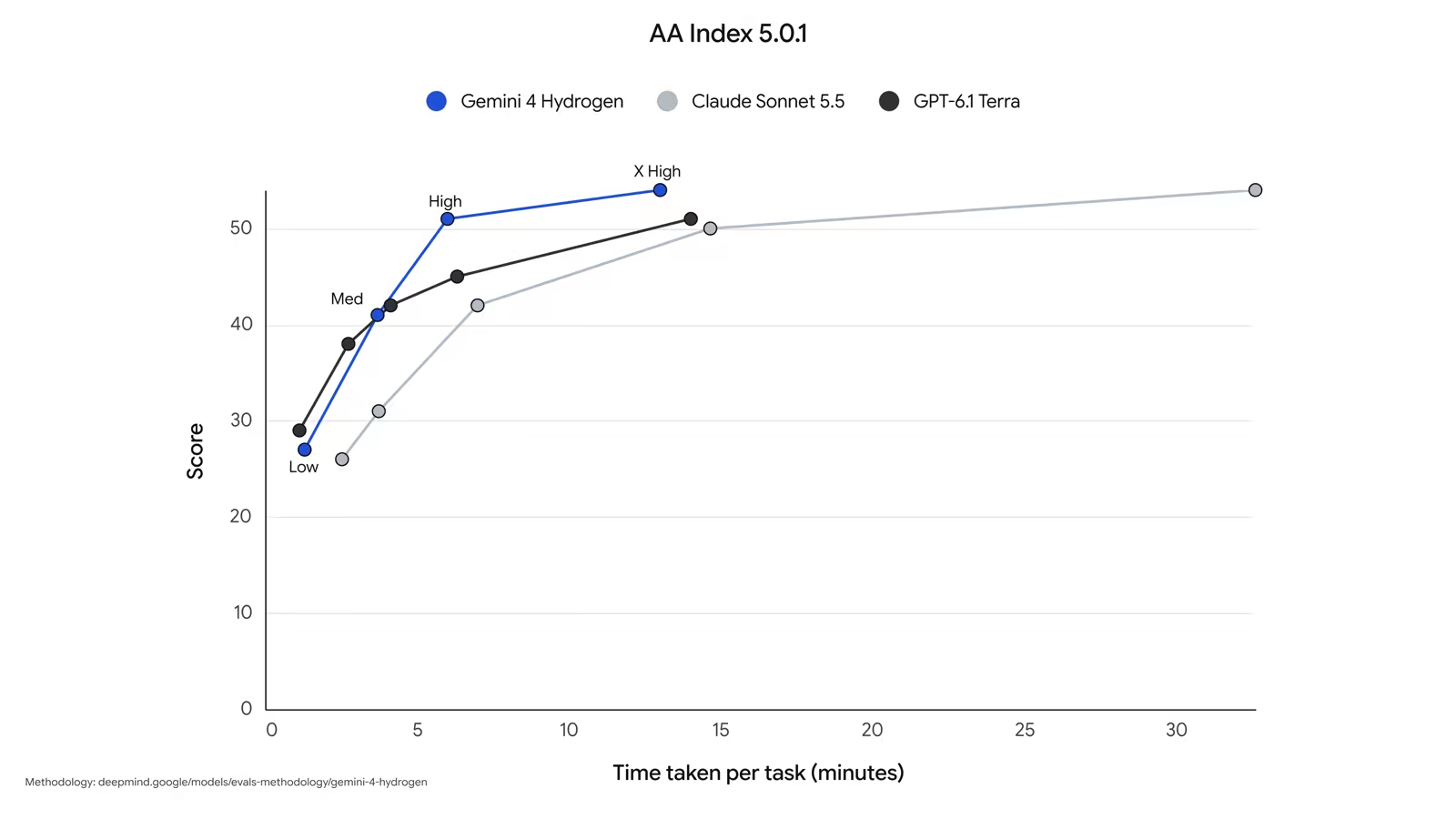
Artificial Analysis published scores and estimated cost per benchmark task for each level, which makes the trade-off concrete:
| Thinking level | AA Intelligence Index | Est. cost per task |
|---|---|---|
| Low | 27 | $0.29 |
| Medium | 41 | $0.80 |
| High (default) | 51 | $1.87 |
| xhigh | 54 | $3.16 |
| Gemini 3.8 Flash (high), for reference | 31 | $7.77 |
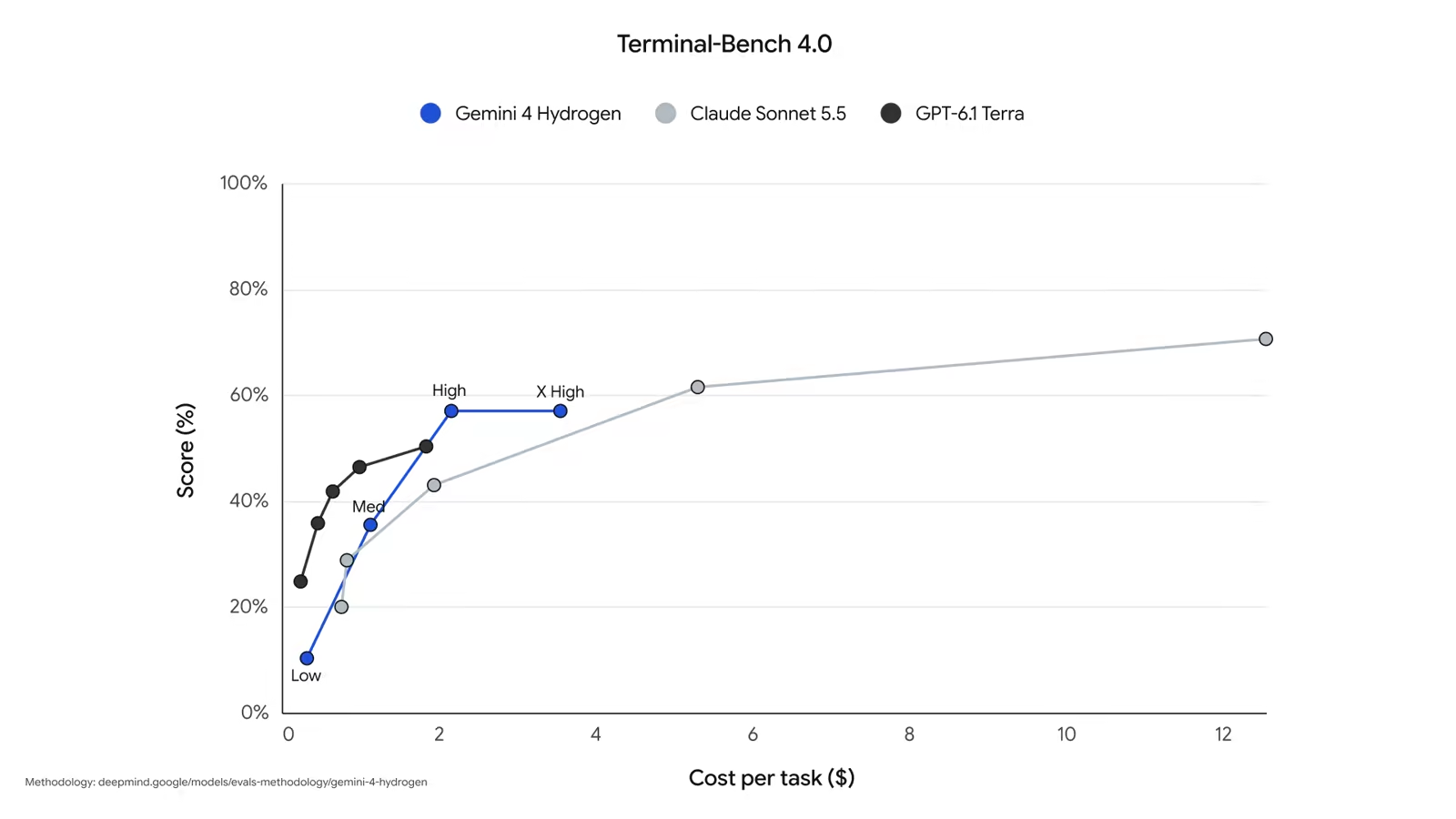
Two things stand out. First, Hydrogen at high is both far smarter and far cheaper per task than 3.8 Flash at high, despite costing more per token, because it reaches answers with fewer tokens. Second, xhigh is not always worth it. On Terminal-Bench 4.0, Artificial Analysis measured 54% at both high and xhigh, so the extra $1.29 per task bought nothing on that test. Use xhigh for hard reasoning and knowledge tasks, not by default for coding agents.
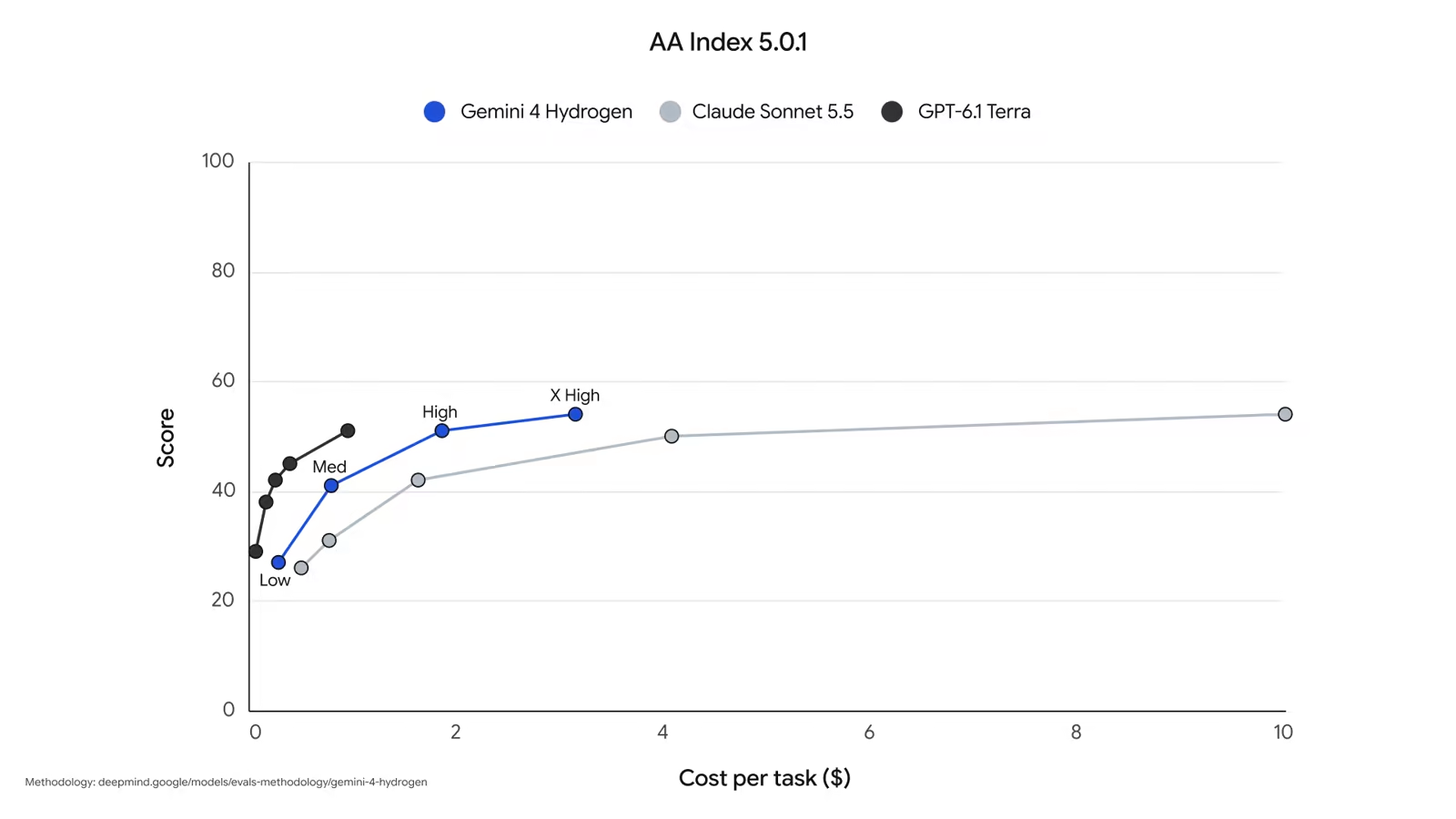
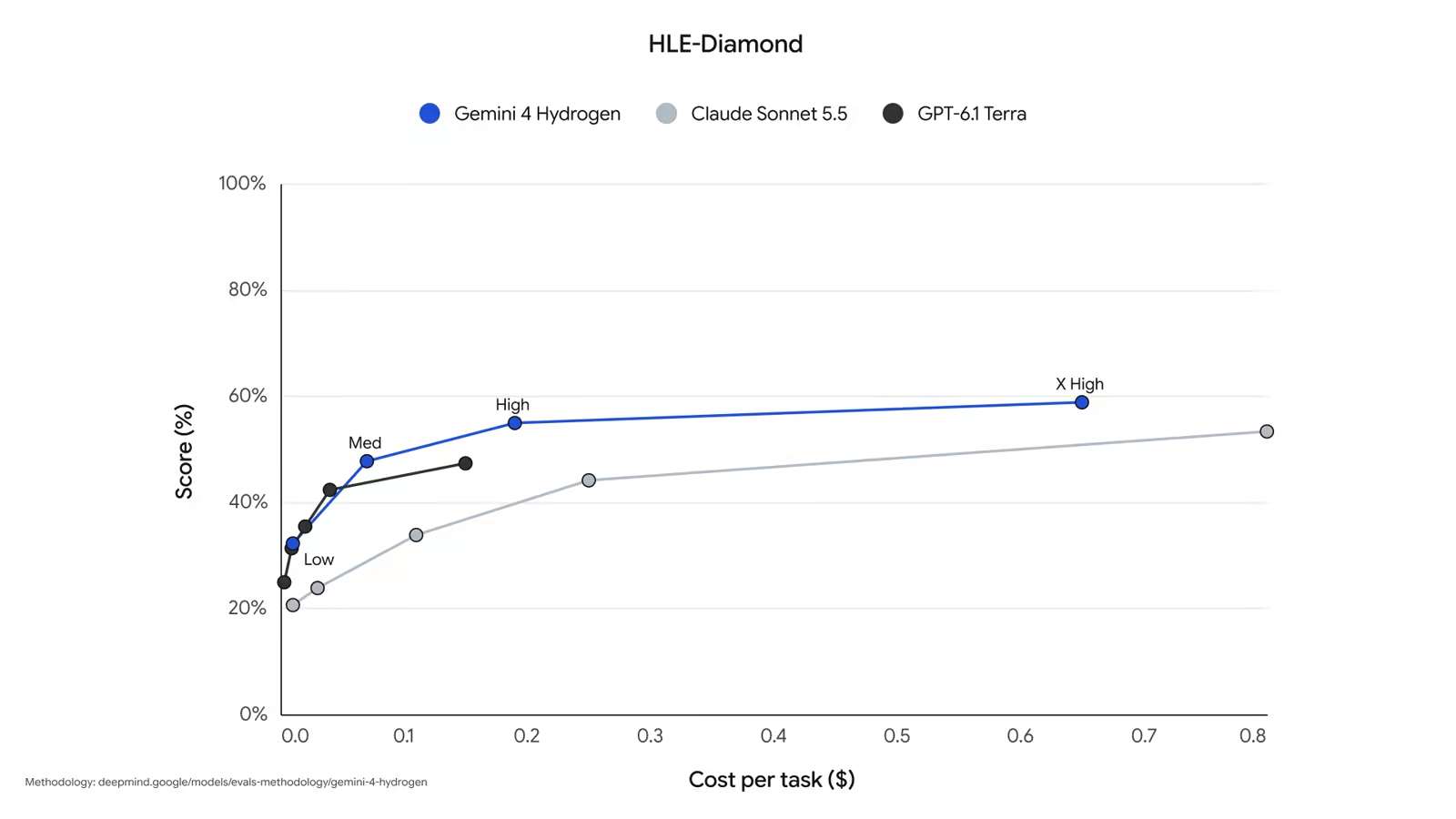
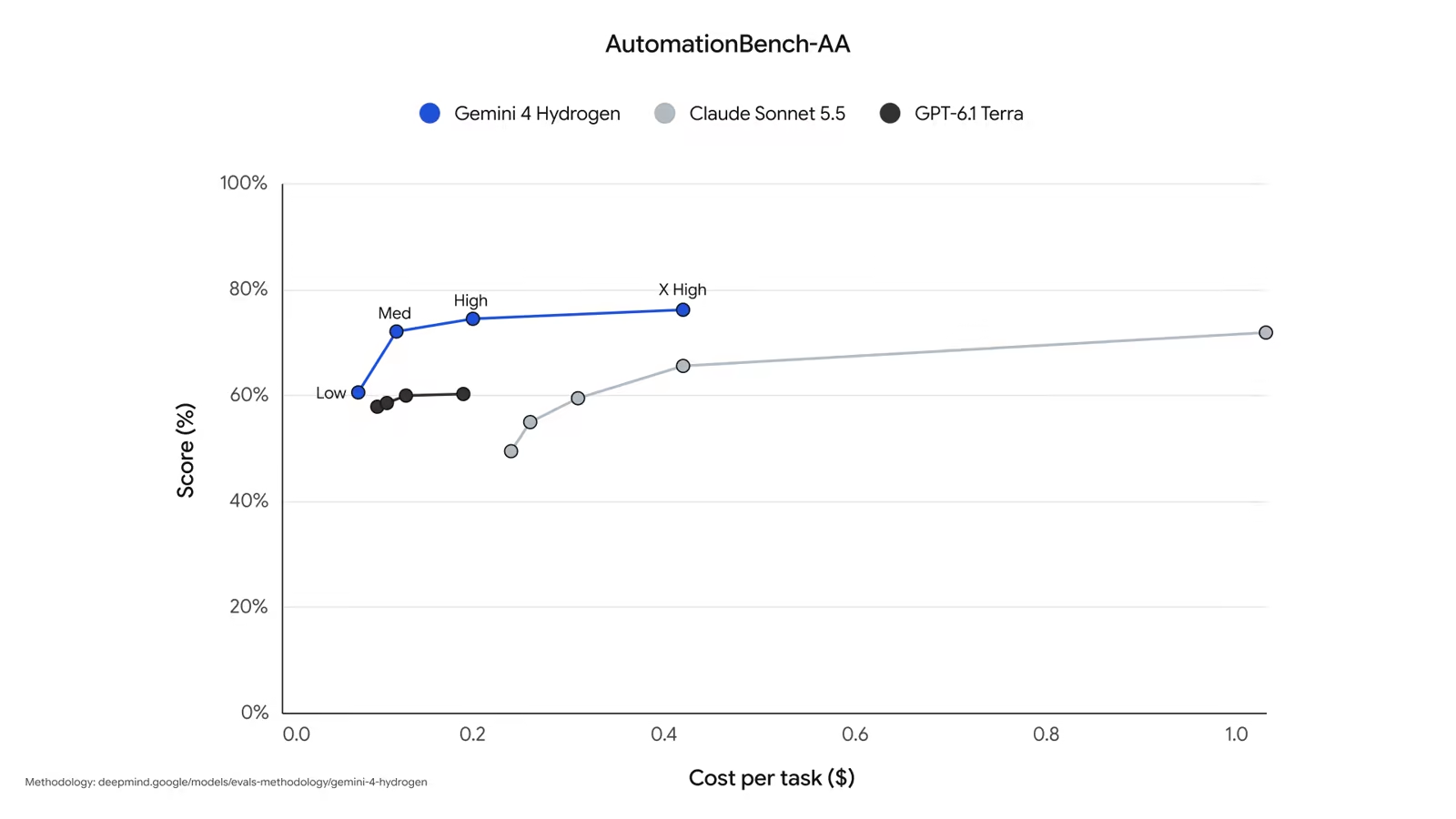
Note what that chart shows and what it does not. Hydrogen sits above and to the left of Claude Sonnet 5.5 at every level, meaning a higher score for less money. But GPT-6.1 Terra is further left still: its top point scores close to Hydrogen at high for roughly half the cost per task. Google chose these two comparators; it is a fair chart, but not one where Hydrogen dominates outright.
Benchmarks: Google's Table, Read Carefully
Google published a ten-row comparison against Claude Sonnet 5.5 and GPT-6.1 Terra. Those are mid-tier models from Anthropic and OpenAI, not their small ones, which is itself a statement about where Google thinks Hydrogen competes.
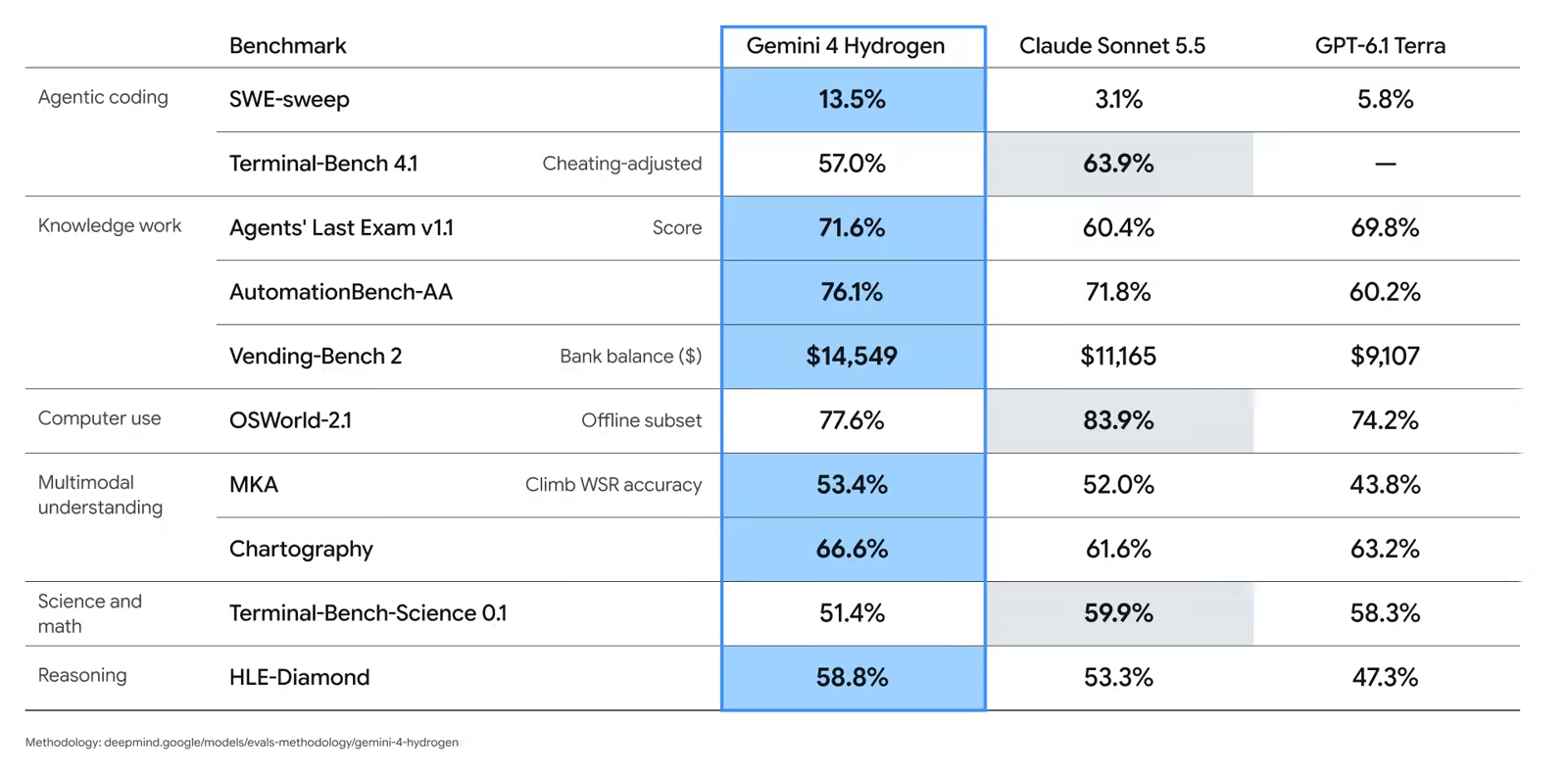
| Benchmark | Hydrogen | Sonnet 5.5 | GPT-6.1 Terra |
|---|---|---|---|
| SWE-sweep (agentic coding) | 13.5% | 3.1% | 5.8% |
| Terminal-Bench 4.1 (cheating-adjusted) | 57.0% | 63.9% | n/a |
| Agents' Last Exam v1.1 | 71.6% | 60.4% | 69.8% |
| AutomationBench-AA | 76.1% | 71.8% | 60.2% |
| Vending-Bench 2 (bank balance) | $14,549 | $11,165 | $9,107 |
| OSWorld-2.1 (offline subset) | 77.6% | 83.9% | 74.2% |
| MKA (Climb WSR accuracy) | 53.4% | 52.0% | 43.8% |
| Chartography | 66.6% | 61.6% | 63.2% |
| Terminal-Bench-Science 0.1 | 51.4% | 59.9% | 58.3% |
| HLE-Diamond | 58.8% | 53.3% | 47.3% |
Hydrogen leads on seven of ten rows. The three it loses are informative. Claude Sonnet 5.5 is ahead on Terminal-Bench 4.1 (63.9% vs 57.0%), on OSWorld-2.1 computer use (83.9% vs 77.6%) and on Terminal-Bench-Science (59.9% vs 51.4%), where Terra also beats Hydrogen. In other words, for long command-line agent sessions and for driving a desktop, Anthropic's mid-tier model still has the edge. Hydrogen's wins cluster in knowledge work, multimodal document understanding and reasoning.
A few caveats apply to the whole table:
- SWE-sweep is new and low-scoring. All three models score in single or low double digits, so the gap between 13.5% and 3.1% is real but small in absolute terms. Google describes it as a test of discovering and repairing bugs without breaking existing code.
- MKA was co-built by Google. The Multimodal Knowledge Agent benchmark was introduced with Artificial Analysis at the Carbon launch. Hydrogen's 1.4-point lead over Sonnet is within the range where run-to-run variance matters.
- Vending-Bench 2 is a simulation. It measures how much money an agent makes running a simulated vending business over a long horizon. Useful for long-term coherence, less so for predicting coding quality.
- Vendor-run. All figures are Google's, with methodology published at deepmind.google/models/evals-methodology/gemini-4-hydrogen.
Independent Numbers From Artificial Analysis
The most useful independent read so far comes from Artificial Analysis, which compared Hydrogen with the small models it is often lumped in with. At maximum reasoning, Claude Haiku 5.5 scored 36 on the Intelligence Index, Meta's Muse Ember 36 and GPT-6 Luna 28. Hydrogen at medium (41) beats all three; at high (51) it is in a different class. Kimi K3.1 Pro, a much larger open-weight model, scored 46.
On Artificial Analysis's own Terminal-Bench 4.0 runs, Hydrogen scored 54% against 40.9% for Muse Ember, 32.8% for Haiku 5.5 and 12.6% for GPT-6 Luna. Those are big gaps for agentic coding.
The cost picture cuts the other way. Artificial Analysis's estimated cost per benchmark task at maximum settings was $0.41 for Haiku 5.5, $0.15 for Luna and $0.14 for Ember, against $1.87 for Hydrogen at high. So the honest summary is: Hydrogen is much smarter than the small models and much more expensive than them. It is a different product, not a cheaper version of the same one. If you came here looking for the cheapest competent agent model, read our pieces on Muse Ember, Claude Haiku 5.5 and DeepSeek V4.1 Flash 1017 as well.
Capabilities Deep Dive
Repository coding and debugging
Google says Hydrogen makes "focused, surgical edits" rather than rewriting unrelated files, which is the complaint developers most often have about fast models. A notable behaviour is parallel exploration: the model natively batches file-read and search calls instead of opening files one at a time. In early partner testing across graph, SQL and data-heavy enterprise workflows, Google reports Hydrogen ran 2 to 2.8 times faster than 3.8 Flash while using 12% to 23% fewer tokens. Those are partner anecdotes summarised by Google, not a public benchmark, but they match the direction of the Artificial Analysis cost data.
Open-ended agentic work
On multi-step research, data analysis and codebase navigation, Google cites a #5 ranking on arena.ai's live Agent Arena, #1 on Vals Tax Agent Bench (52.3%), a tie for #1 on Vals Legal Research Bench (55.8%) and a class lead on AutomationBench-AA. Google also says Hydrogen "adapts cleanly when a tool call fails or a search returns empty", which is the unglamorous behaviour that decides whether an agent finishes a job or loops.
Multimodal knowledge work
Hydrogen takes text, images, audio and video, with a 1 million-token context window and, in Google's words, "up to 1 million output tokens" via APIs that continue generation beyond a single 65,536-token segment. On Google Cloud it can ingest Office and OpenDocument files directly. Its 71.6% on Agents' Last Exam v1.1 and 53.4% on MKA are the numbers behind Google's claim that it can turn dense PDFs, spreadsheets and recorded video into cited reports.
Web development and front-end design
Google's showcase demos lean heavily on front-end work. Paired with a new Gemini front-end design skill in Antigravity, Hydrogen built an e-commerce storefront in one shot with a WebGL2 topographic shader, four-stage scrollytelling and a live configurator. Other demos include a shared voxel island game, a Google Sheets "pixel canvas" animated with native formulas, and a Google Slides deck generated from a keynote video with an automatic audit-and-fix loop for overlapping text.
Sheets and Workspace
In Gemini in Google Sheets, Google says Hydrogen generates financial models that adjust to forecasting scenarios more than 30% faster than previous models in Sheets canvas. This is the same territory Anthropic is pushing into with its spreadsheet and whiteboard features, covered in Claude Sheets, Whiteboards, Data and Meetings.
Orchestrator: Carbon Plans, Hydrogen Executes
The most interesting product change is not the model itself but Orchestrator in Google Antigravity. Instead of running one model from start to finish, Orchestrator switches dynamically between Carbon and Hydrogen within a single session. On Terminal-Bench 4.0, Google says it reached "near-Carbon task success rates while, on average, consuming 24% less quota and completing 19% faster".
For parallel work, Google describes a pattern where Carbon acts as coordinator and Hydrogen powers worker and verifier agents building and testing changes across isolated workspaces. That is essentially the architecture of /swarm, which launched with Carbon's general availability two days earlier, now with a cheaper engine underneath. It mirrors a pattern that is spreading across the industry: Anthropic's Claude Code subagents, OpenAI's planner-worker set-ups and Meta's pairing of Muse Wonder with Muse Ember all split planning from execution.
Why it matters: model routing is quietly becoming more important than raw model choice. Notice that Google is also using its new Gemini Decision 1 model as a real-time router in Gemini Notebook. The direction of travel is clear: expensive reasoning only where it is needed, fast execution everywhere else.
Safety, Alignment and Honesty Data
Because Hydrogen is going to the broadest audience of any Gemini 4 model, its safety profile matters more than its frontier siblings'. Google published the following, with details in the Gemini 4 Hydrogen model card. All are Google's internal evaluations, compared against 3.8 Flash:
- Overreach and under-service: up to 81% less overreach in agentic tasks (doing more than asked) and up to 79% less under-service (doing less than asked).
- Misaligned actions: a 12-fold reduction in misaligned actions and task shortcutting across tool-use and coding evaluations.
- Permission boundaries: up to two times less likely to bypass permission boundaries when faced with impossible or blocked tasks.
- Honesty: 96.7% on Google's internal agent honesty evaluation, and fabricated claims cut by more than five times versus 3.8 Flash.
- Reasoning transparency: 99.9% chain-of-thought legibility with zero deceptive reasoning edits across more than 200,000 audited turns.
- Prompt injection: more than 2.3 times more resilient on the Gray Swan indirect prompt injection benchmark.
- Over-refusal: false refusals on HealthBench Pro kept under 0.4%, which Google attributes to more precise biosecurity safeguards.
Two observations. First, the baseline is 3.8 Flash, not a competitor, so these are improvement figures rather than league-table positions. Second, "up to" figures describe the best case across a set of tests. The 12-fold cut in shortcutting is the one most relevant to coding agents: a model that quietly deletes a failing test to make the suite pass is worse than useless, and our report on long-horizon agent safety incidents shows why labs now measure this explicitly.
Unlike Argon and Carbon, Hydrogen was not held back for a cyber-defender preview. Google has not suggested Hydrogen reaches its critical capability levels for cyber or other risk domains, and the launch post does not mention any. If you need the strongest Google security model, that remains the Fairwind-only Carbon for cyber.
Hydrogen in the Gemini App and Search
For most people, Hydrogen will arrive invisibly. In the Gemini app, free users get it through automatic model selection when Gemini decides it suits the prompt; paid users can pick it from the model drop-down. Google says it follows tone, format and specific rules more closely, calls the right tools and skills more often, and pulls context from Gmail, Drive and connected apps such as Airtable and Dropbox.
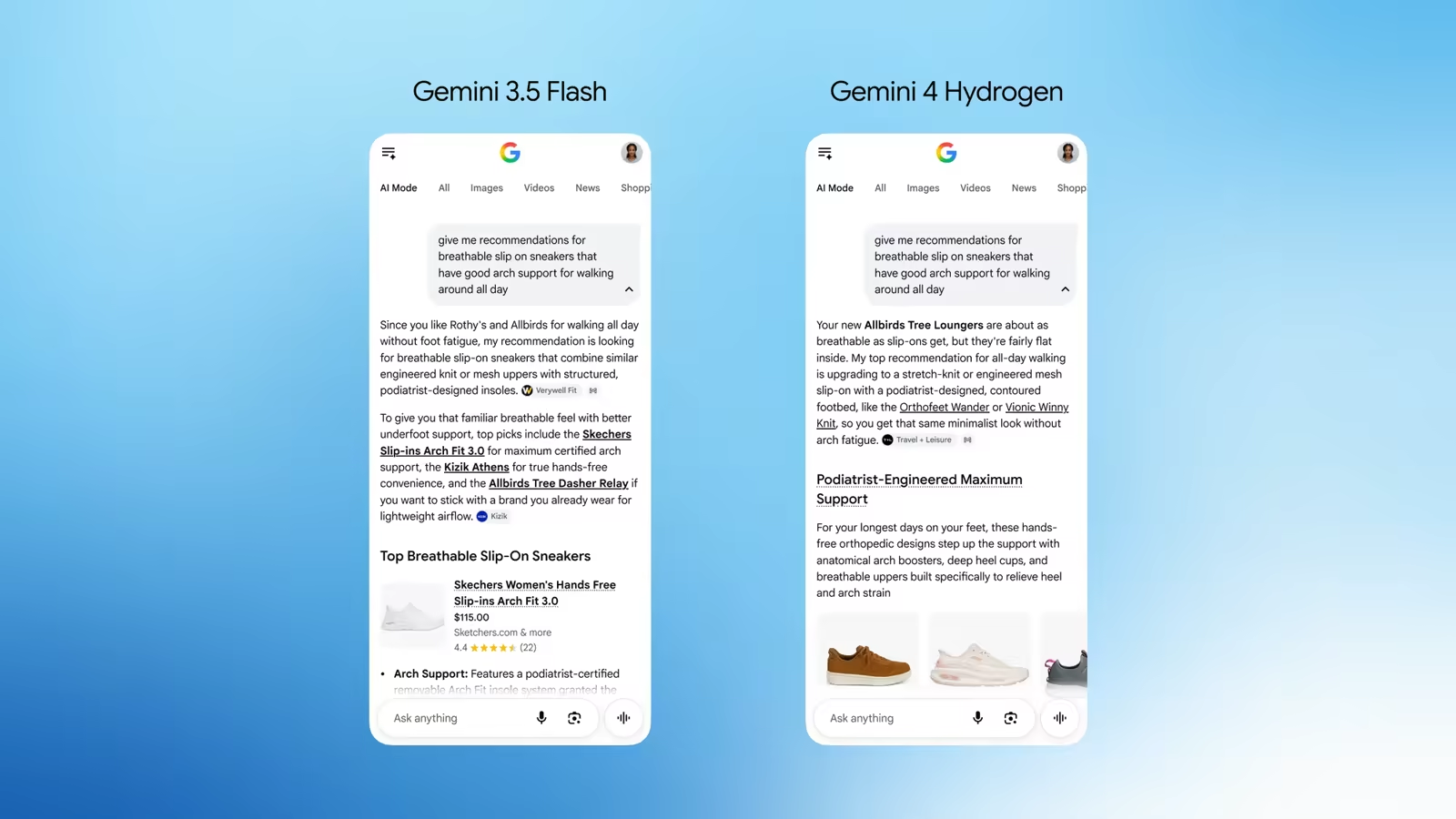
In Google Search, Hydrogen is now the model behind AI responses for all users globally. Google highlights three changes: better handling of messy, multi-part queries with typos; more visual, scannable answers; and an upgraded "query fan-out" technique that, Google says, connects users "to a broader range of helpful links than before". For publishers and anyone doing generative engine optimisation (GEO), that last point is worth watching: a wider fan-out could mean more, smaller sources being cited in AI answers.
Pricing: Not the Cheap Flash Any More
| Model (per 1M tokens) | Input | Output |
|---|---|---|
| Gemini 4 Hydrogen | $1.50 (~£1.18) | $7.50 (~£5.93) |
| Gemini 3.8 Flash (intro, to 31/12/2026) | $0.75 | $3.75 |
| Gemini 3.8 Flash (standard, from 01/01/2027) | $1.50 | $7.50 |
| Gemini 4 Argon / Carbon (intro, to 30/11/2026) | $2 | $10 |
| Gemini 4 Argon / Carbon (standard) | $4 | $20 |
| Claude Sonnet 5.5 | $2 | $10 |
| Claude Haiku 5.5 / GPT-6 Luna / Muse Ember (lowest rate) | $0.10 | $0.50 |
Hydrogen's pricing is flat across the whole 1 million-token window, with no long-context surcharge, which is genuinely useful for document-heavy work. Cached input costs $0.075 per million, and Google Cloud's automatic caching now kicks in from 4,096 tokens rather than 6,144. Explicit caching is not available at launch. Batch (24-hour turnaround), Flex (1 to 15 minutes, limited availability) and an invite-only Contributor tier (which lets Google use your data for training) are each half the standard rate. Output pricing includes reasoning tokens, so the thinking level you pick directly drives your bill.
The uncomfortable fact for budget-conscious teams: until 31/12/2026 Hydrogen costs twice as much per token as 3.8 Flash on its introductory rate. Per task, though, Artificial Analysis's data suggests Hydrogen at high is cheaper than 3.8 Flash at high ($1.87 vs $7.77), because it wastes fewer tokens. Measure on your own workload before assuming either way.
Real-World Results vs Benchmarks
The early customer evidence is encouraging but thin. Box reported accuracy on its Complex Work Eval rising from 74% with 3.8 Flash to 79% with Hydrogen; Box CEO Aaron Levie said Hydrogen took less than half as long and used about 12% fewer tokens on a typical task. Andrew Carr, chief scientist at Cartwheel, told SiliconANGLE the model caught two problems with an approach his team had been stuck on for ten days. Discovery Loop, co-founded by former Google Chief Scientist Jeff Dean, was among the early testers.
Creators testing it on launch day focused on speed and front-end output. As always, launch-week impressions skew positive. The things to test yourself are the ones the benchmark table flags as weaker: long terminal sessions, desktop computer use and scientific command-line work, where Claude Sonnet 5.5 led.
Limitations and Open Questions
- Price creep. Google's cheap tier is no longer cheap. Teams that relied on Flash for high-volume classification or extraction should look at Gemini Decision 1 or a smaller model instead.
- Not the best agentic coder in its price band on every test. Sonnet 5.5 leads on Terminal-Bench 4.1 and OSWorld-2.1.
- xhigh is uneven. It lifts the Intelligence Index from 51 to 54 but added nothing on Terminal-Bench 4.0 in Artificial Analysis's runs.
- Breaking API changes.
thinking_budgetandMINIMALare rejected; explicit caching is missing at launch. - Vendor-reported safety. The safety figures are Google's own, against its own previous model. Independent red-team results have not yet been published.
- Is "beats Argon" meaningful? One point on a composite index is within noise, and Google itself still recommends Argon and Carbon for the hardest reasoning. Read it as "comparable", not "better".
How Hydrogen Compares
Versus Gemini 4 Argon: similar headline intelligence, a quarter cheaper on input until 30/11/2026 and nearly two and a half times cheaper per token after Argon's standard rate kicks in. Argon still suits the deepest reasoning. For most everyday API work, Hydrogen is now the sensible Google default.
Versus Claude Sonnet 5.5: Hydrogen is cheaper per token ($1.50 / $7.50 vs $2 / $10) and wins on knowledge work, multimodal and reasoning in Google's table. Sonnet wins on terminal and computer-use agents. For coding agents specifically, our Sonnet 5.5 vs GPT-6.1 Sol comparison is a useful companion read.
Versus GPT-6.1 Terra: Terra is notably cheaper per task on Google's own charts and stronger on Terminal-Bench-Science; Hydrogen wins most other rows.
Versus Haiku 5.5, GPT-6 Luna and Muse Ember: Hydrogen is far more capable and far more expensive. These are different tools. Use the small models for volume, Hydrogen for work that needs judgement.
Who Should Use It
- Teams on Gemini 3.8 Flash doing agentic or reasoning-heavy work: migrate and measure. The quality jump is large and per-task cost may well fall.
- Antigravity users: try Orchestrator; letting Carbon plan and Hydrogen execute is the clearest cost saving on offer.
- Document and multimodal pipelines: the flat-priced 1 million-token window and strong MKA and Chartography scores make it a good fit.
- High-volume classification or routing: probably not. A decision model or a $0.10-per-million small model will be cheaper by an order of magnitude.
- Everyone else: you are already using it in Search and, quite possibly, in the Gemini app.
The Bottom Line
Gemini 4 Hydrogen is the most consequential Gemini 4 release for ordinary users, simply because it is the one most people will touch. As a model it is a genuine step change over 3.8 Flash, competitive with Claude Sonnet 5.5 at a lower token price, and paired with Orchestrator it makes the "big model plans, fast model executes" pattern a default rather than a DIY project. The headline "beats Argon" claim is technically true and practically a tie. The real caveat is that Google has retired its bargain tier: Hydrogen is a mid-priced workhorse, and anyone who loved Flash for being cheap needs a new plan.
Last updated: 13/11/2026. Prices in US dollars as published by Google; sterling conversions are approximate at $1 = £0.79.