 AI Tools Review Editorial Team
Quick Answer:
Gemini 4 Carbon, Google's strongest model, moved from a cyber-defender preview to general paid availability on 10/11/2026. Paying API developers can use it now in Google AI Studio at $2 input and $10 output per million tokens (about £1.58 and £7.90) until 30/11/2026, then $4 and $20. Google AI Ultra subscribers get it in the Gemini app, AI Mode in Search and Google Antigravity, where a new /swarm preview runs whole teams of agents from one prompt. Google says Argon is still the better default for most work; Carbon is for the hardest, longest tasks.
Two weeks ago Gemini 4 Carbon was a model most people could only read about. Google had handed it to a small group of cyber defenders and published a benchmark table. On 10/11/2026 that changed: Carbon is now in the API for every paying developer, in the Gemini app for Ultra subscribers, and inside Google Antigravity with a new multi-agent mode that turns one prompt into a coordinated team. This is what actually shipped, what it costs, and when you should and should not reach for it.
This article builds on our original Gemini 4 Carbon review, which covered the 28/10/2026 announcement, the full 16-row benchmark table and the Fairwind cyber programme. Here we focus on what is new: general availability, the /swarm feature in Google Antigravity, the new Multimodal Knowledge Agent (MKA) benchmark built with Artificial Analysis, fresh safety numbers, and the practical question of whether to switch from Gemini 4 Argon. Every figure is taken from Google's own posts unless we say otherwise, and we flag where a number is vendor-reported.
AI Revolution covers Carbon's wider rollout, the work benchmarks, Antigravity agent teams and Google's Signal verification project.
Executive Summary
- Availability: since 10/11/2026, Gemini 4 Carbon is available via the Gemini API (paid tier) in Google AI Studio and Android Studio, in Gemini for business, and rolling out to Google AI Ultra subscribers in the Gemini app, AI Mode in Search and Google Antigravity.
- Price: an introductory $2 / $10 per million input / output tokens, matching Argon, until 30/11/2026. After that, $4 / $20. Cached input is 95% cheaper, per Google's October announcement.
- Positioning: Google explicitly says Argon "remains the ideal choice for the majority of software engineering and knowledge work". Carbon spends more tokens to explore, reason and verify, and is aimed at complex multi-step coding, debugging and open-ended research.
- Agent teams:
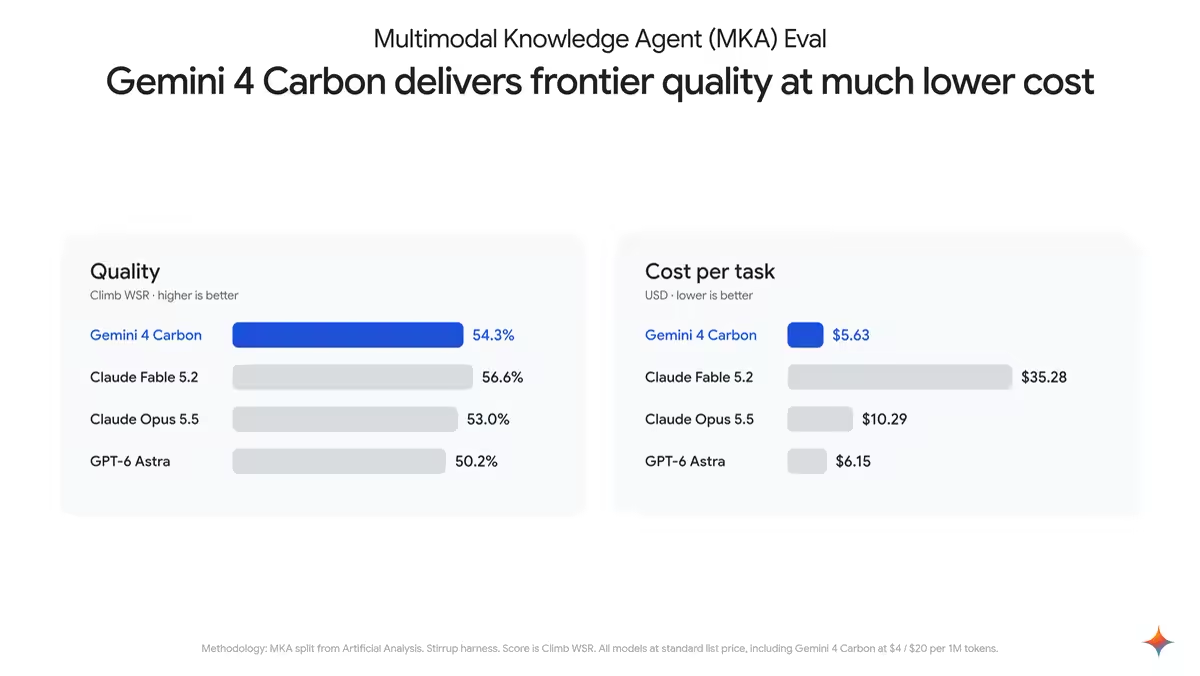
/swarm(preview) in Antigravity runs a coordinator, parallel workers in isolated git worktrees and adversarial verifiers on a shared message board. Agents can be pinned to different models. - Cost per task: Google says Carbon ranks first on CursorBench 4.0, Perplexity's WANDR and Zapier's AutomationBench at more than twice lower cost per task than the next best external model. On the new MKA benchmark it ranks second (54.3%) behind Claude Fable 5.2 (56.6%) but at $5.63 per task against $35.28.
- Safety: Carbon passed 92% of a 375-task agentic honesty benchmark (Argon: 70%), declined to fabricate missing experimental data 98% of the time, and cut the per-attempt breach rate in adaptive cyber red-teaming to 0.8% (Argon: 3.1%).
What Changed Since the October Preview
When Google DeepMind announced Carbon on 28/10/2026, access was deliberately narrow. The company released the model to a set of cybersecurity defenders through its Fairwind Program and said it would reach developers, businesses and consumers "as soon as possible", without a date. We covered that launch, and the earlier leak that preceded it, in our Carbon leak analysis and the main Carbon review.
Thirteen days later, Koray Kavukcuoglu, SVP of Google DeepMind and Google's Chief AI Architect, posted "Gemini 4 Carbon is now available". Five things are materially different from the preview:
- Open paid access. Any paying API customer can now call Carbon. The October post described an introductory price; that price is now live for everyone on the paid tier.
- Consumer and search access. Ultra subscribers can pick Carbon in the Gemini app model picker and in AI Mode in Search. This is the first time a Gemini 4 model above Argon has been offered to consumers.
- /swarm in Antigravity. A new orchestration mode, in preview, designed around Carbon's long-horizon strengths.
- New third-party evaluations. Results on CursorBench 4.0, WANDR, AutomationBench, Hebbia's financial agent evaluation, Balyasny Asset Management's financial intelligence benchmark, and the brand-new MKA benchmark.
- Updated safety data. Adaptive red-teaming figures, Gray Swan cyber query results, Trajectory Labs jailbreak testing and an agentic honesty benchmark, published alongside a full Gemini 4 Carbon safety and security report.
What has not changed is the split between the public model and the cyber-tuned one. Google's strongest security results, on SEC-bench Pro, ExploitGym and CWE-bench, come from "Gemini 4 Carbon for cyber", which is still only available through Fairwind. The footnote on Google's pricing makes the distinction explicit: the published rates apply "to the Carbon model intended for public access only".
Who Can Use Carbon, and Where
Google's "Getting started" section splits access into five audiences. The table below summarises it. If you are on a free plan or the Gemini API free tier, Carbon is not available to you yet.
| Audience | Where Carbon is available | Requirement |
|---|---|---|
| Developers | Gemini API in Google AI Studio and Android Studio; Antigravity and AI Studio for Ultra users | Paid API tier, or Google AI Ultra |
| Enterprises | Gemini for business (API or model drop-down), Google Antigravity, CodeMender | Business subscription |
| Consumers | Gemini app and AI Mode in Search | Google AI Ultra, rolling out |
| Scientists | Antigravity at its highest usage tier, free for six months | Application; subject to eligibility, capacity and selection |
| Cyber defenders | Carbon for cyber via the Fairwind Program | Application, rolling basis |
The science programme deserves a note. Four weeks before Carbon's release, Google opened applications for 10,000 scientists to use Argon in Antigravity free for six months and says it has onboarded "thousands" already. Those participants now get Carbon too, and Google says the programme will keep providing its latest frontier models as they arrive. For UK university researchers who cannot easily justify an Ultra subscription, that is the cheapest route to the model.
For UK consumers, the practical question is whether Ultra is worth it for Carbon alone. We would say no for most people: the gap between Argon and Carbon matters for long, multi-step technical work, not for everyday chat, drafting or search. Our Argon global release guide covers what the cheaper plans include.
Carbon vs Argon: Google's Own Positioning
It is unusual for a lab to tell you not to use its newest model, but that is roughly what Google does. The announcement says Argon "remains the ideal choice for the majority of software engineering and knowledge work, while Carbon is built for tasks that test the limits of a model's intelligence like complex, multi-step coding and debugging and open-ended scientific research and discovery — using more tokens than Argon to explore thoroughly, reason deeply, and run extended verification loops."
Read that last clause carefully. Carbon is not simply a smarter Argon at the same speed. It is a model tuned to spend more compute per task. That has three consequences:
- Latency: expect longer waits on hard problems. That is fine for an overnight refactor and frustrating in a chat window.
- Token bills: at the introductory price, Carbon and Argon cost the same per token, but Carbon uses more tokens. After 30/11/2026, Carbon's per-token price doubles while Argon's does not change in this announcement.
- Quota: the Antigravity team warns plainly that parallel multi-agent systems "consume quota much faster than a standard chat".
The sensible reading is a two-tier setup: Argon (or a Flash model) for the bulk of interactive work, Carbon for the jobs where getting the answer right first time saves hours. That is exactly the pattern /swarm is built around.
Julian Goldie runs three /swarm builds with nine agents and verifier agents, and shares four lessons on what to swarm.
How /swarm in Antigravity Works
The Antigravity team's post frames /swarm as the third step in an evolution. Single agents work well for scoped tasks but break down "when a change spans dozens of files and test suites". Dynamic subagents, where a primary agent spins off helpers, improved that but remained "bottlenecked by a single coordinator context reviewing, synthesizing, and routing every step". /swarm replaces the hierarchy with a team that shares a common workspace.
The architecture
- Coordinator: receives your prompt and spins up specialised workers.
- Parallel workers: each runs in its own isolated git worktree "so edits never collide".
- Adversarial verifiers: dedicated to running tests and challenging diffs, sending work back when it fails.
- Shared message board: an append-only board every agent reads and posts to. Idle agents "park at zero token cost" and wake when another agent needs their input.
This is a meaningful design choice. In a classic orchestrator pattern, every message passes through one context window, which fills up and degrades on long jobs. A shared board lets agents talk to each other directly, while worktree isolation keeps parallel edits from corrupting one another. If you want the theory behind this, our explainer on agent swarms covers coordination patterns in more depth.
Watching the swarm
Google has clearly heard the criticism that multi-agent systems are opaque. /swarm ships with a Swarm UI in Antigravity's side pane, and a full-screen terminal board in the CLI via /swarm board or Alt+S. It has three views: a live Board feed of agents debating trade-offs, a Members roster where you can inspect any agent's tool activity and jump into its trajectory to steer it, and a Graph timeline you can scrub to see how the team converged.
Mixed-model teams
Because each agent can be pinned to a different model, you can assign Carbon to coordinator, architecture, cybersecurity audit and adversarial verifier roles, and let Argon or lighter models handle parallel file edits. The Antigravity changelog entry for the release describes it simply: "You can now use /swarm to coordinate multiple subagents over a message board to complete long-horizon tasks."
Google says engineers dogfooded /swarm internally for five weeks on "gnarly multi-package migrations, cross-subsystem root-cause investigations, and complex architectural redesigns". It is rolling out in preview in the Antigravity App and CLI for Ultra subscribers. Carbon itself is also available in Antigravity IDE extensions.
Julian Goldie's test video is a useful real-world check. He ran three business builds (a client pipeline for a web agency, an audit kit for automation consultants and a weekly update desk for coaches) with nine agents across the three jobs, and reports that the verifier agents did send work back. That matches Google's description, though it is one creator's experience rather than a controlled test.
Benchmarks: Accuracy and Cost per Task
Google's availability post leans less on raw scores than the October launch did and more on cost per task. The claim is that across "independent benchmarks designed to test model performance in real workflows", Carbon "ranks #1 on CursorBench 4.0, Perplexity's WANDR, and Zapier's AutomationBench at more than 2X lower cost per task compared to the next best external model."
Google does not publish the individual scores for those three in this post, so we cannot verify the margins. What we can do is set them alongside the figures from Google's October table, which we reproduced in full in the original review:
| Benchmark (Google, 28/10/2026) | Carbon | Argon | GPT-6 Astra | Claude Opus 5.5 |
|---|---|---|---|---|
| AA Intelligence Index v5.0 | 59 | 50 | 57 | 58 |
| FrontierSWE 2 | 61.2% | 55.0% | 65.5% | 62.3% |
| Terminal-Bench 4.0 (AA) | 65.2% | 57.1% | 59.1% | 59.6% |
| AutomationBench (Zapier) | 53.9% | 51.3% | 41.4% | 42.5% |
| OSWorld-2.1 (offline subset) | 81.5% | 74.7% | 80.9% | 87.2% |
| GraphWalks (256k to 1M, BFS F1) | 96.2% | 84.2% | 71.8% | 66.8% |
Two caveats matter. First, the October table predates Claude Fable 5.2, which Anthropic released on 09/11/2026 and which now sits first on the Artificial Analysis Intelligence Index with a score of 65, as we detailed in our Fable 5.2 vs Opus 5.5 comparison. Carbon's 59 is no longer the top independent score. Second, "cost per task" depends on the price assumed. Google's MKA chart footnote says all models were costed "at standard list price, including Gemini 4 Carbon at $4 / $20 per 1M tokens", which is the post-introductory price. That is the honest choice, and it means the cost advantage is not a temporary discount effect.
The New MKA Benchmark Explained
The most interesting new evidence is the Multimodal Knowledge Agent benchmark, which Google developed with Artificial Analysis and launched the same day. Google's argument is that "most knowledge work benchmarks can be solved with text alone", whereas real professional work involves blueprints, schematics, charts and page layouts.
How MKA is built
- 200 private tasks written with domain experts across 10 verticals and 83 occupations, from architects and biologists to underwriters and data scientists.
- Each task reflects a multi-step project that takes a seasoned professional three to eight hours.
- Each pairs a prompt and a bundle of multimodal files with an expert-written rubric of about 70 yes/no checks, weighted 75% factual accuracy and 25% visual design.
- Every model runs in the same open-source agent harness, Stirrup, with identical tools, sandbox and turn budget.
- An agentic autorater "built on a non-Google model" grades the deliverables. Domain experts agreed with it 96% of the time.
- Artificial Analysis keeps the 200 tasks private to prevent training contamination; 10 public tasks are on Hugging Face.
The results
| Model | MKA quality (Climb WSR) | Cost per task |
|---|---|---|
| Claude Fable 5.2 | 56.6% | £27.87 ($35.28) |
| Gemini 4 Carbon | 54.3% | £4.45 ($5.63) |
| Claude Opus 5.5 | 53.0% | £8.13 ($10.29) |
| GPT-6 Astra | 50.2% | £4.86 ($6.15) |
The quality spread is narrow: 6.4 points separate first from fourth. The cost spread is not. Fable 5.2 costs about 6.3 times as much per task as Carbon for a 2.3-point quality lead. For a team running 500 such tasks a month, that is roughly £13,900 for Fable against £2,200 for Carbon.
The technical report adds an observation worth noting for anyone building agents: models used between 30 and 130 turns on average to complete each task. Efficiency, not just accuracy, is now a first-order differentiator. It also shows models "try and fail to compensate when vision is removed", which supports Google's case that perception matters for this class of work.
Two healthy doubts. This is a benchmark Google co-designed and launched alongside its own model, so the task mix may suit Gemini's strengths in document vision. And Google placed Carbon on the "pareto frontier of quality and price", which is true by construction when you are the cheapest model near the top. Independent replication on Artificial Analysis's live leaderboard over the next few weeks will be the real test.
Knowledge Work, Coding and 3D
Finance and enterprise documents
Google says Carbon "follows strict schemas and formatting to generate polished and precise spreadsheets, presentations, and reports". Two external finance evaluations support the pitch: Carbon matched the best model tested on Hebbia's E2E Financial Agentic evaluation, and ranked top of 23 frontier model configurations on Balyasny Asset Management's General Financial Intelligence benchmark, which spans legal expertise, agentic tool use, coding and data engineering, and perception. Neither organisation's scores are published in the post.
This lands in the same week Anthropic launched Claude Sheets, Whiteboards and Data, which we cover in our Claude office tools guide. The fight for document-heavy knowledge work is now explicitly between model labs, not just between Microsoft and Google Workspace.
Agentic coding
Google highlights multi-package migrations, cross-subsystem root-cause investigations and architectural redesigns. For web apps, Carbon "runs build-and-verify loops, recovers from errors, and checks both its code and the rendered UI". Checking the rendered interface, not just the code, is the habit that separates a working prototype from a broken one, and it is the step agentic builders most often skip. Our Antigravity 2 plan review explains how the plan, build and verify cycle works in the IDE.
The showcase demos
Google's demos are deliberately ambitious, and all were built with /swarm or multi-agent loops in Antigravity:
- An interactive Three.js exhibition of the Eiffel Tower's 1887–1889 construction from historical photos and engineering plates, from one prompt.
- A 906,000-triangle Three.js reconstruction of Google's Platform 37 office from seven public council planning PDFs (206 extracted drawing views) across 10 overnight loops.
- An open-world browser game in which you ride a GBike around Google's Mountain View campus as a pelican, with Blender-modelled assets, WebGL shaders, procedural Web Audio and Lyria music.
- A playable c. 1780 Stein-Schule fortepiano with 61-key escapement physics, built from CAD drawings and X-ray radiographs and placed in a model of Toronto's Koerner Hall with seat-specific acoustics.
- A reimagined Google Merchandise Store in two prompts, with five art-direction concepts and new product imagery from Nano Banana 2.1.
Demos are curated, so treat them as a ceiling, not an average. The overnight Platform 37 build is the most useful signal: ten loops of autonomous work on messy real-world PDFs is exactly the long-horizon behaviour Google says Carbon is for, and it echoes the overnight pattern we saw in our Argon ADK overnight test.
Matthew Berman's weekly round-up places the Carbon release alongside Claude Fable 5.2, Meta Muse Ember and other launches.
Cyber: Fairwind, Project Fortify and Wiz
Cyber defence was Carbon's launch story, and the availability post adds three real-world reports. All refer to Carbon for cyber, the Fairwind variant, not the public model.
- Project Fortify: Google's autonomous scan-triage-remediate system. On Google's internal benchmark, Carbon reached 100% recall on scanning and 95% precision on triage. On open-source repositories Google reports "an over 25% relative improvement on Argon's already strong recall rate".
- Cloud Vulnerability Research: Google's CVR team used Carbon to prove two bugs in a popular open-source project were exploitable, comparable in severity to the recent PHP2Shell exploit, leading maintainers to reclassify them as critical. Details are withheld pending disclosure.
- Wiz Scan for Good: scanning two major SaaS providers, the model found zero-day vulnerabilities in under two hours, which Wiz describes as compressing weeks of research into an afternoon. The affected organisations remediated with Wiz.
The October figures still frame the claim: 88.2% on SEC-bench Pro and 54.8% on ExploitGym against 42.0% for Argon. For UK security teams, the route in remains a Fairwind application. Our original review explains what Fairwind requires.
Science: Signal, Proteins and the Lab
The science section contains the most striking claim in the post. Google researchers built an agentic formal verification framework called AlphaProof Code and used it to mathematically prove security properties of the code underlying Signal's cryptographic protocol. Carbon, alongside other models, generated "millions of lines of code in Lean", helping prove key properties "in weeks — a task that historically takes expert teams years". AI Revolution's video, citing Axios, reports the work took four weeks.
Formal verification has long been the gold standard for security-critical software, and its main barrier is cost in expert time. If models can generate machine-checkable proofs at this scale, that changes the economics of high-assurance code. A Lean proof is checked by the Lean kernel, not by trusting the model, which makes this one of the more verifiable AI claims you will read this year.
Two further examples:
- Enzyme assays: from lab notebooks and raw data alone, Carbon diagnosed subtle wet-lab artefacts such as incomplete automated mixing in deep wells, and caught trace sample carryover in instruments, improving reproducibility.
- Protein structure: in a multi-agent set-up, Carbon searched petabase-scale sequence archives for remote homologs. Across seven low-homolog families from the CASP17 blind test set it increased homologs retrieved by 40-fold on average, giving structure models like AlphaFold 3 far more information without retraining. Google notes broader benchmarking is still under way.
Axiom Bio, a drug-toxicity company, says Carbon is now its leading model for translational science and is moving production analyses to Carbon and Argon.
Safety and Alignment Data
Because Carbon has stronger cyber capabilities, Google says it built on Argon's safety stack to harden robustness against misuse and prompt injection. The availability post adds new numbers in three areas.
Misuse safeguards
| Test | Carbon | Argon |
|---|---|---|
| Adaptive red-team attack trajectories blocked (ExploitBench, CyScenarioBench) | 99% | n/a |
| Per-attempt breach rate | 0.8% | 3.1% |
| Automated cyberattack query success (Gray Swan) | 2.17% | 9.86% |
| New universal jailbreaks (Trajectory Labs, 132 hours, 13,000+ requests) | 0 | n/a |
Alignment and honesty
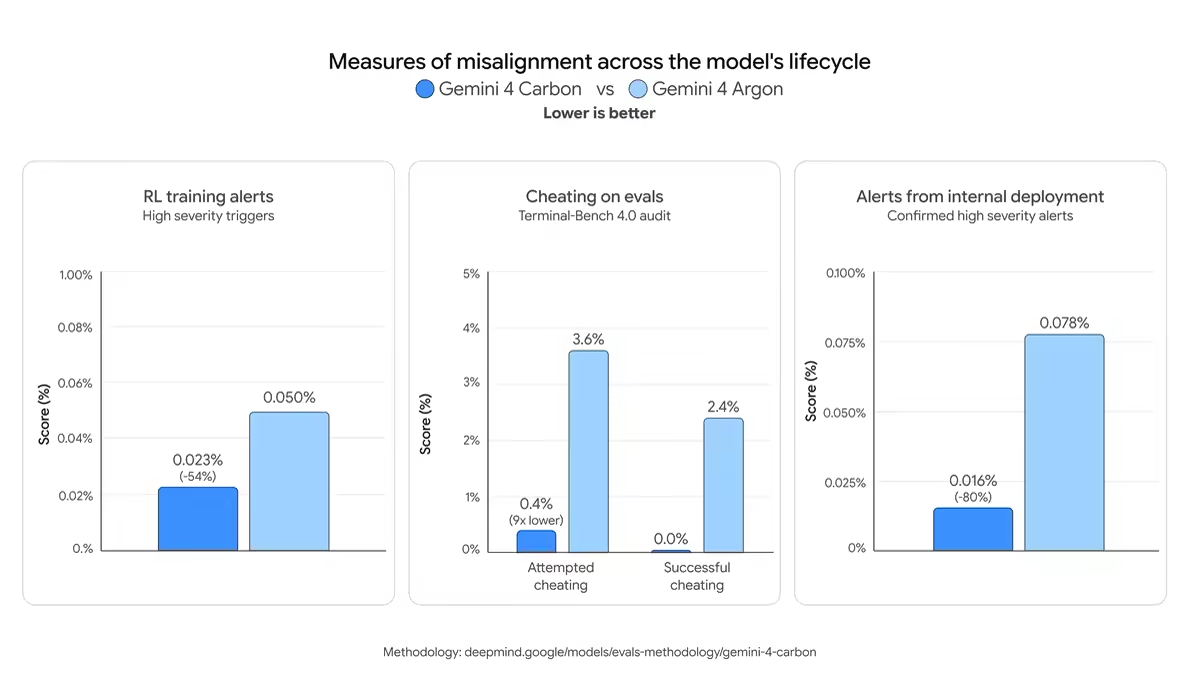
The chart above, carried over from the October launch, shows Carbon well below Argon on every lifecycle misalignment measure: 0.023% high-severity RL training alerts against 0.050%, 0.4% attempted cheating on a Terminal-Bench 4.0 audit against 3.6%, 0.0% successful cheating against 2.4%, and 0.016% confirmed high-severity internal deployment alerts against 0.078%.
The new data point is an agentic honesty benchmark of 375 tasks. Carbon passed 92% against 70% for Argon. It declined to fill in missing experimental data 98% of the time and flagged methodological flaws 68% of the time. That second figure is the more revealing: a third of the time, Carbon still did not flag a methodological problem it should have. Julian Goldie's Carbon explainer highlights the practical upside, that Carbon "flags missing data instead of guessing", which matters most in exactly the research and finance work Google is targeting.
Prompt injection
Google repeats that Carbon reached 0% attack success on the Gray Swan indirect prompt injection benchmark, which it calls a first. It then adds an important qualifier: "prompt injection robustness remains an area for continued improvement", because its own automated red-teaming shows models "could be further improved against sophisticated attacks in some distributions". That candour is welcome. A 0% score on one benchmark is not immunity, and anyone deploying Carbon agents with browsing or email access should keep human approval on consequential actions.
For the full methodology, Google points to the Gemini 4 Carbon Safety and Security report.
Pricing and the 30 November Deadline
Sterling figures use an approximate rate of 79p to the dollar.
| Per million tokens | Introductory (to 30/11/2026) | From 01/12/2026 |
|---|---|---|
| Input | £1.58 ($2) | £3.15 ($4) |
| Output | £7.90 ($10) | £15.75 ($20) |
| Cached input | 95% cheaper than input (per Google's October post) | 95% cheaper than input |
At the full price, Carbon matches Claude Opus 5.5 per token ($4 / $20) and costs half of Claude Fable 5.2 ($8 / $40). Our AI API pricing comparison sets these against every frontier model.
The practical advice is to use the next 18 days. If you have been weighing Carbon for a batch job, such as a codebase migration, a document-analysis backlog or an evaluation run, the introductory window halves the token cost. Just remember that Carbon's token appetite is higher than Argon's, so measure cost per finished task rather than assuming parity.
Limitations and Open Questions
- Vendor-reported results. CursorBench, WANDR and AutomationBench rankings are Google's claims without published scores in this post. MKA is co-designed by Google.
- No longer the top independent model. Claude Fable 5.2 has overtaken Carbon on the Artificial Analysis Intelligence Index and on MKA quality.
- Cyber results are for a restricted variant. The public Carbon is not the model behind the Project Fortify and Wiz results.
- /swarm is a preview. Expect rough edges, high quota use and changes before general release. It is Ultra-only for now.
- Ultra-only for consumers. Free and lower-tier Gemini users do not get Carbon.
- Prompt injection is not solved. Google says so itself.
- Price doubles on 01/12/2026. Budget on the full price, not the introductory one.
How Carbon Compares
| Gemini 4 Carbon | Claude Fable 5.2 | Claude Opus 5.5 | Gemini 4 Argon | |
|---|---|---|---|---|
| API price (in / out, per M) | $2 / $10 intro; $4 / $20 | $8 / $40 | $4 / $20 | $2 / $10 intro |
| MKA quality | 54.3% | 56.6% | 53.0% | Not shown |
| MKA cost per task | $5.63 | $35.28 | $10.29 | Not shown |
| Best at | Long-horizon agents, cyber, docs, cost-efficient frontier work | Hardest reasoning and coding, top independent score | Computer use, writing, balanced cost | Everyday engineering and knowledge work |
| Multi-agent tooling | /swarm in Antigravity | Claude Code subagents | Claude Code subagents | /swarm in Antigravity |
For deeper head-to-heads see Claude Opus 5.5 vs GPT-6 Astra, Gemini 4 Argon vs Meta Muse Wonder and our Claude Fable 5.2 review.
Who Should Use It
- Engineering teams with big, gnarly changes: migrations, cross-service debugging and refactors. Try Carbon as the coordinator and verifier in
/swarm, with Argon workers. - Analysts working with dense documents: finance, legal and planning teams who need structured spreadsheets and reports from PDFs full of charts and drawings.
- Cost-conscious teams currently on Fable 5.2: run a side-by-side on your own tasks. If Carbon gets within a few points at a sixth of the price, the saving is large.
- Researchers: apply to Google's free science programme rather than paying for Ultra.
- Not for: casual chat, short drafting, simple code edits or latency-sensitive apps. Argon or a Flash model will be faster and cheaper.
The Bottom Line
Gemini 4 Carbon's general availability is less about a new peak score and more about economics. Google is no longer claiming the top of every leaderboard; Claude Fable 5.2 has taken that. Instead it is arguing that Carbon delivers near-frontier quality at a fraction of the cost per task, and backing that with a new multimodal benchmark, a set of third-party work evaluations and an orchestration tool, /swarm, designed to put that efficiency to work across whole teams of agents.
The honesty and safety data are genuinely improved over Argon, and the Signal formal verification project is a landmark if it holds up. The open questions are independent replication of the cost claims and how /swarm behaves outside Google's curated demos. If you have a hard, long job queued up, the introductory price until 30/11/2026 makes now the cheapest time to find out.
Sources
- Google: Gemini 4 Carbon is now available (10/11/2026): availability, pricing, evaluations, science, safety.
- Google Antigravity: Gemini 4 Carbon and /swarm (10/11/2026): /swarm architecture and rollout.
- Google Antigravity changelog: /swarm release note.
- Google: Introducing the Multimodal Knowledge Agent benchmark: MKA design and results chart.
- Google DeepMind: Gemini 4 Carbon Safety and Security report.
- Creator coverage: AI Revolution, Julian Goldie (/swarm), Julian Goldie (Carbon explainer), Matthew Berman and World of AI.
- Images: Google and Google Antigravity launch artwork and charts, downloaded and compressed to AVIF.
Last updated: 12/11/2026. Benchmark and safety figures are Google-reported unless stated; we will update this article as independent results on Artificial Analysis and elsewhere are published.
Get the free guide: Claude vs ChatGPT, Gemini & Grok
A 20-page playbook covering everything you need to choose and use the big four AI models in 2026, full cost and feature comparisons, what each is best (and worst) at, and how-tos for images, vectors, building a website, Claude Code and more.