
 AI Tools Review Editorial Team
Genie 4 is the clearest sign yet that Google DeepMind sees world models, AI that simulates an interactive environment frame by frame, as a route to both creative tools and AGI. Announced on 27/10/2026, it arrived the same week as Gemini 4 Carbon and was immediately covered by every AI channel we track.
Sourcing: the facts below come from Google DeepMind's announcement and Google's blog post, supplemented by creator demos. Google's posts are short and mostly point to demo videos, so this article is explicit about what is known and what is not. Related reading: our World Labs Atlas explainer for a rival approach to 3D worlds, and our Gemini 4 Carbon review for the model announced a day later.
Matt Wolfe walks through the Genie 4 demos and what the world model can do.
AI Revolution X covers Genie 4 alongside Anthropic and OpenAI research news, citing Google's source posts.
Executive Summary
- What it is: Genie 4, a real-time interactive world model from Google DeepMind, announced 27/10/2026.
- What is new: native audio on the fly, including ambient sound, music and interactive dialogue.
- How you drive it: natural language, such as moving the camera, changing the weather or adding characters mid-scene.
- How it is built: Gemini Omni anchors simulations in real-world appearance and behaviour; other Gemini models provide reasoning to keep worlds coherent.
- Access: trusted testers now; Google AI Ultra subscribers in Project Genie and early-access partners in the Gemini API and AI Studio 'soon'.
- Missing: benchmarks, resolution, frame rate, session length, pricing and an API model ID.
What Is a World Model?
Unlike a video generator, which produces a clip from a prompt and stops, a world model takes your inputs continuously, such as move forward, turn, open the door, and generates the next frames in response. Nothing is pre-built: there are no meshes, textures or physics code authored by a person. The model has learned from video how scenes tend to look and behave, and it improvises them.
Genie 4 is the fourth generation of Google DeepMind's line, and the first, Google says, to generate audio natively in real time. The company's framing is ambitious: 'Simulating the world is a crucial step toward AGI, enabling safe training environments for robots and agents', as well as tools for filmmaking, journalism, gaming and manufacturing.
What Google Says Is New
Native audio
Every Genie 4 world generates sound as it runs: ambient noise, music and interactive dialogue. Google's teaser invites you to 'see how the scene responds, sounds, and how the people in it move, react, and speak'. Dialogue is the notable part. Characters that talk back make a generated world feel like a place with inhabitants rather than a silent clip, and it is what most creators in our video batch focused on.
Steering with natural language
You can 'set an event in motion and steer scenes in real time' with plain language. Google's examples are moving the camera, changing the weather and introducing new characters. That makes the model closer to a director's tool than a game controller: you are shaping a scene rather than only moving through it.
Realism and physics
Google calls Genie 4 its 'most realistic and interactive world model yet'. Secondary coverage cites simulated aerodynamics and collisions, and more natural character movement. These are qualitative claims shown through demos. Without a physics benchmark, we cannot say how often the simulation breaks, which has been the weak point of earlier world models.
Gemini inside the world
According to Google, 'Gemini Omni anchors simulations in real-world appearance and behavior, while other Gemini models provide the complex reasoning needed to help maintain a simulation's coherence and continuity'. That is a meaningful architectural statement: the world model is not standalone, it leans on the Gemini family for grounding and for keeping long scenes consistent. It also explains why this announcement fits with the Gemini 4 push described in our Gemini 4 Argon review.
Access: Trusted Testers, Project Genie and the API
Google says it has started rolling out Genie 4 to a limited group of trusted testers. It is 'coming soon' to Google AI Ultra subscribers in Project Genie, the consumer-facing experience, and to early-access partners in the Gemini API and AI Studio. There is no date, price or usage limit. Creators in our batch mention a waitlist, but we could not verify its terms from Google's own posts.
For developers, the API route is the interesting one. A world model behind an API could become a simulator for agent training, a prototype tool for game designers, or a generator of interactive explainers. But until Google publishes latency, session length and cost, it is impossible to plan a product around it.
Where World Models Could Matter
- Robot and agent training. Safe, cheap, endlessly varied environments in which to practise before touching hardware. This is the use Google leads with, and it links to our coverage of World Labs' Atlas and other spatial AI work.
- Filmmaking and previs. Directing a scene with words, changing weather and camera without a set.
- Games and prototyping. Rapid ideation of levels and characters, though not yet a replacement for an engine.
- Journalism and education. Interactive explainers of places and events, with obvious accuracy and provenance risks.
- Manufacturing. Simulating processes and layouts before building them.
Each case depends on reliability. A game engine behaves identically every time; a world model does not. For training agents, a simulator that drifts from reality can teach the wrong lessons, so realism claims need measurement, not just demos.
Limitations and Open Questions
- No technical report. Google has not published resolution, frame rate, session length or latency for Genie 4.
- No benchmarks. Claims of realism and physics rest on curated demos.
- No pricing or API ID. Anyone building should wait.
- Consistency. Long-horizon coherence is the classic failure mode of world models, and Google's Gemini-reasoning layer is a bet that it can be fixed.
- Safety and provenance. Photoreal, talking synthetic worlds raise misuse and disinformation questions. Google's own labelling work, such as SynthID, is likely to be relevant, but the announcement does not say how it applies here.
What Creators Saw in the Demos
The videos we tracked this week agree on the broad story and differ in tone. Matt Wolfe walks through the interactive demos and treats it as a creative tool. AI Revolution X calls it 'the beginning of synthetic reality' and cites Google's source posts. Julian Goldie SEO calls the update 'insane'. All of them are reporting demos shown by Google, not hands-on testing, since public access does not yet exist.
Julian Goldie SEO's take on the Genie 4 update and what it means.
The Bottom Line
Genie 4 is a notable step for world models mainly because of native audio and Gemini-based reasoning inside the simulation. If it works as shown, it moves the technology from silent, short, drifting scenes towards something that looks and sounds like a place.
But everything public is announcement-level. There are no benchmarks, no technical details and no price, and access is limited to trusted testers. Watch for the Project Genie rollout to Google AI Ultra subscribers and for the first independent hands-on reports before drawing conclusions.
Sources
Last updated: 29/10/2026. This article is based on Google DeepMind's announcement and creator coverage of the demos. Google has not published benchmarks or technical details for Genie 4; we will update this page when it does.
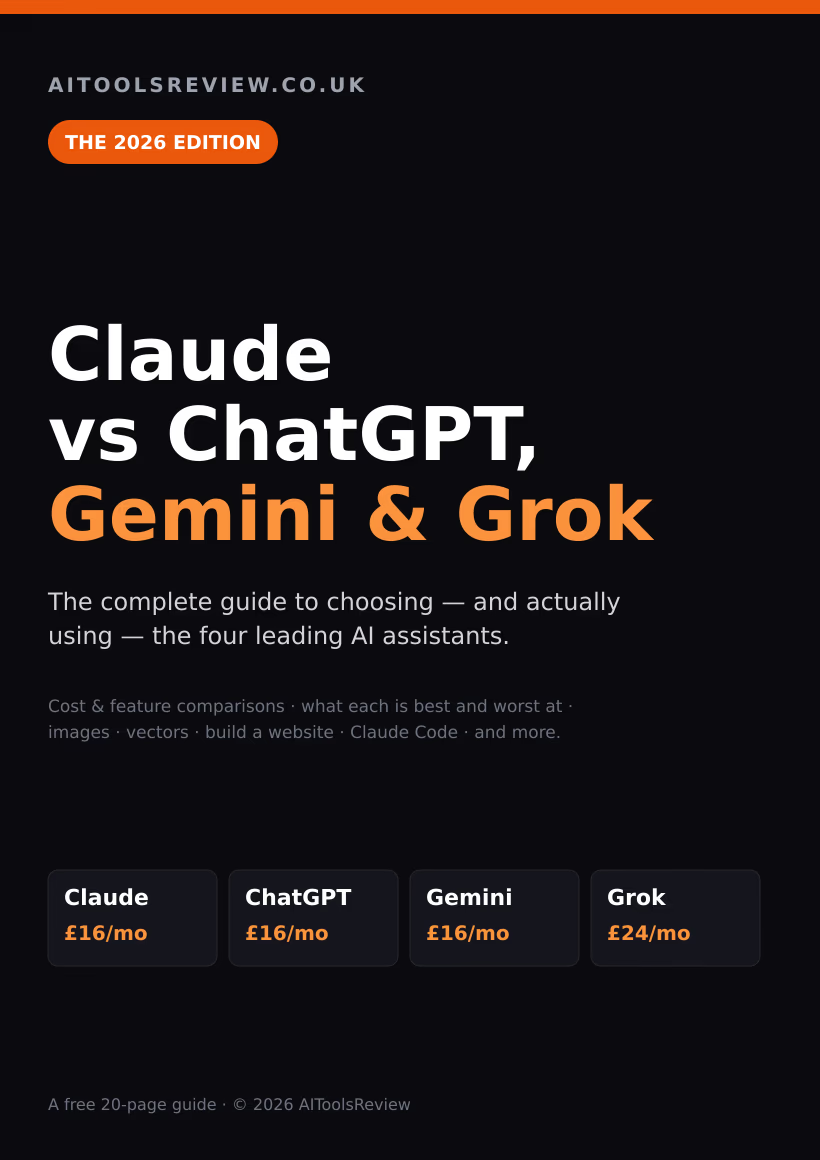
Get the free guide: Claude vs ChatGPT, Gemini & Grok
A 20-page playbook covering everything you need to choose and use the big four AI models in 2026, full cost and feature comparisons, what each is best (and worst) at, and how-tos for images, vectors, building a website, Claude Code and more.