
 AI Tools Review Editorial Team
Quick answer:
Atlas is World Labs' new omni world model, entering early access on 1 September 2026. It natively handles text, images, video and 3D from one pretrained model, generating up to one minute of camera-controlled video at 1440p and reconstructing real scenes as 3D Gaussian splats from as few as two or three images. Human raters preferred Atlas over rival video models in 75-94% of trials, and it beats reproduced open-source specialists on 3D-reconstruction error across six benchmark datasets. The catch: several of those results used asymmetric test conditions favouring Atlas, and no academic paper or independent replication existed at launch. World Labs has raised roughly $1.23 billion and has not published pricing; access is by request only.
World models, systems that generate and simulate coherent, navigable environments rather than flat video, have quietly become one of 2026's more consequential AI races, and Fei-Fei Li's World Labs has been near the centre of it since Marble launched. Atlas is the company's follow-up, and its pitch is broader: one model for reconstruction, generation and simulation, aimed as much at robotics teams as at creative ones.
This review draws on World Labs' own Atlas announcement and technical blog post, its official CDN-hosted demo assets, and independent reporting that specifically scrutinised the launch benchmarks, including two outlets that flagged asymmetric evaluation conditions. Both the official claims and the published counter-evidence are covered here.
A walkthrough of Atlas's 3D-from-photo reconstruction, camera control and robotics angle.
Executive Summary
Atlas is World Labs' second major product after Marble, and the shift in framing matters: where Marble was pitched as a 3D-world generator for creators, Atlas is described as an "omni model", a single pretrained transformer that natively operates across text, images, video and 3D representations including point clouds and 3D Gaussian splats, rather than stitching together separate specialist tools.
- Best fit: creative teams building navigable 3D scenes from reference photos, and robotics teams generating synthetic training environments from sparse real-world capture.
- Headline result: reconstructs a usable 3D scene from as few as two or three photos, and generates up to a minute of 1440p video with a camera path supplied as geometry rather than described in text.
- Honest caveat: the camera-control preference results and the 3D-reconstruction benchmark both used comparison conditions independent reporting has flagged as favouring Atlas.
- Main gap: no independent replication, no academic paper, and robot actions are not yet a native input, so Atlas is a scene generator today, not a verified physics simulator.
Lineage: From Marble to Atlas
World Labs was co-founded by Fei-Fei Li, the Stanford computer scientist and ImageNet creator widely credited with helping trigger the deep-learning boom of the early 2010s, alongside a team of former Google, NVIDIA and Stanford researchers. The company has raised roughly $1.23 billion across two rounds: $230 million at founding in 2024, and a $1 billion round in February 2026 backed by Autodesk (which alone put in $200 million), AMD, Nvidia and Fidelity, a war chest that puts World Labs in rare company among spatial-computing startups.
Marble, World Labs' first product, let users generate persistent, explorable 3D worlds from prompts or images. Atlas is positioned as the next-generation model underneath that product line: World Labs says Atlas is "expected to power future versions of Marble and other World Labs products", framing this launch as infrastructure for the company's existing product rather than a standalone replacement for it.
Architecture & Training
World Labs describes Atlas as a multimodal autoregressive diffusion transformer, pretrained from scratch to natively operate on text, images, video and 3D, rather than a video model with a 3D module bolted on afterward. It natively ingests both 2D image frames and 3D depth maps, which lets the same model write its outputs as point clouds, as fully rendered 3D Gaussian splats, or as flat rectified-flow video using latent diffusion.
World Labs reports "strong evidence that Atlas will continue to improve with scale" through progressive training, with each compute increase reportedly unlocking new capabilities rather than just improving existing ones incrementally, a scaling claim common to frontier labs but one World Labs has not backed with a published scaling-law paper for this specific model.
Capabilities Deep Dive
Camera-controlled video generation
The headline capability is video generation with a camera path supplied as an explicit geometric input, up to one minute at 1440p, from one or more reference images. That is a meaningfully different interface from prompting a video model to "slow pan left, then crane up": Atlas receives the actual camera trajectory as data, which World Labs argues produces more physically consistent, controllable results than text-described camera moves.

3D reconstruction and generation
From as few as two or three input photos, Atlas reconstructs a scene as an explicit 3D format, either a point cloud or a complete 3D Gaussian splat, filling in the geometry gaps the sparse input images don't cover so the result renders on-device at high resolution and framerate. The same underlying model performs novel-view synthesis (generating a believable view of the scene from an angle no input photo covered), 360-degree panorama generation, and pure text-to-image generation with what World Labs describes as complex prompt-following.

Space-time simulation
Atlas can reframe existing video from new camera angles not present in the original footage, a "bullet time" style effect, and generate synchronised RGB and depth data, the kind of paired sensor output used to simulate what a robot's cameras and depth sensors would perceive in a given environment. That capability is the basis for World Labs' Real-to-Sim robotics pitch, covered in detail below.
Benchmarks: What the Numbers Actually Show
On camera-controlled generation, World Labs reports human raters preferred Atlas over rival video models in a range of trials depending on the competitor: 75% against MiniMax H, 81% against Gemini Omni Flash, 86% against Happy Horse 1.1, 93% against FLUX 3, and 94% against Seedance 2.5. On 3D reconstruction, measured by mean absolute-relative pointmap error (lower is better) across six datasets including DTU, ETH3D, KITTI, NRGBD, 7-Scenes and ScanNet, World Labs reports Atlas averaging 25.3, ahead of the specialist open-source models Pi3X (28.7) and π³ VGG (34.7).
Both sets of numbers look decisive in isolation. They are also both the subject of specific, documented methodology concerns, covered in full in the section below, that make them considerably less clean than a first read suggests.
Real-to-Sim: The Robotics Angle
World Labs positions Atlas's Real-to-Sim workflow as a way for robotics teams to turn a handful of real-world photos or a short video capture into a navigable, simulation-ready 3D environment, generating the paired RGB and depth data a robot's onboard sensors would see. The pitch is compelling because collecting real robot training data is expensive and slow; if a sparse photo capture of a warehouse, kitchen or office can become a usable simulation environment, that shortcuts a meaningful bottleneck in robot-policy training.
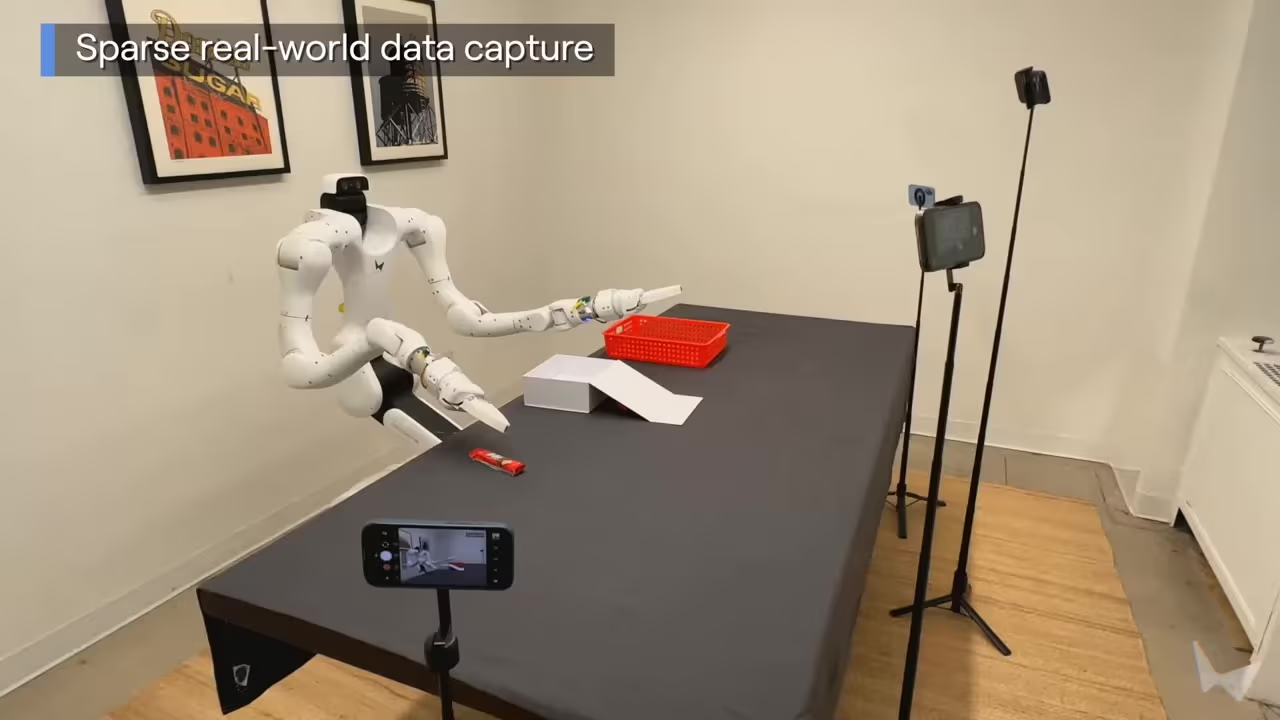
The important limitation, and it is a significant one, is what Atlas is not shown to do yet: World Labs distinguishes internally between rendering (producing correct-looking pixels) and simulation (maintaining a physical state that responds correctly to actions), and by its own description Atlas's currently listed inputs are text, images, camera pose and depth. Robot actions are not a native input. No published, standalone evidence shows that objects inside an Atlas-generated scene move correctly in response to a robot's actions, or that real robot policies can be safely evaluated inside it. Atlas today generates and reconstructs environments a robotics team can look at and navigate through; it has not yet demonstrated that it functions as a physics-accurate simulator those teams can safely train or evaluate real policies against.
The Benchmark Fairness Questions
Independent reporting on the Atlas launch converged on the same set of concerns, and they are specific enough to name directly. First, the camera-controlled generation comparison was not run on equal footing: Atlas received native camera-pose data as its input, the actual 3D trajectory, while text-only competitors such as MiniMax H and Seedance 2.5 were instead given written descriptions of cinematic camera moves like "pan" or "crane shot" and had to infer the intended motion from language. A model given the exact geometric answer will reasonably outperform one given a written approximation of the question, which makes the 75-94% preference figures a weaker signal of general video-generation quality than they first appear.
Second, the 3D-reconstruction comparison used VGGT-Omega 1B as a baseline model. That baseline had a data-contamination warning issued against it on 18 August 2026, roughly two weeks before World Labs published Atlas's comparison results against it on 1 September without disclosing that warning in the launch materials reviewed for this piece. Separately, no academic paper, evaluation code, dataset composition, parameter count or training-compute figures accompanied the launch, and the 3D-reconstruction results specifically came from a company-organised evaluation rather than one accompanied by a technical paper or independent replication.
None of this means the underlying capability is fake, Atlas's demo outputs are genuinely impressive on visual inspection, but it does mean the specific percentage figures World Labs published should be read as marketing-adjacent claims from an interested party rather than settled, independently verified results. Developers evaluating Atlas for production use should wait for or commission independent replication rather than taking the launch benchmarks at face value.
Real-World vs Demo Reel
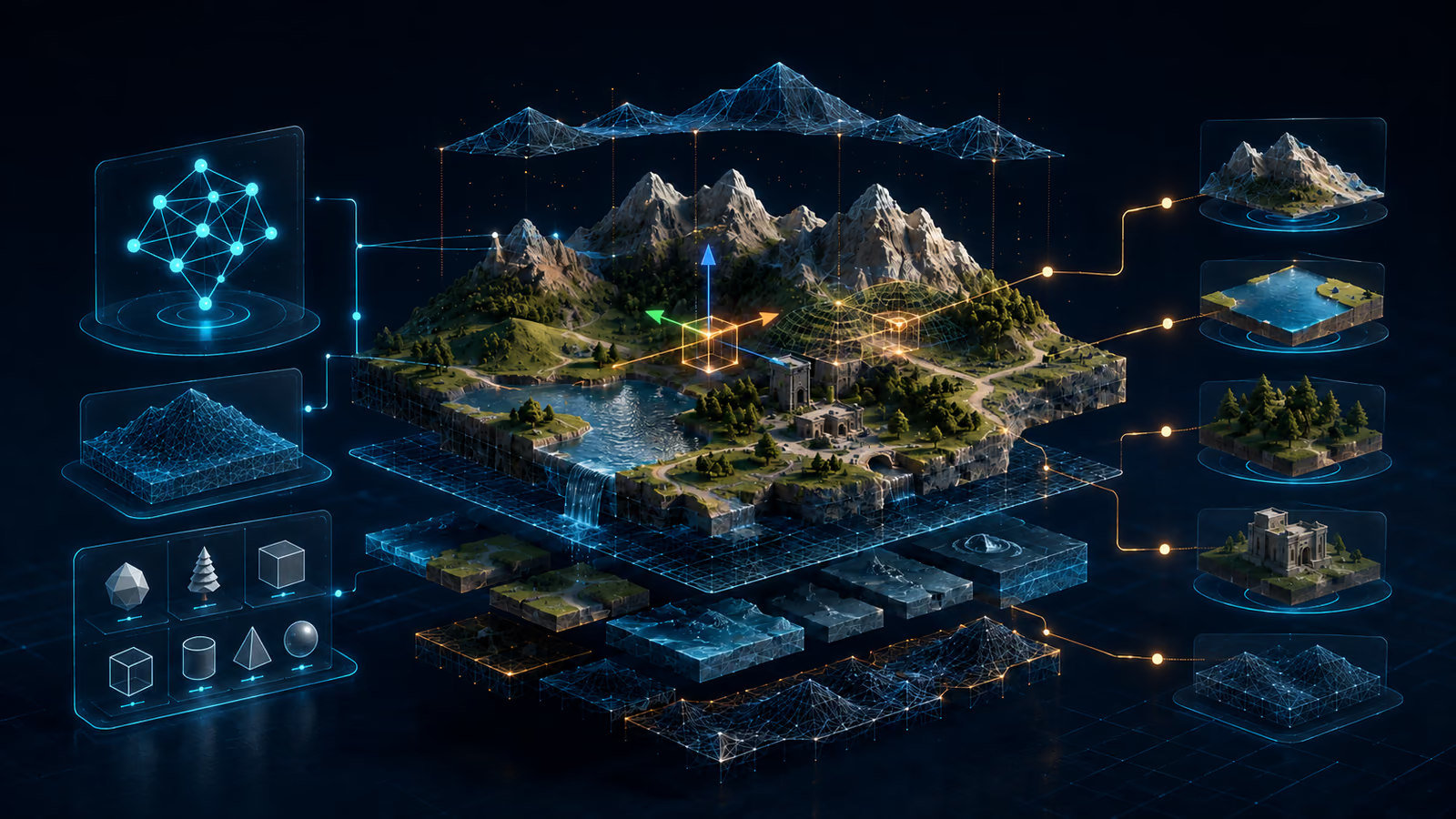
Launch-day creator coverage focused heavily on the demo reel: reconstructing detailed environments from a handful of source photos, generating extended camera-controlled flythroughs, and the robotics angle as a preview of where this category of model is heading. That coverage is directionally fair, the demo assets reviewed for this piece (including the aerial coastline sequence and the generated 3D environment shown above) hold up well on close inspection, with consistent geometry and lighting across the frame.
What launch-day coverage generally did not surface is the gap between those polished demo assets, which World Labs selected and published itself, and the absence of any third-party evaluation using a developer's own photos or scenes. Every genuinely new capability category faces this gap at launch, it is not unique to World Labs, but it is a meaningfully different claim than "independently benchmarked and verified", and treating early-access demo reels as representative of average-case output quality is a common and avoidable mistake.
Pricing & Access
World Labs has not published pricing for Atlas. It is entering early access with select partners only, reachable through a request form on World Labs' site rather than a general-availability API, console sign-up or consumer product page. World Labs says Atlas is expected to eventually power future versions of Marble, its existing consumer-facing 3D-world product, which may be the more likely near-term path for most users to access Atlas-derived capability rather than the raw model itself.
Limitations
- Benchmark conditions favoured Atlas: camera-controlled generation compared native pose data against text-only competitors; the 3D-reconstruction baseline had an undisclosed data-contamination warning.
- No independent replication: no academic paper, evaluation code, dataset details, parameter count or training-compute figures were published at launch.
- Not a verified physics simulator: robot actions are not a native Atlas input, and no published evidence confirms objects respond correctly to actions inside generated scenes.
- Hallucinated geometry risk: filling gaps in sparse input photos is useful for entertainment but risky for precision use cases like surveying or architectural documentation, where an invented wall or missing structural detail matters.
- No public pricing or general access: early access only, via request form, with no announced API or public release date.
How It Compares
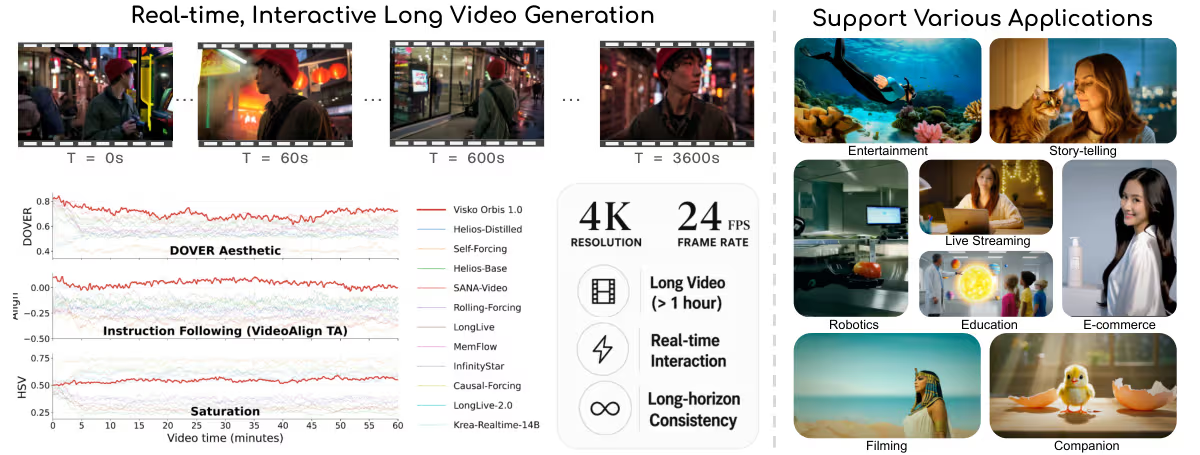
Against Google Genie 3, which generates playable, interactive world simulations in real time, Atlas takes a different approach: higher-fidelity reconstruction and generation from real reference images rather than real-time interactive playability. Against Tencent WorldClaw, which focuses on agentic, editable 3D worlds, Atlas is positioned more toward faithful reconstruction of real scenes and camera-controlled cinematography than agent-editable world-building. Against Visko Orbis 1.0, a real-time "Live Model" built for continuous generation, Atlas is not real-time; its one-minute video generations and 3D reconstructions are closer to a rendering pipeline than a live interactive stream.
The more useful comparison than "which world model wins" is use case: choose Atlas specifically when you need faithful 3D reconstruction from real photos or camera-controlled cinematic video, treat its robotics simulation claims as early-stage rather than production-ready, and wait for independent benchmark replication before making a purchasing or integration decision based on the published preference percentages.
Who Should Use It
Apply for early access if you are a creative or spatial-computing team that needs to reconstruct real locations into navigable 3D scenes from limited reference photography, or a robotics team exploring synthetic scene generation for training-data augmentation (not yet policy evaluation). Wait if you need production-grade, independently verified benchmark numbers before committing engineering time, or you need a true physics simulator for safety-critical robot-policy testing, a category Atlas has not yet demonstrated it belongs to.
The Bottom Line
Atlas is a genuinely impressive technical demo from a very well-funded team with a real track record: the underlying visual quality of its 3D reconstructions and camera-controlled video, viewed directly, is not in dispute. What is in dispute is how much weight to put on World Labs' own published percentages, given the asymmetric camera-control comparison and the undisclosed contamination warning on its 3D-reconstruction baseline.
Treat Atlas as a capable, promising early-access world model with a compelling robotics roadmap rather than an independently verified category leader. The Real-to-Sim robotics story in particular is worth watching closely over the next few quarters: turning sparse real-world capture into simulation-ready environments would be a genuinely significant unlock for robot training if Atlas (or a successor) can eventually demonstrate accurate physical response to actions, not just accurate-looking geometry.
Last updated: 4 September 2026. Sources: World Labs' official Atlas announcement (worldlabs.ai/blog/atlas), independent launch coverage from SiliconANGLE and Radiance Fields, and benchmark-methodology critiques from XenoSpectrum and Winzheng.
Get the free guide: Claude vs ChatGPT, Gemini & Grok
A 20-page playbook covering everything you need to choose and use the big four AI models in 2026, full cost and feature comparisons, what each is best (and worst) at, and how-tos for images, vectors, building a website, Claude Code and more.