 AI Tools Review Editorial Team
Quick answer:
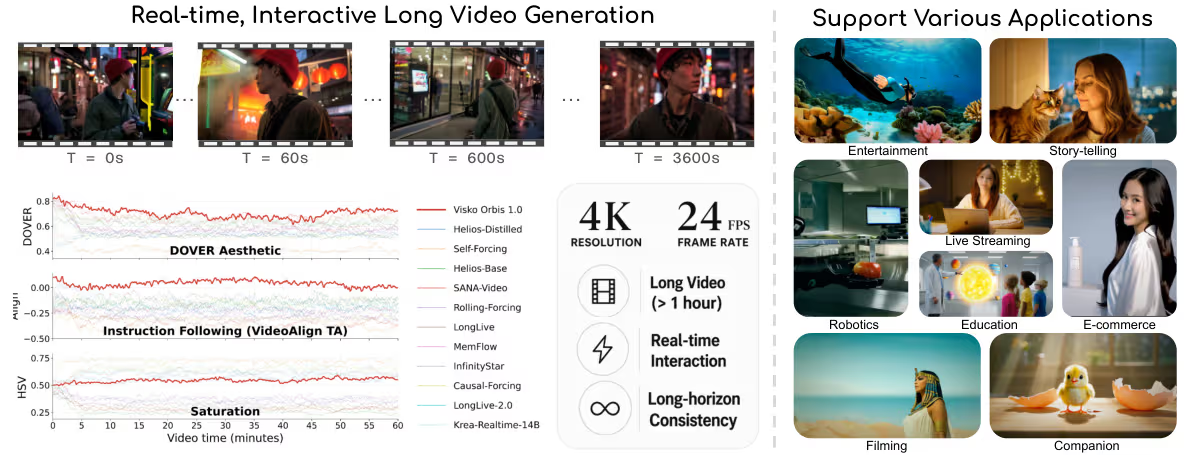
Visko Orbis 1.0, launched 1 September 2026, is the first product in a category Visko calls a "Live Model" - an AI system that generates video continuously in real time rather than rendering a fixed clip. It streams 4K video at 24 frames per second, sustains hour-scale generation without evident quality drift, and lets users change the prompt mid-stream with updates visible in under one second on average. Visko's own arXiv technical report shows it ranking first among ten systems on aesthetic and motion-quality metrics, and a human-preference Arena study puts it top on overall preference and temporal stability - though not on every individual metric. The company, founded by ex-Apple researcher Qing (Will) Yin, closed a $10 million pre-seed round led by Llama Ventures alongside the launch, with an advisory board including UC Berkeley's Michael I. Jordan.
Most AI video tools still work the way a camera does: you ask for a clip, it renders, it ends. Visko's pitch with Orbis 1.0 is that this framing is already outdated - that the next step for generative video isn't longer clips, but a model that behaves less like a renderer and more like a running process you can steer while it's happening.
This review draws on Visko's official launch announcement, its arXiv technical report, and independent press coverage of the funding round - the real benchmark tables, the real architecture description, and an honest look at where the company's own numbers show it losing rather than winning.
Hands-on first look at Visko Orbis 1.0's real-time, steerable video generation.
Summary
Visko Orbis 1.0 is a video-generation model built around continuous, steerable, real-time output rather than one-shot clip generation. Visko calls the underlying category a "Live Model" - a model that runs rather than renders - and Orbis is its first public example: 4K resolution, 24 frames per second, hour-scale rollouts, and in-generation prompt switching with sub-second latency.
The company backs the launch with a genuine technical report on arXiv (rather than marketing copy alone), a $10 million pre-seed round led by Llama Ventures, and an advisory board with real academic weight. Its own benchmark tables show real strengths - leading eight of ten measured metrics against nine competing systems - alongside real, disclosed weaknesses on at least two others.
- Best for: long-form interactive video use cases - live commerce, education, story-telling, simulation - where a fixed-length clip is the wrong shape for the task.
- Headline numbers: 4K/24fps real-time generation, hour-scale rollouts, sub-one-second prompt-update latency, first-place finishes on six of Visko's own reported quantitative metrics.
- Defining trait: a genuinely new product category - "Live Models" - rather than an incremental improvement on existing text-to-video tools.
- Main caveat: Visko's own Arena study shows a rival, HappyOyster, beating it on Visual Fidelity, and a separate benchmark (HeliosBench Aesthetic Score) ranks Orbis third, not first.
What Is a "Live Model"?
Visko's core positioning is a category claim, not just a product claim. The company's framing, per CEO Qing Yin: Orbis was built "to hold together - physically, visually and narratively - for as long as you want to stay inside it." A Live Model, in Visko's definition, is a stateful, continuously active system rather than a bounded query-response generator - closer in spirit to a running simulation than to a one-shot image or video generator you call once and receive a finished file from.
Practically, that means three things a conventional text-to-video model doesn't do: it keeps generating indefinitely (up to an hour, demonstrated) rather than stopping at a fixed duration; it accepts new instructions mid-stream and reflects them in well under a second, rather than requiring a fresh generation call; and it maintains persistent memory of established entities, visual style and physical dynamics across the entire session, rather than treating each new segment as an independent generation.
The Company Behind It
Visko was founded by Qing (Will) Yin, who holds a Stanford PhD in Computational Mathematics and Mechanics and spent three years as a researcher at Apple before starting the company. The 16-person team draws from Apple, Google DeepMind, Meta, Amazon and Tesla - a roster that signals deep systems and applied-ML experience rather than a purely academic research spin-out. The advisory board carries real academic weight: Michael I. Jordan (UC Berkeley, one of machine learning's most-cited researchers), Steve WaiChing Sun (Columbia) and Mengye Ren (NYU).
Visko closed a $10 million pre-seed round led by Llama Ventures, announced alongside Orbis 1.0's public launch on 1 September 2026 - a relatively small round for a compute-intensive video-generation company, suggesting either a lean initial training budget or that a larger round is expected to follow once Orbis demonstrates market traction. Distribution runs through a partner organisation called Reactor. Advisor Michael I. Jordan is on record naming robotics, physical simulation, gaming, live commerce, education and real-time creative media as the opportunities he sees for the underlying technology - a broader set of use cases than video generation alone.
Architecture & Training
Per Visko's technical report, Orbis uses a chunk-wise streaming generator with bounded multi-scale memory: rather than generating an entire video at once, it produces successive temporal chunks under a conditional formulation, each conditioned on a compressed history of what came before. Native generation happens at 832x480 resolution, then a dedicated super-resolution model upscales the stream to 4K. A History KV Cache with multi-GPU sequence-sharded execution and a progressive decode-and-delivery pipeline keep the system running in real time rather than batching output.
Training follows a four-stage curriculum: bidirectional pretraining on short 1-5 second clips using full spatial-temporal attention; streaming adaptation on longer 3-10 second clips using chunk-wise causal generation, which teaches the model to generate in the same left-to-right, chunk-by-chunk manner it will use at inference time; event-aligned mid-training on captions describing single events and temporally localised multi-event sequences; and a final quality fine-tuning stage on a human-curated, high-confidence data subset. The training objective combines a linear rectified-flow objective with self-forcing distribution matching, plus group-relative reinforcement learning (GRPO) for post-training refinement - a training recipe that closely mirrors techniques used in state-of-the-art diffusion and flow-based image and video models, adapted specifically for the streaming, chunk-wise generation setting.
On the inference side, Visko reports compiled transformer execution with fused kernels, full-sequence multi-GPU execution using Ulysses-style sequence-to-head redistribution, and bounded FIFO queues that enable asynchronous decoding and media assembly. A specific engineering problem the paper addresses directly is drift: "long rollouts can expose errors that are weak in any individual chunk but accumulate through recurrent history." Visko's mitigations include history perturbation, temporal position scaling, and periodic VAE refresh cycles - content-adaptive controls designed to stop small per-chunk errors compounding into visible degradation over an hour-long stream.
Capabilities Deep Dive
Generation modes and steering
Orbis supports text-to-video (T2V), image-to-video (I2V) and video-to-video (V2V) continuation, with multilingual prompting throughout. The signature capability is in-generation prompt switching: a user can change the prompt at any point during a live rollout and see the change reflected in the output stream in under one second on average, without restarting generation. Visko describes maintaining a "rolling prompt summary" that preserves established entities and visual style across these interactions, so a switched prompt doesn't erase what came before.
Physical plausibility
Generation is explicitly grounded in physical dynamics: per the technical report, a latent world model scores candidate futures during inference and steers output toward physically plausible motion and object dynamics, rather than relying purely on learned visual pattern-matching. This is the same broad approach - using an internal world model to constrain generated video toward physical consistency - that several competing "world model" projects, including Tencent's WorldClaw for 3D scenes, have converged on independently.
Duration and stability
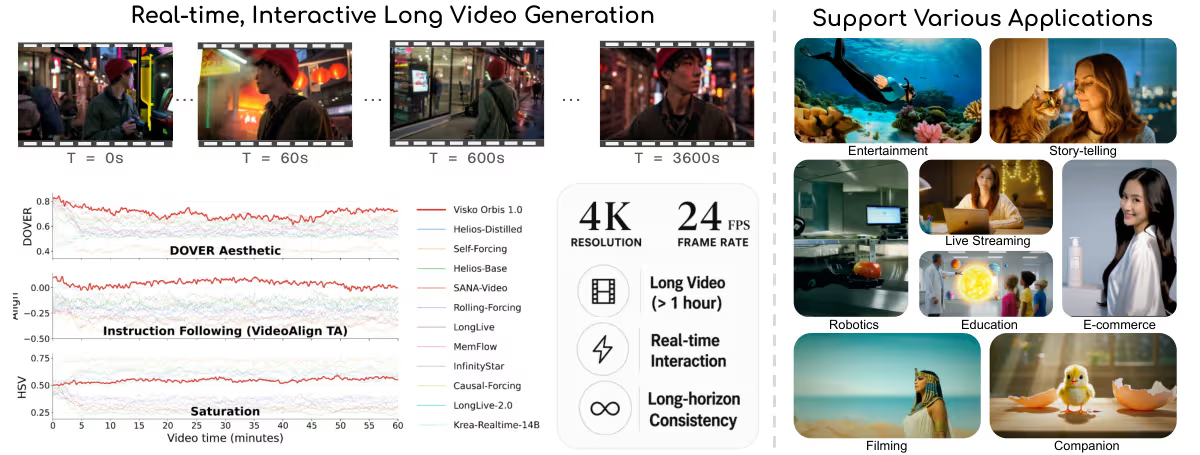
Visko's own teaser figure (below) demonstrates a single continuous rollout sampled at T=0s, T=60s, T=600s and T=3600s - a full hour - showing the same character and setting recognisably maintained throughout. The formal evaluation methodology tested shorter windows for automated scoring (74 cases, six events each, 10-30 seconds per event, yielding 1-3 minute videos) and separately ran a long-form human Arena study comparing 60- and 120-second outputs across nine systems.
Benchmarks: The Real Numbers
Visko's technical report publishes two distinct evaluation tables: an automated quantitative table against ten competing systems, and a human-preference Arena study against nine.
| Metric (automated, vs 10 systems) | Orbis 1.0 score | Rank |
|---|---|---|
| DOVER Aesthetic | 0.8101 | 1st |
| DOVER Technical | 0.5572 | 1st |
| VideoAlign Visual Quality | 1.5777 | 1st |
| VideoAlign Motion Quality | 1.8646 | 1st |
| VideoAlign Text Alignment | 0.1043 | 1st |
| VideoAlign Overall Reward | 3.5466 | 1st |
| HeliosBench Aesthetic Score | 0.5954 | 3rd (behind SANA-Video, LongLive) |
| Metric (human Arena, Elo, vs 9 systems) | Orbis 1.0 | Runner-up |
|---|---|---|
| Overall Preference | 1838 | HappyOyster - 1734 |
| Visual Fidelity | 1843 | HappyOyster - 1937 (leads) |
| Instruction / Switch Compliance | 1711 | HappyOyster - 1722 (leads) |
| Temporal Stability | 1940 | Odyssey - 1735 |
Source: Visko, "Orbis 1.0: A Live Model for Real-Time Interactive Long Video Generation" (arXiv:2607.26694). Long-form Arena study compared 60- and 120-second outputs with randomised side-by-side methodology.
Read plainly: Orbis 1.0 leads six of seven automated quantitative metrics outright, and leads two of four human-preference Arena dimensions. It does not lead every metric - a rival system named HappyOyster scores higher on both Visual Fidelity and Instruction/Switch Compliance in the human study, and Orbis ranks third rather than first on HeliosBench's separate Aesthetic Score measure, behind SANA-Video and LongLive. Visko's own reported conclusion is narrower and more defensible than "we win everything": that "Orbis's perceived advantage is concentrated in maintaining a coherent long-form viewing experience" - i.e., its strength is durability and stability over long rollouts specifically, not necessarily peak per-frame visual fidelity against every rival at every instant.
Data Curation & Safety
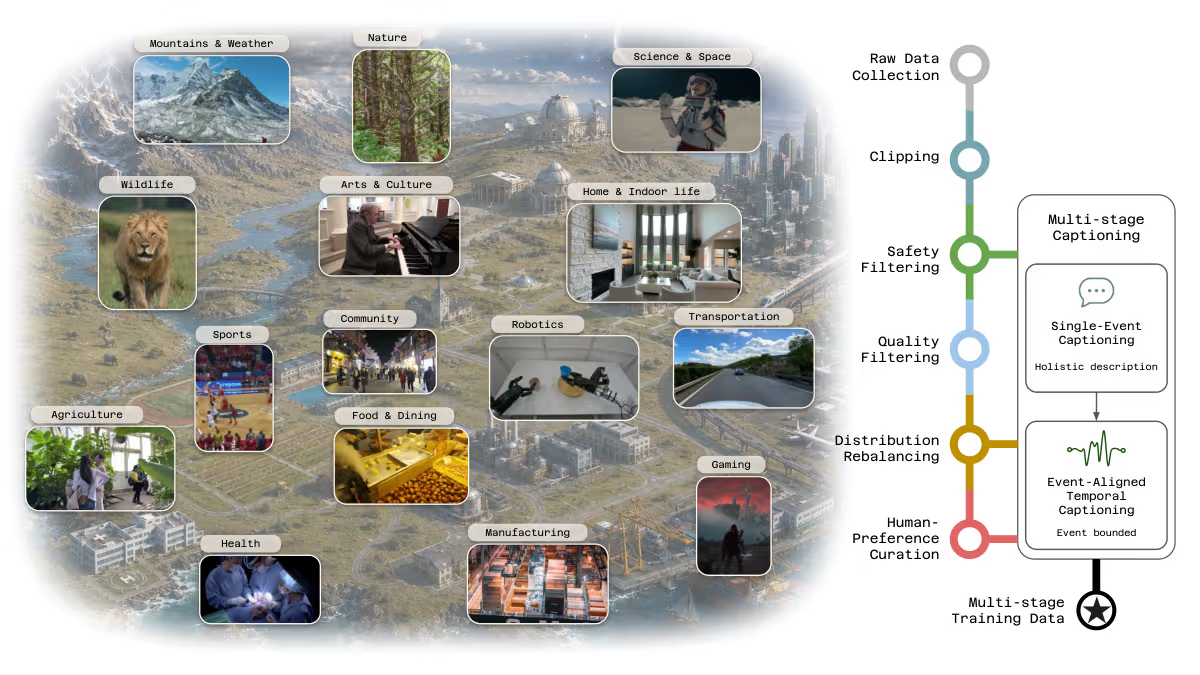
Visko's technical report describes a multi-stage data pipeline: raw video collection, shot-aware clipping into 3-240 second segments, safety filtering (combining automated classifiers with manual review for ambiguous cases), quality filtering with content-specific thresholds, distribution rebalancing across semantic domains, and a final human-preference curation and verification pass. Captioning itself runs in two stages - a holistic single-event description followed by event-aligned temporal captioning that segments longer clips into bounded events.
On safety specifically, the report states that "automated classifiers and rule-based checks screen for sexual or NSFW content, sexual exploitation or endangerment involving minors, graphic violence and gore, self-harm, hateful or extremist material, dangerous or illegal activity, sensitive personal information, and identity-sensitive content." Visko also states it maintains source and technical metadata for governance and analysis purposes, keeping detailed source proportions in an internal data manifest rather than publishing the full breakdown - a common practice among video-generation labs given the copyright sensitivity of large-scale video training data, but one that limits independent verification of the training set's composition.
Real-World Reception
Launch coverage across PR Newswire, Yahoo Finance and The Robot Report focused heavily on the funding angle and the "Live Model" category framing, with Dr. Jordan's named use cases - robotics, physical simulation, gaming, live commerce, education, real-time creative media - repeated across most outlets as the credible near-term application list, rather than pure entertainment content generation. That breadth is notable: it positions Orbis less as a competitor to clip-based tools like Seedance 2.0 or Sora 2 specifically, and more as infrastructure for any application that needs a continuously-running, steerable visual simulation.
Creator coverage of the public launch was positive on the steering latency specifically - the sub-one-second prompt-switch response is the single most demo-able feature, and the kind of capability that is hard to fake convincingly on stage if it doesn't actually work. As with any freshly-launched model, the honest caveat is that Visko's benchmark tables are self-reported from its own technical report; broader third-party benchmarking (Artificial Analysis, LMArena-style community evaluation) had not yet appeared at time of writing.
Availability & Pricing
Visko opened public access to Orbis at visko.ai on 1 September 2026, the same day as the funding announcement. The official launch materials reviewed for this piece do not disclose specific pricing tiers or a cost-per-minute figure for generation - a real gap for anyone trying to budget a production use case around it today. Distribution runs in part through a partner organisation called Reactor, which may account for some enterprise or platform-level access separate from the direct consumer product.
Limitations
- Not a universal benchmark leader: HappyOyster beats it on Visual Fidelity and Instruction/Switch Compliance in Visko's own human Arena study, and Orbis ranks third on HeliosBench Aesthetic Score.
- No public pricing disclosed at launch, making cost planning for production use cases difficult.
- Self-reported benchmarks: the quantitative and Arena tables come from Visko's own technical report; independent third-party benchmarking had not yet appeared at time of writing.
- Native resolution is upscaled: the model generates natively at 832x480 and reaches 4K via a separate super-resolution model, not native 4K generation.
- Undisclosed training-data composition: Visko keeps detailed source proportions in an internal manifest rather than a public breakdown.
- Very early-stage company: a 16-person team and a $10 million pre-seed round is a small operational base for a compute-intensive video-generation product; longevity and scaling risk are real considerations.
How It Compares
Against clip-based generators like Seedance 2.0 and Sora 2, Orbis 1.0 isn't really competing on the same axis - those tools optimise for the best possible short, bounded clip from a single prompt, while Orbis optimises for durability and steerability across an open-ended session. A production team choosing between them should ask which shape the task actually needs: a finished 15-second shot, or a continuously-running, interactively-directed stream.
Against Tencent WorldClaw, the comparison is closer in spirit: both are "world model"-adjacent systems using an internal physical model to constrain output, and both are pushing generative visual AI toward something more like an interactive environment than a static asset generator. WorldClaw targets editable 3D worlds from text, while Orbis targets continuous, steerable 2D video - different output formats aimed at an overlapping set of simulation, gaming and training-data use cases.
Who Should Use It
Try Orbis 1.0 if your use case genuinely needs continuous, steerable, long-form video rather than a fixed clip - live commerce demos, interactive story-telling, education content that adapts mid-session, or early-stage robotics/simulation prototyping where a persistent, physically-grounded visual environment matters more than one perfect shot.
Look elsewhere if you need a single polished, bounded clip for a specific creative deliverable - a clip-based tool with stronger per-frame visual fidelity, like the HappyOyster system that beats Orbis on that specific metric, or an established tool like Seedance 2.0, may be the better fit. Also hold off if firm, disclosed pricing is a hard requirement before you commit engineering time to integration - Visko has not published it yet.
The Bottom Line
Visko Orbis 1.0 is a genuinely new product shape, not just an incremental video-generation update - a model built to run continuously and be steered in real time, backed by a real technical report and a small but credible funding round. Its own numbers show real strength specifically in long-form durability and stability, exactly the property Visko set out to build.
It is not the best system on every measured dimension - Visko discloses that plainly rather than burying it - and the lack of public pricing plus its self-reported benchmark set are real reasons for caution before betting a production workflow on it today. For teams whose actual need is a continuously-running, interactive visual stream rather than a fixed clip, though, Orbis 1.0 is the clearest working example of the "Live Model" category currently available.
Last updated: 3 September 2026. Sources: Visko's official launch and funding announcement and the Orbis 1.0 technical report on arXiv (arXiv:2607.26694).
Get the free guide: Claude vs ChatGPT, Gemini & Grok
A 20-page playbook covering everything you need to choose and use the big four AI models in 2026, full cost and feature comparisons, what each is best (and worst) at, and how-tos for images, vectors, building a website, Claude Code and more.