 AI Tools Review Editorial Team
Quick answer:
WorldClaw is a Tencent Hunyuan research paper, published to arXiv on 5 August 2026, describing an agentic pipeline that turns a text prompt into an explicit, editable 3D world by orchestrating Claude Opus 4.8, GPT-Image-2, SAM3D and Hunyuan3D inside Blender. Despite YouTube coverage calling it "the first AI that builds a full editable 3D world," Tencent's own paper benchmarks itself against four prior systems that already do this - SynCity, WorldGen, MajutsuCity and World Labs' Marble - and none of the code, model weights, pricing or API needed to actually use WorldClaw has been released. It is a credible research contribution to an active field, but it is not yet a usable tool.
A video making the rounds today calls Tencent WorldClaw "the first AI that builds a full, editable 3D world from one sentence." That framing is contradicted by Tencent's own paper, which benchmarks WorldClaw against earlier systems that generate editable 3D worlds.
Here is what WorldClaw actually is, how its three-stage pipeline works, why you cannot use it yet, and how it compares with the existing field of AI world-generation research.
Julian Goldie SEO covers Tencent WorldClaw in this video.
Summary
WorldClaw, formally "WorldClaw: Agentic 3D Open-World Generation at Scale," is a paper from Tencent's Hunyuan team, hosted under the GitHub organisation Tencent-Hunyuan alongside the company's other Hunyuan3D research. It is not a rebrand or version bump of the existing Hunyuan3D mesh-generation models, nor is it the same lineage as Tencent's separate HunyuanWorld/HY-World video-based world models. It is a distinct agentic system that uses Hunyuan3D as one component among several.
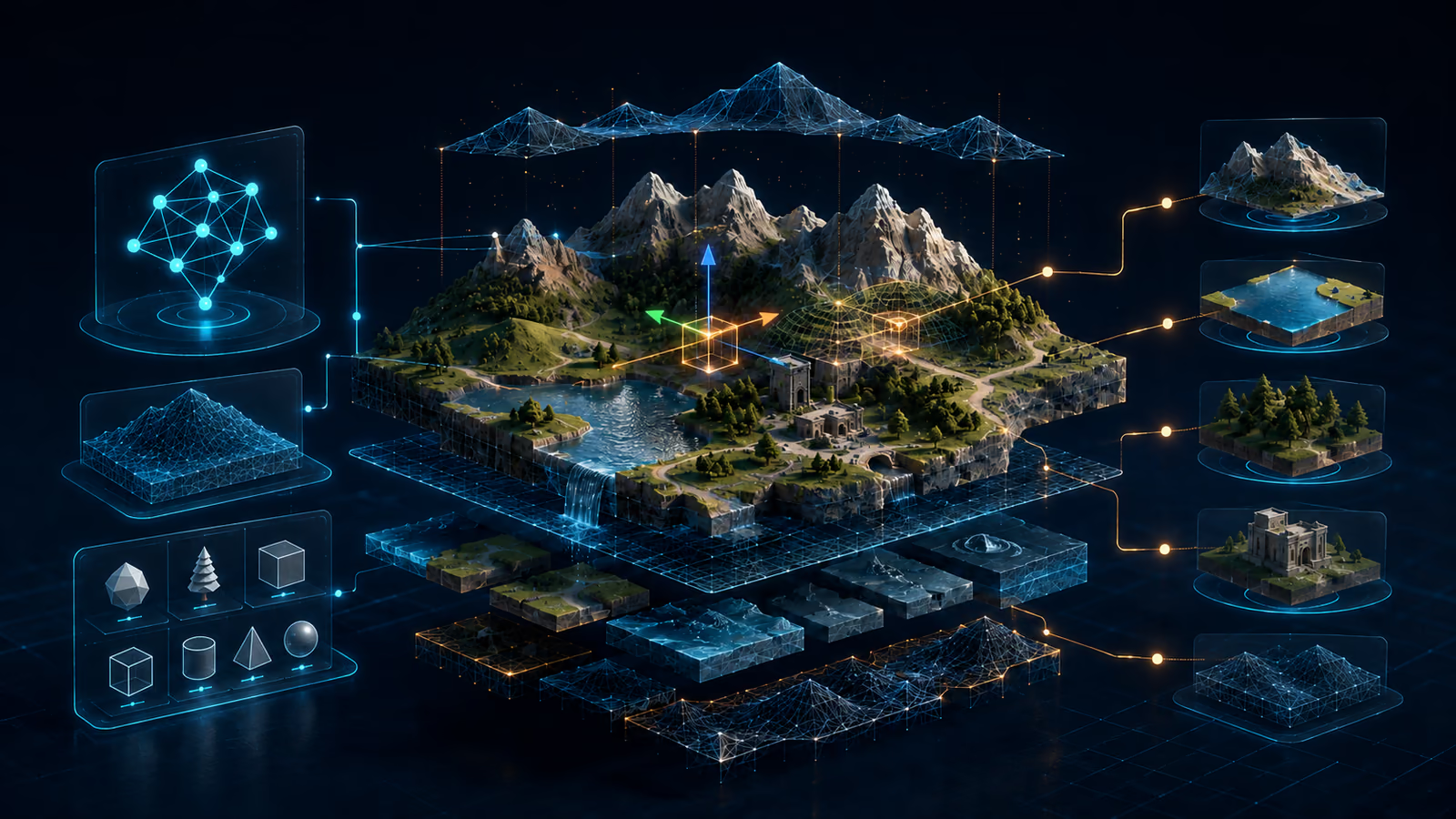
The technical approach is notable: instead of a single model trying to generate a whole 3D world in one pass, WorldClaw runs a multi-agent pipeline that plans a scene, generates terrain and assets, then places and refines objects region by region with a render-inspect-refine loop to catch scale and placement errors. The output is a set of explicit, textured, individually editable meshes. A game developer could take this type of asset into Unity or Unreal, unlike a video or point cloud.
- What it is: a research paper and project demo, submitted to arXiv 5 August 2026, not a shipped product.
- Architecture: an agentic three-stage pipeline orchestrating Claude Opus 4.8, GPT-Image-2, SAM3D and Hunyuan3D inside Blender, run on 4x NVIDIA H20 GPUs.
- Availability: no code, no model weights, no API, no pricing. The GitHub repo has an open issue publicly asking Tencent to add the missing implementation.
- Main caveat: it is not "the first". WorldGen, SynCity and MajutsuCity all shipped comparable text-to-editable-world systems first, and all comparisons in the paper are qualitative, not benchmarked with numbers.
What WorldClaw Actually Is
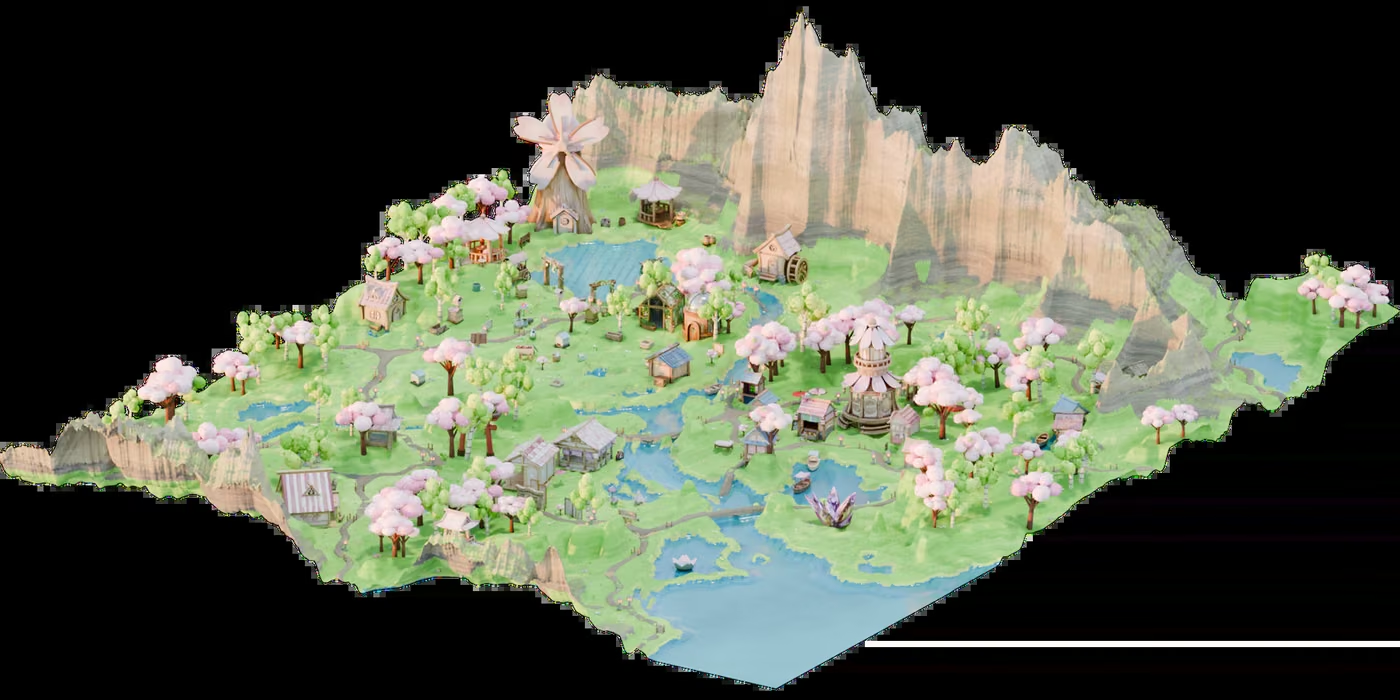
Tencent's own project page describes WorldClaw simply: "one prompt becomes an explicit, explorable, editable world," built around eleven demo worlds, four rendered channels per scene, and editable meshes as the deliverable. The authors listed on the paper - Chunchao Guo and Yang Li as project leads, alongside Jinpeng Li and Zilong Huang - are part of Tencent's Hunyuan research group, and the paper is hosted at arXiv 2608.05248, submitted 5 August 2026.
The key distinction from a typical text-to-3D generator is that WorldClaw does not train one model to do everything. It is explicitly agentic: an orchestration layer that calls out to existing frontier models for different sub-tasks, then does the actual 3D construction work inside Blender using Python scripting, with a vision-language model closing the loop by inspecting renders and flagging what still needs fixing. That is a meaningfully different engineering bet than training a single large generative model, and it is the paper's central technical contribution.
How It Works: A Three-Stage Agentic Pipeline
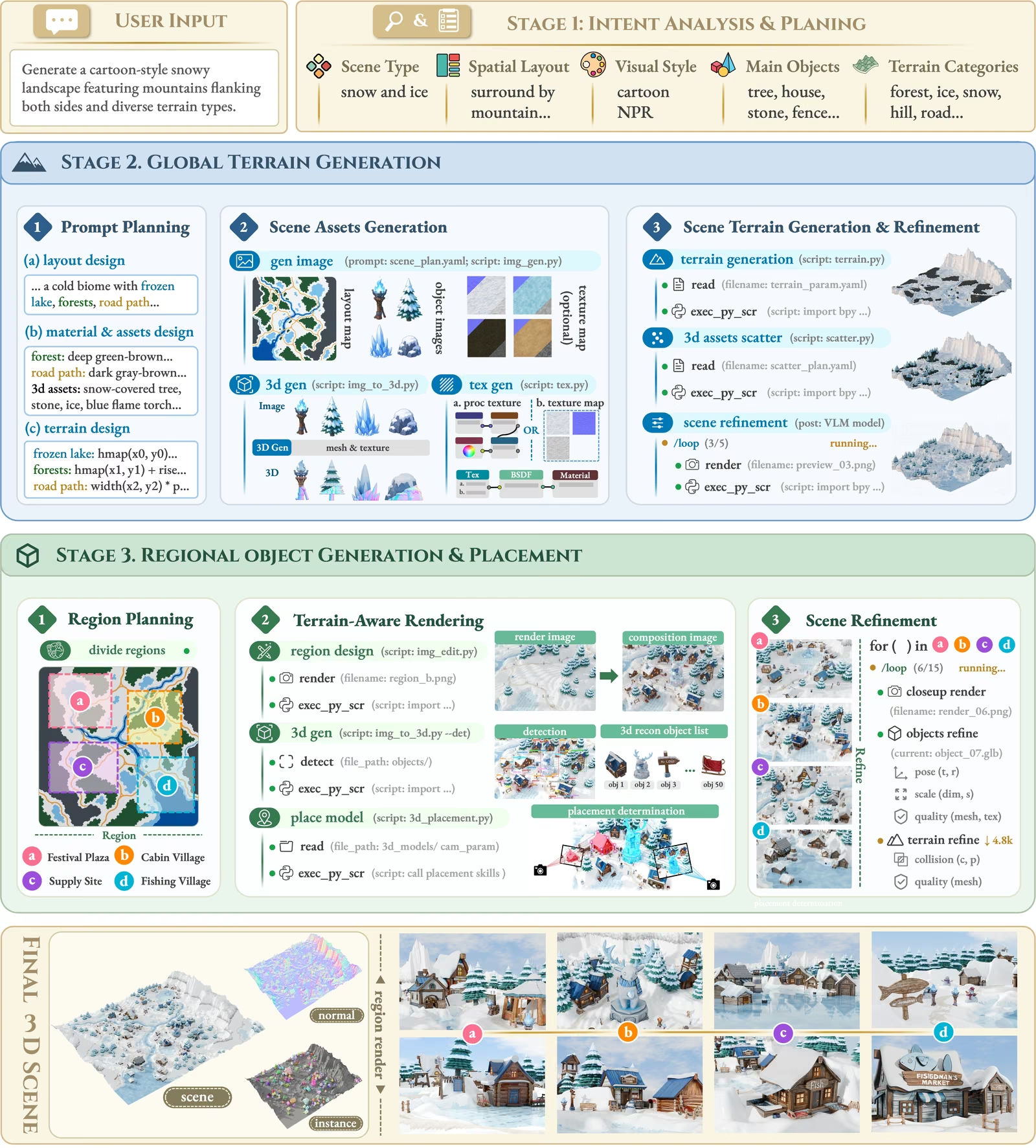
Stage 1 - Intent analysis and planning: an LLM (the paper specifies Claude Opus 4.8 in this role) parses the text prompt into a structured scene specification: scene type, spatial layout, visual style, the main objects to include and the terrain categories needed. A prompt like "a cold biome with a frozen lake, forests, road path" gets decomposed into concrete parameters the later stages can act on.
Stage 2 - Global terrain generation: the pipeline plans materials and assets, generates layout and texture images with GPT-Image-2, converts key assets to 3D, then generates and scatters terrain across the scene using height-map parameters derived from the plan. A render-inspect-refine sub-loop checks the terrain output against the intended design and iterates.
Stage 3 - Regional object generation and placement: the scene is divided into named regions (the demo scene shown in the paper uses a "Festival Plaza," "Cabin Village," "Supply Site" and "Fishing Village" as an example), and each region gets object detection, 3D reconstruction of individual assets via SAM3D and Hunyuan3D, and terrain-aware placement - checking scale, pose, and collisions before a final scene refinement pass produces the finished, editable 3D world.
Availability: Paper, Not Product
This is the section that separates WorldClaw from something you can actually try today. The GitHub repository, Tencent-Hunyuan/Hunyuan3D-WorldClaw, contains an assets folder, a .gitignore file and a README - no implementation code, no training or inference scripts, no model weights. An open issue on the repo, titled plainly "No code in here," reads: "You forgot to commit the code to this repo, so that we can reproduce your results." As of this article, it remains unanswered.
There is a Hugging Face listing for the paper itself, but no downloadable weights specific to WorldClaw. No pricing page, API endpoint or product tier exists anywhere in Tencent's materials. The hardware footprint disclosed in the paper - four NVIDIA H20 GPUs to run the full pipeline - is also not a consumer-accessible setup even if the code were released tomorrow. Independent commentary picking up the paper has explicitly flagged this gap, cautioning that "the exact license and complete code/weight availability should be verified" before treating WorldClaw as something usable.
None of this makes WorldClaw uninteresting. Research papers routinely precede public releases by months, and Tencent's Hunyuan3D line has a track record of eventually shipping open-weights models. But as of 14 August 2026, "Tencent just dropped WorldClaw" is more accurately "Tencent just published a WorldClaw paper and demo reel" - a real distinction for anyone deciding whether to wait for it.
A Crowded Field, Not a Category First
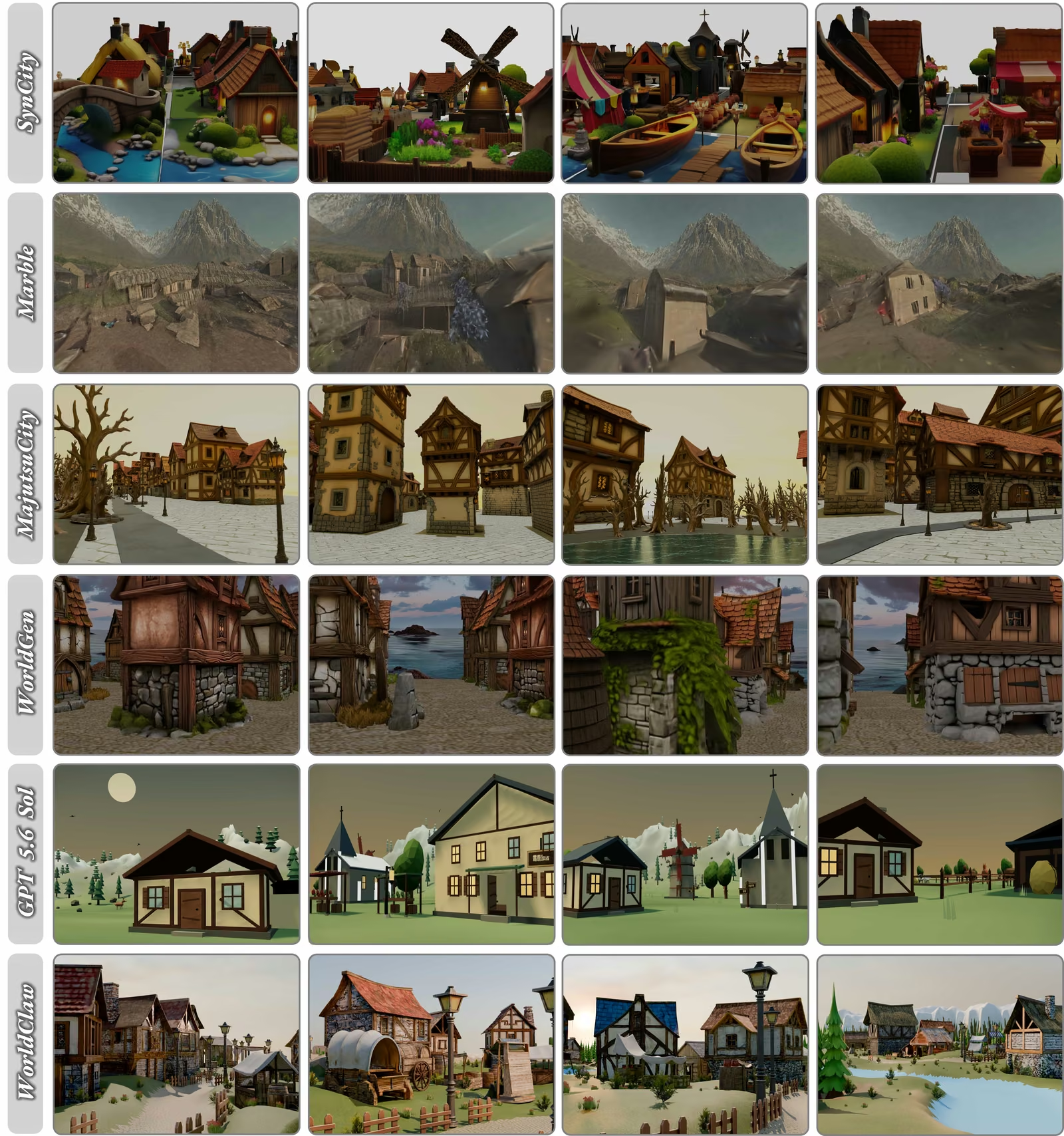
This is the figure that undercuts the "first ever" framing most directly. WorldClaw's own authors chose to compare their system against four existing approaches to text-to-editable-3D-world generation: SynCity (a training-free, tile-by-tile pipeline built on Flux and TRELLIS), Marble (World Labs' commercial product, discussed in more detail below), MajutsuCity (a city-generation-focused system, published to arXiv in November 2025) and WorldGen (Meta Reality Labs' text-to-traversable-world system, also published in late 2025 and presented at CVPR 2026). WorldGen and MajutsuCity both predate WorldClaw's publication by roughly nine months.
The paper's own qualitative claims are that SynCity shows "visible block-wise artifacts" from its tile-based approach, that Marble has "high visual fidelity locally but degrades with distance" and lacks independent object control, and that WorldGen is the "closest baseline for editability" but with less varied terrain than WorldClaw claims to produce. These are Tencent's self-reported characterisations of competing work, not independently verified benchmark results - worth remembering given that the entire comparison in the paper is visual side-by-side, with no quantitative metric attached to any of it.
How It Compares: Genie 3 and Marble
Two names come up whenever "AI world generation" is mentioned, and it's worth being precise about how WorldClaw relates to each. Google DeepMind's Genie 3 generates a real-time, playable interactive video world - you explore it at 24fps in a browser-like interface, but there is no exportable 3D geometry to take anywhere else. WorldClaw solves a different problem: it produces static, explicit, textured meshes you can open in Blender, Unity or Unreal and keep editing. That is precisely why WorldClaw's own comparison figure never puts itself up against Genie 3 - they are not competing products, they are different categories of output entirely (interactive video versus a reusable game-engine asset).
Marble, from Fei-Fei Li's World Labs, is the closer real-world comparison, because it also targets 3D-world output rather than video. Marble launched commercially in November 2025 with a genuine pricing structure - a free tier plus paid plans running from around $20 to $95 a month - meaning it is a product you can actually buy and use today, unlike WorldClaw. WorldClaw's paper claims better independent object-level editability and less quality degradation with distance; Marble has the advantage of existing as a shipping, paying-customer product with a year's head start on real-world usage feedback.
Limitations
- No usable release: no code, no weights, no API, no pricing - only a paper and a demo page, with an open GitHub issue calling out the missing implementation.
- Not a new foundation model: WorldClaw is an orchestration layer over Claude Opus 4.8, GPT-Image-2, SAM3D and Hunyuan3D - its output quality is bounded by those underlying models, not by any novel generative architecture of its own.
- Qualitative comparisons only: the paper's entire case against SynCity, Marble, MajutsuCity and WorldGen is a visual grid, with no FID, CLIP-score or user-study metric published.
- Agentic pipeline is slow: the paper itself notes that the long-horizon, multi-stage agentic approach carries substantial inference latency and is less efficient than single-shot methods for simple scenes.
- LLM-driven errors compound: scale, pose or scene-graph mistakes made by the planning LLM propagate visibly into the final scene, requiring repeated render-refine iterations to catch.
- Limited independent coverage: coverage so far is confined to AI-research aggregators and enthusiast commentary rather than established outlets such as TechCrunch, The Verge or VentureBeat.
Reception: Research Community, Not Mainstream Press
No major Western tech outlet - TechCrunch, The Verge or VentureBeat among them - had covered WorldClaw as of this article. What coverage does exist is concentrated in AI-research aggregators (alphaXiv, HyperAI, Hugging Face's paper listing) and enthusiast social commentary; one 3D-AI-focused account characterised it as a milestone moment where "instead of a single 3D asset, AI now generates an entire 3D world full of editable assets," while broader aggregator commentary noted the appeal of direct Unity/Unreal compatibility. That is a fair, if early, characterisation of the paper's actual contribution - it just should not be confused with independent journalistic verification, which has not happened yet.
That gap between research-community enthusiasm and mainstream coverage is itself informative: it is the pattern you'd expect for a genuine, credible paper that has not yet crossed into product territory, rather than either a launch getting proper scrutiny or a story getting overhyped by press. The YouTube coverage that used "first ever" framing sits closer to the enthusiast end of that spectrum than to a verified claim.
Who Should Care Right Now
Worth tracking if you work in game development, virtual production or 3D content pipelines and want an early read on where agentic, multi-model orchestration approaches to world generation are heading - the pipeline design itself, independent of whether Tencent ever ships it, is a useful reference architecture.
Not yet actionable if you need a working tool today. For an actual product you can buy and use now, World Labs' Marble is the closer fit among the systems discussed here; for real-time interactive exploration rather than exportable assets, Google's Genie 3 solves a different but related problem. Revisit WorldClaw once - or if - Tencent answers that open GitHub issue and ships code and weights.
The Bottom Line
WorldClaw is a technically interesting piece of research: a well-documented, thoughtfully engineered agentic pipeline that orchestrates several frontier models to produce editable 3D worlds rather than training one model to do it all. That is a real and useful contribution to a field that already includes Marble, WorldGen, SynCity and MajutsuCity.
As of 14 August 2026, it is neither the category first described by same-day creator coverage nor something readers can open and use. It is a promising paper worth following, not a tool worth changing workflows for. That distinction is clear in the primary sources.
Last updated: 14 August 2026. Sourced from Tencent Hunyuan's WorldClaw paper (arXiv 2608.05248) and official project page, the Tencent-Hunyuan/Hunyuan3D-WorldClaw GitHub repository, and independent research-community commentary.
Get the free guide: Claude vs ChatGPT, Gemini & Grok
A 20-page playbook covering everything you need to choose and use the big four AI models in 2026, full cost and feature comparisons, what each is best (and worst) at, and how-tos for images, vectors, building a website, Claude Code and more.