
 AI Tools Review Editorial Team
Quick Answer:
Meituan released LongCat-2.5 on 01/11/2026 (some outlets say 02/11/2026): a native multimodal mixture-of-experts model with 1.6 trillion total parameters, about 48 billion active per token and a 1 million-token context window, built for long-horizon agentic work. Meituan's self-reported scores are strong on agent benchmarks (Terminal Bench v2.1: 88.4, BrowseComp: 91.9) but behind Claude Opus 5 on the harder Terminal Bench v4.0 (38.5 vs 53.9). Weights are promised but not yet published, and none of the numbers is independently verified.
The company best known in the West as a Chinese food-delivery giant has just shipped a very large model. On 01/11/2026 Meituan's LongCat team announced LongCat-2.5, a 1.6-trillion-parameter model that accepts images alongside text and is aimed squarely at the job every lab is now chasing: agents that keep working, sensibly, for hours rather than minutes.
This article pulls together what is actually known: the architecture, the unusually detailed infrastructure claims, the benchmark table (and the places where it does not flatter the model), pricing, availability, and the gaps that matter before you rebuild anything on it. Where a figure comes from Meituan alone, we say so. Where sources disagree, we say that too.
Julian Goldie SEO walks through LongCat 2.5 and three business workflows built on it: a landing page, an SEO content brief and a lead-magnet report.
Executive Summary
LongCat-2.5 is the successor to LongCat-2.0 from Meituan's LongCat team. It is a native multimodal mixture-of-experts (MoE) model: 1.6 trillion parameters in total, roughly 48 billion of which are activated for any given token. It takes text and image input (one aggregator also lists video input) and produces text, with a 1 million-token input window. Meituan's own framing is that it is a model for long-horizon agentic tasks, with visual understanding added to a coding-focused lineage.
The headline findings, with the source of each:
- Scale: 1.6T total, ~48B active per token (about 3% of the weights doing the work on each token). Source: Meituan launch post as relayed by TechNode, FourWeekMBA and RuntimeWire.
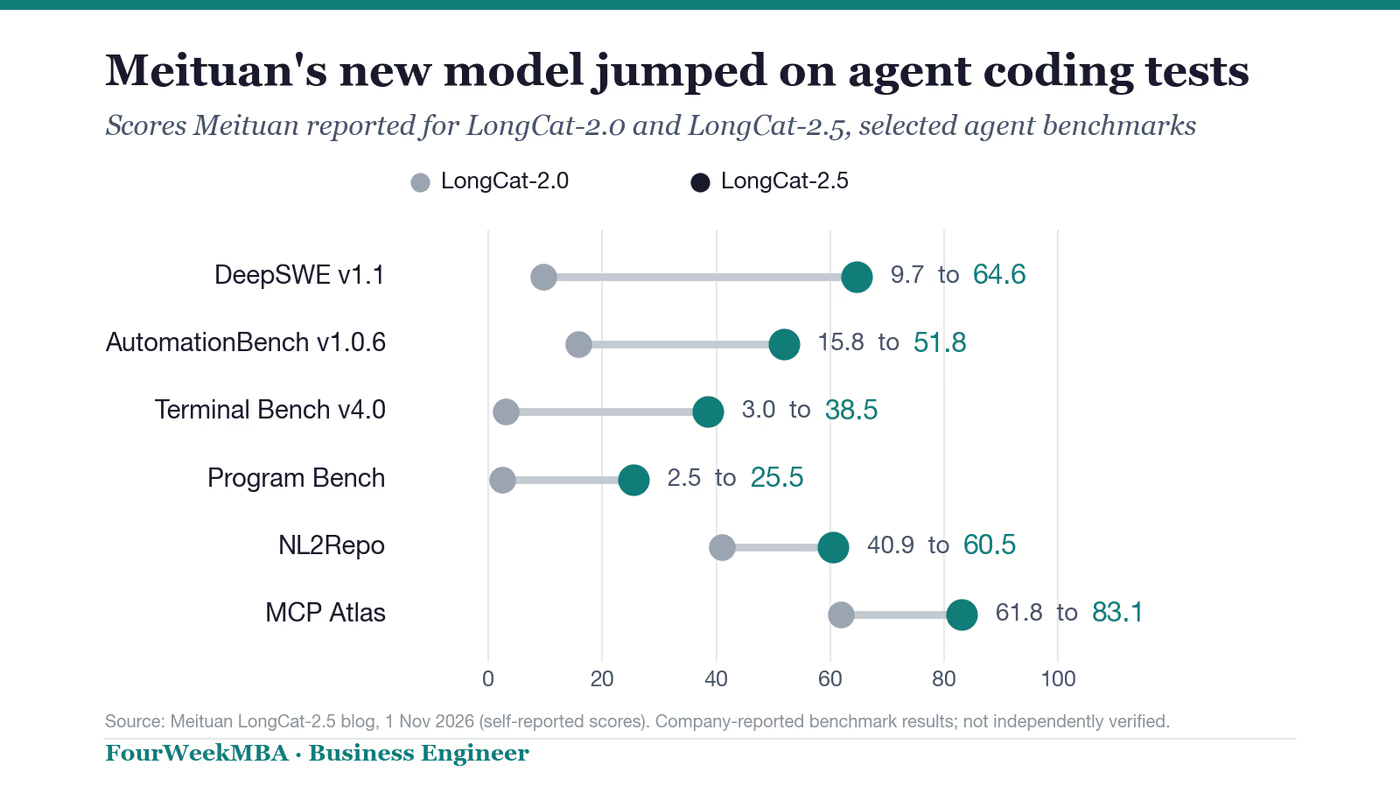
- Agent benchmarks: large jumps over LongCat-2.0 on every agent benchmark Meituan charted, for example DeepSWE v1.1 from 9.7 to 64.6 and Terminal Bench v4.0 from 3.0 to 38.5. Self-reported.
- Versus frontier rivals: ahead of GPT-5.6-Sol on 20 of 27 shared tests and Claude Opus 5 on 10 of 27, according to FourWeekMBA's tally of Meituan's table. Behind Opus 5 by a wide margin on Terminal Bench v4.0.
- Infrastructure: trained and served on unnamed domestic Chinese accelerators with under 80 GB of memory each, using FSDP and 4-bit (W4A4) inference.
- Availability: live in Meituan's chat service and API. GitHub and Hugging Face releases are listed as coming soon, with no date and no licence stated.
If you only take one thing away: LongCat-2.5 is a credible, very large, agent-focused model from outside the usual US labs, but the evidence for it is currently a company blog post plus secondary reporting. Treat the numbers as claims until someone else reproduces them.
Who Is Meituan and Why Is It Building a Frontier Model?
Meituan, co-founded by Wang Xing, runs China's largest local-services platform, covering food delivery, groceries, travel and in-store services. That background explains the product direction better than any benchmark does. A company that coordinates millions of couriers and merchants cares about long, messy, multi-step workflows that touch many tools, which is exactly the definition of agentic work.
The same logic shows up in the marketing image RuntimeWire used for the launch: one of Meituan's yellow delivery robots beside a branded paper bag, with floating screens showing pedestrians crossing streets. Whether or not that is a hint about embodied ambitions, it signals that the company sees its models as operating software that acts in the world, not just chatbots.
LongCat is Meituan's model family, and this is the second major generation. The jump from 2.0 to 2.5 is not a gentle iteration: the charted agent scores moved by tens of points, which suggests most of the work went into post-training and agent tooling rather than raw pre-training scale (our inference, not a Meituan statement). The September preview of 2.5 reportedly shipped with no benchmarks at all, which makes the full launch table the first real data.
For readers following the wider Chinese open-model race, this lands in the same fortnight as Kimi K3.1 Pro's open-weights release and shortly after DeepSeek V4.1 Flash and GLM-5.3. The pattern is clear: Chinese labs are converging on the same recipe of very large sparse models, long context and heavy reinforcement learning on agent tasks.
AI Search's 08/11/2026 news round-up covers LongCat 2.5 at 42:34 alongside Kimi K3.1, ERNIE 5.5 Flash and a long list of research releases.
Architecture: What 1.6T Total and 48B Active Really Means
A dense model uses every parameter for every token. A mixture-of-experts model splits much of its feed-forward capacity into many specialist sub-networks and routes each token to only a few of them. LongCat-2.5 is reported as 1.6 trillion parameters with about 48 billion active, so around 3% of the weights are used per token. That ratio is the whole point of the design: you get the knowledge capacity of a giant model at something closer to the per-token compute of a mid-sized one.
There are trade-offs that the headline number hides. Memory is set by total parameters, not active ones, so you still need to hold 1.6 trillion weights somewhere, which is why serving such a model needs many accelerators and careful sharding. Routing quality matters enormously, because a poor router wastes the experts. And long context makes it harder still, because key-value caches grow with every token of that 1 million-token window.
Context window and output limits
Sources agree on a 1 million-token input window. Maximum output is reported as 128K tokens in Meituan's API documentation, while the aggregator llm-stats lists 131.1K, which is simply 128 x 1,024 expressed in a different way. For agent work the output limit matters as much as the input: a model asked to write or rewrite a large codebase needs room to emit it.
Native multimodality
TechNode reports that the model handles visual and text inputs in a unified token framework, supporting visual coding, creative design and 3D tasks. The word to focus on is native. Rather than bolting a separate vision encoder onto a text model after the fact, the claim is that images and text are processed in one shared representation. In practice that is what lets an agent look at a screenshot of a broken interface and fix the code behind it in one loop, which is the use case Meituan highlights.
Output is text only. This is a model that sees, but it does not generate images or audio itself.
The Infrastructure Story: Domestic Chips, FSDP and 4-bit Inference
The most unusual part of the launch post is how much it says about hardware and systems. As summarised by FourWeekMBA, Meituan states that training used domestic AI accelerators, although the vendor is not named. The accelerators used for long-sequence training have less than 80 GB of memory each, which is a tight budget for a model of this size and context length.
- Supernode topology: Meituan describes arranging devices so that heavy traffic stays inside a high-bandwidth interconnect domain rather than crossing slower links.
- FSDP over DDP: Fully Sharded Data Parallel, which shards parameters, gradients and optimiser state across devices, delivered 86% higher per-device throughput than a distributed data parallel baseline in long-sequence fine-tuning.
- W4A4 inference: experts run with 4-bit weights and 4-bit activations. Against an 8-bit baseline in online stress tests, Meituan reports prefill throughput up 43.3%, decode throughput up 42.77% and time to first token down 15.91%.
Why does this matter beyond engineering pride? Because it speaks to supply-chain resilience. If a 1.6-trillion-parameter model with a million-token window can be trained and served on accelerators that are not the latest US-designed parts, then export controls on advanced chips constrain Chinese labs less than many forecasts assumed. We would not over-read a single blog post, but it is a data point, and it is consistent with the efficiency-first approach we have seen from DeepSeek's V4 line.
Two honest caveats. First, all of these systems numbers are self-reported baselines, and a comparison against a deliberately weak baseline can look impressive. Second, W4A4 quantisation is aggressive: quality loss at 4-bit activations is a known risk, and Meituan has not, in the material we could see, published a quality comparison between the quantised and full-precision model. Anyone self-hosting should test their own tasks.
How It Was Trained: Long Task Sequences and Failure-Driven RL
TechNode relays two training claims worth dwelling on. The first is that Meituan expanded training on long task sequences, so the model sees many steps of an agent's work rather than isolated question-and-answer pairs. The second is that it used large-scale reinforcement learning to improve performance on complex codebases and complete software projects.
The third claim is the most interesting: Meituan says it converts failures that real agents encounter into reproducible training tasks, closing gaps in model performance. That is a data flywheel. When an agent gets stuck, say on a flaky build, an unusual tool error or a misread requirement, the failure is captured, turned into a reproducible environment, and fed back as something the model can practise against.
This approach is sensible and increasingly common, and it explains why the agent benchmark scores moved so much between 2.0 and 2.5. It also carries a known risk: a model trained heavily on its own harness's failure modes can become excellent inside that harness and brittle outside it. Which brings us to the benchmark methodology.
Benchmarks: The Numbers, and the Honest Caveats
Meituan compared LongCat-2.5 against GPT-5.5, GPT-5.6-Sol, Claude Opus 4.8, Claude Opus 5, GLM-5.3, Kimi K3 and DeepSeek V4.1 Flash across 31 benchmarks. The full table is in the launch post. The chart below, produced by FourWeekMBA from Meituan's published scores, shows the six agent benchmarks where the gain over LongCat-2.0 is largest.
| Benchmark | LongCat-2.0 | LongCat-2.5 |
|---|---|---|
| DeepSWE v1.1 | 9.7 | 64.6 |
| AutomationBench v1.0.6 | 15.8 | 51.8 |
| Terminal Bench v4.0 | 3.0 | 38.5 |
| Program Bench | 2.5 | 25.5 |
| NL2Repo | 40.9 | 60.5 |
| MCP Atlas | 61.8 | 83.1 |
Against the frontier
The comparison with rivals is more mixed, and it is where a careful reader should slow down. FourWeekMBA reports these company-published results:
- Terminal Bench v2.1: LongCat-2.5 scored 88.4, against 88.8 for GPT-5.6-Sol and 89.1 for Claude Opus 5. Effectively a three-way tie at the top.
- BrowseComp: LongCat-2.5 scored 91.9 against 90.4 and 90.8 for two rivals (the source does not label which is which).
- Terminal Bench v4.0: LongCat-2.5 scored 38.5 against 53.9 for Claude Opus 5. This is the clearest gap in the published numbers.
- Head-to-head tallies: higher than GPT-5.6-Sol on 20 of 27 shared tests, higher than Claude Opus 5 on 10 of 27, and higher than DeepSeek V4.1 Flash on 12 of 26.
Read plainly, that says LongCat-2.5 is competitive with the best closed models on some agent tasks, clearly behind Opus 5 overall, and much closer to GPT-5.6-Sol. It is a strong result, not a leap to the top. For how those rivals themselves perform, see our coverage of Claude Opus 5 and GPT-5.6.
Why the harness matters
One detail changes how to read everything above. Meituan says its coding evaluations for Terminal Bench and similar tests were run inside Anthropic's Claude Code harness. That is a reasonable choice, since Claude Code is the most widely used agent scaffold, but it means the model was evaluated in a scaffold designed around another family of models. Scores in agent benchmarks depend heavily on scaffolding, tool definitions and retry policy. A different harness can move results by many points in either direction.
Three other cautions apply. The scores are company-reported and, at the time of writing, we have found no independent reproduction. The aggregator llm-stats lists no numeric scores at all for the model, marking comparison models as pending. And the very large jump on Terminal Bench v4.0 (3.0 to 38.5) is from a very low base, so the relative improvement looks more dramatic than the absolute capability.
Real-World Use: What the Creator Demos Show
The video coverage so far is mostly practical. Julian Goldie SEO's walkthrough, titled as covering China's new LongCat 2.5 with 1.6 trillion parameters, runs through three business workflows: building a landing page, writing an SEO content brief and producing a lead-magnet report. These are sensible smoke tests for a coding-and-writing agent, and they tell you the model can be pointed at ordinary commercial tasks.
They do not tell you much about reliability. A single successful landing page is one sample, and creator demos are, by nature, the runs that worked. The more informative evidence for a long-horizon model would be completion rates over dozens of multi-hour tasks, and Meituan has not published project-completion benchmarks of that kind. One report says so explicitly.
If you are evaluating the model yourself, we suggest a short protocol. Pick five tasks from your real backlog that take a human two to eight hours. Run each three times with the same scaffold you use for your current model. Record completion, number of human interventions and cost. That is a better predictor than any leaderboard.
Pricing and Availability
LongCat-2.5 is available through Meituan's online chat service and its API platform. The API offers both OpenAI-format and Anthropic-format endpoints, which makes it a near drop-in for existing tooling. That is a pragmatic detail: many agent frameworks, including Claude Code, can be pointed at a compatible endpoint with little more than a base URL change.
The aggregator llm-stats lists Meituan as the only provider and gives pricing of $0.30 per million input tokens and $1.20 per million output tokens (roughly £0.23 and £0.93, assuming about $1.30 to the pound). Cached input is listed inconsistently on the same page, at either $0.006 or $0.01 per million tokens. Treat these as indicative and check Meituan's own pricing page, which we could not load directly.
- Open weights: GitHub and Hugging Face releases are described as coming soon. No date has been given.
- Licence: not stated in any source we could access. This is the single most important unknown for commercial use.
- Date discrepancy: sources give 01/11/2026 or 02/11/2026 as the launch date. Meituan's own post is reported as 01/11/2026, with the secondary coverage following on 02/11/2026.
For context, those prices are far below the frontier closed models, which is the usual story with Chinese releases and part of why they matter to cost-sensitive agent builders.
Limitations and Open Questions
- No independent evaluation yet. Every benchmark number traces back to Meituan.
- No weights, no licence. Until the Hugging Face release lands you cannot self-host, audit or fine-tune.
- No safety documentation we could find. Frontier labs increasingly publish system cards covering cyber, biological and autonomy evaluations. We found no equivalent for LongCat-2.5. For a model built to run autonomously for long periods with tool access, that gap is notable. See how others have handled it in our coverage of Kimi K3's sandbox escape.
- Harness dependence. Results were produced in a competitor's scaffold. Your results will differ.
- Quantisation quality. The W4A4 speed gains are documented; the accuracy cost is not.
- Data governance. Using Meituan's hosted API sends your prompts to a China-based provider, which matters for regulated data. Self-hosting, when it is possible, is the cleaner route.
How It Compares
| Model | Total / active params | Context | Where it stands |
|---|---|---|---|
| LongCat-2.5 | 1.6T / ~48B | 1M input | Strong agent scores, self-reported, weights pending |
| Claude Opus 5 | Not disclosed | See our review | Leads on Terminal Bench v4.0 (53.9 in Meituan's table) |
| GPT-5.6-Sol | Not disclosed | See our review | Edges LongCat-2.5 on Terminal Bench v2.1 (88.8 vs 88.4) |
| DeepSeek V4.1 Flash | Not covered here | See our review | LongCat-2.5 ahead on 12 of 26 shared tests |
The honest summary is that LongCat-2.5 sits in the same tier as the leading closed models on agentic coding and browsing, while being substantially cheaper per token on the aggregator's listed prices. Whether it stays there under independent testing is the open question. Our coverage of Claude Opus 5.5 and the GPT-6 Sol versus Claude Opus 5.5 comparison gives the benchmark for what the very top currently looks like.
Who Should Pay Attention
- Agent and tooling developers: the OpenAI-compatible and Anthropic-compatible endpoints make a trial cheap. Run it against your own task suite.
- Cost-sensitive teams: if the listed pricing holds, a model that is competitive on agent tasks at a fraction of frontier prices is worth a serious look.
- Infrastructure and policy watchers: the domestic-accelerator training claim is the most strategically interesting part of the release.
- Regulated industries: wait for weights, a licence and independent evaluation before sending sensitive data anywhere.
The Bottom Line
LongCat-2.5 is a significant release: a 1.6-trillion-parameter, natively multimodal agent model from Meituan, with a 1M-token window, large reported gains over its predecessor and a notably open account of how it was trained and served. On the evidence published, it competes with the best closed models on several agent tasks and trails Claude Opus 5 on the hardest terminal benchmark.
But the evidence is a vendor blog post. Until weights, a licence, a safety write-up and independent reproductions arrive, the sensible position is interested scepticism: trial it on your own work, do not rebuild on it yet, and revisit when the Hugging Face release and third-party results land. We will update this article when they do.
Sources
- Meituan LongCat team: Introducing LongCat-2.5 (01/11/2026, primary source (the page body could not be loaded by our fetcher; figures are taken from the secondary reports below)).
- FourWeekMBA: Meituan's 1.6T Model on Chinese Chips Rivals OpenAI GPT-5.6 (02/11/2026, source of benchmark figures, infrastructure numbers and the chart).
- TechNode: Meituan launches LongCat-2.5 (02/11/2026, source for training and multimodal claims and availability).
- RuntimeWire: Meituan launches LongCat-2.5 (02/11/2026).
- llm-stats: LongCat-2.5 (aggregator listing for pricing, context and modalities).
- Julian Goldie SEO on YouTube: This NEW Chinese AI is WILD! (07/11/2026).
- AI Search on YouTube: AI NEWS round-up (08/11/2026).
Chart: FourWeekMBA, built from Meituan's self-reported scores, downloaded and compressed to AVIF. Hero: Meituan logo from TechNode's coverage, cropped and compressed to AVIF.
Last updated: 08/11/2026. Benchmark figures are company-reported and relayed by secondary sources; we have not independently verified them.
Get the free guide: Claude vs ChatGPT, Gemini & Grok
A 20-page playbook covering everything you need to choose and use the big four AI models in 2026, full cost and feature comparisons, what each is best (and worst) at, and how-tos for images, vectors, building a website, Claude Code and more.