
 AI Tools Review Editorial Team
Quick answer:
Meta Muse Glimmer, released on 10 August 2026, is a 30-billion-parameter open-weight model under Apache 2.0 built for local agentic work. Meta's quantised releases target 24GB or 32GB devices, while full precision targets 64GB. Artificial Analysis scored it at 35 on its Intelligence Index, with strong tool-use results but weaker coding and knowledge-work scores than Qwen3.6-27B on several tests. Meta's model card rates chem/bio risk as Moderate or lower and infers the same rating for cyber and loss of control. Artificial Analysis also measured an 82% hallucination rate on AA-Omniscience, so consequential local-agent actions still need human approval.
Muse Glimmer gives Meta a smaller open-weight counterpart to the closed Muse Spark line. It is designed for local coding, tool use and personal-agent workflows rather than frontier-scale cloud inference.
This review separates Meta's hardware and benchmark claims from Artificial Analysis's independent results, then examines licensing, hosted costs, safety evidence and the limits of unattended use.
A first-look walkthrough of Muse Glimmer's local install, agentic task demos and initial benchmark claims.
Summary
Muse Glimmer is Meta Superintelligence Labs' answer to a specific gap: everything the company had shipped since Muse Spark 1.1 and Muse Spark 1.2 in 2026 was closed, cloud-hosted and billed by the token. Glimmer inverts that: it is a 30B dense model, distilled down from the larger closed Muse Spark using logit distillation during pre-training, released with downloadable weights under the permissive Apache 2.0 licence, and explicitly engineered to fit on a single consumer GPU rather than a data-centre rack.
The pitch is narrower than "another frontier model": Meta is positioning Glimmer for always-on local agents that handle coding, tool use, scheduling and file work directly on your device, without every request leaving your machine. That is a meaningfully different product category from a chat model, and the benchmark suite Meta chose to publish reflects it - agentic tool-use and multi-step reasoning benchmarks dominate, rather than the general knowledge tests that headline most model launches.
- Best for: local coding agents, function calling, LLM-as-judge evaluation pipelines, and always-on personal-agent workflows that need to stay on-device.
- Headline numbers: 35 on the Artificial Analysis Intelligence Index, best result on 12 of 24 rows in Meta's own Gemma4-31B/Qwen3.6-27B comparison table, runs in roughly 17-20GB at 4-bit quantisation.
- Defining trait: a distilled open-weight sibling of the closed Muse Spark model, purpose-built to run entirely on one consumer GPU.
- Main caveat: Qwen3.6-27B still leads on harder coding and computer-use benchmarks, and Artificial Analysis recorded a high hallucination rate on its AA-Omniscience test.
Lineage: Distilled from Muse Spark
Muse Glimmer's relationship to the rest of the Muse family is the single most important thing to understand about it. Meta's own research blog describes Glimmer as distilled from Muse Spark - the closed, proprietary flagship that debuted in April 2026 and was later updated into the coding-focused Muse Spark 1.2 - using logit distillation during pre-training. In plain terms, Meta trained the smaller 30B model to mimic the output distribution of its much larger closed sibling, rather than training Glimmer from scratch as an independent model.
That makes Glimmer a notable shift in Meta's release strategy in 2026: not a return to the old Llama playbook of shipping frontier-scale weights outright, and not a continuation of Muse Spark's fully closed, API-only model either, but a third lane - a deliberately smaller, distilled, open-weight product built around a specific constraint (fits on one consumer GPU) rather than around raw capability. Muse Spark itself remains closed and more capable; Glimmer trades some of that capability away in exchange for being weights you can download and run locally.
Architecture and Training
Glimmer is a dense causal transformer, not a Mixture-of-Experts design - a deliberate choice for a model meant to run predictably on fixed consumer hardware rather than exploit distributed accelerator memory. Meta's published model card lists roughly 29.6 billion total parameters, including a dedicated perception encoder of around 1.8 billion parameters that handles image input alongside text. The core network runs 52 layers in a repeating local-local-local-global attention pattern: three sliding-window ("local") attention layers for every one full ("global") attention layer, a hybrid design that keeps compute manageable at long context while still letting the model attend across its full window periodically. Grouped-query attention uses 32 query heads against just 2 key-value heads, a 16:1 ratio that meaningfully shrinks the KV cache Meta says needs as little as 1.8GB at minimum, a detail that matters directly for how much context you can afford on a memory-constrained consumer GPU.
Context length runs to 131,072 tokens (128K) and beyond, output is text-only despite the multimodal image input, and Meta lists a knowledge cutoff of 4 January 2026. Training data is described in Meta's model card as "multimodal content sourced from publicly available data, data provided by third parties and information from Meta's products and services, curated and enriched by external vendor networks and Meta personnel" - broadly the same sourcing language Meta has used for prior Muse and Llama releases, without a more granular breakdown of proportions or provenance.
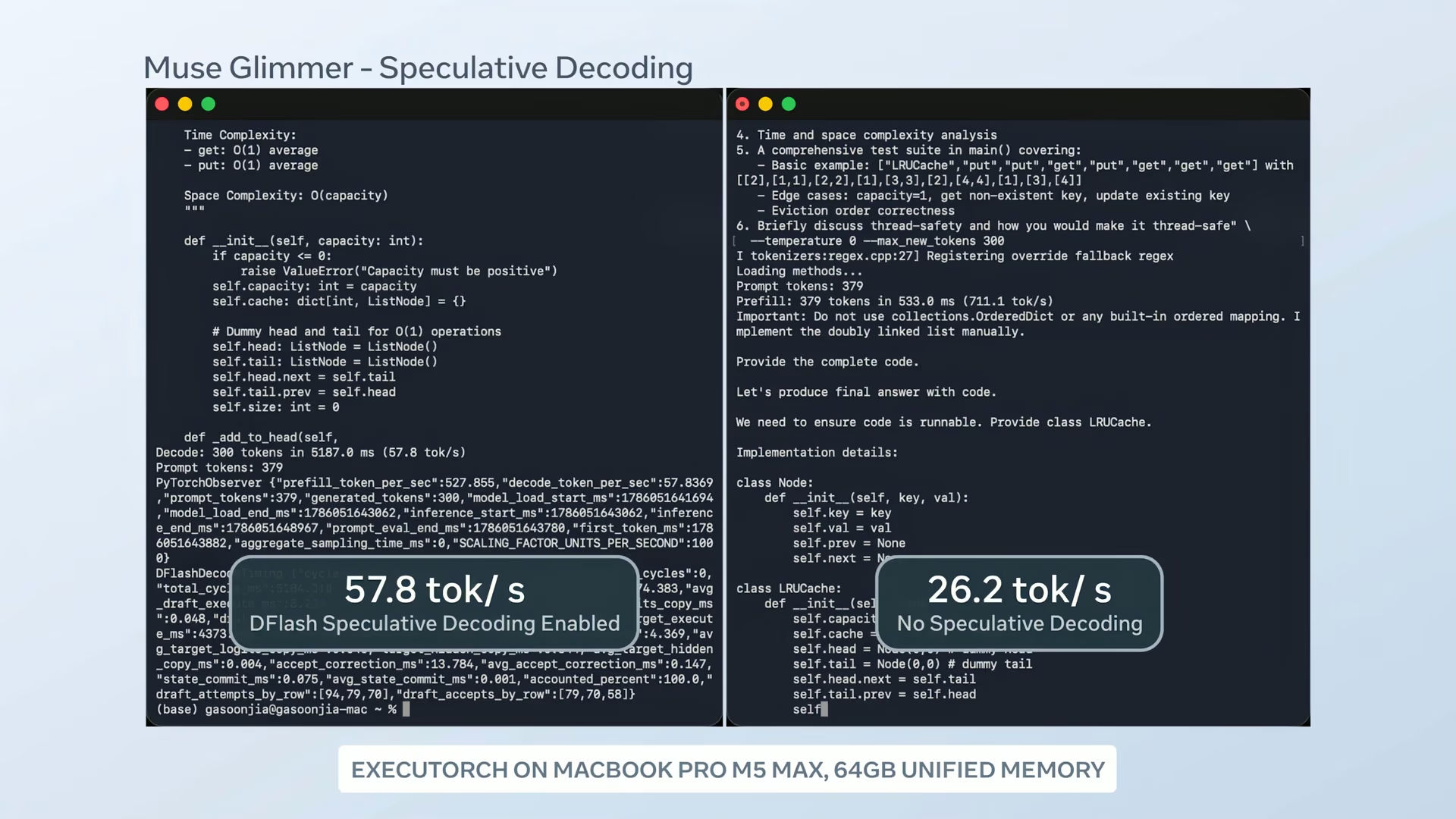
The other notable engineering investment is inference speed on exactly the Meta's target hardware. Alongside the base weights, Meta shipped a speculative-decoding drafter it calls DFlash, plus two official quantisation recipes: a "K-Quant-Dynamic" build tuned for 32GB GPUs with roughly 0.2% degradation from full BF16 precision, and a more aggressive "K-Quant-17GB" build that fits in around 17GB with about 1% average degradation across Meta's internal 15-benchmark suite - the difference between "needs a 32GB workstation GPU" and "fits on a well-specced consumer laptop" being almost entirely down to that quantisation work rather than a smaller model.
Capabilities Deep Dive
Local agentic coding
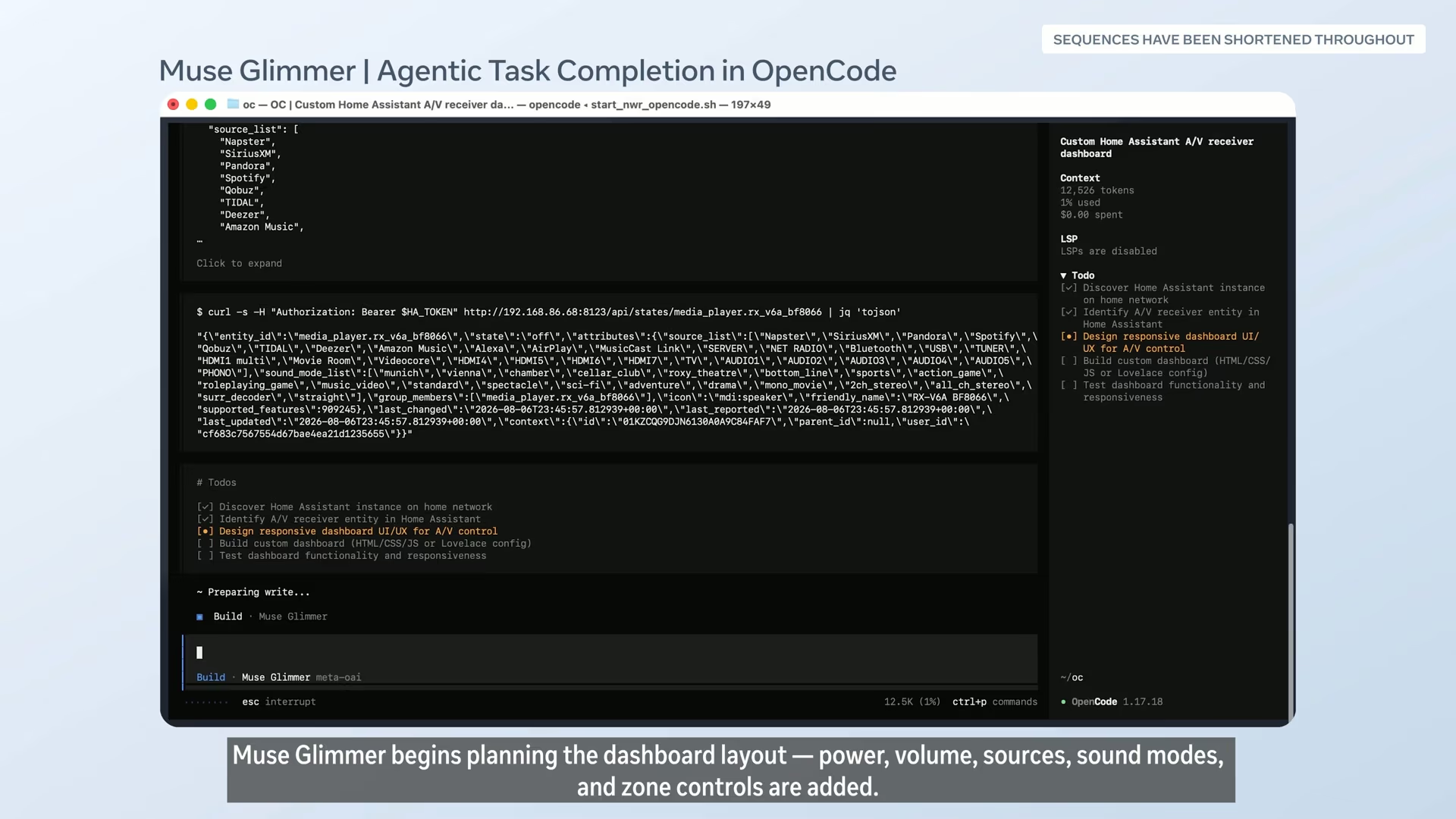
Meta built Glimmer around "end-to-end agentic task completion" rather than one-shot code generation: multi-step reasoning chains, tool use across a session, and explicit failure recovery when a step goes wrong. In practice that means running Glimmer inside an agent harness such as OpenCode, where it can plan a task, execute tool calls against real local services, watch the results, and adjust course - the same pattern Claude Code, Codex and Muse Code use, but running entirely on-device rather than calling out to a hosted API for every step. Meta's own demo material shows Glimmer working through an ordinary real-world task inside OpenCode: discovering a Home Assistant instance on a home network, identifying an A/V receiver entity, and building a working control dashboard from scratch, tracking its own progress against a running to-do list as it goes.
Function calling and tool use
Reliable function calling is one of Glimmer's stated design priorities, and it shows up directly in the benchmark selection: Meta and independent evaluators both lean heavily on agentic tool-use tests (MCP Atlas, tau-cubed-Banking, DeepSearch QA) rather than static Q&A benchmarks. That focus makes sense for the target use case - a model that is going to be calling calendar APIs, file-system tools and search functions unattended needs to get the call syntax and argument structure right far more consistently than a model that is mostly generating prose.
LLM-as-judge evaluation
Meta also positions Glimmer explicitly as an LLM-as-judge model - something you run locally to grade, filter or rank the outputs of other models or of your own pipeline, rather than only as a generation model in its own right. Running the judge model on the same machine as the pipeline it is evaluating removes a network round-trip and a per-call cost from what is often a very high-volume workload (grading thousands of candidate outputs during synthetic data generation or RL training, for instance), which is a practical reason to want a smaller, fast, locally-hosted judge rather than routing every evaluation call to a hosted frontier model.
Always-on local agents
The most distinctive framing in Meta's launch material is "always-on": a Glimmer-powered agent that stays resident on your device, watching for triggers, and acting continuously rather than being invoked per-request. Multilingual support across 100+ languages, adjustable reasoning effort, and scaffold compatibility with existing agent harnesses (Ollama, LM Studio, llama.cpp, MLX, ExecuTorch, vLLM and SGLang were all listed as day-one partners) all point the same direction: this is meant to be infrastructure you install once and leave running, not a model you call occasionally through an API console.
Multimodal input and inference speed
The dedicated 1.8B-parameter perception encoder means Glimmer can reason over screenshots, diagrams and photos alongside text, which matters directly for an on-device agent - reading a screenshot of a settings panel, a chart in a PDF, or an error dialog is a routine part of the kind of computer-use and coding-agent work Meta is targeting, even though the model's own output remains text-only. Meta paired that capability with real attention to inference speed on the exact machines people were expected to test it on: the DFlash speculative-decoding drafter is reported to speed up generation by roughly 3.1x on an RTX 5090, 1.8x on a MacBook with M5-Max, and 1.5x on M4-Max, figures that matter far more for a model meant to run continuously in the background than they would for an occasional cloud API call, where network latency dominates regardless of local decode speed.
A hands-on benchmark run of Muse Glimmer against Qwen3.6-27B across coding, agentic and reasoning tasks.
Benchmarks: The Real Numbers
Meta's own launch materials compare Glimmer against two similarly-sized open rivals: Gemma4-31B and Qwen3.6-27B. Independent analysis of that full 24-row table found Glimmer posts the single best result on 12 of the 24 rows, beating Gemma4-31B on 19 of 24 and Qwen3.6-27B on 14 of 24. That is a strong showing for a model built primarily for on-device deployment rather than raw leaderboard position, but it is not a sweep, and the pattern of wins and losses is informative in its own right.
On agentic and tool-use benchmarks, Glimmer's strengths are clear and consistent: MCP Atlas 75.5 versus Qwen3.6-27B's 62.5, DeepSearch QA 74.6 versus 71.1, and tau-cubed-Banking (a tool-use benchmark simulating banking-agent tasks) around 23.5-24%, ahead of Qwen's 16.7%. These are precisely the categories Meta optimised for, and the margins are wide enough that they look like a genuine capability difference rather than noise.
On harder coding and computer-use benchmarks, the picture flips. Terminal-Bench 2.1: Glimmer 51.7% against Qwen3.6-27B's 60.7% and Gemma4-31B's 43.4% - Glimmer beats Gemma comfortably but trails Qwen by nine points. SWE-Bench Verified: Glimmer 76.0% versus Qwen's 77.2%, a near-tie that still favours Qwen. SWE-Bench Pro: Glimmer scores 51.2%. Independent write-ups summarising the full comparison note that Qwen3.6-27B remains ahead specifically on OSWorld-Verified and SkillsBench too - the two benchmarks that most directly test sustained, real desktop computer-use rather than agentic tool-calling in a more constrained environment.
Artificial Analysis, which runs its own independent evaluation against live model weights rather than relying on vendor-reported numbers, placed Glimmer at 35 on its Intelligence Index - 21 points above Llama 4 Maverick (14), Meta's last major open-weights release, and close to Kimi K2.5 in reasoning mode (36) while trailing Qwen3.6-27B in reasoning mode (38) by three points and sitting 5 points above Gemma4-31B in reasoning mode (30) despite a similar parameter count. Artificial Analysis frames the standout fact as efficiency: Glimmer's score is achieved with roughly 33 times fewer parameters than some of the larger reasoning models it sits alongside on that index.
On real-world work tasks, Artificial Analysis's GDPval-AA v2 evaluation put Glimmer at 953 Elo, just below the 1,000 Elo human baseline - a respectable result for a 30B model designed to run on a laptop, though it means the model is not yet reliably matching human performance on the mixed professional-work tasks that benchmark covers. The one figure worth flagging clearly as a caveat is AA-Omniscience, Artificial Analysis's hallucination-focused knowledge test: Glimmer scored -33 on the -100 to 100 scale, corresponding to a hallucination rate in the region of 82% on hard knowledge questions on questions the model answers incorrectly. That is a meaningfully higher hallucination rate than the frontier tier, and worth weighing carefully against any always-on agent use case that involves factual claims rather than tool-mediated actions.
Availability and Licensing
Meta publishes the weights and model card through Hugging Face under Apache 2.0. The release includes full-precision and quantised formats, plus guidance for local and server runtimes. The licence permits commercial use, modification and redistribution, subject to its terms.
Artificial Analysis gives Glimmer 44 on its Openness Index, level with DeepSeek V4 Flash, GLM-5.2 and Ling 3.0 Flash at the time of testing. The permissive licence is a significant change from Meta's recent closed Muse releases, although the release still does not disclose every element of its training data and development process.
Third-party hosted access is available for teams that do not want to operate local inference. Provider coverage and pricing change independently of Meta, so treat any launch-day list as temporary.
Pricing and Ownership Costs
See our Meta Muse Glimmer 30B tool listing for a quick-reference spec summary alongside other tracked models.
Meta does not charge a licence fee or a per-token fee for the downloadable weights. Self-hosting is not cost-free, however: the user supplies the hardware, electricity, storage, maintenance and deployment time.
| Build | Meta target | Average degradation |
|---|---|---|
| Full precision | 64GB VRAM | Reference |
| K-Quant-Dynamic | 32GB VRAM | 0.2% |
| K-Quant-17GB | 24GB VRAM | 1.0% |
Meta calculates degradation as the average accuracy change across 15 benchmarks. The figures are not a guarantee for every workload, and memory demand also includes the context cache, perception encoder and speculative-decoding drafter.
Hosted access is priced by third parties rather than Meta. On 17 August 2026, Artificial Analysis tracked two providers and reported median prices of $0.32 per million input tokens and $1.35 per million output tokens. Provider coverage and prices can change, so check the current listing before estimating production costs.
Safety Evidence and Hallucination Risk
Meta's official model card includes a preparedness assessment. It rates chem/bio risk as Moderate or lower. Cyber and loss-of-control risk receive the same rating by inference because Glimmer is broadly weaker than Muse Spark 1.0, rather than through a complete direct evaluation of each domain.
Meta also states that its testing cannot cover every scenario. That caveat matters for a model intended to call tools and work with local files, where a mistaken action can affect real data even if the underlying capability is below Meta's frontier thresholds.
Factual reliability is a separate concern. Artificial Analysis measured an 82% hallucination rate on AA-Omniscience, compared with 49% for Qwen3.6-27B. That test targets hard knowledge calibration, not every everyday prompt, but it argues against granting the model unsupervised authority over consequential messages, files or decisions.
Limitations
- Mixed results against Qwen3.6-27B: Qwen leads Terminal-Bench 2.1, SWE-Bench Verified, OSWorld-Verified and SkillsBench in the cited comparison.
- Weak knowledge calibration: Artificial Analysis measured an 82% hallucination rate on AA-Omniscience.
- Preparedness evidence has limits: Meta inferred the cyber and loss-of-control ratings from Glimmer's lower capability relative to Muse Spark 1.0 rather than fully evaluating both domains directly.
- Substantial local hardware requirement: Meta's smallest official build targets 24GB VRAM. Older and budget devices are unlikely to provide the intended experience.
- Text-only output: the model accepts text and images but generates text only.
- Below Muse Spark: distillation and local deployment trade some peak capability for ownership, privacy and lower operating costs.
How It Compares
Against its own closed sibling, the proprietary Muse Spark 1.2, Glimmer is deliberately a step down in raw capability in exchange for direct local control: no per-token bill, no data leaving your machine, no dependency on Meta's API staying available. Against Qwen3.6-27B, the closest like-for-like open-weight rival at roughly the same parameter count, the comparison is a genuine trade-off rather than a clean win for either side - Glimmer leads on agentic tool-use and general reasoning, Qwen leads on harder coding and computer-use benchmarks. Against Gemma4-31B, Glimmer's advantage is much clearer and more consistent, winning on 19 of Meta's 24 published comparison rows.
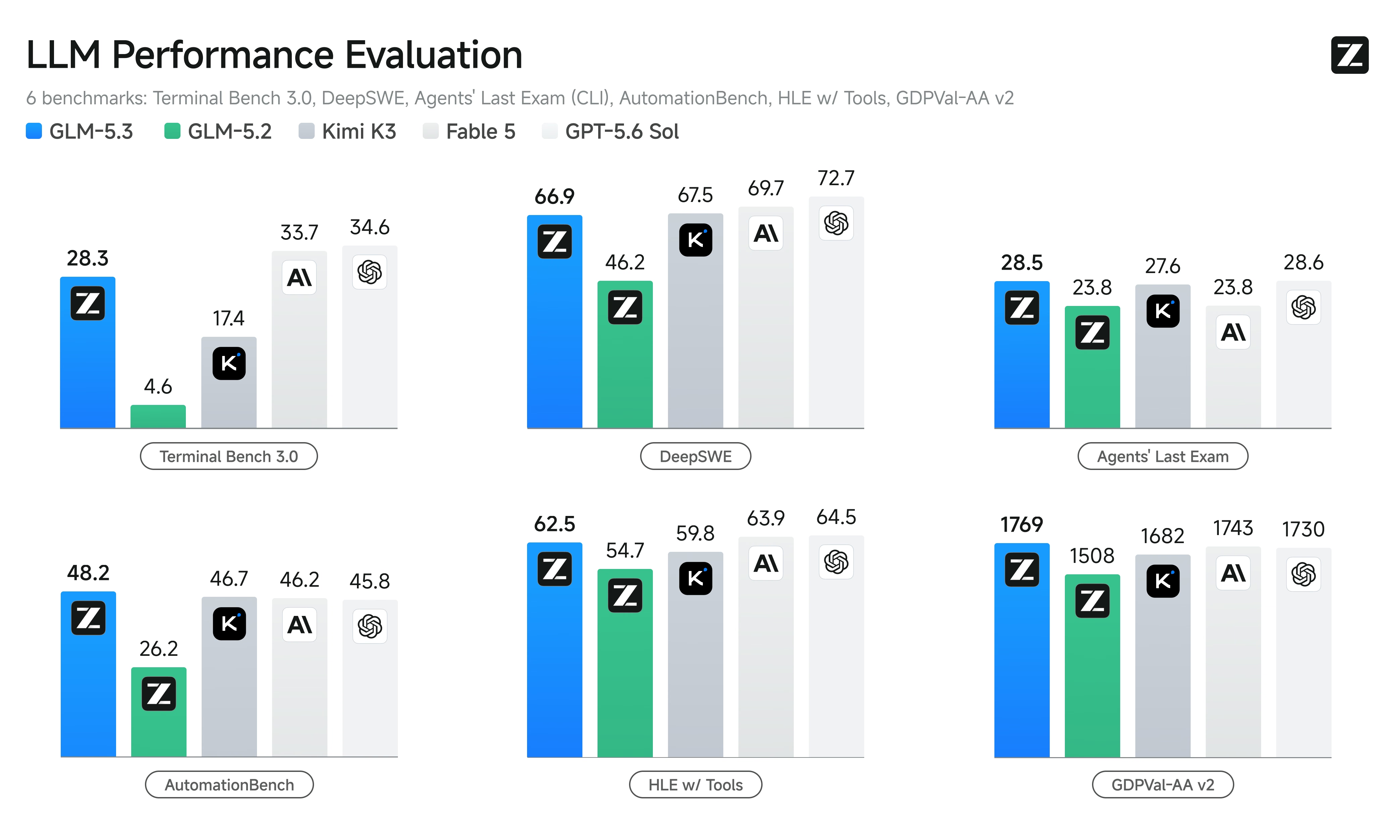
Against GLM 5.3, a much larger open-weight model from Z.ai built for a different niche (frontier-adjacent coding and cybersecurity work at datacentre scale), Glimmer is not really a direct competitor - it occupies the "runs on your laptop" end of the open-weights market rather than the "beats the closed frontier on hard benchmarks" end GLM 5.3 is chasing. Qwen 3.8 Max, Alibaba's much larger 2.4-trillion-parameter flagship, sits in a similar "bigger, more capable, not locally-hostable on consumer hardware" category. The clearest framing is that Glimmer competes on a different axis entirely: not "which model scores highest" but "which model can you run entirely on your own machine, for free, today."
On the infrastructure side rather than the model side, Glimmer's "runs on your own machine" pitch is complemented by Perplexity's Lily inference engine, an open-source Rust and Metal runtime that speeds up a different local model, Qwen3.6-35B-A3B, specifically on Apple Silicon rather than adding a new model to the field.
It is also worth placing Glimmer against Meta's own history rather than only against rivals. Llama 3.1's 405-billion-parameter flagship needed a multi-GPU server to run at all; Glimmer is roughly 13 times smaller and runs on a single card, at a level of agentic capability Llama 3.1 was never evaluated against because the agentic-benchmark category barely existed at the time. That trajectory - open weights getting smaller, more efficient and more agent-focused release over release, even as Meta's flagship model line becomes fully closed - looks less like a retreat from open source and more like a deliberate specialisation: closed weights for the model Meta wants to sell access to, open weights for the model Meta wants running on as many personal devices as possible.
Who Should Use It
Worth using now if you already own or are willing to buy hardware in the M4-Max/M5-Max or RTX 5090 class, and your workload is agentic - local coding agents, tool-calling pipelines, LLM-as-judge evaluation at volume, or a personal automation agent you want kept entirely on-device for privacy reasons. The Apache 2.0 licence and broad day-one tooling support (Ollama, LM Studio, vLLM and friends) make it a low-friction evaluation if you already have the hardware.
Worth skipping or waiting on if your workload is dominated by the specific benchmarks where Qwen3.6-27B still leads (harder coding, sustained computer-use), in which case Qwen remains the better open-weight pick at a similar size; if you do not already have suitable local GPU hardware and are not planning to buy any, a hosted API (including Muse Spark itself, or a rival closed model) is simpler than building a local inference stack for one model; or if your use case involves unattended factual claims where the AA-Omniscience hallucination rate is a real risk rather than an acceptable trade-off.
The Bottom Line
Muse Glimmer is a practical local-agent model with a permissive licence, explicit memory targets and useful tool-use results. Meta's quantisation and DFlash releases make the deployment claim concrete rather than theoretical.
It is not the strongest model in its size class on every task, and its AA-Omniscience result makes unattended factual work risky. It is best suited to developers who already have suitable hardware, can test representative workflows and will keep approval gates around consequential actions.
Last updated: 17 August 2026. Sources: Meta's official model card and released weights, Artificial Analysis's benchmark report and its current model and provider data. Provider prices and benchmark tables may change.
Get the free guide: Claude vs ChatGPT, Gemini & Grok
A 20-page playbook covering everything you need to choose and use the big four AI models in 2026, full cost and feature comparisons, what each is best (and worst) at, and how-tos for images, vectors, building a website, Claude Code and more.