 AI Tools Review Editorial Team
Quick Answer:
Meta Muse Spark 1.1 is Meta's paid frontier-model API for coding, multimodal understanding and agentic work. The US developer preview launched on 9 July 2026 with $20 in introductory credits and pricing of $1.25 per million input tokens and $4.25 per million output tokens. Artificial Analysis has since independently scored it at 51 on the Intelligence Index and 71.3 on the Coding Index, an 8-point and 12-point jump over Muse Spark 1.0 respectively, at roughly a third of the cost per task of comparably scored rivals.
WorldofAI covers Meta Muse Spark 1.1 in this video.
What Is Muse Spark 1.1?
Muse Spark 1.1 is an updated model from Meta's superintelligence organisation. It is positioned for software engineering and complex multi-step work rather than simple chat. Reported capabilities include writing and debugging code, using tools, understanding text and images, analysing video and coordinating agent-like sequences.
The launch also introduced a Meta Model API in public preview for US developers. Reuters reported that new accounts receive $20 in credits before paid usage begins. At launch, the model was connected to Meta AI experiences, with broader distribution across Meta products expected over time.
Because the API is in preview, availability and product limits can change. Treat current access details as a launch snapshot and confirm the developer dashboard before planning production capacity.
API Pricing and Commercial Position
See our Meta Muse Spark 1.1 tool listing for a quick-reference spec summary alongside other tracked models.
Launch reporting puts Muse Spark 1.1 at $1.25 per million input tokens and $4.25 per million output tokens. The low input price is relevant for codebase context, document analysis and retrieval-heavy agents that repeatedly send large prompts.
Price alone does not determine task cost. Reasoning length, caching, tool-call overhead, retry rate and output verbosity can outweigh the token rate. A cheaper model that needs more attempts may cost more per accepted task, so teams should measure end-to-end success.
Meta's decision to charge for access matters strategically. It creates a direct developer revenue channel and a tighter feedback loop from production workloads, extending beyond an open-weight distribution strategy.
Coding, Multimodal and Agentic Capabilities
Meta emphasises complex debugging, sustained coding tasks and multi-agent systems. Those claims make Muse Spark relevant to IDE assistants, repository maintenance, test generation and internal automation. Image, video and document understanding broadens it beyond a coding-only endpoint.
The practical questions are reliability and control. Coding teams need patch acceptance and test pass rate. Multimodal users need evidence that visual understanding stays dependable across long sequences. Agent users need timeouts, permission boundaries and complete tool traces.
Now that Artificial Analysis has independently benchmarked the release, the early conclusion holds up: Meta has entered the paid frontier API market with a broad, competitively priced model that measurably improved on its predecessor within three months.
Benchmarks: The Independent Numbers
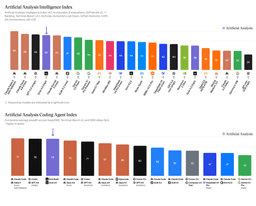
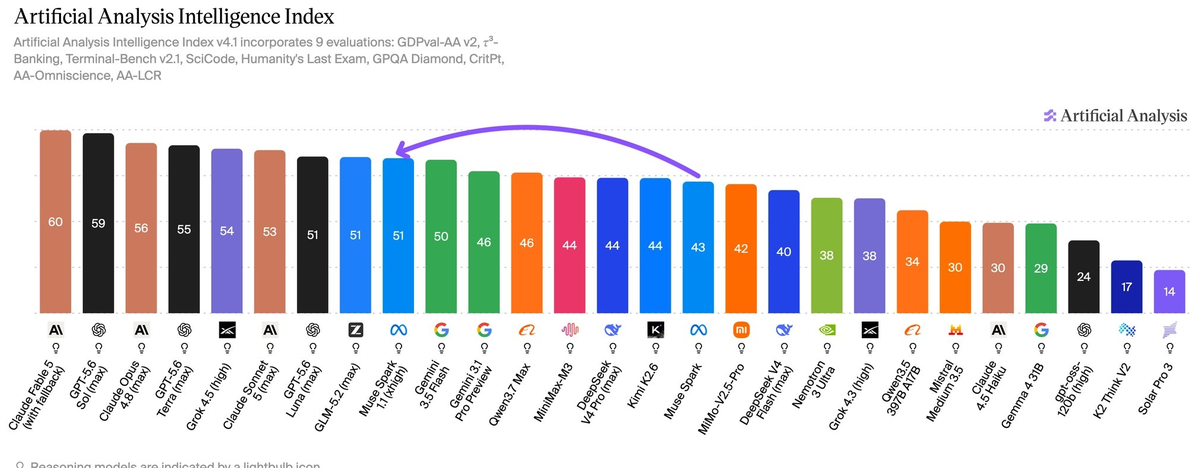
Artificial Analysis, which runs its own evaluations against live APIs rather than relying on vendor-reported scores, placed Muse Spark 1.1 (xhigh reasoning effort) at 51 on its Intelligence Index v4.1, a composite of nine evaluations including GDPval-AA v2, τ³-Banking, Terminal-Bench v2.1, SciCode, Humanity's Last Exam and AA-Omniscience. That is an 8-point jump over the original Muse Spark's score of 43 in three months, with the gains concentrated in scientific reasoning, coding and knowledge.
The score puts it effectively tied with GLM-5.2 (max) and GPT-5.6 Luna (max), three points behind Grok 4.5 (54), and behind the frontier trio of Claude Fable 5 (60), GPT-5.6 Sol (59) and Claude Opus 4.8 (56). It also edges ahead of both Gemini 3.5 Flash (50) and Gemini 3.1 Pro Preview (46), a detail Meta's own launch materials did not volunteer.
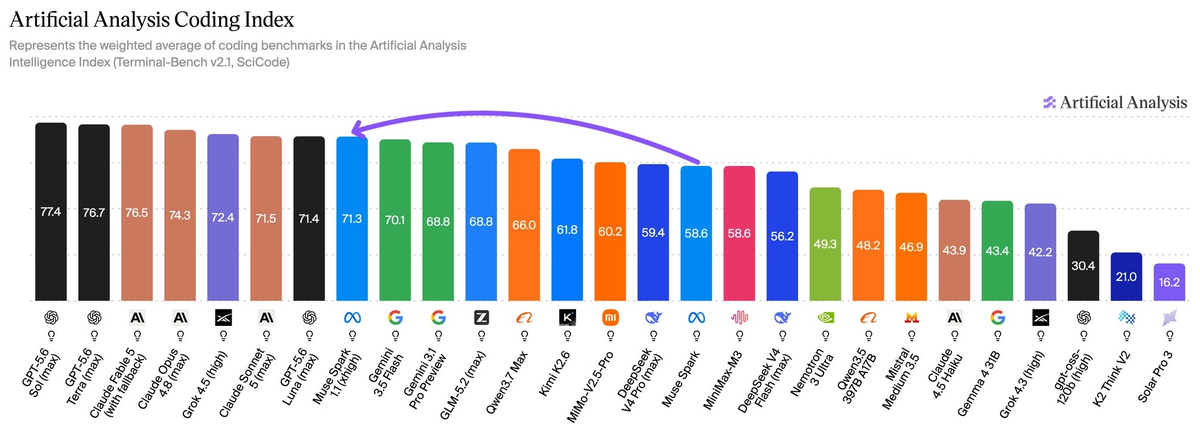
Coding is where Muse Spark 1.1 looks strongest. It scores 71.3 on the Artificial Analysis Coding Index (a weighted average of Terminal-Bench v2.1 and SciCode), a 12-point improvement over the prior version and good enough for 7th place overall, ahead of both Gemini models and GLM-5.2 (max). On GDPval-AA v2, which measures real-world work tasks against a human baseline of 1,000 Elo, it reaches 1,376 Elo, comfortably above that baseline and ahead of Gemini 3.5 Flash and DeepSeek V4 Pro.
The most notable improvement is reliability, not raw capability. On AA-Omniscience, which scores knowledge reliability from -100 to 100 and penalises confident wrong answers more than admitted uncertainty, Muse Spark 1.1 rose from 4 to 18, with its hallucination rate falling from 73% to 38%. That is a meaningfully safer model to point at agentic and retrieval tasks than its predecessor, though a 38% hallucination rate on hard knowledge questions is still high in absolute terms and well behind the frontier leaders.
Cost is the other half of the story. Artificial Analysis puts Muse Spark 1.1 at roughly $0.26 per Intelligence Index task, around a third of GPT-5.4's $0.89 and cheaper than every other model scoring within five points of it, whilst using fewer output tokens per task (94 million to run the full index, versus 109 million for GPT-5.4 and 125 million for GPT-5.6 Luna). Measured output speed is 119 tokens per second with a 1.50-second time to first token, both faster than the median for reasoning models in its price tier. On the intelligence-versus-cost scatter, that places Muse Spark 1.1 inside Artificial Analysis's "most attractive quadrant": near-tied top-tier intelligence at a fraction of the price.
The AI Tools Review benchmarks hub tracks these figures as the wider model field updates. Independent scores can still shift as providers ship follow-up checkpoints, so treat any single snapshot as a point-in-time comparison rather than a permanent ranking.
How Muse Spark 1.1 Compares
Against GPT-5.6, Muse Spark 1.1 trails Sol (59) and Terra (55) on raw intelligence and ties Luna (51 apiece) at a lower published price, whilst OpenAI still has a more mature platform and broader third-party tooling ecosystem. Against Claude, both Fable 5 (60) and Opus 4.8 (56) remain ahead on the Intelligence Index, and Anthropic's documentation and agent tooling are more familiar to enterprise teams, but Muse Spark 1.1's $0.26 cost-per-task undercuts both by a wide margin.
Against Grok 4.5, Muse Spark 1.1 trails by three Intelligence Index points (51 to 54) but has a cleaner AA-Omniscience trend: Grok 4.5's hallucination rate actually rose from 25% to 54% over its predecessor, while Muse Spark 1.1's fell from 73% to 38%. Both remain the two most cost-efficient ways to buy near-frontier coding performance.
Independent creator testing adds a third data point worth noting with the right caveat. WorldofAI's 14 July hands-on comparison against Claude Opus 4.8 and Grok 4.5 found Muse Spark 1.1 competitive on coding demos and computer-use tasks, consistent with the Artificial Analysis coding score, though a single YouTuber's side-by-side is not a substitute for a controlled benchmark and should be read as anecdotal confirmation rather than independent proof.
Run a representative evaluation set: real repository issues, expected tests, tool-use traces, long-context tasks and total accepted-task cost. The best model is the one that clears that workload reliably within latency and governance constraints, not the one with the single highest headline score.
Limitations and Risks
Independent scoring narrows the evidence gap but does not close it. Artificial Analysis measures Intelligence Index, Coding Index, GDPval-AA and AA-Omniscience, but it is not a substitute for a full model card covering red-teaming, dangerous-capability evaluation or bias testing, none of which Meta has published for this release. A 38% hallucination rate on AA-Omniscience, though much improved, is still high enough to require citation-checking on any factual task.
Geography is a second limitation: initial API access is US-focused. The third is governance: multimodal and agentic systems need clear controls over uploads, tools and generated code, and Meta has not detailed enterprise data-handling terms separate from its consumer products.
Do not send sensitive code or documents until retention, training use and deletion policies are understood and approved. Model identity and versioning must also be explicit: if a preview alias changes silently, benchmark results and production behaviour can drift, so pin versions where possible and keep a dated regression suite.
Who Should Use It and the Verdict
Muse Spark 1.1 is most interesting for developers who want near-frontier coding performance at a fraction of the price of Claude or GPT-5.6, and who can tolerate preview status while Meta fills in safety documentation. It is also relevant to teams wanting another supplier alongside OpenAI, Anthropic and Google, now with independent benchmark evidence rather than launch claims alone to justify the evaluation.
Use the introductory credits for a controlled bake-off. Measure successful task cost against the $0.26-per-task figure Artificial Analysis reports, inspect tool traces, and require human approval for actions that affect production. Do not migrate a critical workload purely on the strength of an Intelligence Index score.
The verdict has moved from promising-but-provisional to promising-and-substantiated. Meta has launched an aggressively priced model, a new paid API, and, three months after the original Muse Spark, a genuine capability and reliability improvement that an independent evaluator has now confirmed. The open questions are safety documentation, production-grade availability outside the US, and whether Meta sustains the pace of iteration.
Update: Meta answered the coding-agent question three weeks later. See our Muse Spark 1.2 and Muse Code review for the coding-focused successor, its new terminal agent, and the two-tier pricing that trades a steep discount for training-data rights.
Last updated: 14 July 2026. Pricing and launch capabilities were checked against Reuters reporting; benchmark figures against Artificial Analysis's independent evaluation.
Get the free guide: Claude vs ChatGPT, Gemini & Grok
A 20-page playbook covering everything you need to choose and use the big four AI models in 2026, full cost and feature comparisons, what each is best (and worst) at, and how-tos for images, vectors, building a website, Claude Code and more.