 AI Tools Review Editorial Team
Quick answer:
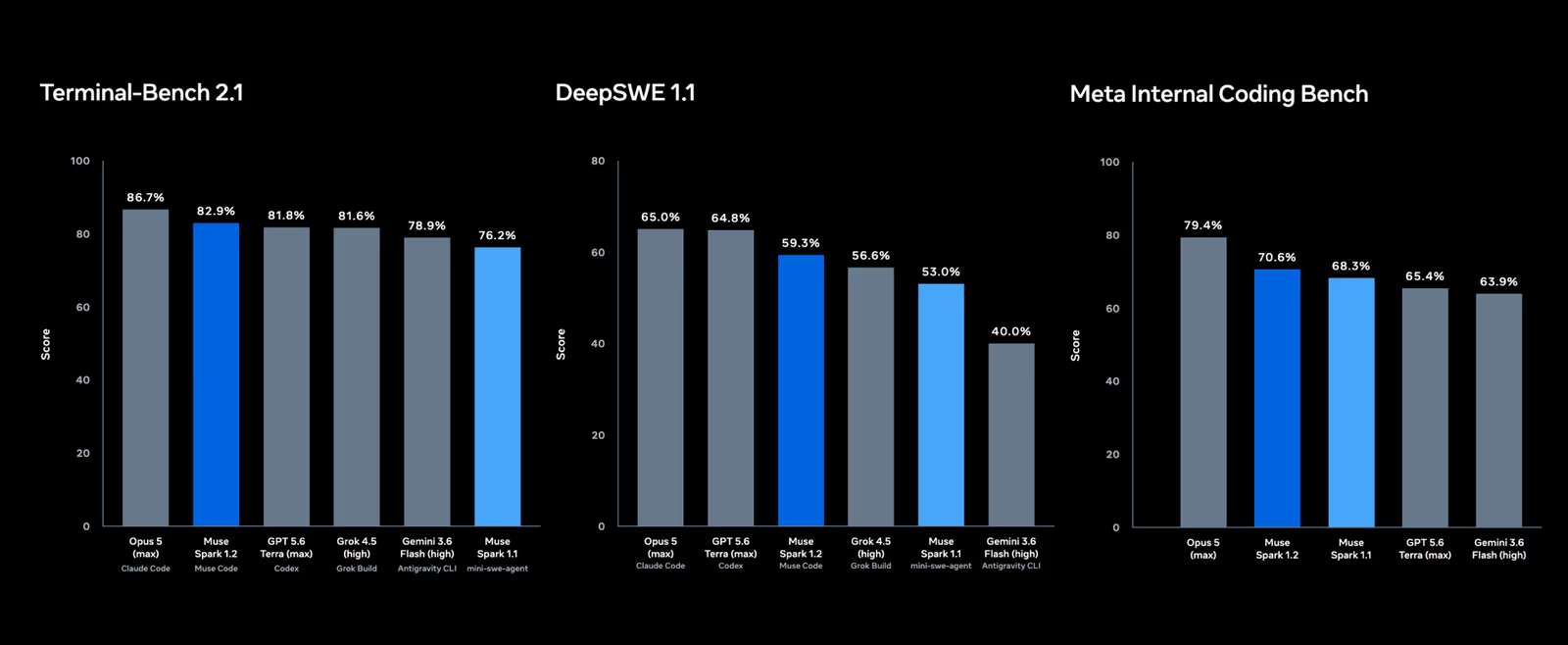
Meta released Muse Spark 1.2 and a new terminal coding agent, Muse Code (beta), on 5 August 2026, its most serious entry yet into a category Anthropic and OpenAI have dominated. Meta's own published benchmarks put Muse Spark 1.2 at 82.9% on Terminal-Bench 2.1, ahead of GPT-5.6 Terra and Grok 4.5 but behind Claude Opus 5's 86.7%, a strong but clear second place across all three charts Meta shared. The bigger story may be pricing: a standard tier at $1.25 input / $4.25 output per million tokens sits alongside a "contributor" tier at $0.10 / $0.20, roughly 12–21x cheaper, in exchange for letting Meta train on your prompts and completions. Neither Muse Spark 1.2 nor Muse Code has open weights, a striking reversal for the company that built Llama into 1.2 billion downloads.
Four months after Muse Spark ended the Llama era as Meta's first fully proprietary model, the company has come back with a coding-specialised sequel and a purpose-built harness to run it in. Muse Spark 1.2 and Muse Code are a direct answer to the one gap the original Muse Spark could not close: agentic coding, the exact category where Claude Code and Codex have become the default way many professional developers ship software.
Meta's own benchmark charts are unusually candid about where that leaves it: a strong, clear second place behind Anthropic's Claude Opus 5 on every chart the company published, undercut by a pricing structure that pairs a normal per-token rate with a steeply discounted tier that runs on your data instead of your money. This article works through what Meta actually confirmed, what its own numbers show, and what the trade-offs really are.
Note: this analysis is based on Meta's official research blog post (research.meta.ai), Mark Zuckerberg's own posts on X, and VentureBeat's launch-day reporting and independent hands-on test of the installer. All benchmark figures and chart images in this article are Meta's own published numbers; AI Tools Review has not independently reproduced any of them, and no third-party evaluator such as Artificial Analysis or LMArena had scored the release at the time of writing. Prices are billed in US dollars.
A full hands-on test of Muse Spark 1.2 and Muse Code across coding, frontend generation and agentic workflows, benchmarked against GPT-5.6, Claude Opus 5 and Grok 4.5.
Summary
- Released 5 August 2026: Muse Spark 1.2 (a coding-focused update to Muse Spark 1.1) and Muse Code, a new terminal coding agent in beta, announced together by Meta and Mark Zuckerberg.
- 82.9% on Terminal-Bench 2.1 running inside Muse Code, ahead of GPT-5.6 Terra in Codex (81.8%) and Grok 4.5 in Grok Build (81.6%), behind Claude Opus 5 at max effort in Claude Code (86.7%).
- A consistent, self-acknowledged second place. Claude tops all three benchmark charts Meta published; Meta's own internal coding benchmark shows Muse Spark 1.2 nearly nine points behind Opus 5.
- Two-tier pricing with a genuine trade-off: a standard tier ($1.25/$4.25 per million tokens) that is not used for training, and a "contributor" tier ($0.10/$0.20) that is roughly 12–21x cheaper in exchange for training-data rights.
- Persistent, resumable agent architecture. Muse Code's "async background agents" stay alive for an entire session, and an append-only local event log makes long runs "replay-exact and restart-safe" after a crash.
- No open weights, no licence. Both products are entirely proprietary, continuing the shift away from Llama-era open distribution that began with the original Muse Spark in April 2026.
- A credible long-horizon demo: Meta ran Muse Spark 1.2 for over 1,000 tool calls across up to 24 hours optimising GPU kernels, with published results showing sustained (not plateauing) improvement.
From Llama to Muse Spark: the lineage
Meta's developer story ran through Llama for three years: the original LLaMA's weights leaked onto 4chan within weeks of its February 2023 debut, inadvertently kickstarting the modern open-weight movement; Llama 2 shipped with a commercially usable licence; and the 405-billion-parameter Llama 3.1 arrived in July 2024 alongside Zuckerberg's manifesto "Open Source AI Is the Path Forward." By early 2026 the Llama family had been downloaded roughly 1.2 billion times, and self-hosting reportedly cut costs by as much as 88% versus proprietary API providers for some enterprises.
Then came the unravelling. Llama 4 launched in April 2025 to mixed reviews and eventual admissions that its benchmark results had been inflated, while Chinese open-weight labs (DeepSeek, Alibaba, Zhipu AI) surged to roughly 41% of Hugging Face downloads by late 2025. Zuckerberg responded with a summer 2025 overhaul into Meta Superintelligence Labs (MSL), recruiting Scale AI co-founder Alexandr Wang as chief AI officer. The Llama era effectively ended on 8 April 2026, when MSL shipped the original Muse Spark as Meta's first fully proprietary model: cloud-only, no downloadable weights, no self-hosting.
That original Muse Spark vaulted Meta back into the top five on frontier reasoning and vision benchmarks, but it trailed badly on agentic coding, the evaluation category that matters most to this market: 77.4 on SWE-Bench Verified against Claude Opus 4.6's 80.8 and Gemini 3.1 Pro's 80.6, and well behind GPT-5.4 on GDPval's measure of long-horizon work. Four months later, Muse Spark 1.2 paired with a purpose-built harness reads as Meta's direct answer to that specific gap, not a general-purpose refresh.
Muse Code: architecture and design
Async background agents
Muse Code's headline architectural bet is what Meta calls async background agents. Rather than spawning helper agents fresh for each task, the pattern most rival harnesses use, Muse Code keeps specialised background agents alive for the entire session. Meta's blog post says these agents "remain active throughout each session, rather than being spawned for individual tasks, helping avoid redundant information gathering," carrying out next steps on their own and choosing when to report back to the main agent. The practical pitch is less latency and less babysitting: an agent that already knows the repository does not have to re-explore it every time the developer asks for something new. When a job is large enough, Muse Code fans out to separate sub-agents working in parallel, each in its own isolated git worktree, so the developer's working copy is never touched. "In testing we had it build six features for a game simultaneously with no collisions," Zuckerberg wrote on X.
A replay-exact, restart-safe event log
The second notable design choice is auditability. Every model call, tool run, approval and edit is appended to a local event log before it executes, a single source of truth Meta says makes the runtime "replay-exact and restart-safe." If Muse Code crashes 20 hours into a long-running task, it resumes precisely where it stopped, with no lost work and no re-prompting. For engineering leaders who have been burned by opaque agent runs, a complete local audit trail may prove to be the feature that matters most in enterprise evaluations, independent of how any given benchmark score holds up.
Bundled skills and installation
Muse Code ships with default skills that will look familiar to users of rival tools: /plan turns a task into an approval-gated plan, /grill stress-tests that plan until it holds up, and /goal drives the agent toward completion of a stated objective. Installation is a single command on macOS or Linux (curl -fsSL https://dev.meta.ai/install.sh | bash), but VentureBeat's own hands-on test found that even after the 97MB installer completed successfully, Muse Code reported no models were visible and that payment was "required to finish setting up your account", meaning the heavily discounted contributor tier is low-cost, but not free, in practice.
Muse Spark 1.2: how it was trained
Meta describes Muse Spark 1.2 as a coding-focused update to Muse Spark 1.1, with "significantly scaled up training compute on coding tasks" and broader training-environment diversity, aimed at improving code generation, complex debugging and codebase understanding while maintaining general agentic capability. Two training details stand out beyond the usual scale claims.
First, Meta co-trained the model with Muse Code itself, using rejection-sampled harness trajectories and recipe optimisations for goals, context compaction and sub-agents, meaning the model was explicitly tuned to perform best inside this particular tool rather than as a general-purpose API endpoint. That mirrors an industry-wide shift away from treating models and harnesses as separable products, the same logic behind Anthropic co-designing Claude around Claude Code and OpenAI co-designing recent GPT releases around Codex.
Second, Meta used a self-improvement loop: Muse Spark 1.1 generated challenging coding environments and instruction-following templates, then graded candidate solutions against those requirements, producing a scalable training dataset for its successor. Meta credits this loop specifically with making 1.2 measurably better at following complex instructions, a distinct capability from raw coding accuracy.
Benchmarks: what Meta actually published
Meta published benchmark charts comparing Muse Spark 1.2 against rival models on three evaluations: Terminal-Bench 2.1, DeepSWE 1.1, and an internal Meta coding benchmark. Notably, the announcement text itself does not tout any leaderboard placements, an unusual reticence in a field where rivals routinely trumpet wins. The charts explain why: they show a consistent, strong second place.
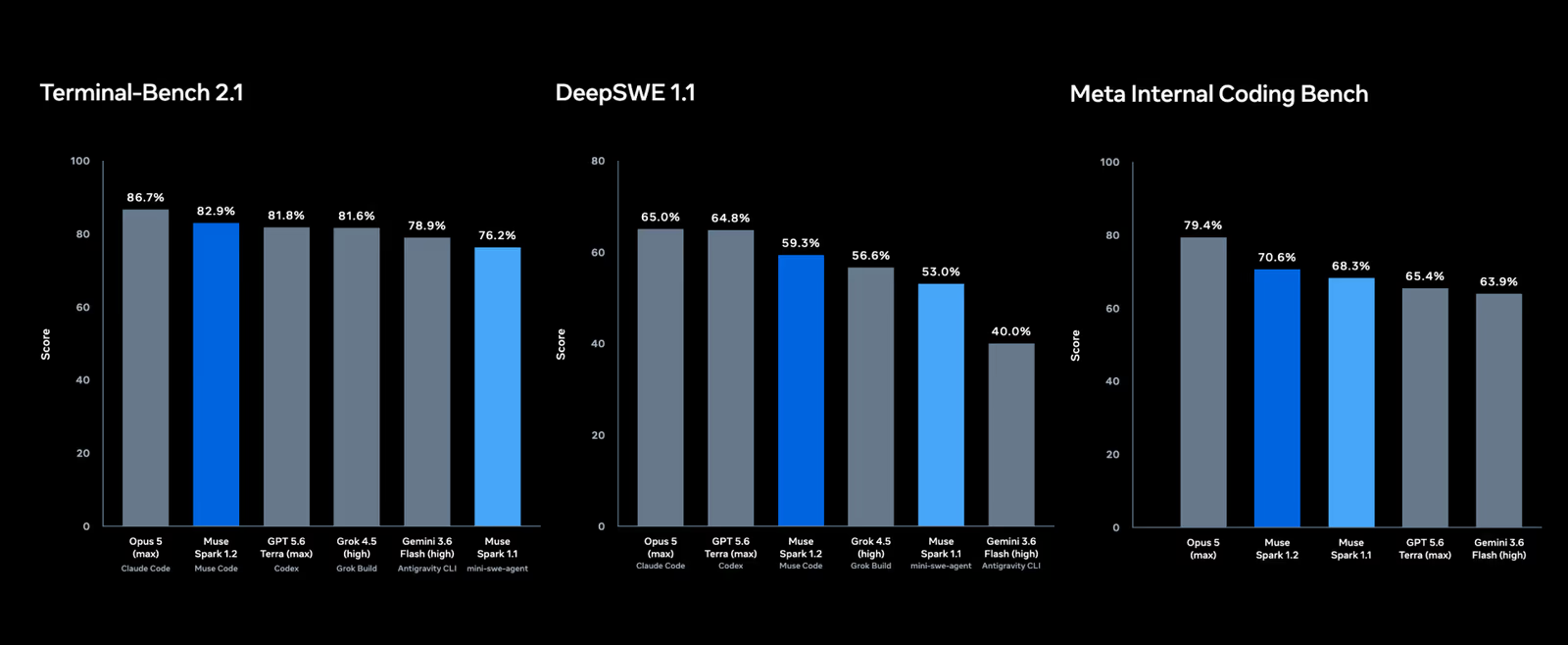
| Benchmark | Muse Spark 1.2 | Muse Spark 1.1 | Claude Opus 5 (max) |
|---|---|---|---|
| Terminal-Bench 2.1 | 82.9% | 76.2% | 86.7% |
| DeepSWE 1.1 | 59.3% | 53.0% | 65.0% |
| Meta internal coding bench | 70.6% | 68.3% | 79.4% |
The generational gains over Muse Spark 1.1 are real: +6.7 points on Terminal-Bench 2.1 and +6.3 on DeepSWE 1.1. One caveat is buried in the chart labels, though, and worth surfacing rather than skipping: the 1.1 scores were recorded in the generic mini-swe-agent harness, while 1.2 ran inside the purpose-built Muse Code. Some of that jump belongs to the new harness, not purely to the new model, since Muse Spark 1.2 was explicitly co-trained to perform best inside Muse Code specifically.
Most striking is Meta's own internal coding benchmark, the one test Meta designed itself, where Muse Spark 1.2's 70.6% comfortably beats GPT-5.6 Terra (65.4%) and Gemini 3.6 Flash (63.9%) yet still sits nearly nine points behind Opus 5's 79.4%. Publishing a chart on which your own model loses on your own test is an unusually candid admission, and it is worth taking Meta at its word here rather than assuming an underlying spin: on every measure the company chose to share, Claude wins.
As with every vendor-published benchmark table on this site, treat these as a strong first signal rather than a settled ranking. No independent evaluator such as Artificial Analysis or LMArena had scored Muse Spark 1.2 or Muse Code at the time of writing; see our live Benchmarks page for updates once independent numbers land.
The long-horizon case study: GPU kernel optimisation
Meta's most striking demonstration was not a benchmark score but a long-horizon case study: the company pointed Muse Spark 1.2 at GPU kernel optimisation and let it run for more than 1,000 tool calls over up to 24 hours on NVIDIA Hopper hardware. Working in Triton and explicitly barred from wrapping existing third-party kernel libraries, the agent wrote, compiled and profiled its way to what Meta calls "substantial improvements" over baseline implementations of KDA and MLA kernels, including genuinely non-obvious optimisations like re-centring gated cumulative decay at a chunk midpoint.
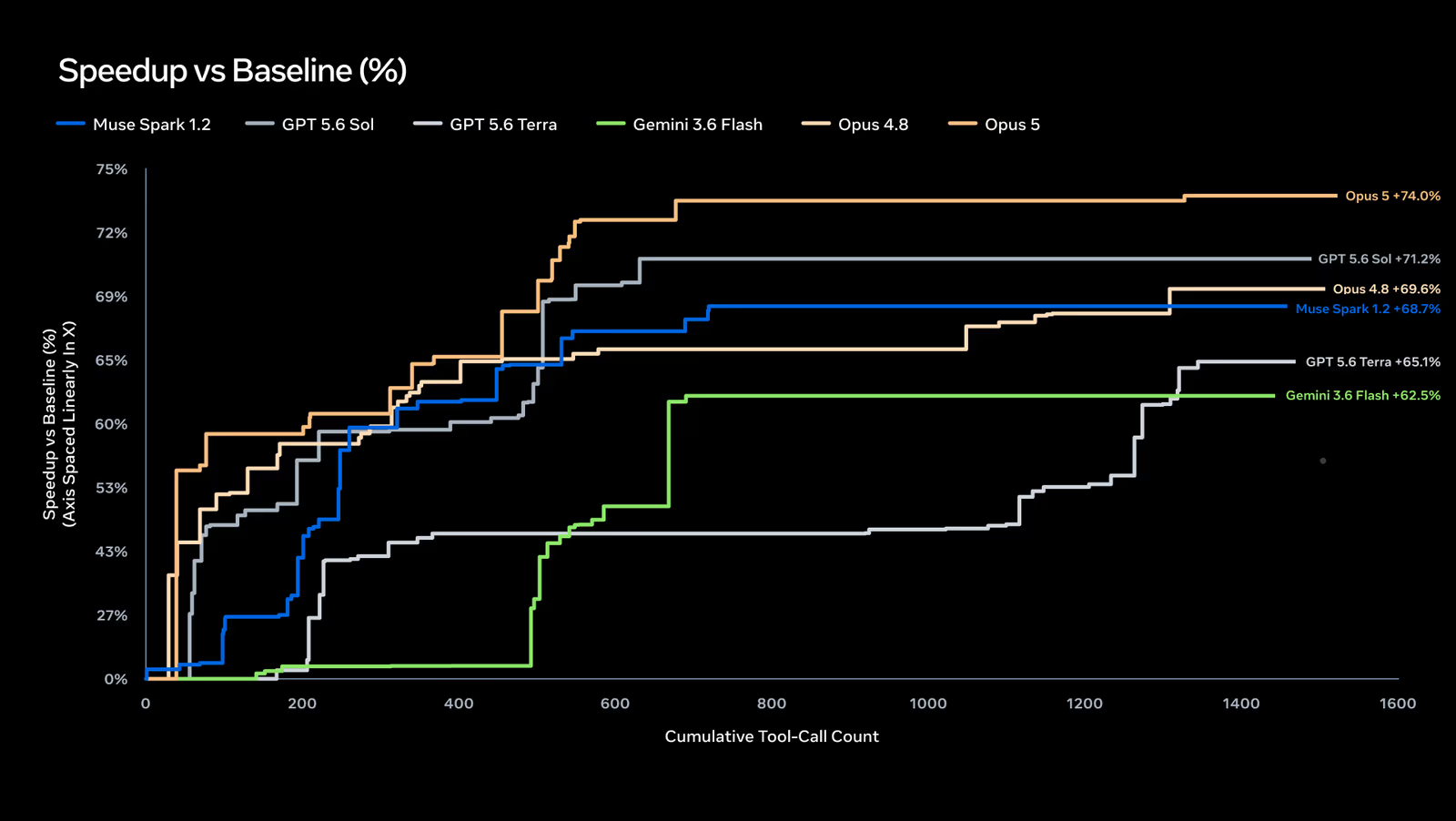
Read against the other frontier models Meta included in the same chart, Muse Spark 1.2's +68.7% speedup lands almost exactly on top of Claude Opus 4.8 (+69.6%), a step behind GPT-5.6 Sol (+71.2%) and Claude Opus 5 (+74.0%), but clearly ahead of GPT-5.6 Terra (+65.1%) and Gemini 3.6 Flash (+62.5%). "It kept finding substantial improvements well beyond the initial exploration phase," Zuckerberg wrote. Sustained improvement over a genuinely long autonomous run, if it holds up outside Meta's own demo conditions, addresses one of the most persistent criticisms of coding agents: that they plateau or drift once past their initial burst of progress. It is also, notably, the one chart in this launch where Meta is comfortable being compared directly against the very top of the frontier field rather than the merely-strong tier just below it.
A head-to-head test of Muse Spark 1.2 against GPT-5.6 Sol, Claude Fable 5 and Qwen 3.8 across multiple real-world game builds.
Data, safety and the "no Llama in sight" problem
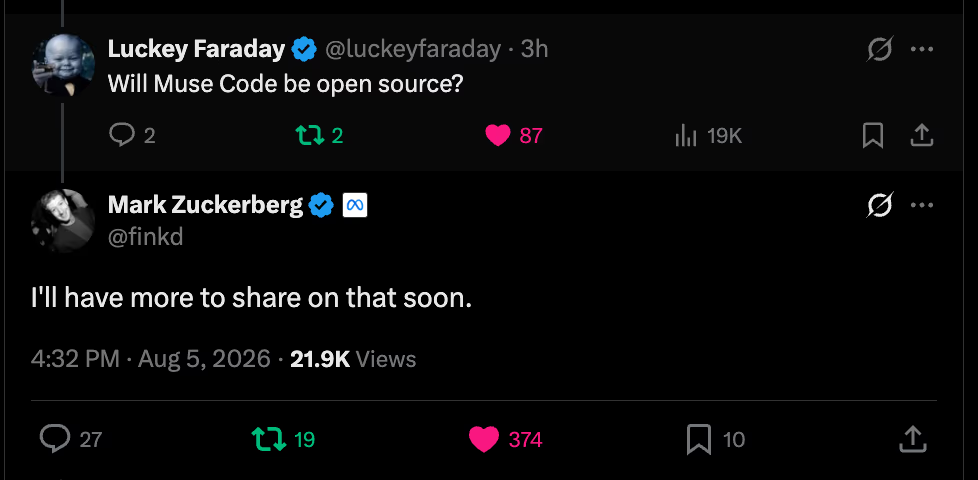
What today's announcement conspicuously lacks is any mention of open source, a striking omission from the company that spent three years positioning itself as the standard-bearer of open AI. Asked directly on X by developer Luckey Farady, "Will Muse Code be open source?", Zuckerberg replied only "I'll have more to share on that soon." Neither the official blog post nor Zuckerberg's own launch thread uses the word "open" once.
The reversal is sharper because Meta's rivals have moved the opposite way: OpenAI released its Codex CLI as open source under the permissive Apache 2.0 licence and followed with its gpt-oss open-weight models, and Google's Gemini CLI harness is likewise Apache-licensed. With Muse Code, Meta lands closest to the posture of Anthropic, whose Claude Code remains proprietary, while the company that once argued open source was the path forward now asks developers to pay per token for a model they cannot inspect, or to subsidise that access with their own data.
That last point is the real safety-relevant story here, since neither Meta's blog post nor its methodology report discloses red-teaming results, a dangerous-capability evaluation, or a model card comparable to what Anthropic, OpenAI and Google DeepMind attach to their own frontier releases. The closest thing to a disclosed trade-off is commercial rather than technical: the contributor tier's steep discount is explicitly the price of Meta training on your prompts and completions, a term any team with proprietary code needs to weigh consciously rather than default into by picking the cheapest option.
Pricing: two tiers, one trade-off
| Tier | Input ($/1M) | Output ($/1M) | Rate limit | Trains on your data? |
|---|---|---|---|---|
| Standard | $1.25 | $4.25 | 3,000 req/min, 4M tokens/min | No |
| Contributor | $0.10 | $0.20 | 60 req/min | Yes |
The standard tier is priced at $1.25 per million input tokens and $4.25 per million output tokens, with cached input at $0.15, and Meta commits that prompts and completions on this tier are not used to train its models. There is no long-context premium, and rate limits run to 3,000 requests and 4 million tokens per minute, per team. That puts it roughly mid-range against other leading models: cheaper than Qwen3.8-Max ($2.00/$6.00) and GLM-5.2 ($1.40/$4.40), pricier than DeepSeek V4 Flash ($0.14/$0.28) or GPT-5.6 Luna ($0.20/$1.20).
The contributor tier is where Meta's strategy diverges sharply from its rivals: $0.10 per million input tokens and $0.20 per million output tokens, roughly 12x and 21x cheaper than standard respectively, with cached input at a near-free $0.002, in exchange for explicit permission to use your prompts and completions to train future Meta models. At $0.30 per million blended tokens it is one of the cheapest rates on the market for a model with published frontier-adjacent benchmarks, comparable to Xiaomi's MiMo-V2.5 Flash ($0.40 blended) and cheaper than DeepSeek V4 Flash ($0.42 blended). "It's easy and low-cost to get started," Zuckerberg wrote, steering new users toward exactly this tier. But the much tighter rate limit (60 requests per minute versus 3,000) is a clear signal it is aimed at individuals and small experiments rather than production workloads, and VentureBeat's own installer test found a payment method is required even to use it, so "low-cost" is accurate but "free" is not.
Read together, the pricing structure reads as the successor to the Llama strategy itself: the ecosystem flywheel is no longer free weights in exchange for mindshare, but cheap tokens in exchange for training data. For developers and enterprises legally required to keep their code secure, that trade may not be one they are willing or able to make, which is precisely why the standard tier's no-training commitment exists as the explicit alternative.
Limitations
- Second place on every published benchmark. Claude Opus 5 leads Muse Spark 1.2 on Terminal-Bench 2.1, DeepSWE 1.1 and Meta's own internal coding benchmark, by margins of roughly 4 to 9 points.
- No independent verification yet. Every number in this article is Meta's own published figure; neither Artificial Analysis nor LMArena had scored the release at the time of writing.
- The harness-versus-model confound. Muse Spark 1.2's gains over 1.1 were measured after switching from a generic harness to the purpose-built Muse Code, so some of the improvement is architectural rather than purely the model.
- No model card or safety disclosure. There is no published red-teaming, dangerous-capability evaluation, or bias testing comparable to what Anthropic, OpenAI or Google DeepMind publish for equivalent releases.
- No open weights or licence, and Zuckerberg's only comment on the subject is a non-committal "soon."
- The contributor tier requires payment despite being marketed as the low-cost on-ramp, and its 60 requests-per-minute limit makes it unsuitable for anything beyond individual experimentation.
None of this means Meta's claims are false, the benchmark charts and the kernel-optimisation case study are Meta's most detailed technical disclosure to date for a Muse Spark release. It means the claims remain unverified by anyone outside Meta, and that the pricing advantage carries a real, clearly disclosed cost for anyone who takes it.
How Muse Spark 1.2 compares
Against Claude Opus 5, Muse Spark 1.2 trails on every metric Meta itself chose to publish, by roughly 4 points on Terminal-Bench 2.1, 6 points on DeepSWE 1.1, and nearly 9 points on Meta's own internal benchmark. Anthropic also retains the clearer safety-disclosure posture and a mature agent-tooling ecosystem around Claude Code. Muse Spark 1.2's counter is entirely on price: at $1.25/$4.25 (standard) or $0.10/$0.20 (contributor), it is a fraction of Opus 5's published per-token rate.
Against GPT-5.6 Terra, Muse Spark 1.2 leads on Terminal-Bench 2.1 (82.9% vs 81.8%) and DeepSWE 1.1 (59.3% vs 64.8%, where Terra actually edges ahead) with a mixed picture overall, but a clear win on Meta's internal benchmark (70.6% vs 65.4%). Against Qwen 3.8 Max, another model that shipped a full self-published benchmark table this week, Muse Spark 1.2 is the cheaper of the two on standard pricing and offers the unique contributor-tier option, though Qwen leads on several of its own agentic and multimodal benchmarks. Against Meta's own predecessor, Muse Spark 1.1, the generational jump is consistent and real: +6.7 points on Terminal-Bench 2.1 and +6.3 on DeepSWE 1.1, even accounting for the harness change.
Who should use it, and who should wait
Worth trying now: individual developers and small teams who want to test a genuinely new agent architecture (persistent background agents, a resumable event log) at a very low price point, and who are comfortable with the contributor tier's training-data trade-off for prototyping and experimentation where that is acceptable. The one-line installer and bundled skills make this a fast, low-friction evaluation.
Better to wait, or use the standard tier deliberately: any team with proprietary code who cannot accept the contributor tier's data terms, should default straight to the standard tier's no-training commitment rather than the cheaper on-ramp. Anyone choosing a model purely on coding capability, where Meta's own charts show a consistent gap behind Claude Opus 5, should weigh that against the price difference rather than assume "cheaper" means "close enough." And anyone who needs open weights, a named licence, or a published safety card should look elsewhere until Meta says more than "soon" on open-sourcing.
The bottom line
Muse Spark 1.2 and Muse Code are Meta's most credible entry yet into agentic coding, a genuinely different architecture, a candid set of self-published benchmarks, and a long-horizon demo that addresses a real criticism of coding agents. They are also, by Meta's own numbers, a clear step behind Claude Opus 5 on every chart the company chose to share, and a proprietary product from a company that built its developer reputation on the opposite premise.
Terminal coding agents had, until this week, been effectively a two-horse race between Anthropic and OpenAI, with Google and a crowd of startups in pursuit. Meta's entry does not change that ranking, but it does bring a genuinely different architecture and an aggressive pricing wedge into a category that badly needed a credible third option. The open questions are the ones benchmark charts cannot answer: whether Muse Spark 1.2 holds up on real repositories rather than curated evaluations, whether developers trust Meta with their code, and whether the contributor tier's discount is steep enough to make them stop asking.
Meta's official Muse Code and Muse Spark 1.2 announcement and VentureBeat's launch-day reporting and hands-on installer test provide the underlying detail referenced throughout this article.
Meta moved fast on the next iteration too: see our Muse Spark 1.3 review for what changed a month later, including where it overtakes Claude Opus 5 on coding benchmarks and where it still trails.
Last updated: 6 August 2026, the day after Muse Spark 1.2 and Muse Code launched. This article will be revised once independent evaluators publish scores, or once Meta clarifies the open-source status Zuckerberg deferred at launch.
Get the free guide: Claude vs ChatGPT, Gemini & Grok
A 20-page playbook covering everything you need to choose and use the big four AI models in 2026, full cost and feature comparisons, what each is best (and worst) at, and how-tos for images, vectors, building a website, Claude Code and more.