 AI Tools Review Editorial Team
Quick answer:
MiniMax Code 2.0 is a ground-up rebuild of MiniMax's desktop coding-agent app, not a new product. The rebuild shipped in the v3.0.48-v3.0.49 update on 13 July 2026, and MiniMax's own release notes claim it cut p95/p99 first-token latency by over 90%, reduced silent stalls and interruptions, improved conversation-state and tool-call persistence, reduced runtime dependencies, and streamlined Windows installation. Chinese-language tech coverage attributes the rebuild to Pi, an open-source minimal coding-agent framework (pi.dev), though MiniMax's own English changelog never names it directly. Follow-up releases through v3.0.56 on 29 July 2026 added Remote Control, a built-in browser with Browser Control, Goal Mode, BYOK model configuration, and (per Chinese coverage) a financial-data module built on Hang Seng market data and Qichacha company records. The app now defaults to MiniMax's M3 model and is sold through a $20/$50/$120 monthly Token Plan.
Most "2.0" product announcements are marketing. MiniMax Code 2.0 is closer to the real thing: a documented core rewrite of the desktop app's session, state-management and tool-calling layers, released across five point updates in July 2026, culminating in v3.0.56 on 29 July. What makes it worth a close look is not any single headline number, it is how much of the story is genuinely traceable to a public changelog, and how much rests on secondary reporting that MiniMax itself has not confirmed in English.
This article separates the two. It walks through what MiniMax's own release notes say, what Chinese tech press adds (including the specific claim that the rebuild runs on the open-source Pi agent framework), what the underlying MiniMax M3 model brings to the app, and what a fair reading of the evidence looks like for a team deciding whether to trial it.
Note: this analysis is based on MiniMax's own official changelog at agent.minimax.io/docs/changelog, MiniMax's Token Plan pricing documentation at platform.minimax.io, MiniMax's M3 model page at minimax.io, MiniMax's official release notes for models, a screenshot of MiniMax Code's own home screen sourced from MiniMax's documentation CDN, and Chinese-language tech coverage of the 2.0 rebuild (Tencent News, Sohu, ifeng, and a widely circulated X post from developer 0xLogicrw). Where a claim comes only from Chinese press rather than MiniMax's own English-language materials, that is flagged explicitly. No claim in this article has been independently benchmarked by AI Tools Review, and none of MiniMax's own performance figures have been reproduced by a third-party evaluator at the time of writing.
Julian Goldie SEO's hands-on walkthrough of MiniMax Code 2.0 shortly after the v3.0.56 desktop release.
Summary
- Not a new app, a core rebuild. MiniMax Code 2.0 refers to the v3.0.48-v3.0.49 desktop update on 13 July 2026, which rewrote how sessions, conversation state and tool calls are handled inside MiniMax's existing desktop agent.
- p95/p99 first-token latency cut by "over 90%", per MiniMax's own quoted release note, alongside reduced silent stalls, fewer lost conversations, reduced runtime dependencies, and a streamlined Windows installer.
- Attributed to the open-source Pi agent framework by Chinese tech press and a widely shared X post, not by MiniMax's own English changelog, which never uses the words "Pi" or "Pi Agent".
- Four real feature releases followed: Remote Control and a built-in browser with BYOK model configuration (v3.0.52, 20 July), Browser Control and Goal Mode (v3.0.54, 27 July), and two bug-fix releases through v3.0.56 (29 July), which fixed proxy-related network errors.
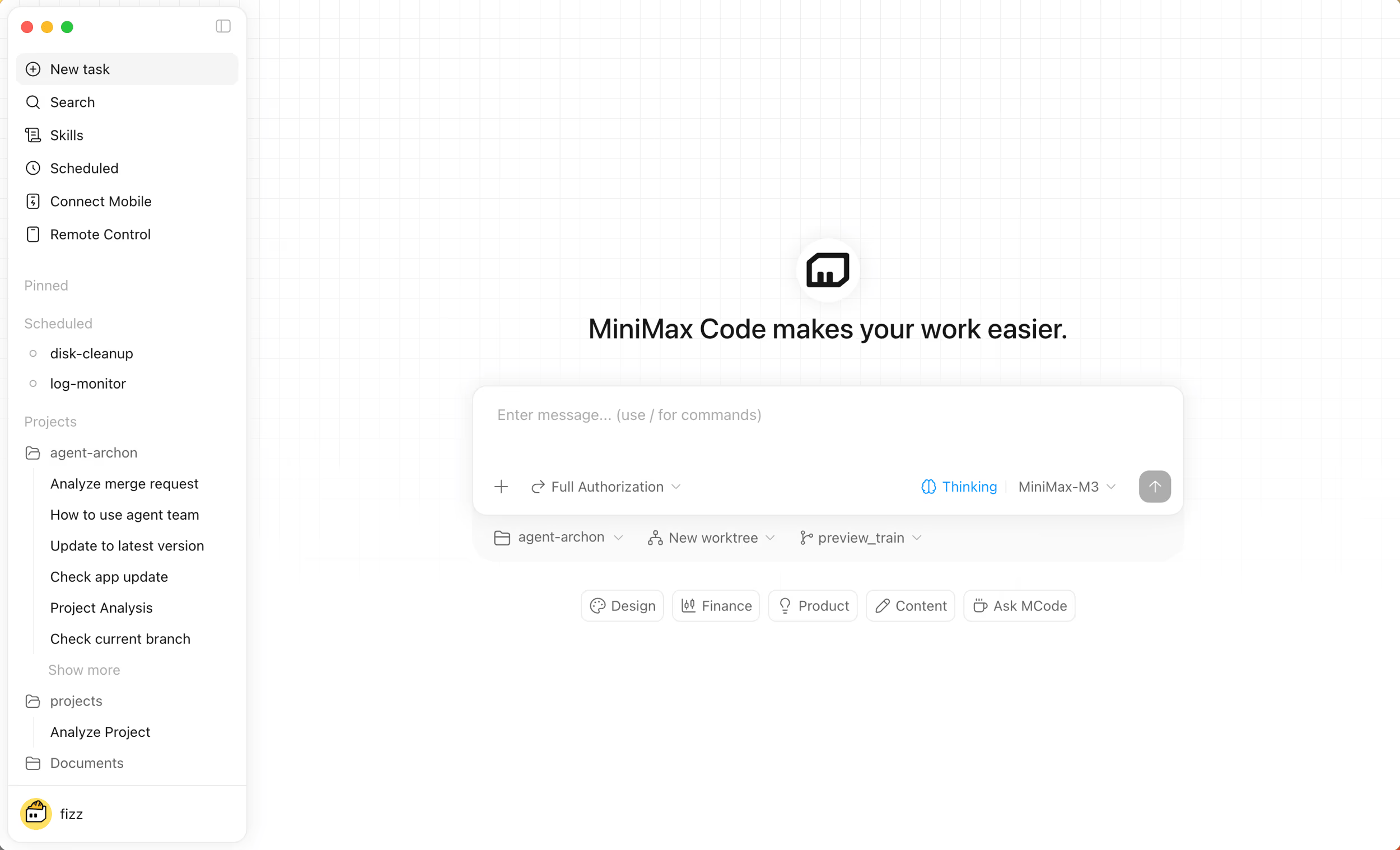
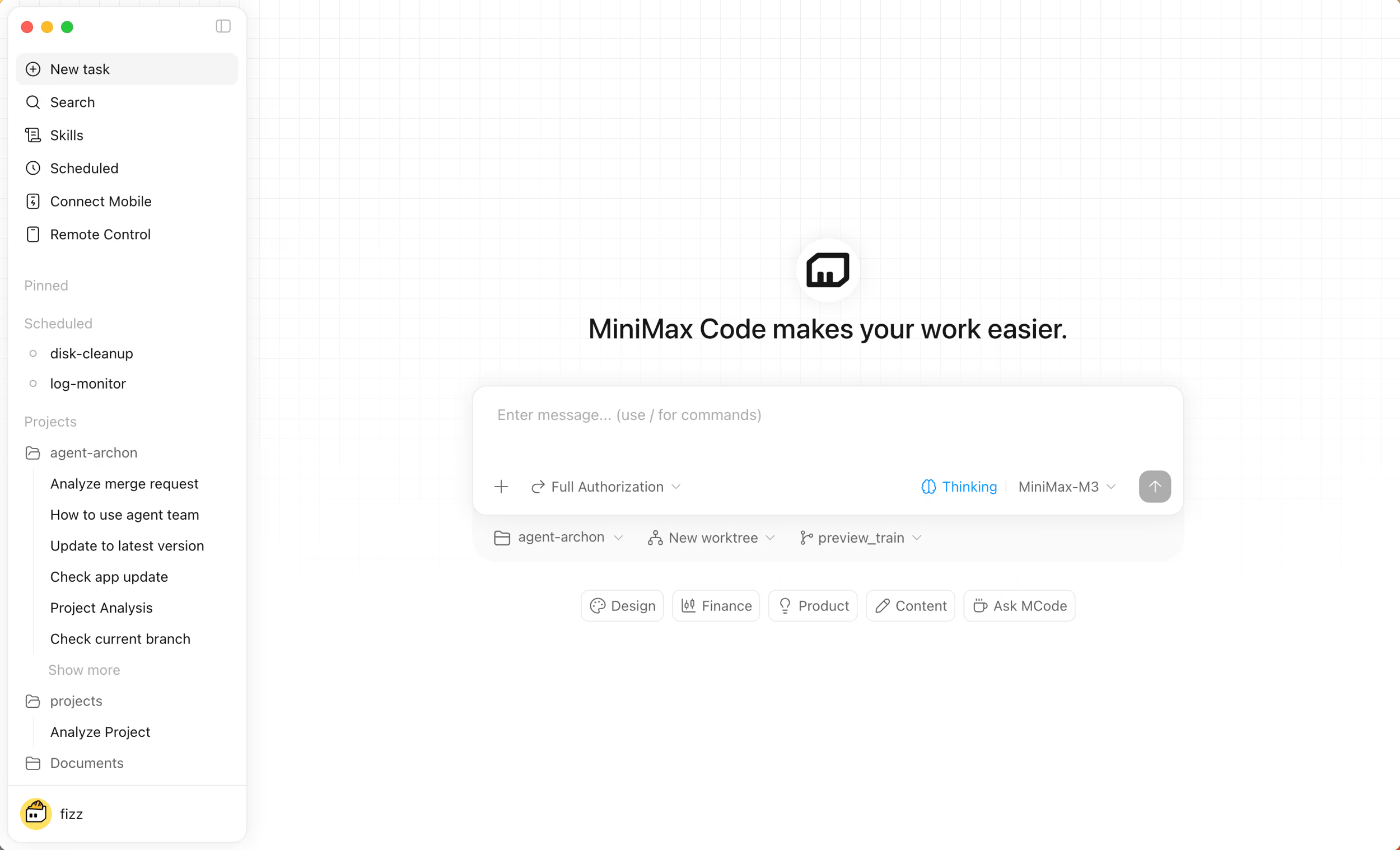
- A financial-data module, built on Hang Seng market data and Qichacha company records, is documented in Chinese coverage and visible as a "Finance" quick-action button in MiniMax Code's own interface, but is not named in the English changelog entries we could access.
- Powered by MiniMax-M3 by default, MiniMax's flagship model (released around 1 June 2026) with up to a 1-million-token context window, alongside continued access to the older MiniMax-M2.7.
- Sold on a $20/$50/$120 monthly Token Plan (Plus/Max/Ultra), with 5-hour rolling and weekly usage windows, plus a BYOK option to bring your own API key or third-party provider instead.
- Every performance number is self-reported. No independent evaluator had reproduced MiniMax's latency or stability claims for Code 2.0 at the time of writing.
What is MiniMax Code?
MiniMax Code is the Shanghai AI lab's desktop AI agent app: a local workspace that combines chat, project-aware file operations, terminal sessions, a built-in browser, memory, Skills and task automation, distinct from the MiniMax API, the MiniMax M3 model itself, or MiniMax's separate browser-based Agent product. It runs natively on macOS (Apple silicon and Intel, Big Sur 11 or later) and 64-bit Windows 10 or later; no officially documented native Linux build exists at the time of writing.
The app sits downstream of MiniMax's model lineage, which has moved fast through 2026. MiniMax M2.5 launched on 11 February 2026 as a 230-billion-parameter Mixture-of-Experts model with only 10 billion active parameters per token, pitched at near-frontier coding performance for a fraction of Claude Opus 4.6's cost; we covered it in detail in our own MiniMax M2.5 review. MiniMax followed that with M2.7 on 18 March 2026 (which MiniMax framed as "beginning the journey of recursive self-improvement"), then M3 around 1 June 2026, MiniMax Code's current default model. In between, MiniMax also shipped the H3 video model on 31 July 2026, which we cover separately in our MiniMax H3 explainer, and listed on the Hong Kong Stock Exchange on 9 January 2026. MiniMax Code 2.0, in other words, is not an isolated release: it is the desktop front end catching up architecturally at the same time the company has been shipping a new flagship model roughly every six to eight weeks.
That context matters for reading the 2.0 rebuild correctly. MiniMax has not published a single comprehensive launch post covering Code 2.0 the way it did for M2.5 or M3; instead, the story is assembled from a sequence of dated changelog entries and secondary press coverage, which is a materially different (and thinner) evidence base than a flagship model launch with a benchmark table attached.
Architecture: the Pi Agent rebuild
MiniMax's own official changelog is specific about what changed, if not about how. Under the heading "MiniMax Code 2.0: All-New Core", dated to the v3.0.48-v3.0.49 release on 13 July 2026, MiniMax writes that it "rebuilt MiniMax Code at its core to make conversations, workflows, and long-running tasks smoother and more reliable", and lists five concrete improvements verbatim:
- "Reduced the time from starting a new conversation to the first output, cutting p95/p99 first-token latency by over 90%."
- "Reduced unexpected interruptions and silent stalls during conversations, with clearer status feedback when errors occur."
- "Improved how conversation state and tool-call data are saved and carried over, reducing cases where conversations are unexpectedly lost or execution context is interrupted."
- "Reduced runtime dependencies for smoother performance on low-memory devices."
- "Streamlined the Windows installation process to reduce setup time."
That is a genuinely detailed list for a changelog entry, and it reads as a real architecture change, not a UI refresh: latency, stall rate, state persistence, dependency footprint and installer friction are five different engineering problems, and MiniMax addressed all five in the same release. What the English changelog does not do is name the framework underneath the rebuild.
That detail comes from Chinese-language tech coverage. Multiple outlets, including Tencent News, Sohu and ifeng, ran near-identical reporting the week of 16 July 2026 stating that MiniMax Code's underlying architecture was rebuilt on top of an open-source framework called Pi (基于开源框架 Pi Agent). A widely shared post on X from developer 0xLogicrw put it more directly: MiniMax rebuilt session execution, state management and tool calling on the open-source Pi Agent framework, specifically to fix waiting, freezing and context-loss problems during long tasks, and the new version starts faster and stays more stable during long reads, tool calls and file edits.
Pi itself is a real, independently verifiable project: a minimal, extensible coding-agent harness built by Earendil Inc, distributed as an MIT-licensed open-source package (documented at pi.dev and published to npm as @mariozechner/pi-coding-agent). Its design philosophy is deliberately spare, a roughly 150-word system prompt, four core tools (read, write, edit, bash), no built-in sub-agents or plan mode by default, and extensibility through TypeScript extensions and skills rather than a large baked-in feature set. Pi supports more than fifteen model providers, MiniMax among them, which is consistent with MiniMax being able to adopt it as a foundation and layer MiniMax-specific functionality, its own desktop UI, model routing, permissions system, Agent Team, memory and task scheduling, on top, exactly as the Chinese coverage describes.
The honest position, and the one this article takes throughout, is that the rebuild itself is well documented and credible: MiniMax's own dated, versioned changelog corroborates real engineering work on session handling, state persistence and installation. The specific claim that Pi is the framework underneath it is well sourced in Chinese press and plausible given Pi's existing MiniMax provider support, but it is not something MiniMax has stated in the English-language materials we could access, so it should be read as strongly reported rather than officially confirmed.
Capabilities deep dive
Performance and latency
The centrepiece claim, "p95/p99 first-token latency reduced by over 90%", describes the 95th and 99th percentile wait time between starting a new conversation and seeing the first token of output. Percentile latency metrics are the right thing to optimise for an agent app specifically because they capture tail behaviour: an agent that is fast on average but occasionally hangs for ten seconds feels broken in a way a simple mean latency figure would hide. MiniMax pairing that number with "reduced unexpected interruptions and silent stalls" and "reduced runtime dependencies for smoother performance on low-memory devices" suggests the underlying problem being solved was less "make it faster" and more "make it reliably start and keep running", a believable motivation for adopting a leaner agent harness like Pi.
Conversation-state and tool-call persistence
The second pillar of the rebuild is durability: MiniMax says it "improved how conversation state and tool-call data are saved and carried over, reducing cases where conversations are unexpectedly lost or execution context is interrupted." For an agent that runs terminal commands, edits files across a Git worktree, and can be handed off between the desktop app and a phone via Remote Control, losing execution context mid-task is a serious failure mode, not a cosmetic bug. This is also the area where Pi's minimal-core design plausibly helps: a smaller, more predictable state machine is generally easier to make durable than a larger one accumulated through years of incremental features.
The financial-data module
Chinese coverage from mid-July 2026 describes a financial-data capability that integrates real-time market data with automated research workflows: users specify a research goal, and the agent retrieves market performance, company information and industry context, then generates a structured analysis report. The reporting names two specific data integrations, MiniMax's own tie-up with the Hang Seng financial database for global market data, and an Enterprise Check (企查查/Qichacha) MCP integration for domestic Chinese company and entity data. One worked example cited in Chinese press: a user uploads an exhibition directory PDF, and the agent identifies which exhibitors are listed companies, pulls their financials, analyses supply-chain exposure, and produces a trip-preparation document with recommended companies, risk flags and a suggested list of questions to ask.
At the time that reporting ran (16 July 2026), the financial module was live on MiniMax's web Agent product but described as "coming soon" to desktop. The "Finance" quick-action button visible in MiniMax Code's own home-screen interface, alongside Design, Product and Content, indicates it has since reached the desktop app, though we could not find the specific feature named in the English-language changelog entries we accessed, so its exact desktop release version is unconfirmed from primary English sources.
Remote control (and browser control)
MiniMax's changelog lists Remote Control as a real, shipped feature in v3.0.52 (20 July 2026), not merely a preview: it lets a user "connect to your desktop Agent from your phone to check progress, send instructions, and approve permission requests on the go". The same release added a built-in browser ("open web pages and HTML artifacts directly in the app sidebar") and BYOK model configuration. A week later, v3.0.54 (27 July 2026) extended the browser into full Browser Control, letting the agent "operate continuously inside the built-in browser: reading pages, filling forms, uploading workspace or task files, and checking results", with MiniMax's own documentation specifying that confirmation is requested before outward-facing actions. The same release introduced Goal Mode, for setting complex or long-running work as a goal the agent keeps progressing on its own, and an upgraded Feedback Center.
Real-world performance vs claims
It is worth being explicit about what kind of evidence this article rests on, because it is a different kind of evidence than a benchmarked model launch. MiniMax Code 2.0 is a product changelog, not a research paper: there is no published methodology for how the p95/p99 latency figures were measured, no disclosed sample size, no baseline hardware or network conditions, and no comparison against a specific prior version number beyond "the old core". "Over 90%" is also a floor, not a precise figure, which is typical of marketing-adjacent release notes and worth noting as such.
The same caution applies more strongly to the Pi Agent framework attribution and the financial-data module, both of which we could source only through Chinese-language secondary reporting and, in the financial module's case, a screenshot of the app's own UI rather than a dated English changelog entry. None of this means the claims are false, the changelog's specificity (five distinct, plausible engineering improvements, each dated and versioned) is a stronger evidence base than a single marketing sentence would be, and the Chinese press coverage is consistent across multiple independent outlets rather than a single unverified source. But it does mean every number in this article should be read as MiniMax's own reporting of its own product, corroborated by press coverage that itself relies substantially on MiniMax's own briefings, rather than as independently benchmarked fact.
We could not find any independent third-party evaluation, benchmark, or teardown of MiniMax Code 2.0's actual latency or stability improvements at the time of writing. Community reaction visible on X was limited to the single widely shared summary post cited above, rather than a broad wave of independent user testing threads. Anyone routing real engineering workflows through the app is best served by testing it against their own tasks and forming their own view of the reliability improvements, rather than taking the "over 90%" figure as a settled, externally validated number.
Pricing and availability
| Plan | Price | MiniMax's stated fit |
|---|---|---|
| Plus | $20/month | Personal projects and prototyping (roughly 3-4 agents) |
| Max | $50/month | Daily coding with agents and multimodal work (roughly 4-5 agents) |
| Ultra | $120/month | Heavy agent workflows and extended sessions (roughly 6-7 agents) |
All three tiers of MiniMax's Token Plan share the same quota structure: usage is governed by both a 5-hour rolling window and a weekly window, and MiniMax states unused quota does not carry over between windows. The plan covers MiniMax's full current model lineup, M3, M2.7, plus image, speech and music models, though MiniMax notes "a small number of special models" (including MiniMax H3 and certain voice-cloning models) are excluded. Beyond the monthly subscription, MiniMax sells top-up credits at a flat rate of 1,000 credits per $1, valid for 365 days from purchase, useful for smoothing over a single heavy week without upgrading tiers.
MiniMax Code also supports BYOK (Bring Your Own Key): instead of subscribing to a Token Plan, users can configure their own MiniMax API key, or add an entirely custom provider by supplying a base URL, API key, request format and model information. This is a meaningfully different cost model to a fixed monthly plan, but independent guidance to MiniMax Code users is explicit that "context, modalities, tool support, privacy, and cost depend on the provider" when going the custom-provider route, so it is not a drop-in substitute for the officially supported model lineup.
The desktop app itself is free to download for macOS (Apple silicon and Intel, macOS Big Sur 11 or later) and 64-bit Windows (Windows 10 or later); the Token Plan or BYOK configuration governs actual usage cost. No officially documented native Linux build exists at the time of writing, according to independent setup guidance for the app.
Limitations
- No independent verification of the headline latency claim. The "p95/p99 first-token latency reduced by over 90%" figure is MiniMax's own, with no disclosed methodology and no third-party reproduction.
- The Pi Agent framework attribution is not first-party. MiniMax's own English changelog never names Pi; the specific architecture claim traces to Chinese tech press and a single widely shared social-media summary post.
- The financial-data module's desktop rollout is unconfirmed in primary English sources. It is visible in the app's own UI and documented on the web version by Chinese press, but not named in the English changelog entries we could access.
- No native Linux desktop build is officially documented, limiting the app to macOS and Windows users.
- BYOK quality depends entirely on the provider you bring. MiniMax's own guidance is explicit that context length, modality support, tool compatibility, privacy posture and cost all vary once you step outside the officially supported model lineup.
- This is a fast-moving, minor-version-driven product. Five point releases shipped in a single month (v3.0.48 through v3.0.56); anyone evaluating the app should check the current changelog rather than relying on any single version's feature set, including the one described here.
None of this means the rebuild is not real or not useful; the versioned, dated changelog is a stronger evidence base than most product announcements offer. It does mean the specific numbers and the Pi Agent framework attribution should be treated as well-sourced claims rather than independently confirmed facts.
How MiniMax Code compares
MiniMax Code competes in a crowded field of desktop and terminal coding agents, and the comparison is easiest to frame by what each one actually is rather than by unverifiable head-to-head benchmark claims. Anthropic's Claude Code is a terminal-first coding agent sold on its own subscription structure with weekly usage limits, covered in detail in our Claude Code pricing guide; unlike MiniMax Code, Claude Code does not ship a dedicated desktop GUI app with a built-in browser or phone remote-control feature in the way MiniMax Code now does. Cursor, reviewed on this site in our Cursor 2.0 review, is a full IDE fork built around multi-agent editing rather than a lightweight agent harness bolted onto a file workspace, a genuinely different product category to MiniMax Code's minimal-core, Pi-adjacent design philosophy. OpenAI's Codex app, covered in our piece on the Codex app for macOS, is closer in spirit, a command centre for managing multiple coding agents in parallel, though it is macOS-only where MiniMax Code also supports Windows. GitHub Copilot remains the most widely deployed of the group by installed base, but is primarily an in-editor completion and chat product rather than a standalone desktop agent workspace with terminal, browser and remote-control features of its own.
The clearest differentiator MiniMax Code has over all four is price and openness of its underlying stack: a $20/month entry tier, BYOK support for bringing your own model or provider, and (per Chinese coverage, not MiniMax's own confirmation) an open-source agent framework underneath its 2.0 core, versus the largely closed, proprietary harnesses that power Claude Code, Cursor and Codex. Whether that translates into a better day-to-day experience is precisely the question MiniMax's own self-reported latency and stability numbers cannot answer on their own; it is a question worth testing directly against your own workflow, alongside Moonshot's open-weight coding model covered in our Kimi K2.7 Code review and Alibaba's Qwen 3.8 Max, two other models increasingly used inside third-party and BYOK-style agent harnesses.
Who should use it
Worth trying now:
- Developers who want a desktop agent workspace with a built-in browser, terminal and phone remote control in one app, on either macOS or Windows
- Teams price-sensitive enough that a $20/month entry tier or BYOK access to MiniMax-M3 is meaningfully cheaper than existing tooling
- Anyone curious to evaluate MiniMax-M3's coding and agentic performance directly, rather than through a third-party benchmark table
- Users who specifically want a lightweight, open-source-adjacent agent core rather than a large proprietary IDE fork
Better to wait or look elsewhere:
- Linux desktop users, since no native build is officially documented
- Teams that require independently benchmarked latency and reliability numbers before adoption, rather than self-reported vendor figures
- Anyone whose workflow depends on the financial-data module specifically, until its desktop availability and scope are confirmed in primary English-language documentation
- Enterprises needing an established, widely documented safety and compliance track record before routing production workloads through a fast-iterating, minor-version-driven product
The bottom line
MiniMax Code 2.0 is a real, well-documented engineering rebuild wrapped in a much thinner layer of independently verifiable evidence than the changelog's specificity might suggest. The five improvements MiniMax lists for the July 2026 core rewrite, latency, stall rate, state persistence, dependency footprint and installer friction, are concrete and plausible, and the follow-on feature releases through v3.0.56 (Remote Control, Browser Control, Goal Mode, BYOK) arrived on a genuine, dated cadence rather than as a single marketing burst. The claim that the rebuild runs on the open-source Pi agent framework is credible and consistently reported across multiple Chinese outlets, but it is not something MiniMax has stated directly in the English-language materials available to us, and the "over 90%" latency figure has no disclosed methodology or independent reproduction.
For a team evaluating coding agents, that combination, real architectural change, transparent (if incomplete) versioned changelog, low entry price, but entirely self-reported performance claims, is a reasonable basis for a trial, not for a purchasing decision made on the numbers alone. The honest summary is the one this article has tried to model throughout: MiniMax Code 2.0 is a genuine rebuild of a real product, and its own release notes are the best evidence for what changed; whether it is actually faster and more reliable for your workload is still a question only your own testing can answer.
MiniMax's own MiniMax Agent changelog, MiniMax's Token Plan pricing documentation, and MiniMax's MiniMax-M3 model page provide the primary-source detail referenced throughout this article.
Last updated: 9 August 2026, shortly after MiniMax Code reached v3.0.56. This article will be revised if MiniMax publishes further detail on the Pi Agent framework attribution, the financial-data module's desktop rollout, or if independent evaluators reproduce the latency and stability figures cited here.
Get the free guide: Claude vs ChatGPT, Gemini & Grok
A 20-page playbook covering everything you need to choose and use the big four AI models in 2026, full cost and feature comparisons, what each is best (and worst) at, and how-tos for images, vectors, building a website, Claude Code and more.