 AI Tools Review Editorial Team
Quick answer:
Two quantum results landed within a day of each other. On 15 October 2026 Google Quantum AI reported magic state cultivation on its Willow chip, with about 40 times lower errors and 99.99% logical fidelity for T-states. On 16 October Anthropic reported that Claude Mythos 5 designed circuits with fewer qubits and gates than the best published algorithms across eight primitives, including one elliptic-curve design with 17 times fewer gates. Both are genuine advances; neither is a working fault-tolerant machine.
Quantum computing has a long-standing problem: the algorithms we know how to run on a perfect machine are enormously expensive on a real one. Two announcements this week attack the cost from opposite ends. One makes the hardware cheaper to operate. The other makes the software cheaper to run, and it was largely written by an AI model.
This guide explains both results, checks the headline numbers against the primary sources, and separates what was demonstrated from what was implied. One correction up front: a widely shared video summary says Mythos 5 beat human designs on "7 of 8 tasks". Anthropic's own post does not say that. It says Claude found better designs across all eight primitives it studied, and that is the claim we examine.
AI Revolution X summarises Anthropic's quantum-circuit research and Google's Willow magic-state result, with links to the primary sources.
Executive Summary
Anthropic's post, "Designing more efficient quantum circuits with Claude", is dated 16/10/2026 and was led by Andi Gu, mentored by Alek Kemeny, with Susanne Yelin and Mikhail Lukin. A full paper is on arXiv (2610.22367). Google's post, "Bringing the magic", is dated 15/10/2026, written by Emma Rosenfeld and Craig Gidney of Google Quantum AI, and accompanies a paper in Science (DOI 10.1126/science.aee7961).
- Anthropic: Mythos 5 improved circuits for eight primitives across chemistry, optimisation, quantum simulation, number theory and numerical computing, using a closed propose, evaluate, revise loop.
- Biggest single claim: an elliptic-curve point-addition design with 17 times fewer gates than the smallest earlier design, at about 12 per cent more qubits.
- Google: magic state cultivation on Willow, with roughly 40 times lower error than uncultivated states and a record 99.99 per cent logical fidelity for T-states.
- Caveat from both teams: these are components. Neither result is a complete, scaled, fault-tolerant system.
Read together they describe a plausible route to useful quantum computing: cheaper circuits, cheaper error correction, and an AI model that can search the design space faster than people can. We would not treat either as a date for anything.
How Mythos 5 Designed the Circuits
The setup is simple and the discipline around it is what makes it credible. Claude Mythos 5 was given a plain-language specification for each task and asked to explore several approaches in parallel. It proposed a circuit as Python code. An external evaluator checked that the circuit was correct and scored it on qubits multiplied by gates. Claude read the result and revised, with no human input between rounds. Because the evaluator, not the model, decides what counts as correct, the result is a verified circuit rather than a plausible-sounding claim.
Anthropic also reports behaviour worth noting: the model was conservative. It second-guessed its own improvements, over-checked results and tended to favour known approaches. The team countered this by requiring parallel, qualitatively different approaches and by occasionally prompting a broader search. That is a useful operational lesson for anyone building similar loops: left alone, a careful model may under-explore.
For background on the model itself, including how it relates to the publicly available Fable variant, see our explainer on Claude Fable 5 versus Mythos 5 and the earlier Mythos 1 release article.
The Eight Primitives and the Results
Anthropic's summary figure plots seven of the primitives as small charts of Toffoli count against peak qubits, with an X for prior work and a dot for Claude's design. In every panel the dot sits to the lower left of the X, meaning fewer qubits and fewer gates. A Toffoli gate is the costly non-Clifford operation that dominates the resource estimates for fault-tolerant algorithms, which is why it is the unit of account.
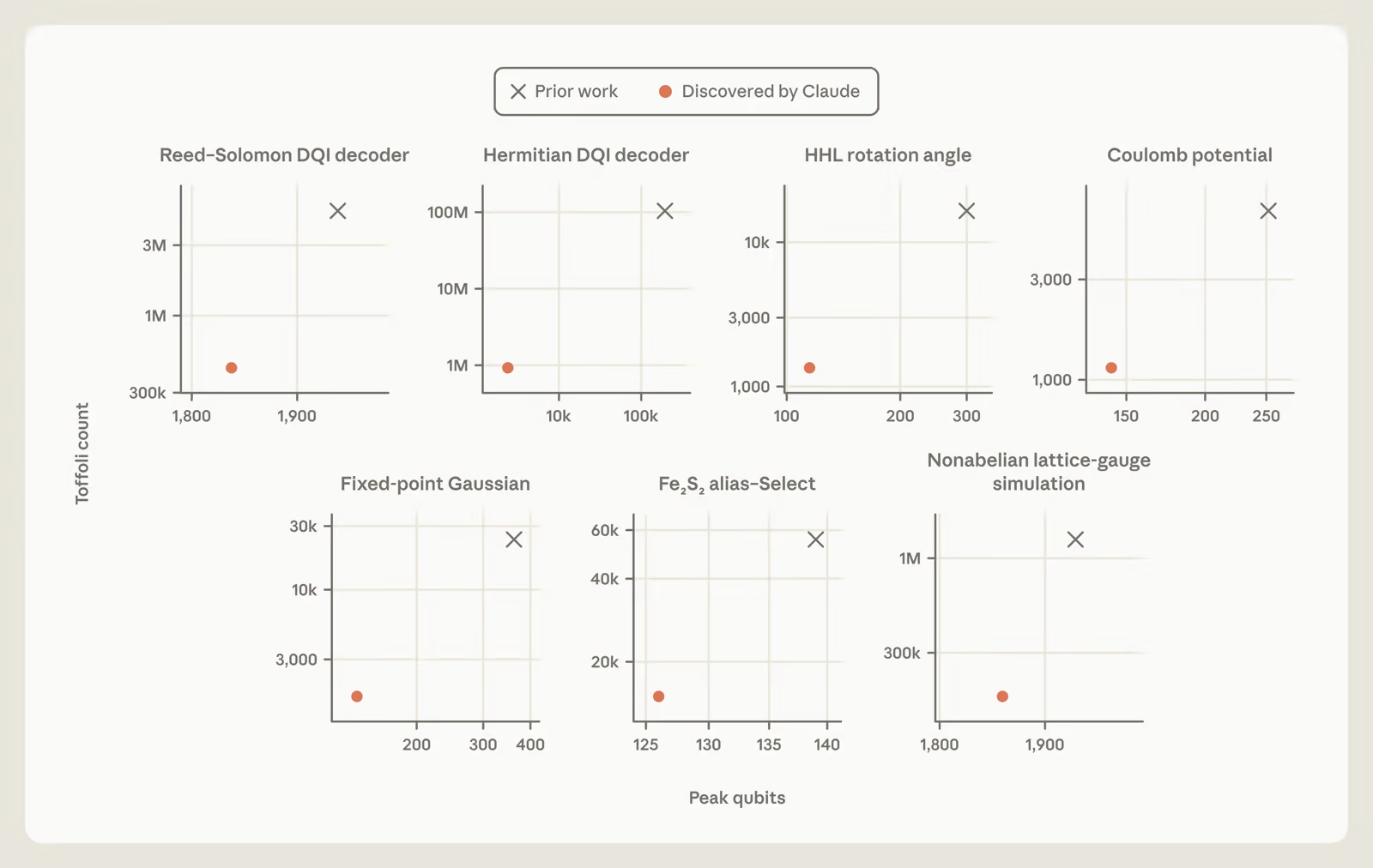
The seven panels cover a Reed-Solomon decoder and a Hermitian decoder for Decoded Quantum Interferometry (DQI), an HHL rotation angle, a Coulomb potential, a fixed-point Gaussian, an alias-select routine for the iron-sulphur cluster Fe2S2, and a non-Abelian lattice-gauge simulation. Axes are logarithmic, so even modest vertical gaps are large multiples; Anthropic says some improvements are an order of magnitude or more. The chart gives no exact values for most panels, so we do not quote any beyond those Anthropic states in text.
Case Study 1: Elliptic-Curve Point Addition
The headline discovery came from a one-paragraph brief and 53 hours of work. Elliptic-curve point addition is the core arithmetic step of Shor-style attacks on elliptic-curve cryptography, so its cost is a standard input to estimates of how large a quantum computer would need to be. Anthropic says Claude built the first reversible divsteps modular inversion with no stored branch history: the branch information is decoded from the numbers themselves. Claude also proved the required algebraic identities, checked the result with large-scale simulation and formalised the claim in the Lean proof assistant.
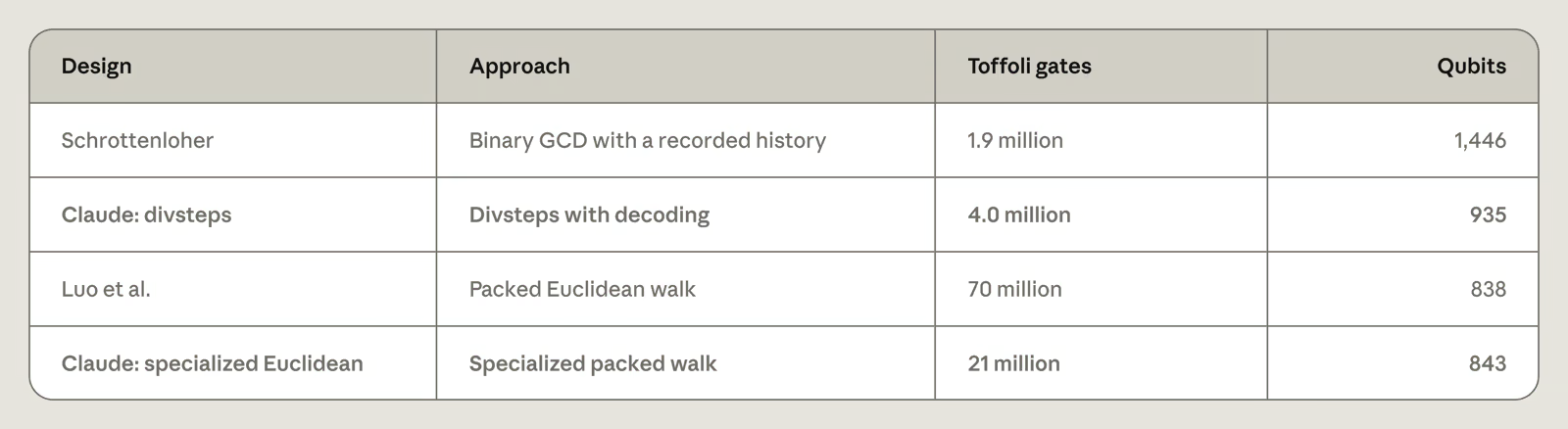
The table shows where the 17 times figure comes from. The qubit-lean prior design by Luo et al. uses 838 qubits and 70 million Toffoli gates. Claude's divsteps design uses 935 qubits (about 12 per cent more) and 4.0 million gates, which is 17.5 times fewer. A second Claude design, a specialised Euclidean walk, uses 843 qubits and 21 million gates against the same baseline: nearly identical qubit count and about a third of the gates. At the gate-minimal end, Schrottenloher's design is still cheaper in gates (1.9 million) but needs 1,446 qubits.
A threshold parameter in Claude's construction yields a whole family of designs between the qubit-minimal and gate-minimal extremes, so the result is an expanded trade-off frontier rather than one point. Anthropic stresses this came from a method that "hadn't been possible previously", not from trimming an existing design.
Case Study 2: A Cheaper Decoder for DQI
The second case study concerns Decoded Quantum Interferometry, a quantum optimisation algorithm that needs a classical error-correcting-code decoder to run reversibly on the quantum computer. Claude replaced the extended Euclidean algorithm with Berlekamp-Massey decoding and, rather than storing every intermediate value, reconstructed most of them as needed. Simulation over 403 million sample decodings showed that saving a single value, worth 19 qubits, is enough, with failure in about one run in 10,000.
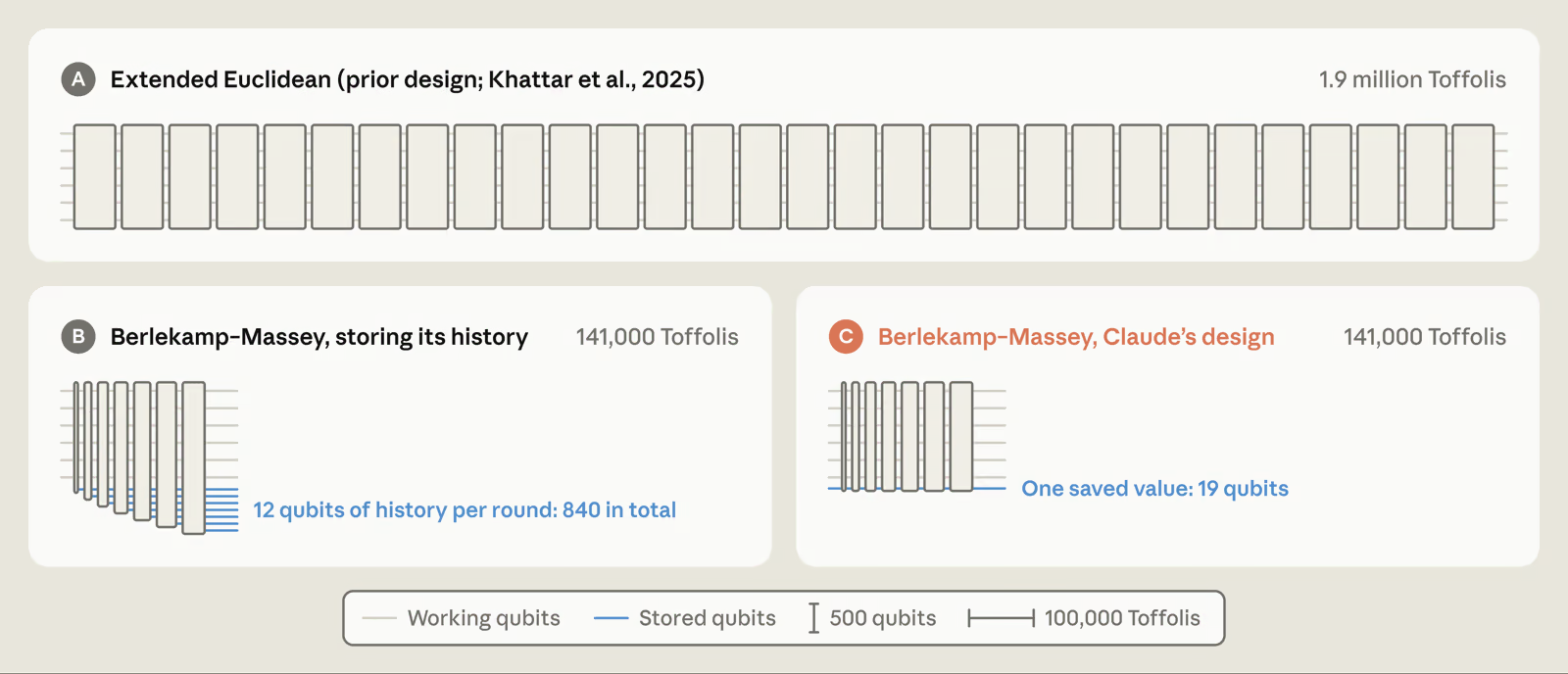
The figure makes the trade clear. Moving from Euclidean to Berlekamp-Massey cuts the gate count from 1.9 million to 141,000. Storing the algorithm's history would cost 840 qubits in total (12 qubits per round); Claude's design removes that overhead down to 19 qubits. Anthropic's text describes the gate reduction relative to Google's earlier construction as about a factor of 12, and we quote that wording because it is the authors' own comparison basis; our arithmetic from the figure labels alone gives a somewhat larger ratio.
Anthropic places this in a wider context. It cites an estimate that a particular optimal polynomial intersection problem would take about three months on the Frontier supercomputer but roughly an hour on a future quantum computer running DQI. It also notes that the cost of simulating the FeMoco catalyst has fallen from about 50 trillion Toffoli gates (2017 estimate) to about 340 million, roughly a 150,000-fold reduction, a few hours on a machine with about three million physical qubits, citing work from 2025. Those figures come from the wider literature, not from Mythos 5 alone.
Google's Willow: Magic State Cultivation
Google's result attacks a different cost. Fault-tolerant quantum computers need special resource states, called magic states, to apply certain gates; they have been recognised as a bottleneck since 2004. A magic state can be used once, and some estimates put up to 95 per cent of a quantum computer's capacity into producing them.
Cultivation, proposed in 2024 by Craig Gidney, Noah Shutty and Cody Jones, works like a filter. A noisy state is injected into a small region of the chip and coordinated measurements discard flawed attempts, leaving a much cleaner state without a large distillation factory. On the Willow processor Google reports roughly 40 times lower errors compared with uncultivated states and a record logical fidelity of 99.99 per cent for T-states. The post calls this the first practical demonstration of a solution to the bottleneck on real hardware.
Two engineering details are instructive. Emma Rosenfeld traced anomalous data to a flawed assumption in the team's benchmark: electrical equipment drift and temperature variation in the lab. The team added control to reduce that noise and built a benchmarking method in which cultivation measures itself. And the team showed it can switch codes, transferring a state from a distance-3 color code to a distance-5 surface code, a technique called grafting.
Google's own caveat is plain: cultivation still needs demonstration at larger scale before it is practical, and plenty of technical challenges remain. It is a demonstration on current hardware, not a full practical system.
AI Search's news round-up includes Google's quantum announcement alongside the week's other major AI releases.
Why the Two Results Fit Together
Resource estimates for a useful quantum computer multiply three things: the number of logical operations the algorithm needs, the number of physical qubits needed per logical qubit, and the overhead of producing magic states. Anthropic's work attacks the first factor, by finding circuits with fewer gates and qubits. Google's attacks the third. Neither touches the second directly, which is why independent progress on all three matters.
The more interesting question is the role of an AI system as a circuit designer. Anthropic suggests joint optimisation of circuits, error correction, decoders and hardware control might one day be possible, but it labels that a possibility, not a demonstrated result. If AI can keep finding order-of-magnitude savings in published designs, resource estimates will keep falling, and that has consequences for planning around cryptography, chemistry and materials simulation. For a related example of AI producing research-grade mathematics, see our coverage of OpenAI Astra and mathematics.
What It Means for Cryptography
The obvious worry is encryption. Elliptic-curve point addition is the repeated step inside the quantum algorithm that attacks elliptic-curve discrete logarithms, so a 17 times cheaper point-addition circuit lowers the estimated cost of that attack, other things equal. It does not by itself make the attack feasible, because no machine today has anything like the millions of high-quality physical qubits and the error-corrected operation such circuits require.
The practical advice is unchanged and worth repeating: organisations holding long-lived sensitive data should already be inventorying cryptographic dependencies and planning migration to post-quantum standards. Results like these are the reason that planning has a deadline, even if the deadline is not this year.
Limitations and What to Watch
- Components, not computers: circuit designs and a single-chip demonstration are steps, not a working fault-tolerant system.
- Verification scope: Anthropic's circuits are checked by an external evaluator and, for the main result, by simulation and a Lean formalisation, but they have not been run on quantum hardware at scale.
- Baselines matter: "better than published" depends on what has been published. Prior designs were not all optimised for the same metrics.
- Unreplicated: the arXiv paper (2610.22367) and Science paper (10.1126/science.aee7961) are the places to check detail; independent replication has not yet been reported.
- Secondary-source drift: the "7 of 8 tasks" framing in some summaries is not in Anthropic's text, a reminder to check the primary post.
- Scale-up risk: Google says cultivation needs larger-scale demonstration. Lab noise sources such as equipment drift will not disappear.
Watch for three things: independent teams running Anthropic's circuits through their own estimators, Google demonstrating cultivation at larger code distances, and whether the AI-designed-circuit approach is applied to error-correction components rather than algorithms alone.
Who Should Pay Attention
Security and risk leads should treat these as further evidence for the post-quantum migration timeline. Researchers in quantum algorithms and chemistry should read the Anthropic post and the arXiv paper closely, as the verification pipeline is as interesting as the circuits. AI practitioners should note the pattern: an external evaluator, a closed loop, parallel diverse attempts and formal proof where possible. That recipe generalises well beyond quantum computing.
Everyone else can take a simpler message: the cost of useful quantum computation is falling from both the hardware and the software side, and AI is now part of how it falls.
The Bottom Line
Google made the machine's most expensive step much cheaper to perform on real hardware. Anthropic showed that an AI model, working in a tightly verified loop, can find circuit designs that beat the published state of the art, in one case by 17 times in gates. Both results are real, both are carefully caveated by their own authors, and neither means encryption is broken or a useful quantum computer is here.
The lesson with the longest shelf life is the method. Give a capable model a precise evaluator and room to explore, and it can find savings that people missed. Expect more of it.
Last updated: 18 October 2026. Sourced from Anthropic, "Designing more efficient quantum circuits with Claude" (anthropic.com/research/designing-efficient-quantum-circuits, 16/10/2026; arXiv 2610.22367) and Google, "Bringing the magic: Google breaks open a bottleneck in quantum computing" (blog.google, 15/10/2026; Science, DOI 10.1126/science.aee7961). Figures reproduced from Anthropic's post with credit.
Get the free guide: Claude vs ChatGPT, Gemini & Grok
A 20-page playbook covering everything you need to choose and use the big four AI models in 2026, full cost and feature comparisons, what each is best (and worst) at, and how-tos for images, vectors, building a website, Claude Code and more.