 AI Tools Review Editorial Team
Quick answer:
Nemotron 3.5 Transcribe, released by NVIDIA on 28/10/2026, is an open-weight speech model (about 30B parameters, ~4B active) that transcribes 40 languages, translates 31, labels up to eight speakers and runs on a single NVIDIA GPU. NVIDIA reports 5.33% average WER on the Hugging Face Open ASR English leaderboard (first among open models) and 2.8% on Artificial Analysis AA-WER, tied with Voxtral Small at about a sixth of the active parameters. It is for recorded audio only, not live streaming.
Open speech recognition just got a new front-runner, and it is doing more than transcribing: NVIDIA's Nemotron 3.5 Transcribe diarizes, translates and answers questions about audio from a single checkpoint.
Here is what the real benchmark data shows, where the numbers need caveats, how the medical fine-tuning result works, and who should switch.
Julian Goldie covers the launch and the open-weight leaderboard claim.
Executive Summary
Speech recognition has quietly become one of the most contested corners of open-weight AI. OpenAI's Whisper set the baseline years ago; since then Mistral's Voxtral family, Alibaba's Qwen3-ASR, Cohere Transcribe and NVIDIA's own Parakeet and Canary lines have pushed accuracy down while pushing model size around. Nemotron 3.5 Transcribe, released on 28/10/2026, is NVIDIA's attempt to collapse a lot of that into one open checkpoint: transcription in 40 languages, translation, speaker labelling, audio question answering and PII-redacted output, all driven by a text prompt.
The headline numbers are strong but need careful reading. NVIDIA reports a 5.33% average word error rate on the Hugging Face Open ASR English leaderboard, first among open-weight models there, and 2.8% on the Artificial Analysis AA-WER index, tied with Mistral's Voxtral Small. It also posts the lowest diarization error on David AI's multilingual benchmark and the lowest concatenated-permutation WER on VoiceArena's diarization bench. Those are different tests with different scoring, and we keep them separate below rather than blending them into one claim.
The practical story for builders is threefold: an open model that fits on a single NVIDIA GPU (from Jetson boards to Blackwell data-centre cards), a prompt-steerable interface that replaces several specialised pipelines, and a documented fine-tuning recipe that cut medical-speech errors by more than half in NVIDIA's case study. The limits are equally clear: it is built for recorded audio, not live streaming, and the independent evidence so far is a few weeks old at best.
What Nemotron 3.5 Transcribe Actually Is
Nemotron 3.5 Transcribe is a speech-to-text model with a large-language-model backbone. Rather than the classic encoder-decoder design of earlier ASR systems, NVIDIA pairs an audio encoder with a language side powered by its Nemotron 3.5 Lightning model, which we covered in our Nemotron 3.5 Lightning review. That language side is a hybrid of Mamba state-space layers, Transformer attention layers and sparsely routed experts, with about 30 billion parameters in total (the Hugging Face model card is named 30B-A4B) and roughly 4 billion active for each generated token. Some launch coverage rounds the total to 34B; the model-card naming points to 30B, which is the figure we use.
Because the language model decides what to write, the same checkpoint can be told what to do. Developers can request a clean or verbatim transcript, supply domain vocabulary such as drug names or product terms, ask for translation, ask for speaker labels, or ask a question about the recording. NVIDIA says it handles recordings up to about an hour and labels up to eight speakers.
Capabilities in one checkpoint
- Transcription in 40 languages.
- Translation between English and 31 languages.
- Speaker attribution in 13 languages, up to eight speakers.
- Audio question answering and PII-redacted transcripts via text prompts.
- Recordings up to roughly one hour; recorded audio only, no live streaming.
That consolidation matters operationally. A typical production transcription stack today chains a speech model, a separate diarization model, a translation model and an LLM for clean-up or summarisation, each with its own failure modes and latency. A single prompt-steerable model will not beat every specialist at every step, but it removes plumbing, and NVIDIA's diarization results suggest it does not have to give much up to achieve it.
Architecture, Training Data and Granary v2
Alongside the model, NVIDIA released Granary v2, an open speech dataset covering 463,062 hours across 48 languages, up from 25 languages in the first version. There is an important licensing nuance: the dataset is free to use, but developers download the audio from each original source and remain bound by that source's licence, so check provenance before commercial training runs. For a model of this kind, data breadth is the real moat, and publishing the corpus recipe gives other teams a genuine path to reproduce or specialise the work.
On hardware, NVIDIA positions the model for a single chip. Its published targets range from Jetson AGX Thor and DGX Spark through to Blackwell data-centre GPUs. In one throughput test, a single RTX PRO 6000 Blackwell Server Edition processed 100 hours of audio in under three minutes using NVFP4 quantisation, 30-second clips and high concurrency. That is aggregate batch throughput, not the latency of a single file, and NVIDIA gave no single-stream latency figures, so treat it as a cost-per-hour indicator for backlog processing rather than a promise for interactive use.
Serving options include vLLM for server deployment and NeMo-Speech.cpp for local use, with hosted endpoints from Baseten, DeepInfra and Simplismart plus a demo on Hugging Face Spaces. For anyone comparing to the Whisper-style workflow, that is a more modern serving story than the older toolchains, though you should budget engineering time to validate it on your own audio.
Benchmarks: What the Numbers Really Say
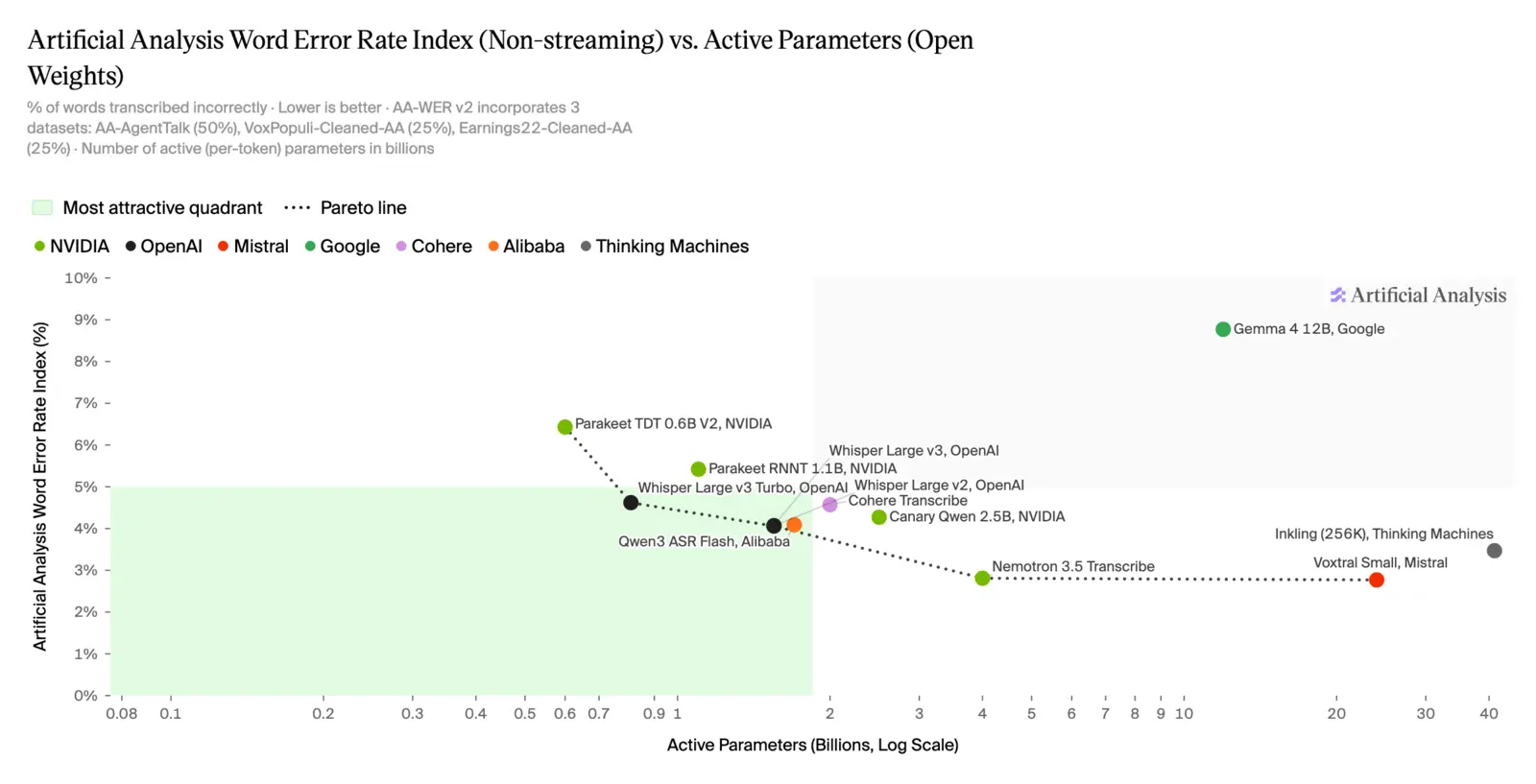
The most useful independent view is the Artificial Analysis chart at the top of this page. AA-WER v2 blends three datasets: AA-AgentTalk (50% of the score), VoxPopuli-Cleaned-AA (25%) and Earnings22-Cleaned-AA (25%). On that index Nemotron 3.5 Transcribe scores 2.8%, matching Voxtral Small at the top of the open-weight board, with Thinking Machines' Inkling third. The remarkable part is the x-axis: Voxtral Small has about 24 billion active parameters, Nemotron roughly 4 billion. Both sit on the Pareto line, but Nemotron reaches the same accuracy at about one-sixth of the active compute. We covered Inkling separately in our Thinking Machines Inkling review.
NVIDIA-reported results
- Hugging Face Open ASR, English average: 5.33% WER, first among open-weight models (NVIDIA's chart excludes API-only models).
- Open ASR seven-language track: 4.62% mean WER.
- Open ASR long-form audio: 10.98% WER.
- AA-AgentTalk: 1.8%, against 2.3% for the next-best model on that dataset.
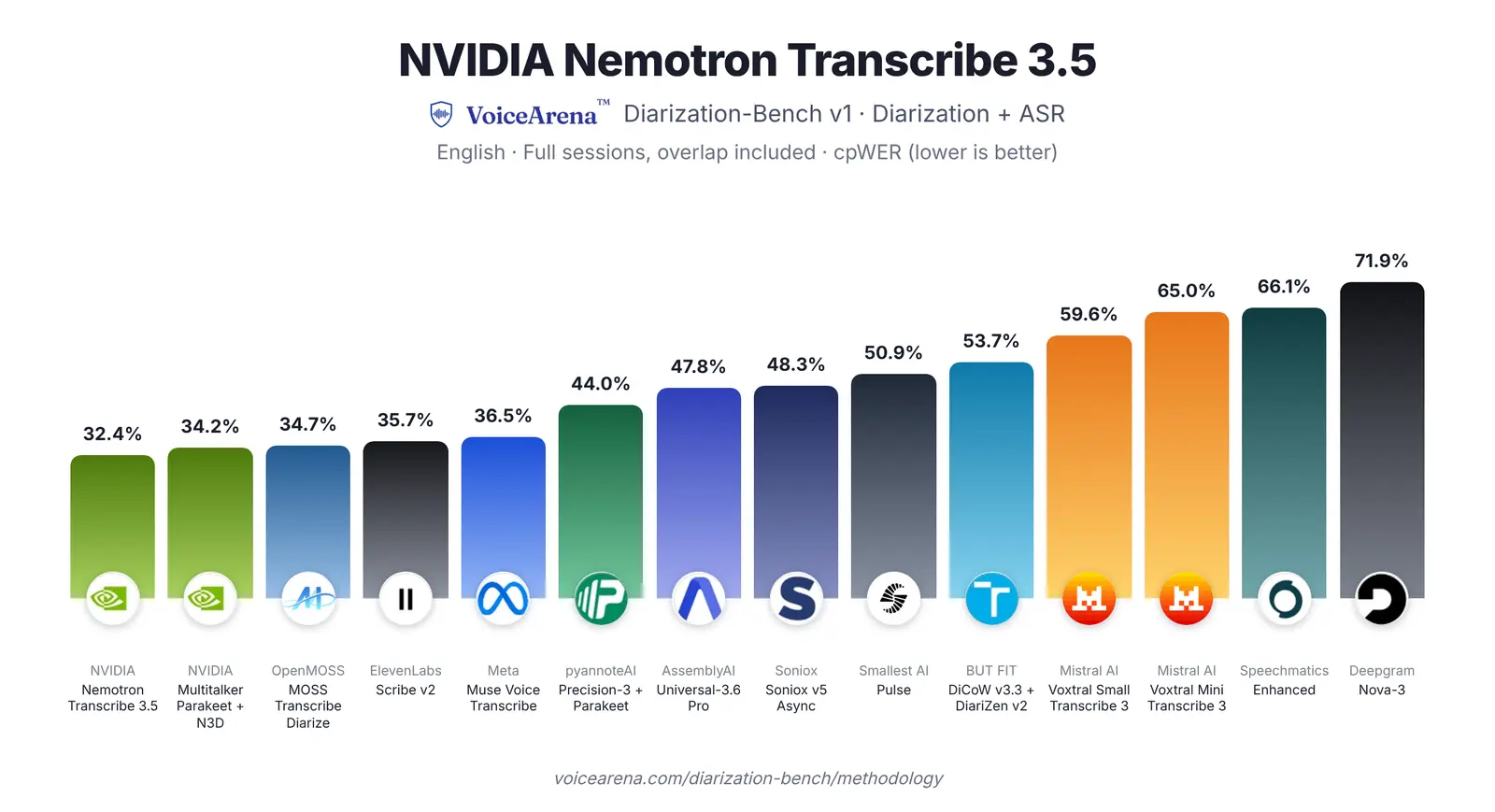
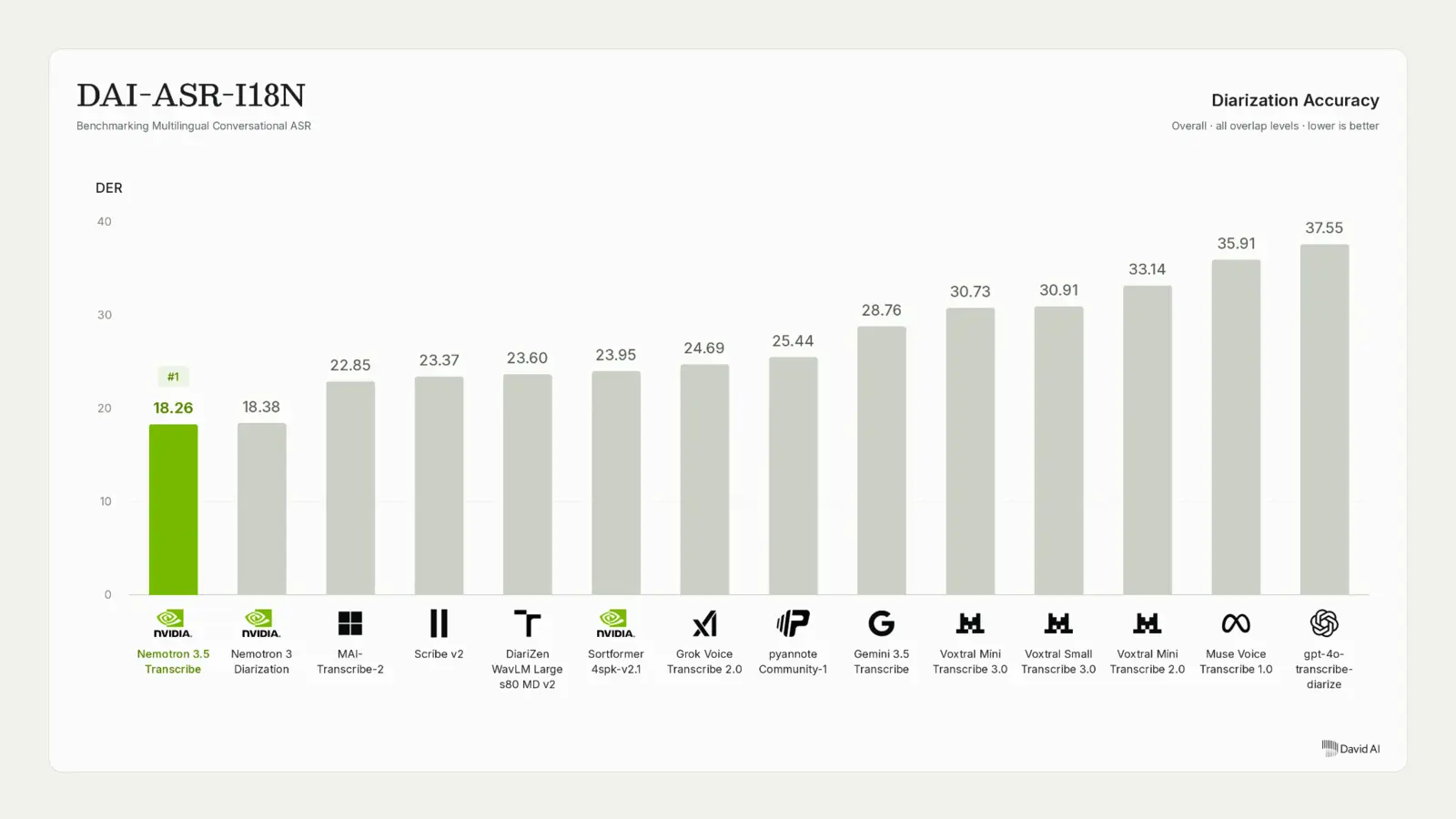
- Diarization: lowest error among 14 systems on David AI's 21-language benchmark, and lowest concatenated minimum-permutation WER among 14 systems on VoiceArena.
A reviewer's separate table dated 12/10/2026 shows a 4.71 mean WER across nine sets, ahead of Qwen3-ASR-1.7B at 4.94. That is a different measurement from NVIDIA's 5.33%, so do not read the two as a contradiction or as a single ranking. The lesson for buyers is the usual one: WER is dataset-dependent. A model that wins on clean read speech can lag on noisy call-centre audio, and long-form accuracy (10.98% here) is materially worse than short-clip accuracy for almost every system.
One more honest caveat: leaderboard positions among open models shift week to week. Qwen3-ASR, Cohere Transcribe and Canary-Qwen all appear on the Artificial Analysis chart within a couple of percentage points of Nemotron. If your audio is accented, domain-heavy or telephony-grade, the gap between these systems on your data can easily exceed the gap between them on the public boards.
Speaker Diarization: The Under-Rated Win
Transcription accuracy gets the headlines, but for meetings, interviews, podcasts and support calls the question is who said what. Here the evidence is arguably more impressive than the WER numbers. On David AI's multilingual conversational benchmark, Nemotron 3.5 Transcribe records a diarization error rate of 18.26, just ahead of NVIDIA's own Nemotron 3 Diarization at 18.38 and clearly ahead of the rest of the 14-system field, which runs from 22.85 up to 37.55 for the weakest entry.
On VoiceArena's English Diarization-Bench v1, which scores concatenated minimum-permutation WER on full sessions with overlapping speech included, it posts 32.4%, against 34.2% for NVIDIA's own Multitalker Parakeet pipeline and 35.7% for ElevenLabs Scribe v2. Several commercial systems land between 44% and 72% on the same test. Overlapping speech is the hardest case in the field, so the absolute numbers remain high; the useful takeaway is the relative ordering, and that a single prompt-driven model leads systems that were purpose-built for the job.
Fine-Tuning for Your Domain: The Medical Case Study
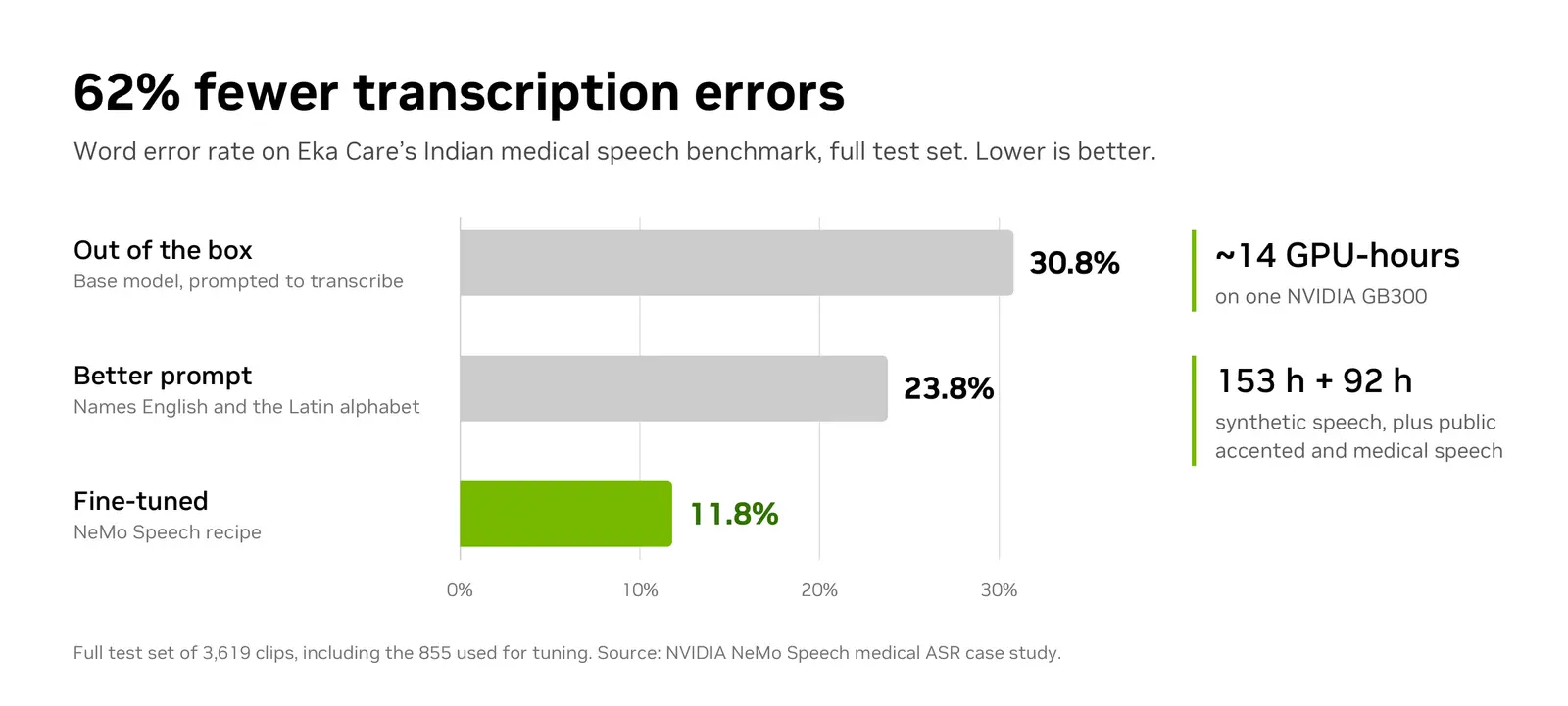
The most commercially interesting section of NVIDIA's release is the fine-tuning demonstration. Working with Eka Care's Indian medical speech benchmark, NVIDIA fine-tuned the model on 153 hours of synthetic speech plus 92 hours of public accented and medical speech. Training took about 14 GPU-hours on one GB300.
On the full 3,619-clip test set (including the 855 clips used for tuning, so treat it as optimistic), word error rate fell from 30.8% out of the box to 23.8% with a better prompt that names English and the Latin alphabet, and to 11.8% after fine-tuning with the NeMo Speech recipe, NVIDIA's headline 62% reduction. On a stricter held-out speaker set, error fell from 22.44% to 12.17%, a 45.8% relative cut. Two numbers, two test conditions; the held-out figure is the more conservative one.
The trade-off is disclosed: LibriSpeech test-clean error rose from 1.54% to 1.69%. That is tiny, but it illustrates the usual pattern that specialisation costs a little generality. The prompt result is also instructive. Moving from 30.8% to 23.8% with nothing but a better instruction shows that prompt engineering is now a real lever for speech models, just as it is for text ones.
Real-World Use vs Benchmarks
Benchmarks measure averages; deployments fail on tails. Before committing, run a bake-off on a few hours of your own audio with at least three candidates, and score three things separately: raw WER, entity accuracy (names, numbers, drug names, product codes) and speaker attribution. Public WER rarely tells you which system mangles your customers' surnames.
The recorded-audio-only limitation shapes where it fits. Strong fits include call and meeting archives, podcast and video captioning, legal and medical dictation review, research interviews and compliance monitoring. Weak fits include live captions, voice assistants and anything needing sub-second response. For those, NVIDIA's separate streaming models or another real-time stack remain the right tools.
Long-form accuracy deserves attention. The 10.98% Open ASR long-form figure is about double the short-form average, so for hour-long recordings consider chunking with overlap and testing whether segment-level stitching beats a single pass on your content.
Pricing and Cost of Ownership
The weights are free to download, so the cost is compute. NVIDIA's batch figure of 100 hours of audio in under three minutes on one RTX PRO 6000 Blackwell card implies very low per-hour processing costs at high utilisation, but that number assumes quantised weights, short clips and heavy concurrency. For comparison, the hosted Grok transcription service was reported at 10 cents (about £0.08) per hour of audio. At low or spiky volume, a hosted API will usually beat owning a GPU; at sustained high volume, or where data cannot leave your network, self-hosting wins. Hosted Nemotron endpoints from Baseten, DeepInfra and Simplismart sit in between, though we have not verified their current price lists, so check them directly.
Licensing: launch coverage says the licence permits commercial use. Read the model card's licence and the Granary v2 source terms yourself before shipping anything commercial.
Limitations and Open Questions
No live transcription. The model is for recorded files. Evidence is fresh. Most numbers come from NVIDIA or from benchmark operators within days of launch; independent field reports will take weeks. Benchmark selection. NVIDIA's Open ASR ranking excludes API-only models, so it says nothing about how it compares with every commercial service. Inconsistent specs in coverage. Some reports say 34B parameters, the model card says 30B-A4B. No latency figures. Throughput is published; single-stream latency is not. Domain trade-offs. Fine-tuning improved medical speech but slightly worsened LibriSpeech. And as with any LLM-backed transcriber, test for hallucinated text on silence and music, a failure mode classic encoder-decoder systems are less prone to.
How It Compares
Against Whisper Large v3, the Artificial Analysis chart places it clearly lower in error at a modestly larger active size, and it adds diarization and translation in one pass. Against Mistral's Voxtral Small it matches AA-WER with about a sixth of the active parameters. Against Qwen3-ASR and Cohere Transcribe the margins are narrow on public boards and your data should decide. Within NVIDIA's own family it supersedes much of the Parakeet and Canary line for batch work, while Parakeet remains the better fit for tiny or streaming deployments. For the wider picture of NVIDIA's open-model push, see our reviews of Nemotron 3.5 Lightning and Nemotron 3.5 Super VL; for the broader frontier context, see Gemini 4 Carbon.
Who Should Use It
Use it now if you transcribe large archives of multi-speaker audio, need diarization and translation without stitching several models together, need on-premises processing, or want to fine-tune for a specialist vocabulary. Skip it, for now, if you need real-time captions, run on tiny edge hardware where a sub-1B model is mandatory, or cannot yet validate it on your own audio. For most teams the right move is a one-week bake-off against your current provider, scored on entities and speaker labels as well as WER. Browse more options in our AI tools directory.
The Bottom Line
Nemotron 3.5 Transcribe is the strongest open speech release we have reviewed this year on the evidence available: top-tier AA-WER at roughly a sixth of the active parameters of its closest rival, the best published diarization numbers in two independent benchmarks, and a credible fine-tuning path. It is not a live-captioning engine, its numbers are weeks old, and public WER is not your WER. Test it on your audio, and if it holds up, it is a very good reason to bring transcription in-house.
Last updated: 31/10/2026. Sourced from NVIDIA's Hugging Face blog and model card, Artificial Analysis, David AI and VoiceArena charts as published by NVIDIA, and launch coverage by The Next Web and AlphaSignal. Figures are vendor-reported unless stated; GBP conversions are approximate.
Get the free guide: Claude vs ChatGPT, Gemini & Grok
A 20-page playbook covering everything you need to choose and use the big four AI models in 2026, full cost and feature comparisons, what each is best (and worst) at, and how-tos for images, vectors, building a website, Claude Code and more.