 AI Tools Review Editorial Team
Quick answer:
Nemotron 3.5 Super VL, released by NVIDIA on 15 October 2026, is an open-weights, multimodal Mixture-of-Experts model with 120 billion total parameters and 12 billion active per token. It reads text, images and up to two minutes of video, supports a context window of up to one million tokens, and is released under the permissive OpenMDW-1.1 licence. NVIDIA's model card reports 71.10 on SWE-bench Verified, 51.14 on OSWorld-Verified, 80.82 on CharXiv reasoning and 89.52 on GPQA-Diamond. It is a genuine open-weights option for screenshot-driven agents, but it is not the strongest open model on every coding test, and it needs roughly four H100s to serve comfortably.
Most open-weights models can read text. Far fewer can look at a screenshot, a scanned invoice or a chart, work out what is on it and then take the next step in an agent loop. Nemotron 3.5 Super VL is NVIDIA's attempt to make that a free, downloadable capability rather than something you rent from a closed lab.
This guide goes through what NVIDIA has actually published: the architecture, the training pipeline, the full benchmark table, the two charts on the model card, the hardware you need, and the places where the marketing in some launch-day videos runs ahead of the data.
Julian Goldie covers the launch-day pitch: a free vision model that reads screenshots, PDFs and charts, and how to try it free inside OpenCode.
Executive Summary
Nemotron 3.5 Super VL is a vision-language model: it takes images and video as well as text, and answers in text. It is a member of NVIDIA's Nemotron 3.5 family and is built on the company's Nemotron 3 Super backbone, with a vision encoder and connector bolted on. NVIDIA published it with full weights on Hugging Face, in both BF16 and NVFP4 (4-bit) variants, and listed it as version 1.0, generally available.
The pitch, echoed in launch coverage such as the video above, is that it "reads screenshots, PDFs and charts, then acts on what it sees". That is a fair summary of the design brief, and the model card supports it: strong chart and document scores, a respectable desktop-control result on OSWorld-Verified, and tuned sampling settings for image and video prompts. What the card does not support is the idea that it beats everything around it. Its own chart shows several open competitors ahead on terminal and multilingual coding tasks.
- Best for: screenshot-driven and document-driven agents, chart and PDF understanding, GUI automation experiments and long-context work where you want open weights.
- Headline numbers: 120B total / 12B active parameters, 512 routed experts, up to 1M tokens of context, 71.10 SWE-bench Verified, 51.14 OSWorld-Verified, 80.82 CharXiv reasoning.
- Defining trait: a hybrid Mamba-2 and Attention Mixture-of-Experts backbone with native multi-token prediction, so no separate draft model is needed for speculative decoding.
- Main caveats: serious GPU requirements, no audio input, and a mid-table result on Video-MME v2 (32.85) and BabyVision (29.60).
If you follow open models closely, think of it as NVIDIA filling the vision gap beside Nemotron 3.5 Lightning, the small, fast text-first worker model we reviewed in August.
Lineage: Where Super VL Fits
NVIDIA's Nemotron 3 line has moved quickly through 2026. At the small end sits Nemotron 3 Nano, a roughly 30B-total, 3B-active model. Above it came Nemotron 3 Super, the roughly 120B-class backbone this release builds on, and at the top Nemotron 3 Ultra, a 550B-total, 55B-active model that our tracker lists on its Nemotron 3 Ultra tool page. The 3.5 generation added Lightning for fast agent steps, and now Super VL for vision.
NVIDIA's documentation for its NeMo AutoModel framework lists two NVIDIA omni models: a Nemotron 3 Nano Omni 30B-A3B reasoning variant and the Nemotron 3.5 Super VL 120B-A12B. The names follow a convention worth learning: the number before the "A" is total parameters, and the number after it is the parameters actually used for each token. A12B means that although the network stores 120 billion parameters, only about 12 billion are active when it generates a token, which is why a model of this size can be served at useful speeds.
The training recipe also shows the family connection. The model card says the backbone was initialised from Nemotron 3 Super Base, and that the multi-token prediction head was trained first on 100 billion tokens and then on a further 1 trillion tokens of distillation from Nemotron 3 Ultra Base. In other words, the 550B Ultra model acted as a teacher for the smaller model's speed feature. That detail matters when you read third-party claims that Super VL "beats" Ultra: on some agentic benchmarks it does, but it was partly taught by Ultra, and Ultra remains the larger general model.
Architecture & Training
According to NVIDIA's Hugging Face model card, Super VL is a Mamba-2 and Transformer hybrid Mixture-of-Experts model. It has 512 routed experts per MoE layer, a C-RADIO vision encoder, a vision-language connector and a multi-token prediction (MTP) head. NVIDIA's AutoModel documentation describes the same design in slightly different words (a RADIO v2.5-H encoder and 22 active experts per token, 121B parameters, or 124B with the MTP head), so the exact encoder version and parameter count differ by a few percent between NVIDIA pages. The model name, 120B-A12B, is the figure to quote.
Mamba-2 layers are state-space layers. Unlike standard attention, whose cost grows with the square of sequence length, they process long sequences with far less memory, which is how NVIDIA can advertise a context window of up to 1 million tokens. The model card is careful to note that some deployment recipes use smaller windows, which is sensible: a million-token context needs a lot of memory whichever architecture you choose.
Native speculative decoding
The MTP head lets the model propose several tokens ahead and verify them in a single pass, so no separate drafter model is required. NVIDIA's quick-start table uses three draft tokens on four H100s and five draft tokens on two GB200s. This is a practical advantage: speculative decoding normally means finding, hosting and tuning a second model.
Configurable reasoning
Reasoning can be switched through the chat template using an enable_thinking flag, with off, on (medium) and on modes. NVIDIA recommends a temperature of 1.0 and top_p of 0.95 for text, and a temperature of 0.6 with top_p 0.95 for vision, although its own code examples use 1.0 and 0.95 for image and video requests. If you are evaluating the model, pick one setting and record it, because the discrepancy can move scores.
The six-stage training pipeline
NVIDIA describes training in six stages. First, foundation and MTP training from the Nemotron 3 Super Base backbone. Second, continued pre-training, including 100 billion Indic-language tokens, 35 billion tokens extending context to 1 million, 67 billion software-engineering tokens at 256K context and 9 billion long-context recovery tokens. Third, vision-language training. Fourth, supervised fine-tuning on packed sequences of up to 524,288 tokens. Fifth, reinforcement learning combined with multi-teacher on-policy distillation. Sixth, an MTP "boosting" pass against the frozen backbone.
The foundation data is described as more than 20 trillion tokens covering English, 19 other spoken languages and 43 programming languages. For vision, the card gives wide ranges rather than precise counts: between 1 million and 1 billion images and between 10,000 and 1 million hours of video. The data collection period runs from 2013 to December 2025. Post-training added French, German, Italian, Japanese, Spanish and Chinese beyond English. That wide range of vision data is honest, but it also means the card does not let you audit exactly how much of the model's chart skill comes from synthetic versus real documents.
Capabilities Deep Dive
Documents, charts and OCR
This is the model's clearest strength. The card reports 80.82 on CharXiv reasoning, a test that asks questions about charts taken from scientific papers, 68.12 on OCRBench v2 in English and 59.15 in Chinese, 65.08 on OCR-Reasoning, and 62.82 on MMLongBench-Doc, which tests understanding of long, multi-page documents. NVIDIA's comparison chart shows these figures sitting alongside, rather than far above, Qwen's vision models, but for an open model of this class they are strong, and the documents can be supplied as page images with accompanying text.
Visual perception and maths
On V*, a benchmark of finding small details in high-resolution images, it scores 85.60. On MathVision, visual mathematics problems, it scores 78.16. On BabyVision, which probes basic visual reasoning of the sort a young child finds easy, it scores a modest 29.60. That last figure is a useful reminder that strong chart reading does not mean strong general visual common sense.
Video
Video input is MP4 up to two minutes, sampled into frames. NVIDIA's example settings sample at 2 frames per second up to 256 frames with a pruning rate of 0.5, or 1 frame per second up to 128 frames for 1080p footage. Its Video-MME v2 score is 32.85. The benchmark is a harder revision of an earlier test, so the number is not directly comparable with older Video-MME results, but it does suggest video is the weakest of the three modalities. The example vLLM configuration also limits prompts to one video and one image, which constrains multi-clip workflows.
Long context and retrieval
On GraphWalks, a long-context reasoning benchmark, Super VL scores 89.71, and on AA-LCR v1.1 it scores 68.62. On NVIDIA's chart GraphWalks is one of the model's standout results, well ahead of the larger Nemotron 3 Ultra at 63.3. Long-context performance is plausibly where the Mamba-2 design earns its keep.
Languages and general knowledge
MMLU-ProX, a multilingual knowledge test, comes in at 76.91, WMT24++ translation at 84.80, and GPQA-Diamond graduate-level science at 89.52. Humanity's Last Exam is much harder: 31.79 on the text-only subset and 29.20 on the full set. The Artificial Analysis Omniscience results are worth reading closely: accuracy of 26.20 with a hallucination rate of 30.0, for an index of 4.03. A 30% hallucination rate on questions the model cannot answer is a reminder to ground its outputs in documents rather than trusting its memory.
Benchmarks
NVIDIA's model card includes a single composite chart comparing Super VL (labelled N3.5 Super 120B-A12B) with seven other open models: Nemotron 3 Ultra 550B-A55B, Qwen3.5 122B-A10B, Qwen3.8 Flash-Next, DS-V4 Flash-0731, Inkling Small and GLM-5.3 Flash. The right-hand panel compares maximum output throughput on NVIDIA GB200 hardware.
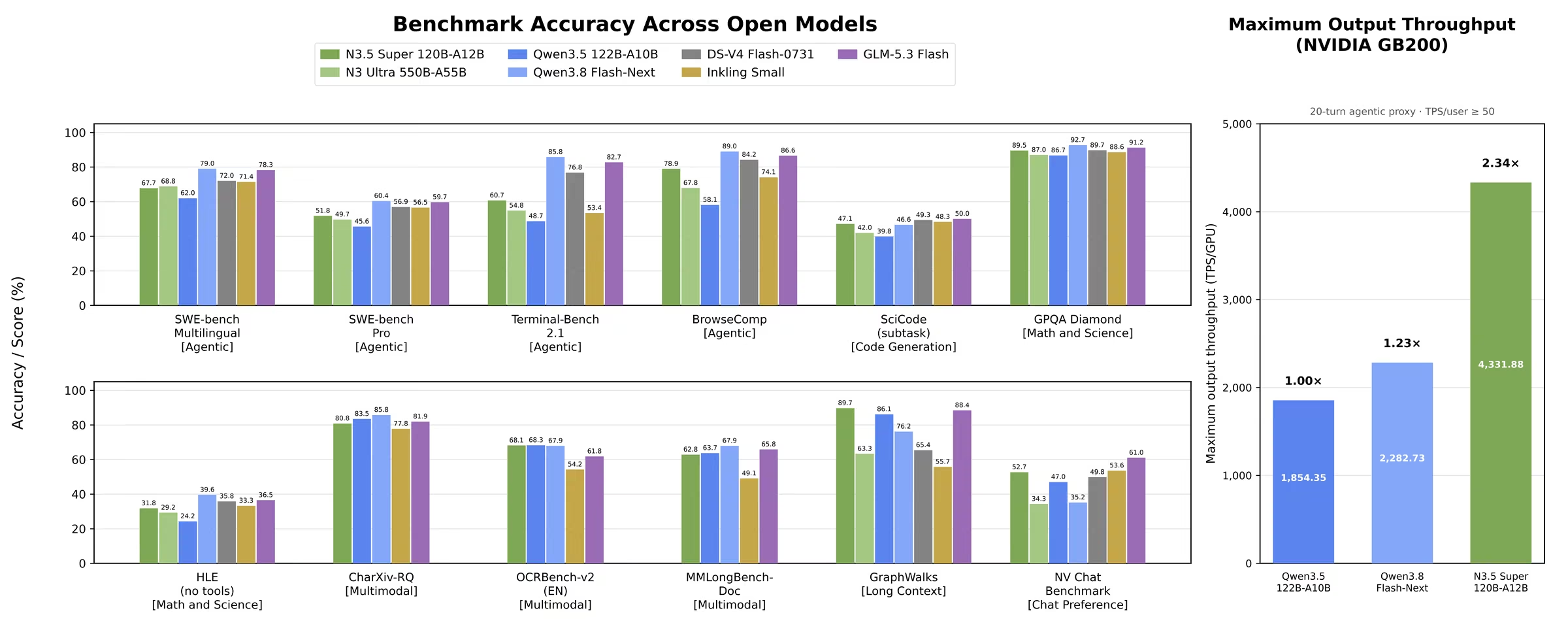
Reading the chart honestly, as NVIDIA's own vendor-produced comparison, gives a mixed picture:
- Where Super VL leads or ties: GraphWalks (89.7, narrowly ahead of GLM-5.3 Flash at 88.4), GPQA Diamond (89.5, close to GLM-5.3 Flash at 91.2 and Qwen3.8 Flash-Next at 92.7 but ahead of Ultra at 87.0), and OCRBench v2 English (68.1, level with Qwen3.5 and Qwen3.8).
- Where it trails: Terminal-Bench 2.1 (60.7 against 85.8 for Qwen3.8 Flash-Next, 82.7 for GLM-5.3 Flash and 76.8 for DS-V4 Flash), SWE-bench Multilingual (67.7 against 79.0 for Qwen3.8 Flash-Next), BrowseComp (78.9 against 89.0 for Qwen3.8 Flash-Next) and Humanity's Last Exam without tools (31.8 against 39.6).
- Against Nemotron 3 Ultra: Super VL beats the 550B Ultra on Terminal-Bench 2.1, BrowseComp, SciCode, GPQA Diamond, HLE, GraphWalks and the NV Chat benchmark, but Ultra is slightly ahead on SWE-bench Multilingual (68.8 against 67.7).
- Throughput: 4,331.88 tokens per second per GPU on a 20-turn agentic proxy with at least 50 tokens per second per user, against 2,282.73 for Qwen3.8 Flash-Next (1.23 times Qwen3.5) and 1,854.35 for Qwen3.5 122B-A10B. NVIDIA presents this as 2.34 times the baseline.
One caveat on the chart: not every model appears on every benchmark (Inkling Small and DS-V4 Flash, for instance, are absent from some multimodal panels). The throughput comparison uses only three models, with the baseline being Qwen3.5 rather than a newer Qwen. A fair summary is that Super VL is the throughput winner of the group, a strong long-context and chart reader, and a middling terminal and browsing agent.
The full model-card table
For reference, here are the figures from the model card for the BF16 checkpoint, grouped by theme. Agentic coding: SWE-bench Verified 71.10, SWE-bench Multilingual 67.72, SWE-bench Pro 51.78, Terminal-Bench 2.1 60.67, DeepSWE (offline) 24.65. Computer and web use: OSWorld-Verified 51.14, WebVoyager (offline) 77.72, BrowseComp 78, AutomationBench-AA (offline) 32.44. Tool use: tau2-bench retail 69.24, airline 76.50, telecom 73.19, and tau3-bench banking 18.88. Knowledge work: GDPval-AA v2 1211, IFBench 70.86, LMArena v3 proxy 52.67, APEX shortlist 88.36. Code generation: LiveCodeBench v6 88.22, SciCode subtask 47.13. Hard science: CritPt 10.86. Some offline rows on the card are garbled in the page text, so we have left those out rather than guess.
Two numbers deserve a second look. The tau3-bench banking score of 18.88 is very low next to the 69 to 77 range on tau2-bench, which suggests the newer, harder banking tasks remain a weakness for tool-using agents generally. And CritPt at 10.86 shows how far research-level physics reasoning still is from solved.
Agentic Coding Harnesses
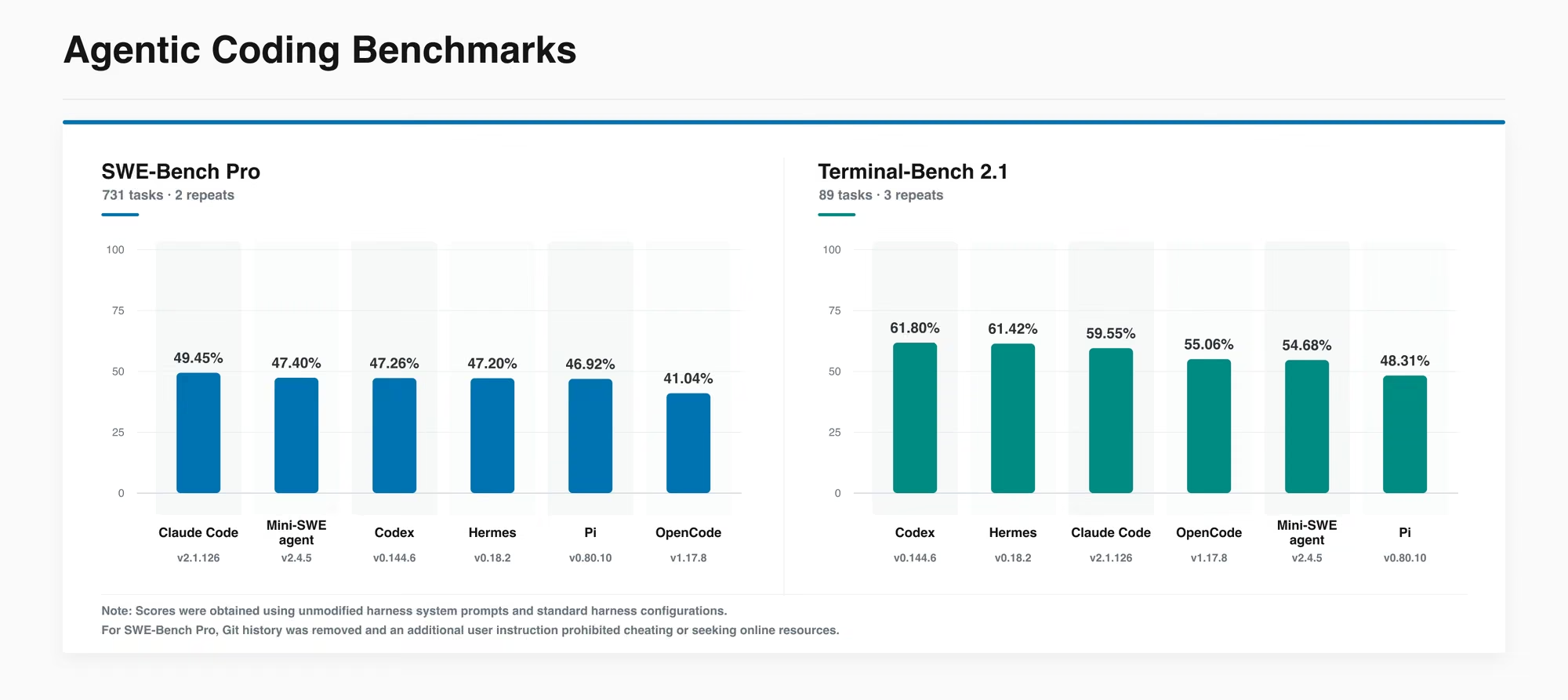
The second chart in NVIDIA's repository is arguably more interesting for developers, because it asks a question that raw model scores hide: how much does the agent harness around the model matter? It reports scores on SWE-Bench Pro (731 tasks, two repeats) and Terminal-Bench 2.1 (89 tasks, three repeats) across six harnesses: Claude Code, Codex, Hermes, OpenCode, Mini-SWE agent and Pi.
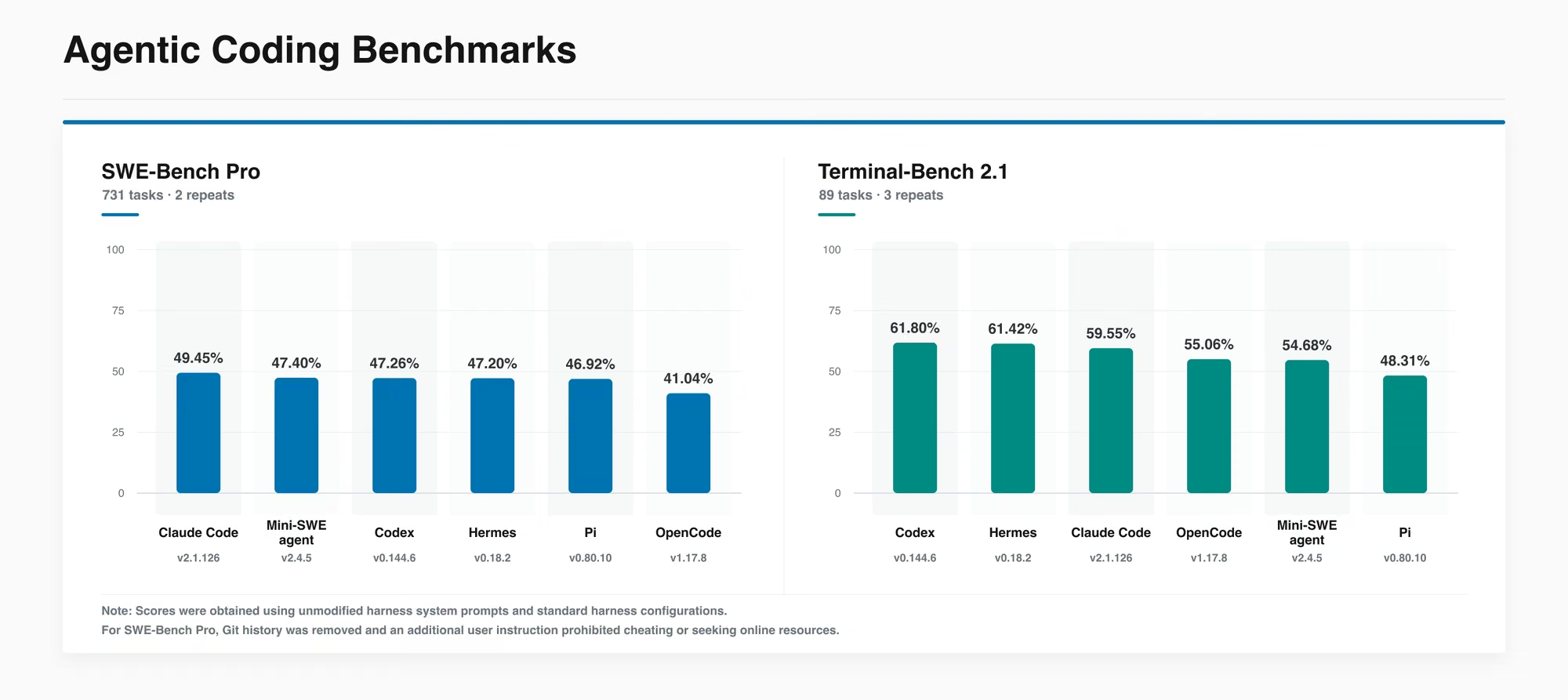
The chart does not name the model inside the image, but it sits in the Super VL repository and its Terminal-Bench figures (for example Codex at 61.80%, Claude Code at 59.55%) bracket the model card's headline Terminal-Bench 2.1 score of 60.67, so it is reasonable to read it as Super VL run through different harnesses. We treat it that way while noting NVIDIA has not labelled it explicitly.
The results are instructive. On SWE-Bench Pro the spread runs from 41.04% (OpenCode) to 49.45% (Claude Code), an eight-point gap from harness choice alone. On Terminal-Bench 2.1 it runs from 48.31% (Pi) to 61.80% (Codex), a 13-point gap. The ranking also flips: Claude Code leads on SWE-Bench Pro but Codex and Hermes lead on Terminal-Bench. The practical lesson is that open-model benchmark numbers are not portable. A model that scores 51.78 in one setup can land anywhere between 41 and 49 in another, and teams choosing between harnesses such as OpenCode and Hermes Agent should test with their own tasks.
This also matters for the "free in OpenCode" angle in the launch video. OpenCode scored lowest of the six on SWE-Bench Pro and fourth on Terminal-Bench 2.1 in this data, so while running Super VL there at no cost is a convenient way to try it, it is not the harness NVIDIA's own data would point you to for best results.
Hardware & Deployment
"Open" does not mean "light". NVIDIA recommends four H100 GPUs (vLLM with tensor parallelism of four and three MTP draft tokens) or two GB200 GPUs (vLLM, tensor parallelism of two, five draft tokens) for its quick-start recipes. It also documents SGLang v0.5.20 running on two GB200s. The target hardware is NVIDIA Blackwell and Hopper on Linux. Hosting four H100s at typical cloud rates is a significant monthly spend, so most readers will use a hosted endpoint, a free tier or the NVFP4 build, which NVIDIA also provides and which cuts memory needs.
The practical implications are straightforward. If you are a hobbyist with a single consumer GPU, Super VL is not for you; the smaller Nemotron 3.5 Lightning was explicitly designed for single-GPU and laptop use. If you are an enterprise with a GPU cluster already, Super VL is a plausible self-hosted multimodal worker that keeps documents and screenshots on your own infrastructure. For fine-tuning, NVIDIA's AutoModel documentation includes a LoRA recipe on the CORD-v2 receipt dataset and a full supervised fine-tuning recipe on Tulu-3, although its Megatron Bridge documentation says pre-training, SFT, PEFT and checkpoint-resume paths were still marked as unverified at the time of writing. Treat training workflows as experimental.
The model is also available through third-party catalogues. Modal lists an NVFP4 variant, and OpenCode's model directory lists the model with a release date of 15 October 2026, open weights, text, image and video input, text output and a price of £0 per token. We would read the £0 as a promotional or free-tier price rather than a permanent one.
Safety & Responsible Use
Unlike Anthropic or OpenAI frontier releases, open-weights releases of this kind do not usually come with a system card of cyber, biological and autonomy evaluations, and we found none for Super VL. The model card says only that post-training includes safety data, and that anyone integrating the model into an AI system should perform additional testing with use-case-specific data, following a V-model development approach. The "Ethical Considerations" section appears in the card's contents but its body was not retrievable in the text we reviewed, so we cannot summarise it.
For a model that can read screenshots and operate a desktop, that gap matters. An agent given OSWorld-style control of a machine can be steered by instructions hidden in a web page or document. Open weights also mean anyone can remove guardrails through fine-tuning. If you deploy it, run it in a sandbox, restrict its tool permissions, log every action and keep a human approval step for anything irreversible. Our guide to Claude's computer use and browser use covers the same safeguards for a closed-model equivalent.
Real-World vs Benchmarks
Three cautions apply. First, nearly all of these numbers are vendor-reported. NVIDIA ran, or commissioned, the evaluations, chose the comparison models and drew the chart. Some entries are marked "offline", meaning they were run in NVIDIA's own setup rather than against a public leaderboard. Treat them as strong indications, not independent verification.
Second, benchmark scores depend on harness and settings, as the harness chart shows. Third, the OSWorld-Verified score of 51.14 means the model completes roughly half of a fixed set of desktop tasks, which is impressive for open weights but not the reliability you want for unattended automation. Half-successful agents are fine when a person checks the output and risky when they act alone.
What the numbers do suggest is a model well suited to the "perception" half of an agent: take a screenshot, a dashboard, a scanned form or a chart, extract what matters, and hand structured findings to a stronger planner. That is how many teams already combine models, and it echoes the routing approach we covered in the Nemotron 3.5 Lightning review.
Pricing & Licence
The weights are released under OpenMDW-1.1, and the model card states the model is ready for commercial or non-commercial use. In practice that means you can download it, fine-tune it and ship products on it without asking NVIDIA, which is the main reason to prefer it to a closed API where terms and prices can change.
There is no single NVIDIA price per token, because hosting is provided by third parties. OpenCode's directory lists £0 per token for now. For self-hosting, your cost is GPUs: four H100s running continuously is a substantial recurring cloud bill (check current on-demand rates), so for low-volume use a hosted free tier or pay-per-token endpoint will be far cheaper. Check your provider's current price list before committing, and confirm that the provider's terms allow your use case.
Limitations
- Heavy hardware: NVIDIA's own recipes need four H100s or two GB200s, which rules out most individuals and small teams for self-hosting.
- No audio: the BF16 checkpoint has no audio encoder, so speech and sound inputs are unsupported.
- Weak video score: Video-MME v2 of 32.85 and BabyVision of 29.60 point to limited video and basic visual reasoning.
- Behind on terminal and browser agents: NVIDIA's own chart shows Qwen3.8 Flash-Next and GLM-5.3 Flash well ahead on Terminal-Bench 2.1 and BrowseComp.
- Hallucination: a 30.0 hallucination rate on the Artificial Analysis Omniscience test means it should be grounded in supplied documents.
- Vendor-reported results: most scores come from NVIDIA, several are "offline", and the throughput comparison uses an older Qwen baseline.
- Documentation gaps: inconsistent encoder and parameter figures across NVIDIA pages, an unretrievable ethics section and unverified training workflows.
How It Compares
Within the Nemotron family, Super VL is the multimodal middle child: bigger and more capable than the text-first Lightning, smaller and cheaper to serve than the 550B Ultra, and the only one of the three that reads images and video.
Against other open models, the competition is intense. Alibaba's Qwen 3.8 line and Zhipu's GLM 5.3 lead NVIDIA's own chart on terminal and browsing agents, while Super VL leads on throughput and long-context graph reasoning. Meta's Muse Spark family has been pushing towards open weights too, though the 816B open release mentioned in some launch-day videos is not yet something we could verify from an official source, so we have not covered it here.
Against closed frontier models such as Claude Opus 5.5, the trade is control for capability. Closed models still lead on the hardest agentic and reasoning work, but an open model you can host, inspect and fine-tune has advantages in privacy, cost predictability and customisation that no benchmark captures.
Who Should Use It
Worth trying if you build document-processing, chart-analysis or screenshot-reading pipelines and want open weights you can host in your own environment; if you are researching GUI agents and want a capable open baseline; or if you want a long-context multimodal model for large reports and PDFs. Starting with a free hosted endpoint is the lowest-risk way to test it on your own data.
Skip it if you need the strongest possible coding agent (the Qwen and GLM models in NVIDIA's own chart are ahead), if you need audio, if your hardware is a single GPU, or if you require independent safety evaluations before deployment.
The Bottom Line
Nemotron 3.5 Super VL is a credible, openly licensed multimodal model with real strengths in chart and document understanding, long-context reasoning and serving throughput. NVIDIA's own charts also show it trailing the best open rivals on terminal and browser agents, needing a serious GPU budget, and scoring modestly on video. The honest verdict is "very good at looking, adequate at acting".
The most useful takeaway may be the harness chart: the same model can score eight to thirteen points apart depending on the agent wrapper. Before you adopt any open model, test it in your own harness on your own tasks, and treat headline numbers, including the ones in this article, as a starting point rather than a purchase decision. For more on how open models are reshaping agent stacks, see our OpenCode 2.0 review and the Gemini 4 Argon ADK overnight test.
Last updated: 16 October 2026. Sourced from NVIDIA's Hugging Face model card for NVIDIA-Nemotron-3.5-Super-VL-120B-A12B-BF16, NVIDIA's NeMo AutoModel and Megatron Bridge documentation, the Modal and OpenCode model listings, and the Julian Goldie SEO launch video. Benchmark figures are as published by NVIDIA and have not been independently reproduced by AI Tools Review.
Get the free guide: Claude vs ChatGPT, Gemini & Grok
A 20-page playbook covering everything you need to choose and use the big four AI models in 2026, full cost and feature comparisons, what each is best (and worst) at, and how-tos for images, vectors, building a website, Claude Code and more.