
 AI Tools Review Editorial Team
Quick Summary:
DeepSeek has officially released DeepSeek V4, its most capable foundational model yet. Surpassing leading western models in coding, logic, and mathematics while using a fraction of the compute, V4 represents a significant shift in global artificial intelligence power dynamics.
Update, 21 July 2026: DeepSeek V4 has since reached General Availability with confirmed specifications and pricing. Read our DeepSeek V4 Pro GA review for the current architecture, MIT-licensed pricing, and independently-checked benchmark data, including a fact-check of the viral claim that V4 "beats Claude Fable 5."
AI Revolution X covers New DeepSeek V4 Shocks in this video.
Introduction
The AI landscape has just experienced a seismic shift. China-based AI lab DeepSeek has released V4, a model that not only rivals but in many cases surpasses the capabilities of leading US-based models. This marks a critical moment where compute efficiency and architectural innovation challenge the massive GPU-cluster approach favoured by Silicon Valley.
It is worth being precise about what happened, because the headline coverage has not been. DeepSeek did not quietly leak a model or tease a roadmap. On 24/04/2026 it published an open-weight preview of V4 and exposed two hosted variants through its API on the same day. The weights went up under the MIT licence, meaning anyone with the hardware can download, fine-tune and self-host them, and the accompanying technical report laid out the architecture in enough detail for outside researchers to argue with it.
What DeepSeek Actually Released
V4 arrived as two tiers rather than one model. DeepSeek-V4-Pro is the flagship: 1.6 trillion total parameters with roughly 49 billion active per token. DeepSeek-V4-Flash is the cheaper sibling at 284 billion total parameters and around 13 billion active. Both share a 1 million token context window and a maximum output length of 384,000 tokens, which is unusually generous even by 2026 standards and matters enormously for agentic work where the model has to write long patches rather than short answers.
The training run itself is part of the story. DeepSeek reports V4-Pro was trained on roughly 33 trillion tokens and V4-Flash on about 32 trillion. More significantly, Reuters reported that the model was trained on Huawei Ascend silicon rather than Nvidia hardware, and Huawei publicly confirmed that its Ascend supernode built on the Ascend 950 series would offer full support for V4. That is a genuinely new development: previous DeepSeek generations were trained on Nvidia parts acquired before export controls tightened.
The model is also a merger of two previously separate DeepSeek product lines. Where the company used to ship a general-purpose V-series and a reasoning-specialised R-series, V4 folds both into a single system that allocates reasoning depth according to how hard the task looks. If you followed our DeepSeek V3 analysis, this is the obvious next step: one model, two modes, no more choosing which checkpoint to point your application at.
The Architecture Behind V4
DeepSeek V4 relies on a highly advanced Mixture-of-Experts (MoE) architecture. By routing specific tokens to specialised experts, the model achieves unprecedented reasoning capabilities without requiring the entire parameter space to be active for every query.
This efficiency allows it to run complex algorithmic tasks, from advanced data science pipelines to deep reasoning chains, at a fraction of the cost. The implications for the enterprise sector are profound, democratising access to top-tier reasoning capabilities.
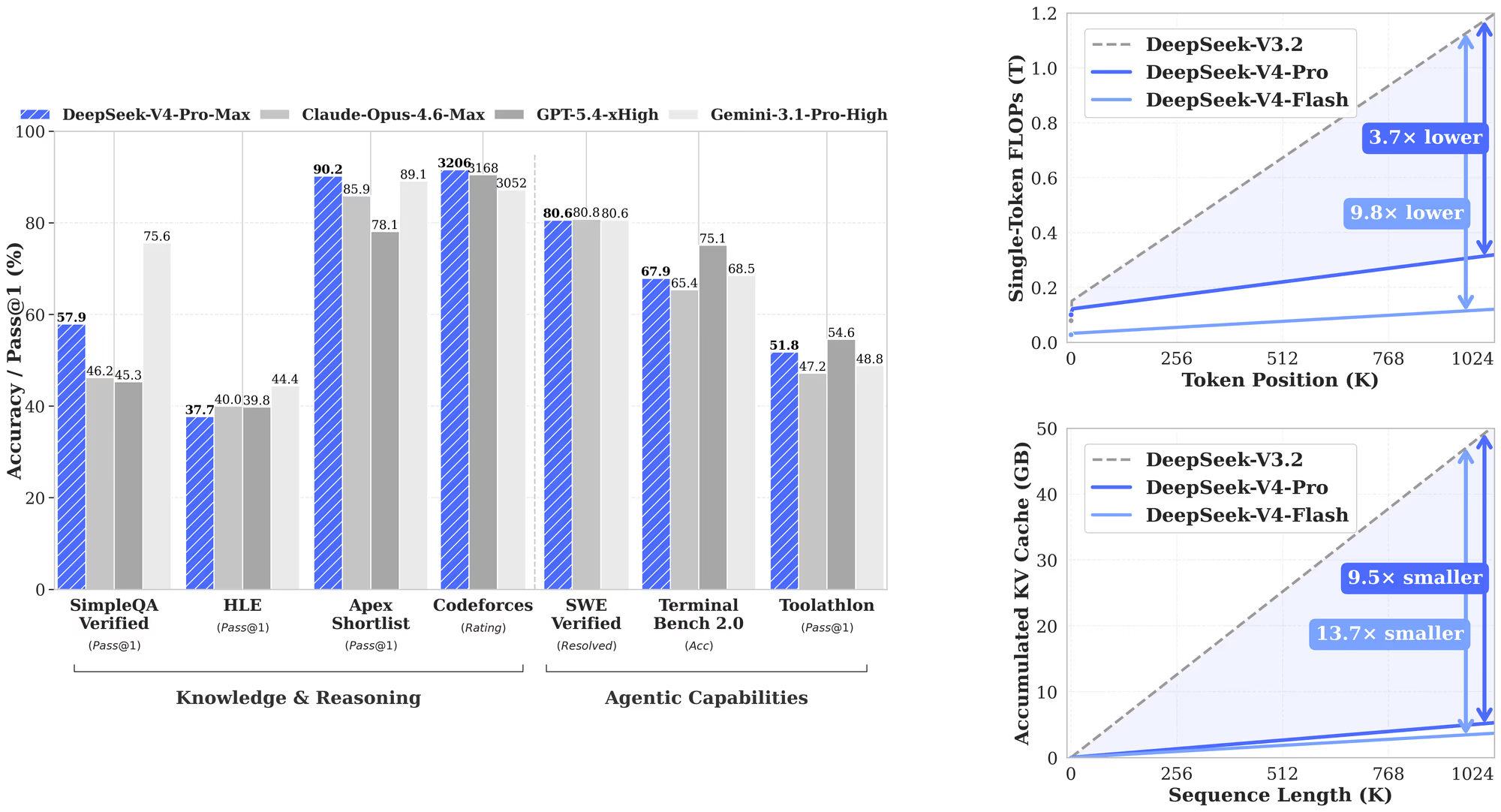
The more interesting engineering sits in the attention layer. V4-Pro uses a hybrid design that pairs Compressed Sparse Attention with a new Heavily Compressed Attention head, the latter aimed squarely at making long-context prefill cheap. DeepSeek's own technical report claims this combination cuts single-token inference FLOPs to roughly 27% of DeepSeek-V3.2 at a 1M token context, and shrinks the KV cache to about 10%. Those are the numbers that make a million-token window commercially viable rather than a demo feature: without them, the memory cost of holding a long conversation dwarfs the cost of generating the reply.
Two further changes are worth flagging for anyone tracking architecture rather than leaderboards. The first is manifold-constrained hyper-connections, which extend the familiar residual connection into parallel streams while constraining the interaction matrices so that signal amplification stays bounded, a stability trick that matters at trillion-parameter scale. The second is the use of the Muon optimiser during pre-training, chosen for convergence stability rather than headline speed. Neither is a marketing feature, and both point to a lab that is now publishing genuine research rather than reproducing other people's recipes cheaply.
The practical consequence is that V4 behaves less like a chatbot and more like an inference substrate you can point an agent at. A 384K output ceiling and a 1M context window together mean the model can hold an entire repository in view and still emit a multi-file change set without being chunked, which is precisely the workload that separates a coding assistant from a coding agent.
Benchmarks: Outperforming the Titans
The numbers below come from the comparison chart DeepSeek published alongside the preview, so treat them as vendor-reported rather than independently replicated. They are still informative, because the models DeepSeek chose to line up against are the ones it believes it can beat, and the margins are narrow enough to be credible.
| Benchmark | DeepSeek V4-Pro | Claude Opus 4.6 | Gemini 3.1 Pro |
| SWE-bench Verified | 80.6% | 80.8% | — |
| Terminal-Bench 2.0 | 67.9% | 65.4% | — |
| LiveCodeBench | 93.5% | 88.8% | 91.7% |
| Humanity's Last Exam | 37.7% | 40.0% | 44.4% |
| SimpleQA-Verified | 57.9% | — | 75.6% |
Read that table carefully and the "shocks the world" framing starts to look thinner. On coding, V4-Pro is genuinely competitive: a 67.9% Terminal-Bench 2.0 score edges past Claude Opus 4.6, and LiveCodeBench is a clear win. On SWE-bench Verified the two models are effectively tied, a difference of 0.2 percentage points that sits comfortably inside run-to-run noise. DeepSeek also reports a Codeforces rating of 3206 for V4-Pro, ahead of the GPT-5.4 and Gemini 3.1 Pro figures in the same chart.
On knowledge and reasoning, though, V4 loses. Humanity's Last Exam and SimpleQA-Verified both put it behind the Western frontier, and the SimpleQA gap in particular is large. The honest summary is that DeepSeek has built a superb coding and agentic model that is merely decent at open-ended factual recall, which is a very different claim from "China has overtaken the United States".
What Independent Testing Found
Vendor charts are one thing; third-party evaluation is another. The most substantial independent assessment so far comes from the US National Institute of Standards and Technology, whose Center for AI Standards and Innovation (CAISI) evaluated V4-Pro during April 2026 and published its findings on 01/05/2026.
CAISI's headline conclusion is blunt: DeepSeek V4's capabilities lag the frontier by roughly eight months, placing it at about the level of a model released three quarters earlier. Crucially, CAISI does not simply average published benchmark scores. It applies item response theory, the statistical machinery behind standardised testing, to estimate each model's underlying capability from which specific problems it does and does not solve, across nine benchmarks spanning cybersecurity, software engineering, natural sciences, abstract reasoning and mathematics.
The resulting profile is lopsided in an instructive way. V4-Pro scored 97% on the OTIS-AIME-2025 mathematics set but only 46% on ARC-AGI-2, a test built specifically to resist memorisation and reward genuine abstraction. That gap is consistent with a model trained hard on verifiable reasoning traces and less hard on the kind of novel-pattern generalisation that still separates the leaders. CAISI nonetheless described V4 as the most capable Chinese model it had evaluated to date, which is the part of the report that got much less airtime in the enthusiastic coverage.
The Cost Argument
If the capability gap is real but narrowing, the price gap is not narrow at all. At preview launch, Fortune reported V4-Pro at roughly $3.48 (about £2.60) per million output tokens and V4-Flash at around $0.28 (about £0.21), against $30 for OpenAI's comparable tier, $25 for Anthropic's and $4 for Moonshot's Kimi. Even allowing for currency conversion and the fact that DeepSeek revised its pricing structure again at General Availability, that is an order-of-magnitude difference rather than a discount.
CAISI's cost analysis tempers this slightly. Measured per completed task rather than per token, V4 came out cheaper than GPT-5.4 mini on five of seven benchmarks, ranging from 53% cheaper to 41% more expensive. The reason is verbosity: a model that thinks at length can burn its per-token advantage on the way to the answer. Anyone building a budget around V4 should benchmark on their own workload rather than trusting the rate card.
The strategic point still stands. When a credible open-weight model sits within a few percentage points of the frontier on agentic coding and costs a tenth as much to run, the pricing power of closed frontier labs erodes from the bottom up. That pressure is already visible in how quickly Western labs now ship cheaper mid-tier models.
Global AI Implications
Beyond the technical achievements, DeepSeek V4 is a geopolitical statement. It proves that massive compute constraints can be overcome with superior algorithmic design and architectural ingenuity.
As Western nations tighten export controls on advanced AI hardware, China's AI sector has clearly adapted, focusing on efficiency rather than raw scale. This approach ensures that global AI development remains a multipolar race.
The Huawei angle is the part that should worry Washington most. V4 was trained on Ascend processors, and Huawei confirmed its Ascend supernode would fully support the V4 family. Nvidia chief executive Jensen Huang had already named this scenario as the one to avoid, telling reporters that "the day that DeepSeek comes out on Huawei first, that is a horrible outcome" for the United States. Export controls were designed to deny China frontier compute; a frontier-adjacent model trained end to end on domestic silicon is the clearest evidence yet that the denial strategy has a shelf life.
The open-weight licence compounds the effect. A closed Chinese frontier model would be a national achievement; an MIT-licensed one is an export. Any startup, research group or government department anywhere in the world can now run a near-frontier model on its own hardware with no vendor relationship and no usage reporting. That changes the diffusion dynamics of AI capability far more than any single benchmark score does.
Where V4 Falls Short
Three caveats deserve to travel alongside every enthusiastic headline about this release.
Calibration. V4 answers when it should hedge. Evaluations of both tiers found them producing a confident answer rather than declining or expressing uncertainty in the overwhelming majority of cases, including on questions designed to test whether a model knows what it does not know. For a research assistant or a customer-facing agent, that is a more serious defect than a couple of points on a coding benchmark.
Self-reported benchmarks. Every number in DeepSeek's launch chart was produced by DeepSeek, on configurations DeepSeek selected. Its own technical report is more modest than the coverage, describing V4 as falling marginally short of GPT-5.4 and Gemini 3.1 Pro and trailing the state of the art by roughly three to six months.
Running it yourself is hard. "Open weights" is not the same as "accessible". A 1.6 trillion parameter Mixture-of-Experts model needs a serious multi-GPU deployment before it does anything at all. For most teams the realistic options are DeepSeek's own API or a third-party host, both of which reintroduce the data-governance questions that self-hosting was supposed to solve. V4-Flash, at 284 billion parameters, is the tier most organisations will actually be able to run.
The Verdict
DeepSeek V4 is a serious release that does not need the hype. It is roughly level with the Western frontier on agentic coding, clearly behind on open-ended knowledge and abstraction, dramatically cheaper to run, trained on Chinese silicon, and given away under a permissive licence. Any one of those would be notable; together they make the April preview the most consequential open-weight launch of 2026 so far.
What it is not is a model that "beat" the frontier labs. The gap has narrowed from years to months, and the cost gap has widened in China's favour, but the ranking at the top has not changed. If you are evaluating V4 for production work, start with coding and agentic pipelines where it is strongest, keep a Western frontier model in reserve for research and factual tasks, and read our General Availability review for the confirmed specifications and pricing that followed this preview.