 AI Tools Review Editorial Team
OpenAI rarely announces Codex changes in one tidy release note. Over the space of ten days at the end of July 2026, it published a model-retirement notice, shipped a feature update, opened a beta, and separately confirmed the shutdown of an entire product - the Atlas browser - with the load-bearing agentic-browsing work moving into Codex itself. None of this is speculative: every date and feature below comes from OpenAI's own changelog and help centre.
This piece lays out the actual timeline, what the GPT-5.4 retirement does and doesn't affect, what replaces Atlas, the features that shipped in July that are easy to miss if you don't read changelogs closely, and the unofficial "free Codex" workaround currently doing the rounds on AI YouTube.
Part of this week's wave of creator coverage digging into lesser-known Codex configuration options.
Summary
Codex - OpenAI's coding agent, available via CLI, web, IDE extension and the macOS app - is going through a compressed period of change. A model-deprecation notice, a browser product shutdown, and a feature release all landed within the same ten-day window at the end of July 2026, and they are easy to conflate if you only catch one AI YouTube video summarising "what's new."
Separating them matters because they affect different users in different ways: the model change only touches people signed in with a ChatGPT account rather than an API key, the Atlas shutdown affects anyone who adopted OpenAI's standalone browser specifically, and the July feature wave is additive - nothing to configure, it simply shows up in the app.
- Who is affected by GPT-5.4's retirement: ChatGPT sign-in users with saved workspace defaults, custom agents or scheduled tasks pinned to
gpt-5.4orgpt-5.4-mini. - Who is affected by Atlas shutting down: anyone using the standalone Atlas macOS browser app for agentic browsing tasks, who needs to export bookmarks and saved pages before 9 August.
- Who benefits from the July features: everyone using the Codex macOS app (Appshots, image editing) or reviewing changes that span multiple repositories.
The Timeline: July into August 2026
| Date | Change |
|---|---|
| 23 July 2026 | ChatGPT Voice (GPT-Live) reaches Codex desktop; Appshots ship on macOS; multi-folder local projects (v26.715) |
| 29 July 2026 | Sign in with ChatGPT (Beta) rolls out for connected plugins: Airtable, GitLab, HubSpot, Notion, Supabase, Vercel |
| 30 July 2026 | Browser upgrades (address bar history search, Google queries), Chrome extension tab mentions, multi-repository review, expanded image editing (v26.727) |
| 31 July 2026 | GPT-5.4 / GPT-5.4-mini retirement from Codex announced, effective 31 August |
| 9 August 2026 | Atlas browser scheduled to stop working |
| 31 August 2026 | GPT-5.4 / GPT-5.4-mini fully removed from Codex for ChatGPT sign-in users |
Read chronologically, the sequence tells a coherent story: OpenAI spent the back half of July shipping incremental Codex features, then used the same week to announce it is retiring an older model tier and sunsetting a separate, underperforming product - both changes that push users toward the newer GPT-5.6 family and toward doing agentic browsing inside Codex and ChatGPT rather than a dedicated browser app.
GPT-5.4 Retires: What Actually Changes
On 31 July 2026, OpenAI's official changelog confirmed that GPT-5.4 and GPT-5.4 mini will no longer be available in Codex for users signed in with ChatGPT, effective 31 August 2026. The recommended replacements are direct: gpt-5.4 becomes GPT-5.6 Terra, and gpt-5.4-mini becomes GPT-5.6 Luna - the same Terra and Luna tiers covered in our GPT-5.6 pricing breakdown, which themselves received a price cut earlier in the summer.
Crucially, this deprecation is scoped to ChatGPT sign-in users only. Both retiring models remain available on the OpenAI API, and Codex sessions authenticated with an API key keep access past the 31 August cutoff. If your team runs Codex through API credentials rather than individual ChatGPT logins - common for CI pipelines and headless agent deployments - this change does not touch you directly.
For everyone else, OpenAI's guidance before the cutoff is to update workspace defaults, saved model settings, managed configurations, custom agents, and scheduled tasks that reference either gpt-5.4 or gpt-5.4-mini by name. Anything left pointing at the old model IDs after 31 August will presumably fail or silently fall back, though OpenAI's changelog does not specify the exact failure behaviour post-cutoff.
The Atlas Browser Shuts Down
The bigger structural change is Atlas, OpenAI's standalone AI browser, which is scheduled to stop working on 9 August 2026 - roughly nine months after its October 2025 launch. OpenAI's own help centre article, titled "Evolving Atlas into ChatGPT for browser-based agentic work," frames this as consolidation rather than abandonment: the company says it is bringing what it learned building Atlas into browser-based agentic capabilities inside ChatGPT and Codex directly, including multiple tabs, downloads, improved navigation and account login support.
The practical read is straightforward. Atlas never shipped outside macOS in its entire lifespan - no Windows, iOS or Android release ever arrived - and OpenAI appears to have concluded it is more effective to embed agentic browsing into products people already have open (ChatGPT, Codex) than to ask them to adopt an entirely separate browser. One of the stated replacements for Atlas's functionality is ChatGPT Work, an agent designed to take action across apps and files and stay with complex, multi-step projects over extended periods.
If you use Atlas:
OpenAI's guidance is to export or save important Atlas data - bookmarks and pages you want to keep - before 9 August 2026. After that date, Atlas may no longer open, browse, or support any browser-based agentic workflows.
July's Feature Wave: Appshots, Multi-Repo Review & More
Beyond the two headline changes, three separate July releases quietly expanded what the Codex app and CLI can do. These are easy to miss because none of them individually justified a standalone announcement, but together they represent a meaningful update.
Appshots (23 July, v26.715)
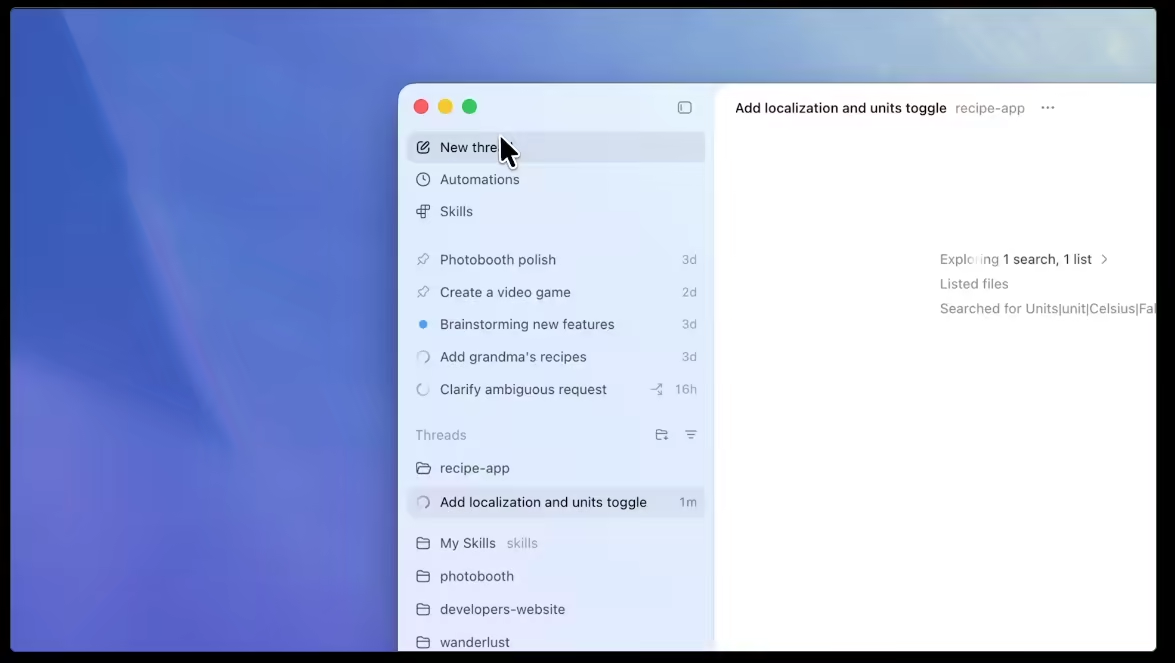
On macOS, you can now attach an open app window to a Codex thread using a hotkey. Codex captures a screenshot of the window along with any available text content, so it can understand what you're looking at without you needing to write a long setup prompt describing the state of your screen. This pairs naturally with the Codex app's existing thread-based workflow, shown below.
Sign in with ChatGPT (29 July, Beta)
A new authentication option rolling out across a specific set of connected plugins - Airtable, GitLab, HubSpot, Notion, Supabase and Vercel - lets you authorise those integrations using your ChatGPT identity. OpenAI says partner services receive only your name, email and profile picture during authentication, not broader account data.
Multi-Repository Review & Browser Upgrades (30 July, v26.727)
Codex can now inspect "changes across repositories" in a single review pass rather than requiring separate sessions per repo - useful for changes that span a monorepo split into multiple git remotes, or a service and its client library. The same release upgraded Codex's built-in browser with address-bar history search and direct Google queries, added history management in Settings, and gave the Chrome extension the ability to reference open tabs and answer questions about YouTube videos directly.
Scheduled Time Awareness
Separately, Codex can now receive scheduled UTC time reminders and query the current time directly, including through client-provided app-server clocks - a small but practical fix for agents running long, time-sensitive automations that previously had no reliable way to know what time it actually was mid-task.
The "Codex Without Paying" Workaround
Alongside the official changes, a separate thread of AI YouTube content this week is showing creators routing Codex through third-party, free-tier model gateways to avoid hitting OpenAI's usage caps mid-build. The pitch, as demonstrated in creator walkthroughs, is a configuration swap that points Codex's model calls at a pool of alternative providers with automatic fallback, so a capped free tier never kills a long-running agent session - using the same Codex commands and interface, just against different backend models.
This is worth flagging clearly as not an OpenAI feature. It is a community-built workaround that relies on gateway or proxy tooling outside OpenAI's control, and creators demonstrating it note real limitations - local models don't work well as drop-in replacements, and free tiers on the alternative providers break down under sustained load. There are also obvious considerations that most of these walkthroughs skip: routing an agentic coding tool's prompts and generated code through a third-party gateway means that provider - not OpenAI - is handling your data, and doing so may fall outside both OpenAI's and the alternative provider's terms of service depending on how the swap is implemented.
For hobby experimentation, understanding how these gateway setups work is reasonable. For anything involving proprietary code or client work, sending it through an unreviewed third-party relay carries a data-handling risk that the £0 price tag doesn't offset.
A walkthrough of the free-gateway swap and its stated limitations, including where local models and capped free tiers break down.
Pricing and Official Access
Officially, Codex is bundled into ChatGPT Plus, Pro, Business, Enterprise and Edu plans, and remains accessible via the OpenAI API on a pay-per-token basis for anyone with API credits - unaffected by the ChatGPT-side model retirement discussed above. At its original February 2026 launch, the Codex app extended this further, with temporary access included on ChatGPT Free and Go plans and doubled rate limits on paid plans; OpenAI's July/August changelog does not indicate that promotional access has ended, but availability on free tiers can change without a dedicated announcement, so it is worth checking current plan details directly in ChatGPT settings before assuming free-tier access still applies.
None of the July or August 2026 changes covered here altered the underlying subscription or per-token pricing structure - the changes are entirely about which models are available and which browsing surface handles agentic work, not what Codex costs to use.
What This Means for Codex Users
If you use Codex day to day, the practical action items are narrow but time-sensitive. Anyone with saved configurations pinned to gpt-5.4 or gpt-5.4-mini should update them to GPT-5.6 Terra or Luna before 31 August, since OpenAI has not detailed what happens to sessions still referencing the old model IDs after that date. Anyone actively using Atlas needs to export bookmarks and saved pages before 9 August, and should expect to shift any browser-based agentic workflows into ChatGPT or Codex directly going forward.
Everyone else benefits passively: Appshots, multi-repository review and the browser upgrades apply automatically to current app and CLI versions with no migration required. The net effect of this update cycle is OpenAI consolidating agentic browsing into fewer, more central surfaces while pushing the model lineup forward - consistent with the broader GPT-5.6 rollout covered in our pricing guide and the direction set by the Codex app's original February 2026 launch.
The Bottom Line
Nothing in this update cycle is dramatic on its own, but three changes landing within ten days of each other created real confusion in the AI YouTube coverage this week - conflating a model swap, a product shutdown and a feature release into one vague "Codex is changing" narrative. Separated out, the picture is simple: GPT-5.4 retires for ChatGPT sign-in users on 31 August with a straightforward Terra/Luna replacement, Atlas shuts down 9 August with its capabilities absorbed into ChatGPT and Codex, and July already shipped genuinely useful additions like Appshots and multi-repository review with zero migration effort required.
The one thing to treat with real caution is the unofficial "free Codex" gateway workaround circulating alongside these official changes - useful to understand, risky to rely on for anything beyond throwaway experiments.
Last updated: 2 August 2026. Based on OpenAI's official ChatGPT & Codex changelog and Help Centre articles on the Atlas transition. Model availability and promotional free-tier access are subject to change; check your Codex plan settings for current details.