 AI Tools Review Editorial Team
Quick answer:
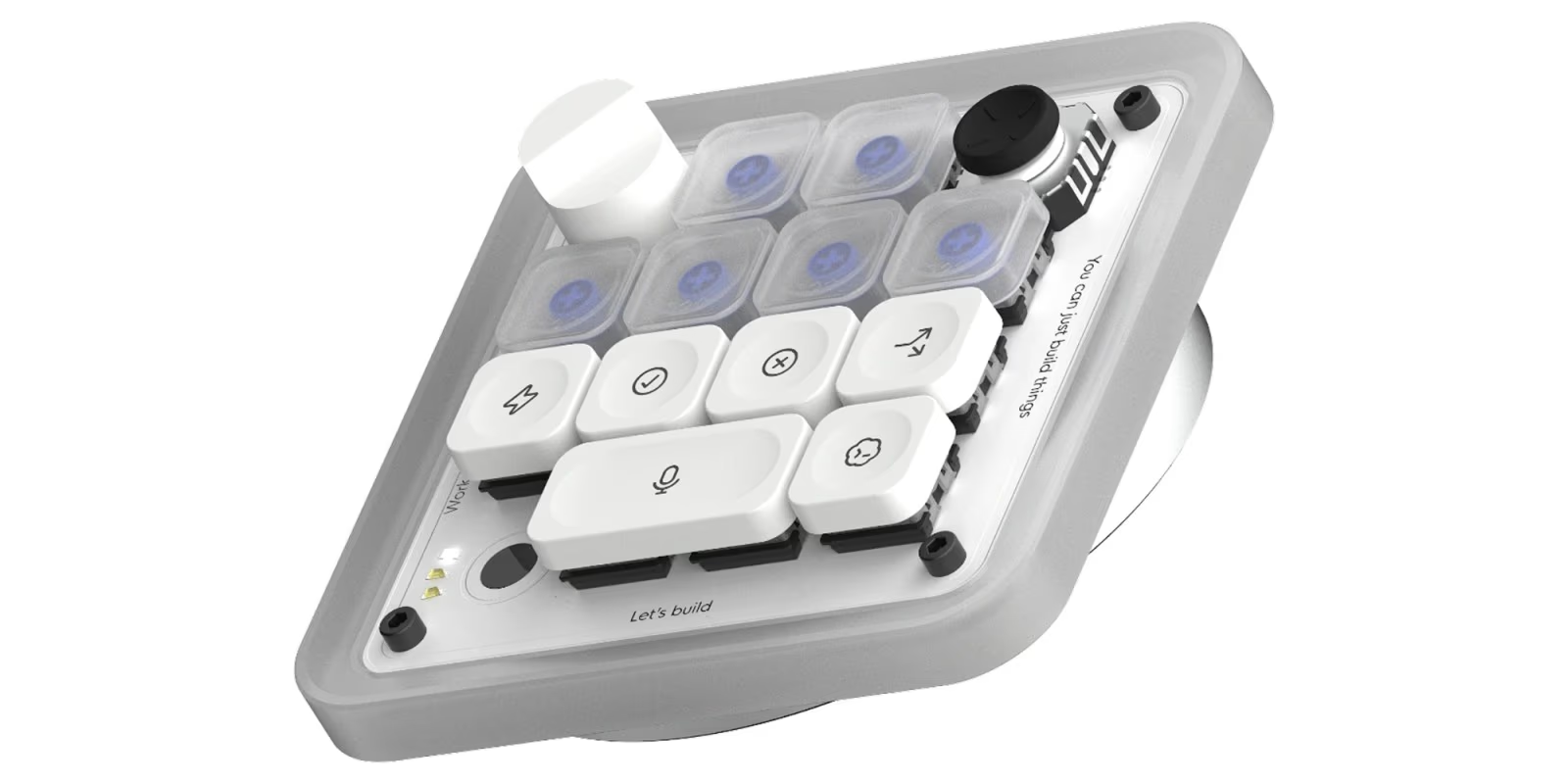
On 15 July 2026, OpenAI shipped its first-ever branded hardware product: Codex Micro, a $230 (approx. £171) programmable macro pad built with the Canadian keyboard maker Work Louder. It reuses Work Louder's existing Creator Micro 2 chassis, 13 mechanical keys, a joystick, a rotary encoder and six illuminated "Agent Keys" that show the live status of your Codex coding agents, and is controlled through the ChatGPT desktop app. OpenAI told TechCrunch this is "a limited-run collaboration" rather than a mass-market device, and it launched five days after Apple sued OpenAI and its acquired hardware studio, io Products, over an unrelated trade-secrets dispute tied to a much bigger OpenAI hardware project still in development.
OpenAI spent its first decade as a software company that occasionally talked about hardware. That changed, in a small and deliberately unglamorous way, on 15 July 2026, when the company started selling a $230 keyboard.
Codex Micro will not replace a phone, and OpenAI has been careful not to suggest it might. It is a niche accessory for people who run AI coding agents most of their working day, built in partnership with an existing keyboard manufacturer rather than engineered from scratch. But it arrived at a genuinely interesting moment (days after Apple sued OpenAI over an entirely different, far more ambitious hardware project) which makes it worth understanding both on its own terms and as a data point in OpenAI's wider hardware ambitions.
Note: this article draws on launch-day reporting from TechCrunch, 9to5Mac, Gizmodo, Tom's Hardware, Axios and Tech Times, on product photography published by 9to5Mac and Gizmodo, and on independent research into the Apple v. OpenAI hardware lawsuit reported by Fortune, Bloomberg and AppleInsider. Several outlets published inconsistent secondary details at launch, differing price fields, differing accounts of which app handles key customisation, and a colour-coding legend for the Agent Keys that appeared in only one source, and those specific disagreements are flagged explicitly below rather than silently resolved in either direction.
Julian Goldie SEO's hands-on look at the Codex Micro hardware.
Summary
- OpenAI's first branded hardware product. Codex Micro, officially model
kbd-1.0-codex-micro, launched 15 July 2026 at $230, built in collaboration with Work Louder. - Reuses an existing chassis. It is built on Work Louder's Creator Micro 2, the same hardware the company previously reskinned for Figma and Framer, not a bespoke OpenAI design from the ground up.
- 13 mechanical keys, a joystick, a rotary encoder and six illuminated "Agent Keys" that display live Codex agent status, plus customisable "Command Keys" for frequent actions.
- Explicitly a limited run, not a mass-market product. OpenAI told TechCrunch as much directly; it is sold until stock runs out, with no confirmed restock plan.
- Landed amid a real, separate legal dispute. Apple sued OpenAI and its acquired hardware studio io Products on 10 July 2026 (five days before Codex Micro shipped) over trade secrets allegedly tied to OpenAI's other, much larger hardware device still in development.
- Targets Codex's fast-growing user base. Codex passed 5 million weekly active users in early June 2026 and, following the 9 July launch of GPT-5.6, reportedly climbed toward 8 million weekly users by the time Codex Micro shipped.
- Reception has been descriptive rather than glowing. Early hands-on and community commentary ranges from mildly enthusiastic to openly skeptical about whether a dedicated physical device is worth $230 when every function duplicates an existing keyboard shortcut.
What Codex Micro actually is
Strip away the branding and Codex Micro is a macro pad, a small, dedicated input device with a fixed set of physical controls, of the kind stream deck and shortcut-key manufacturers have sold to video editors and streamers for years. What makes it a Codex product specifically is what those controls are wired to do once you plug it in and connect it through the ChatGPT desktop app.
| Component | What it does |
|---|---|
| 13 mechanical keys | Split between six illuminated "Agent Keys" and a set of customisable "Command Keys", available in clicky and silent switch versions |
| Agent Keys | Light up to reflect live status of your Codex agents: reporting differs slightly by outlet, but the consistent theme is idle/thinking/waiting-for-approval/error style states shown as colour changes rather than text |
| Command Keys | Remappable shortcuts for frequent Codex actions: accept, reject, push-to-talk, start a new chat |
| Joystick | Launches common workflows such as reviewing a pull request, debugging, or kicking off a refactor |
| Rotary encoder | Dials an agent's "reasoning effort" up or down in real time, trading speed for depth of computation |
| Six programmable layers | Lets a single physical key hold multiple assignments, switched between rather than requiring more physical buttons |
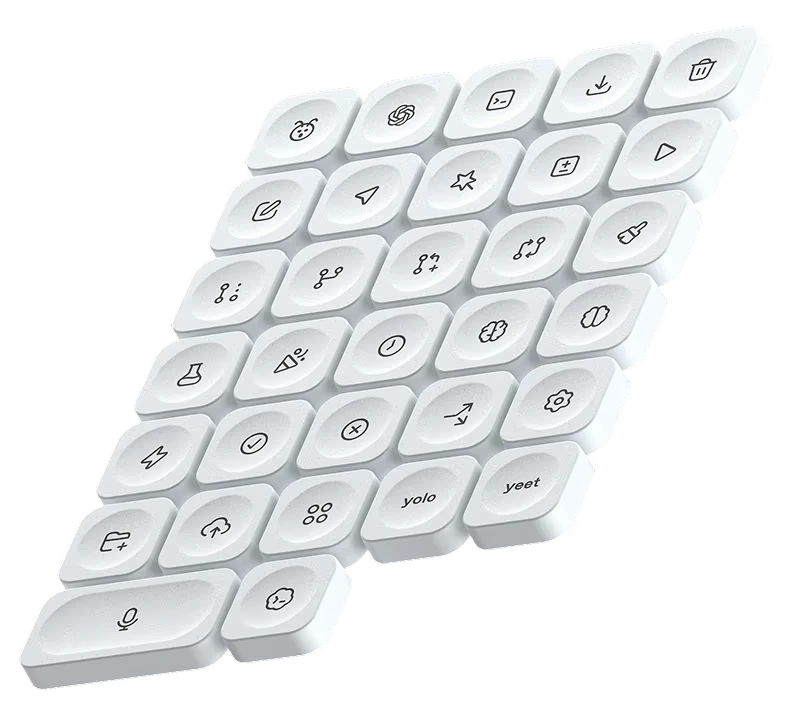
| 32 alternate keycaps | Included icon-printed caps covering common actions (approve, reject, branch, deploy, and playful extras like "yolo" and "yeet") for further personalisation |
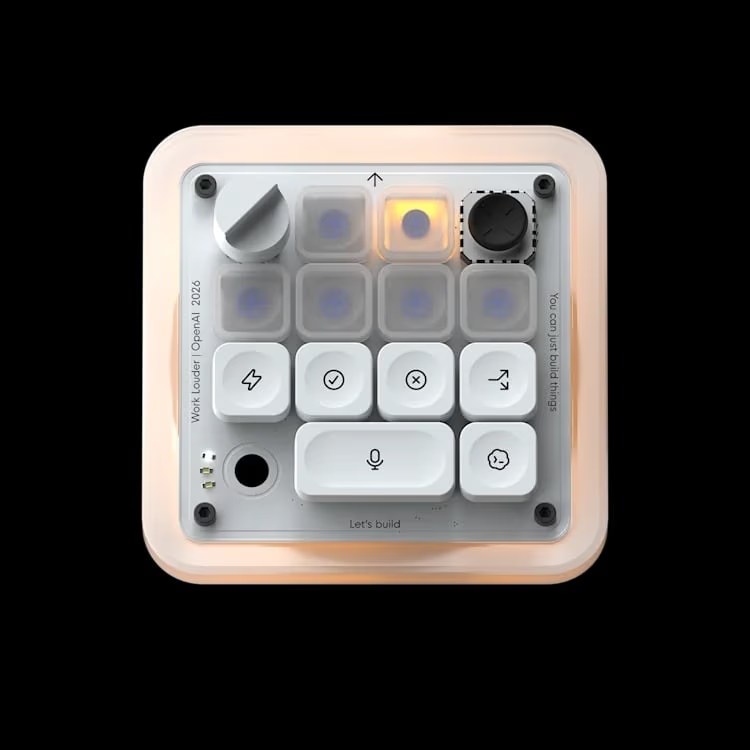
The whole device is built around a single premise: people running several Codex agents in parallel currently have to keep flicking between browser tabs and app windows just to check whether anything needs their attention. Codex Micro turns that into a glance at a lit-up key on your desk instead.
Why OpenAI is doing hardware now
The timing tracks Codex's own growth curve rather than any broader hardware strategy shift. Codex passed 5 million weekly active users in early June 2026, more than six times its user count at the February 2026 launch of its desktop app. That growth then accelerated sharply after OpenAI shipped its GPT-5.6 model family on 9 July 2026: reporting from The New Stack put Codex at roughly 6 million weekly users within three days of that launch, 7 million a day after that, and around 8 million by the weekend: just before Codex Micro itself shipped on the following Wednesday. Different outlets covering the keyboard launch cited the round "5 million" figure that OpenAI had publicised weeks earlier, which is accurate as a milestone but understates how much the user base had grown by the time the hardware actually arrived.
Axios's coverage of the launch captured the actual use case OpenAI is targeting well: Codex Micro is being pitched as a way to manage "fleets" of semi-autonomous coding agents: plural, running concurrently, each capable of writing and executing code with comparatively little supervision. That framing matters more than the device itself. OpenAI is not trying to sell a keyboard to casual ChatGPT users; it is building a physical control surface for a specific, newly common workflow pattern among its most active developer users, where a person's job increasingly involves supervising several agents at once rather than writing code directly.
Positioned that way, Codex Micro reads less like "OpenAI enters the hardware market" and more like a merchandise-grade accessory for its most engaged power users, a low-cost, low-risk way to deepen the relationship with the segment of its user base already spending the most time inside Codex, without committing to the capital expense and supply-chain complexity of a genuinely new consumer device.
The hardware legal battle context
TechCrunch's headline on the Codex Micro launch ("Amid hardware legal battle, OpenAI releases a $230 keyboard for Codex") refers to a genuinely separate and considerably higher-stakes dispute that had nothing to do with the keyboard itself, but which had put OpenAI's hardware ambitions under a harsh spotlight just five days earlier.
On Friday 10 July 2026, Apple filed a 41-page lawsuit in the Northern District of California against OpenAI and io Products, the hardware design studio OpenAI acquired for roughly $6.4 billion in May 2025, the studio co-founded by Apple's former chief design officer, Jony Ive. The complaint accuses two former Apple employees now working at OpenAI of systematically stealing confidential information:
- Tang Tan, OpenAI's chief hardware officer, spent 24 years at Apple and rose to vice president overseeing iPhone and Apple Watch design before joining io Products in 2024. Apple alleges he used Apple codenames during OpenAI's recruiting efforts, encouraged interviewees to share confidential information, and instructed candidates to physically bring Apple hardware to interviews.
- Chang Liu, a technical staff member, is accused of downloading dozens of confidential files and instructing an Apple employee on how to bypass Apple's security teams while copying documents.
Apple's filing describes the resulting hardware business as "rotten to its core by its illegal reliance on misappropriated trade secrets." OpenAI has denied wrongdoing. Crucially, the alleged theft concerns technical specifications and supply-chain details for Apple's own unreleased products, and the OpenAI hardware effort it is alleged to have informed is not Codex Micro: it is a separate, much more ambitious device reported to be a portable, screenless companion speaker for ChatGPT, said to include mechanical elements capable of independent movement, developed with input from several former Apple engineers. That device's timeline remains undisclosed.
One detail analysts at Fortune, Bloomberg and AppleInsider all flagged independently: Jony Ive himself is not named as a defendant in Apple's suit, despite co-founding io Products and remaining its most publicly associated design figure. The consensus explanation is strategic rather than evidentiary: Ive reportedly had limited direct involvement in the recruiting practices and day-to-day operations the complaint describes, and he maintains an unusually close relationship with Laurene Powell Jobs, an investor in io Products with ties to both Ive's design studio LoveFrom and to Apple itself. Naming him risked straining that relationship while generating public sympathy for OpenAI's hardware effort, given Ive's design pedigree and standing.
For Codex Micro specifically, the practical relevance of all this is mostly reputational rather than legal: a $230 keyboard co-built with an existing keyboard manufacturer carries none of the trade-secret exposure of the bigger device, but its launch inevitably got read through the lens of a company whose hardware ambitions were, at that exact moment, under formal legal challenge from the world's largest hardware maker.
Design and build
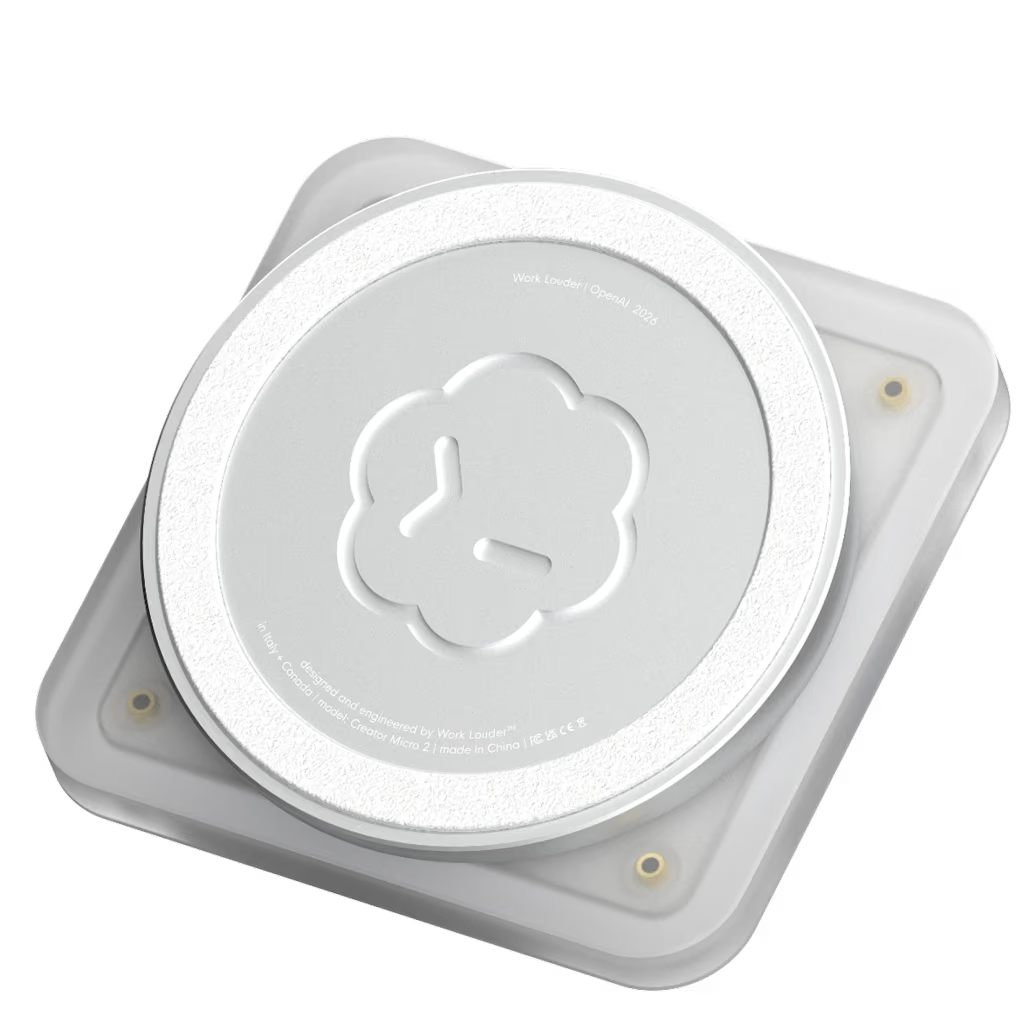
Codex Micro is not a from-scratch OpenAI hardware design. It is built on Work Louder's existing Creator Micro 2 chassis, the same physical hardware Work Louder has previously reskinned for other software partners, including Figma and Framer. Product photography of the device's underside makes the lineage explicit: the moulded base reads "Work Louder | OpenAI 2026" around a Work Louder flower logo, with "designed and engineered by Work Louder" and "model: Creator Micro 2" printed beneath it, alongside "in Italy x Canada" and "made in China" manufacturing credits.
Reviewer descriptions consistent across launch coverage put the finish in frosted white, with translucent, largely legend-less keycaps over the illuminated Agent Keys and opaque keycaps for the Command Keys row, a body reported to combine CNC-machined aluminium with polycarbonate elements, and a capacitive touch sensor alongside the joystick and rotary encoder. It ships in the two switch options common to mechanical macro pads, clicky and silent, a choice aimed squarely at people who will have this sitting on a desk next to a microphone or in a shared office.
A nice, if minor, touch: the box includes a set of 32 alternate icon keycaps beyond the ones pre-installed, covering common developer actions and a couple of playful extras ("yolo", "yeet") alongside more conventional icons for branching, deploying, approving and rejecting, letting owners rearrange which physical key does what without touching software at all.
The packaging itself doubles as a small piece of co-branding: the retail box carries both the OpenAI and Work Louder marks side by side, along with OpenAI's "You can just build things" tagline printed on the base of the box, the same slogan that appears etched into the device's own casing.
How it's meant to be used
Codex Micro is configured and controlled through the ChatGPT desktop app rather than a standalone driver: you map keys, assign layers, and set joystick actions from inside the same application you use to talk to Codex, rather than through a separate configuration utility. That said, coverage of exactly how remapping works has not been fully consistent: some early reporting credited Work Louder's own Input app and the open-source VIA keyboard-configuration tool, while other accounts and at least one developer screen recording suggest the customisation panel is embedded directly inside ChatGPT's own interface. Treat the exact mechanism as unconfirmed until OpenAI or Work Louder publish clearer documentation.
In day-to-day use, the intended workflow looks something like this: you kick off a handful of Codex agents on different tasks, say, a bug fix, a dependency upgrade, and a new feature branch, and instead of switching between browser tabs to check on each one, you glance at the Agent Keys for a colour-coded read on which agents are still working, which are waiting on your approval, and which have hit an error. The joystick lets you jump straight into a specific workflow (reviewing a pull request, starting a debug session, kicking off a refactor) without navigating through the app's menus first. The rotary encoder adjusts how much computational effort an agent puts into its next step, trading speed for thoroughness in real time rather than through a settings menu. And the Command Keys handle the small, constant decisions (accept, reject, push-to-talk, start a new chat) that otherwise mean reaching for the keyboard shortcut cheat sheet.
None of this is capability OpenAI invented for the hardware. Every one of these actions already exists inside Codex and the ChatGPT desktop app as a menu item or keyboard shortcut. What Codex Micro adds is a persistent, glanceable, physically separate surface for them, useful specifically to the extent that switching contexts inside your primary screen is itself the friction you are trying to remove.
Pricing and availability
| Detail | Codex Micro |
|---|---|
| Price | $230 (approx. £171 at July 2026 rates of roughly £1 to $1.35) |
| Launch date | 15 July 2026 |
| Switch options | Clicky or silent mechanical switches |
| Where to buy | OpenAI's own "Supply Co." collaboration page, and directly through Work Louder's store |
| Production run | Limited run: sold until it sells out, no confirmed restock |
The GBP conversion above is an approximation based on the prevailing GBP/USD exchange rate around the time of writing (roughly 1.34–1.35) rather than a price OpenAI has published in sterling: there is no confirmed UK-specific pricing, and buyers outside the US should expect import duty, VAT and shipping costs on top of the headline $230 figure, since this is being sold as a niche US-originated hardware drop rather than a globally distributed retail product.
One reporting wrinkle worth flagging plainly: at least one outlet's article metadata displayed a $144 price field while its own headline and body text stated $230: the same piece contradicting itself. $230 is the figure that OpenAI's own Supply Co. page, and the overwhelming majority of launch-day coverage, converged on, and it is the number used throughout this article.
Reception and early reaction
Mainstream coverage of Codex Micro was broad and almost entirely descriptive rather than critical: TechCrunch, 9to5Mac, Gizmodo, Tom's Hardware, Axios, Tech Times, Interesting Engineering, Engadget, gHacks and The New Stack all ran launch-day or next-day pieces summarising the specs and OpenAI's own framing, without independent hands-on testing in the first 24–48 hours. AI-focused YouTube coverage picked the story up quickly too, including a video from SEO and AI content creator Julian Goldie SEO, whose channel is one of the sources that first surfaced this launch for readers of this site.
Where more pointed reaction has emerged, it splits fairly cleanly along one line: does the physical status indicator solve a real problem, or does it just repackage something you can already do for free? One independent review put the pro-case directly: "if you're running Codex agents in parallel through most of your workday, the physical status indicator solves a real problem." The skeptical case, from the same piece, was equally blunt: "everything this keyboard does is also a keyboard shortcut, a menu click, or a browser tab away, for free." A separate video review (titled, with some justification, "OpenAI Made The Most HATED $230 Keyboard in the World") landed on a similarly split verdict: "Do you need the Codex Micro? No. Is it a fun little toy? Sure. Will it make you more productive? Unclear. Is it worth $230? Only you can decide that."
Developer-community reaction on Slashdot leaned skeptical for a related reason: several commenters pointed out that generic $18 programmable macro pads from other manufacturers can be configured to perform functionally identical shortcuts, making the $230 price largely a function of the OpenAI and Work Louder branding and industrial design rather than anything Codex Micro does that competing hardware cannot.
Limitations and open questions
- Novelty versus genuine utility is unresolved. Every function Codex Micro exposes already exists as a shortcut inside Codex and ChatGPT; its value depends entirely on how much friction you personally feel switching between apps to manage multiple agents.
- It is a limited run with no confirmed restock. OpenAI has been explicit that this is not intended as an ongoing product line, if it sells out, there is currently no public commitment to producing more.
- Launch-day reporting genuinely disagreed on some details. The exact Agent Key colour-coding scheme, the precise configuration software, and even the price appeared in conflicting forms across different outlets at launch. This article has tried to flag those disagreements rather than silently pick a side.
- No confirmed UK or international pricing. Buyers outside the US are working from a converted USD estimate rather than a published local price, and should expect import costs on top.
- Desktop-app dependence. Reporting around the launch consistently ties the Agent Keys' live status functionality to the ChatGPT desktop app specifically, which narrows the useful audience to people who already work primarily on a Mac or Windows desktop rather than purely through web or mobile Codex usage.
- It says nothing about model capability. Codex Micro is a control surface, not an upgrade: it does not make Codex smarter, faster to reason, or more reliable at the underlying coding tasks it performs.
How it fits OpenAI's broader strategy
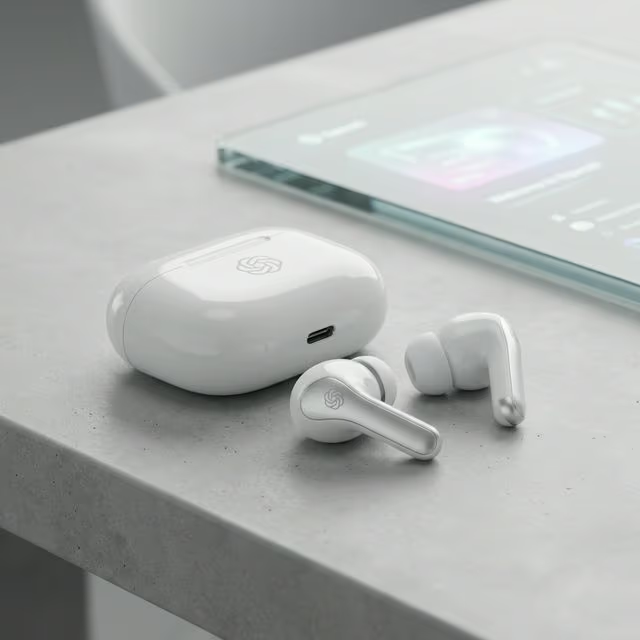
Codex Micro is best read as the small, low-risk end of a hardware strategy whose ambitious end is the io Products companion device: the screenless, portable ChatGPT speaker reportedly under development with former Apple engineers, and the same effort now entangled in Apple's trade-secrets lawsuit. OpenAI has been talking about a category of AI-native hardware for some time; our earlier coverage of the rumoured "Dime" earbuds project traced the same underlying instinct, that software companies increasingly want to own the physical device their AI runs on rather than living entirely inside someone else's phone or laptop.
Codex Micro does not commit OpenAI to that bigger bet in any binding way. It borrows an existing manufacturer's chassis, ships in limited numbers, and is priced and positioned as merchandise for engaged users rather than a mass-market device competing for shelf space against phones or wearables. If it sells well, OpenAI has learned something cheap about demand for physical Codex accessories. If it does not, the exposure is minimal, a marked contrast to the capital, supply-chain and now legal risk wrapped up in the companion-device project. Seen this way, the keyboard functions less as OpenAI's entry into hardware and more as a controlled experiment run in parallel with, and largely insulated from, the much bigger and more contested hardware story unfolding at the same company.
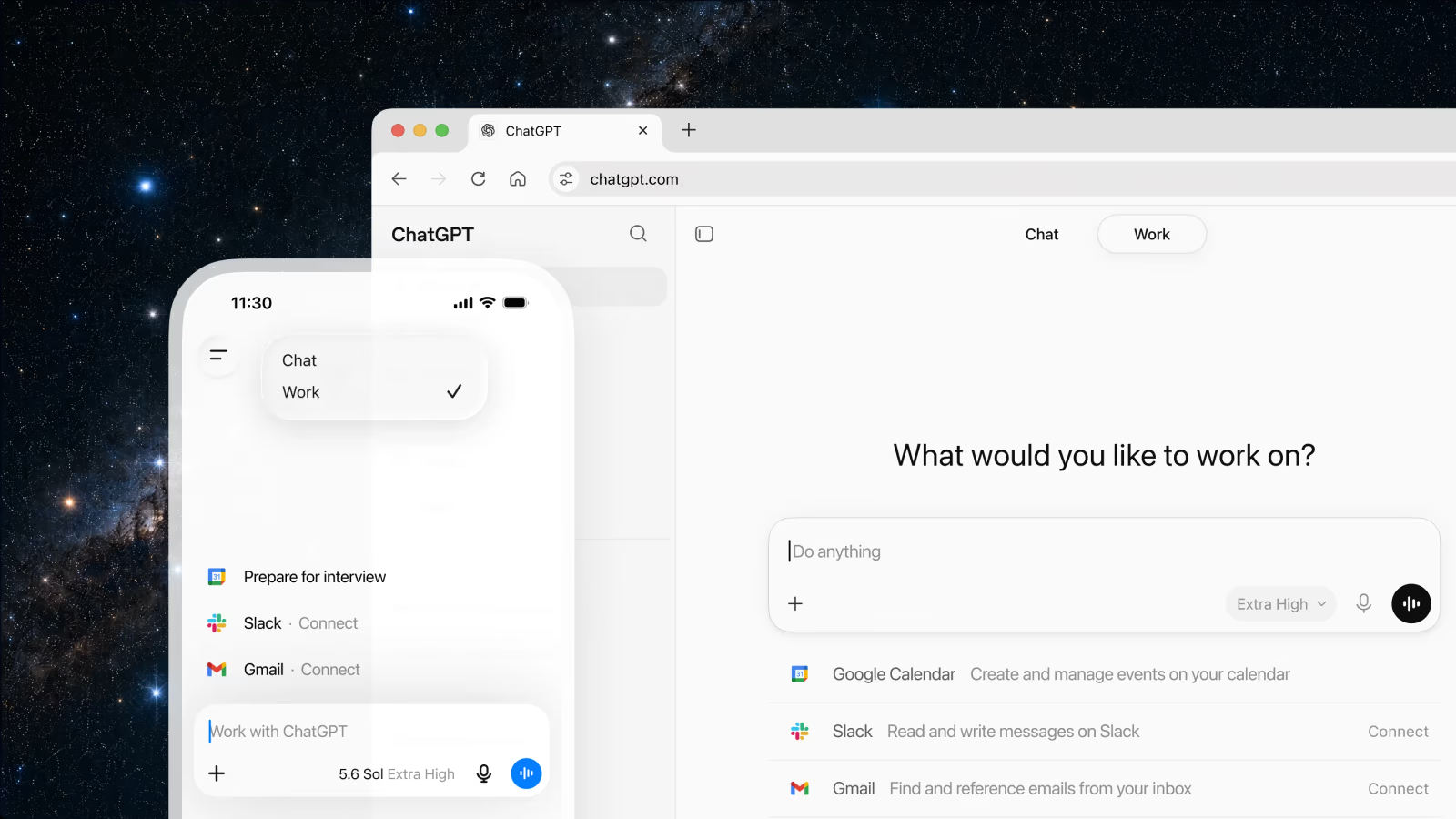
It also sits inside a wider pattern of OpenAI extending Codex's reach through 2026, from the standalone Codex desktop app earlier in the year, to ChatGPT Work's broader agentic mode, to the GPT-5.6 model family that now powers all of it. Codex Micro is a physical artefact of that same push: as Codex usage keeps climbing, OpenAI is betting that a meaningful slice of its most active users will pay for tactile control over agents they are already trusting with real work.
Who should buy it
Good fit: developers who already run multiple Codex agents concurrently through most of a working day, use the ChatGPT desktop app as their primary interface, and find themselves regularly context-switching between browser tabs just to check agent status. For that specific workflow, a dedicated, always-visible status display and a joystick shortcut for common actions is a genuine, if modest, quality-of-life improvement.
Poor fit: anyone who uses Codex occasionally, primarily through the web or mobile app rather than desktop, or who is buying it expecting some kind of capability upgrade rather than a convenience accessory. At $230 for functionality that a $18 generic macro pad can broadly replicate, and with no confirmed restock if you miss this run, it is a purchase to make with clear eyes about what it is: a well-designed, co-branded, genuinely limited-run accessory, not a must-have tool.
The bottom line
Codex Micro is a modest, well-executed piece of merchandise dressed up as OpenAI's hardware debut. It solves a real, if narrow, problem for people running several Codex agents at once, it is built on proven third-party hardware rather than an untested new design, and OpenAI has been unusually candid that it is not trying to sell this to everyone. The more consequential hardware story at OpenAI right now is not this keyboard: it is the screenless companion device that prompted Apple to sue the company five days earlier, and whose outcome will say far more about whether OpenAI can genuinely compete as a hardware company than a $230 macro pad ever could.
For the specific audience it targets (heavy, desktop-based, multi-agent Codex users), Codex Micro is a reasonable, if optional, purchase. For everyone else, it is worth understanding mainly as a signal: OpenAI now thinks enough people are managing "fleets" of coding agents that a physical control panel for them is worth manufacturing at all, however small the first run.
Sources for this article include TechCrunch's launch coverage, 9to5Mac, Gizmodo, Axios, and Fortune's reporting on the Apple v. OpenAI hardware lawsuit.
Last updated: 20 July 2026, five days after Codex Micro's launch. Availability, restock plans and exact configuration mechanics were still settling at the time of writing: check OpenAI's Supply Co. page directly before buying.
Get the free guide: Claude vs ChatGPT, Gemini & Grok
A 20-page playbook covering everything you need to choose and use the big four AI models in 2026, full cost and feature comparisons, what each is best (and worst) at, and how-tos for images, vectors, building a website, Claude Code and more.